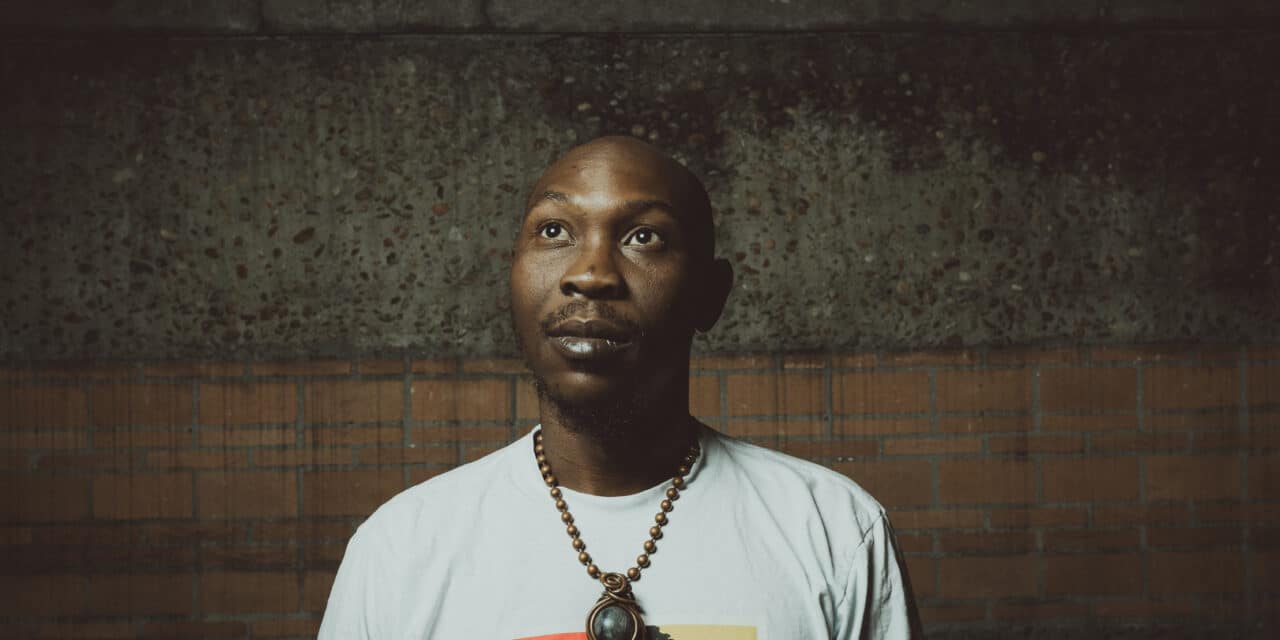
With Egypt 80 and Kabaka Pyramid beside him on “Problems,” Seun Kuti turns working-class frustration into another collision of rhythm and resistance. But after a lifetime spent inside politically conscious music, he has little interest in romanticizing the artist as society’s savior. The revolution, he argues, requires everybody else to show up too.
There is a particularly seductive idea we like to repeat about art:
Art changes the world.
Seun Kuti doesn’t buy it.
Or, more accurately, he thinks we’ve allowed ourselves to misunderstand what the sentence actually demands.
“Musicians cannot change the world,” he tells MUNDANE. “Art on its own cannot change the world.”
Coming from Kuti, the statement initially sounds almost contradictory.
This is, after all, an artist whose entire musical existence is intertwined with resistance.
The youngest son of Afrobeat pioneer Fela Kuti, Seun entered Egypt 80 as a child and eventually assumed leadership of his father’s band after Fela’s death. Across his own career, he has treated Afrobeat not simply as a sound to preserve but as a living political and cultural vocabulary.
Yet Kuti is suspicious of the comforting fantasy that musicians can do everybody else’s revolutionary work for them.
Art can represent.
It can provoke.
It can articulate.
It can make people feel something strongly enough that they reconsider what they previously accepted.
But eventually somebody has to do something.
“The lawyers” need to care about justice, Kuti argues. Doctors need to care about people’s health. Teachers and professors need to care about knowledge. Journalists need to care about truth.
Then music can help push them further.
That’s the distinction.
And it explains one of the most provocative ways Kuti describes his own audience:
“I’m trying to make revolutionaries with my music, not fans.”
Everybody Has Problems
His latest single with Egypt 80 takes that philosophy and gives it horns.
“Problems,” featuring Jamaican reggae artist Kabaka Pyramid, brings two musical traditions with deep histories of social commentary into the same room.
But the song begins somewhere considerably more personal.
Kuti was thinking about the persistent sensation that whatever he did somehow became a problem.
Then he looked outward.
“I realized I definitely am not the only one going through this.”
What initially felt individual began looking structural.
For Kuti, the song became connected to the pressure he sees placed on working-class people and the feeling that ordinary life has become increasingly difficult to navigate successfully.
“Most of us feel like we can’t even get anything right,” he says. “Whatever we do—and especially me—whatever I do is really a problem.”
So “Problems” expands outward from autobiography.
One person’s frustration becomes an entry point into something collective.
And that is where Kabaka Pyramid becomes particularly meaningful.
For Kuti, Afrobeat meeting reggae is not merely genre fusion.
It is reconnection.
Across the Atlantic, the Music Remembers
Kuti’s collaborative history increasingly reads like an argument against treating African and diasporic musical traditions as isolated territories.
He has worked with Damian Marley.
Black Thought.
Carlos Santana.
Sampa The Great.
Janelle Monáe.
Lenny Kravitz.
Tom Morello.
Now Kabaka Pyramid.
But when asked what he looks for beyond musical talent, Kuti doesn’t start talking about studio chemistry or streaming demographics.
He talks about Africa.
“I believe that African music is one.”
In his view, African musical traditions traveled across the world and acquired different names, forms and local histories.
Slavery and colonialism violently displaced African people, but those displaced communities continued creating culture.
The Caribbean became one of those spaces.
The Americas became others.
And Kuti rejects the notion that African-descended cultures created outside the continent should somehow be understood as less authentic than those created within it.
For him, collaboration becomes a way of reconnecting those branches.
“Wherever I find my people expressing Africanness in their unique way, I want to participate.”
Kabaka Pyramid therefore isn’t simply a guest vocalist dropped into an Afrobeat record.
“Problems” becomes part of a larger cultural conversation between the continent and diaspora.
Different histories.
Different sounds.
Shared ancestry.
And rhythm becomes the meeting point.
“Every Form of Art Is Embracing Something and Resisting Something”
Kuti doesn’t believe in apolitical art.
Not even when the artist insists that’s exactly what they’re making.
“I will joke with my colleagues when they say they are not political with their art,” he says. “I say that in itself is a political statement.”
His reasoning is expansive.
Every artistic decision embraces something while rejecting something else.
What gets represented.
What gets ignored.
What kind of world the artist normalizes.
What kind they challenge.
For Kuti, politics therefore isn’t a special layer added onto music after the groove has been written.
It is already there.
But he makes an important distinction when describing himself.
He doesn’t merely call himself political.
He calls himself a revolutionary artist.
That difference shapes what he expects from the people listening.
The goal isn’t passive admiration.
It isn’t fandom for fandom’s sake.
He wants the music to produce participants.
People who leave the concert and bring whatever the music awakened in them back into their own profession, community or daily life.
That is where Kuti believes the possibility of change actually exists.
Hope Is Not the Point
Ask Kuti what gives him hope that music can still create political or social change and the answer comes instantly.
“I don’t have hope.”
Then:
“Hope is dope.”
The phrase is funny.
The argument underneath it isn’t.
Kuti does not want to sit around hoping art somehow changes society.
He wants participation.
“I am not hoping that art changes the world. I am already active in the process of using my art to.”
His frustration is directed partly at what he sees as society’s habit of assigning artists an impossible responsibility.
We ask musicians to speak.
Actors to speak.
Writers to speak.
Artists to diagnose society, inspire the population and somehow produce political transformation.
Meanwhile, Kuti argues, the professionals who possess direct institutional power can escape scrutiny.
A song cannot practice medicine.
A record cannot litigate a case.
A painting cannot teach a classroom.
An album cannot report an investigation.
Art can, in Kuti’s view, help animate the people who do those things.
That is a more demanding vision of political art because it removes the comfortable distance between audience and artist.
You don’t get to applaud the revolutionary musician and consider your participation complete.
The question becomes:
What do you do when you leave?
The Audience Before the Algorithm
That relationship with listeners also explains how Kuti develops music.
“Problems” wasn’t simply manufactured in a studio and immediately uploaded into the digital ecosystem.
Kuti frequently tests songs live before recording them.
The reason is brutally simple.
The crowd doesn’t care about your intentions.
They react.
Or they don’t.
“I let you know for a fact if it’s a good song or not,” he says, “because the people’s reaction without any influence is always honest.”
That philosophy feels almost radical in a contemporary music industry obsessed with pre-saves, snippets, analytics and algorithmic prediction.
Kuti trusts bodies in a room.
The organic relationship between performer and audience remains central to how he understands Egypt 80.
And he doesn’t describe those audiences merely as consumers.
Again, he calls them his “fellow revolutionaries.”
The live show therefore becomes something more complicated than entertainment.
It is a test laboratory for the music.
A communal experience.
And, in Kuti’s conception, a space for political imagination.
The groove is not secondary to that mission.
The groove is how people enter it.
You Can Inherit a Band. You Can’t Inherit Your Own Identity.
There is another question that follows Seun Kuti almost everywhere.
Fela.
How do you honor him?
How do you escape him?
How do you preserve the legacy without becoming trapped inside it?
How do you make Afrobeat while proving that your Afrobeat is sufficiently different from the Afrobeat created by your father?
Kuti finds the anxiety slightly strange.
“This is just something that people worry on my behalf about.”
He sees himself first as an African artist.
His comparison is straightforward: nobody asks every rock musician to invent an entirely new genre simply because other musicians have already played rock.
Why, then, should his participation in Afrobeat automatically become a referendum on whether he has sufficiently distanced himself from the artist who helped create it?
It’s a useful way of reversing the question.
Perhaps the obsession with separating Seun from Fela says more about how audiences understand lineage than how Seun understands himself.
He doesn’t need to deny inheritance in order to possess identity.
The evidence is already in the work.
Heavier Yet
That work reached another significant point with Heavier Yet (Lays The Crownless Head).
Released in 2024 and followed by a deluxe edition in 2025, the project extended Kuti’s conversations around resistance, identity, empowerment and global solidarity.
Looking back, one idea has become increasingly urgent for him:
Global revolution.
His answer moves quickly into questions about gender, responsibility and the tensions he sees within contemporary African political and social discourse.
What concerns him is the erosion of collective responsibility.
The idea that liberation can somehow happen while people stop seeing one another’s struggles as connected.
For Kuti, revolution cannot simply be a slogan attached to a record.
It requires a different understanding of responsibility.
To one another.
To women.
To communities.
To people beyond the borders immediately surrounding us.
That insistence on interconnectedness appears everywhere in his thinking.
It is present politically.
It is present in his understanding of African diasporic culture.
And it is present musically in a record like “Problems.”
The bridge between Afrobeat and reggae is therefore not separate from the worldview.
It is the worldview made audible.
An African Music Without Borders
Kuti’s conception of African music refuses neat geography.
Africa is the continent.
But African culture, in his formulation, also exists wherever African people were forced, through histories of slavery and colonialism, to rebuild culture under different conditions.
That is why his collaborations move so freely.
The goal isn’t to collect famous names.
It is to encounter different expressions of what he understands as a shared cultural lineage.
That gives “Problems” a particular weight.
Nigeria meets Jamaica.
Afrobeat meets reggae.
But neither needs to disappear into the other.
The bridge works precisely because both sides remain visible.
That is the kind of cultural exchange Kuti seems interested in: not flattening difference, but recognizing relationship.
There Is No Outside of Politics
The same logic explains why Kuti doesn’t draw a meaningful boundary between being an artist and being an activist.
For him, the separation is artificial.
“Everything we do is political.”
He extends the argument even into relationships.
Human interaction occurs inside systems of power, competition, cooperation and domination.
Politics doesn’t suddenly appear when somebody walks onto a stage carrying a protest sign.
It is already embedded in the choices people make about how they live with one another.
That worldview helps explain why Kuti’s involvement outside music—from #EndSARS to the revival of the Movement of the People (M.O.P.)—doesn’t feel to him like leaving music behind to become an activist.
They exist within the same continuum.
The song is one expression.
Organizing is another.
What Happens to Afrobeat Next?
Ask Seun Kuti where Afrobeat is heading over the next decade and, refreshingly, he doesn’t pretend to know.
“I don’t know.”
There is no grand prediction.
No neat declaration about the genre’s future.
He does, however, sense something happening among African people.
“We are in a certain age of awakening.”
And his hope—if we can use a word he might object to—is beautifully uncomplicated:
“Hopefully Afrobeat is here forever and ever.”
Maybe that is enough.
A genre doesn’t remain alive by being perfectly preserved.
It survives because people keep needing it.
Keep changing it.
Keep arguing through it.
Keep dancing to it.
Keep finding new people to bring into the conversation.
What Remains
When we ask Kuti what he hopes people will eventually identify as his greatest contribution, his answer begins with composition.
That is where he believes an artist ultimately leaves the deepest mark.
Not the mythology.
Not the surname.
Not even necessarily the political statements surrounding the work.
The compositions.
But then the answer becomes personal.
He talks about his daughter.
He calls her a blessing not only to himself and imagines that she might someday become a blessing to their nation.
And he talks about the Movement of the People.
Those are the things he believes may continue reverberating when future generations take stock.
It is a revealing answer because it places music, family and collective political participation beside one another.
Not one legacy.
Several.
Which brings us back to “Problems.”
The song may begin with Seun Kuti’s personal frustration—the feeling that whatever he does becomes somebody’s problem—but it expands until the individual becomes inseparable from everybody around him.
That might be the central principle running through his entire conversation with MUNDANE.
The individual matters.
But the individual isn’t enough.
The artist matters.
But the artist isn’t enough.
The song matters.
But the song isn’t enough.
The audience has to leave the room eventually.
And according to Seun Kuti, what happens after that is where the real work starts.
In Conversation With Seun Kuti
MUNDANE: “Problems” brings together Afrobeat and reggae with Kabaka Pyramid in a way that feels both timeless and urgent. What made this the right collaboration to explore the political and cultural conversations at the heart of the song?
SEUN KUTI: Well, I think the song, for me, came from experiencing something personal and then trying to project it in a larger sense in the world because I realized I definitely am not the only one going through this.
I realized that the world is putting so much pressure on working-class people, and most of us feel like we can’t even get anything right. Whatever we do—and especially me—whatever I do is really a problem.
So it’s really from a personal perspective, but also seeing it in the greater image of our people.
MUNDANE: Your music has always invited people to dance while asking them to confront uncomfortable truths. Do you see rhythm as a form of resistance—one that can sometimes communicate more powerfully than words alone?
SEUN KUTI: Yeah, I think art in general is a form of resistance. Every form of art, I feel, is embracing something and resisting something. Every form.
I joke with my colleagues when they say they are not political with their art. I say that in itself is a political statement. Saying, “I’m not political,” is a political statement.
So you cannot remove any kind of artistic expression from embracing or resisting something.
But what I want to distinguish, though, is myself as a revolutionary artist. I’m not trying to make fans of my audience. I’m trying to make fellow revolutionaries.
MUNDANE: As the leader of Egypt 80, you’re preserving one of the most important musical legacies in history while constantly pushing it forward. How do you balance honoring your father’s vision with making sure your own artistic identity remains unmistakably yours?
SEUN KUTI: Well, you know, I think this is just something that people worry on my behalf about.
I see myself primarily as an African artist. If I was making rock music, nobody would say, because there are other rock artists, “Oh, you’re a rock artist, why are you not making new rock?”
MUNDANE: Heavier Yet (Lays The Crownless Head) and its deluxe edition expanded your conversations around activism, identity and empowerment. Looking back now, what ideas from that project have become even more relevant in today’s world?
SEUN KUTI: I think global revolution, for me, has become even more relevant.
With the gender war that exists now in our conversations as motherland people, that understanding of being responsible for each other is being lost in our conversations.
Where we are protecting white supremacy at the expense of our women, I think it’s really a low point for African men.
So revolution is becoming more and more relevant.
MUNDANE: You’ve spent decades using music to address corruption, inequality and injustice. After all these years, what gives you hope that art can still inspire real political or social change?
SEUN KUTI: I don’t have hope. Hope is dope. I don’t believe in hope.
As I said, I’m a revolutionary artist, so I’m actively involved in the process of changing this world. I am not hoping that art changes the world. I am already active in the process of using my art to.
I think the professionals of this world are using art and artists as scapegoats for their own political deficiency and apathy.
Musicians cannot change the world. Art on its own cannot change the world. It can only represent and inspire the emotions.
This world will be changed by the lawyers when the lawyers care about justice. That’s what will change the world. When doctors care about the health of the people. These are the people with the power to change the world, not the artists.
We’ve been lied to for so long about that.
We have to understand that the teachers and professors must care about knowledge. The journalists must care about truth. It is in the hands of the global professionals.
And in that world where these people care about these things, music can inspire them to further create that new world that we are talking about.
That’s why I say I’m trying to make revolutionaries with my music, not fans, because they can go into their walks of life. The engineers will begin to imagine a new world and engineer a new world for us.
That’s what is going to change the world. There’s no one artist, or one band, or one album, or one sculpture, or painting.
MUNDANE: You’ve collaborated with artists as diverse as Damian Marley, Black Thought, Lenny Kravitz, Carlos Santana, Tom Morello, Sampa The Great, Janelle Monáe and now Kabaka Pyramid. What do you look for in a collaborator beyond musical talent?
SEUN KUTI: Beyond musical talent? I don’t know—an interest.
For me, I believe that African music is one. We’ve gone all over the world. It has become known by different names in different places, but it’s all African music to me.
For me, it’s always a way to continue to build our bridge, to reunite cultures, to take the culture from the motherland and meet with our cultures in the Caribbean.
Because due to slavery and colonialism, Africans have had to create cultures globally.
Many people wrongly think that the cultures we have created outside of Africa are somehow inferior to the cultures we have created in Africa, which for me is just stupid.
So I go around trying to engage with these different African cultures globally. Wherever I find my people expressing Africanness in their unique way, I want to participate.
MUNDANE: You’ve performed more than 130 shows over the past year, and the new material became part of the live experience before its official release. What do live audiences teach you about your music that you could never discover in the studio?
SEUN KUTI: I’ve always kept faith in the organic relationship with my audience—with my fellow revolutionaries globally, who I perform for to inspire our global movement for change.
Most of the time, I perform my songs before I even record, because it lets you know for a fact if it’s a good song or not.
The people’s reaction, without any influence, is always honest.
MUNDANE: Beyond music, you’ve remained deeply involved in movements like #EndSARS and the revival of the Movement of the People. How do you navigate the line between being an artist and being an activist, and do you believe the two can ever truly be separated?
SEUN KUTI: As I said, everything we do is political. There are no nonpolitical acts.
By saying your act is not political, that in itself is a political statement.
So there is no separating anything from the political. Even relationships are political.
We can’t remove politics from any human relationship, especially in this world where the elites choose competition and domination instead of cooperation.
So everything is politicized. Anybody that says otherwise is a bald-faced liar.
MUNDANE: Afrobeat has become a global language, influencing artists across genres and continents. As someone carrying one of its most important legacies, where do you see the genre heading over the next decade, and what would you like to see the next generation preserve?
SEUN KUTI: I don’t know. I don’t know.
I think, as African people, we are in a certain age of awakening.
Hopefully Afrobeat is here forever and ever.
MUNDANE: Mundane is fascinated by artists who create culture rather than simply respond to it. When people look back on Seun Kuti’s career years from now, what do you hope they’ll say was your greatest contribution—not just to music, but to the conversations that music can ignite?
SEUN KUTI: Oh, wow.
I think my greatest addition to the conversation is in cultural and musical compositions. As a composer, that is where I’ve truly made my mark as an artist. It is in your compositions that you will be praised.
But personally, as a father, I think my daughter is a blessing, not just to me. Hopefully she’ll be a blessing to our nation as well, following the footsteps that have led her to the destiny of being my child.
And also the Movement of the People, which will assist those willing to play a pivotal role.
Those, for me, are the things that I’m sure will reverberate when Africans take stock of everyone’s contribution.