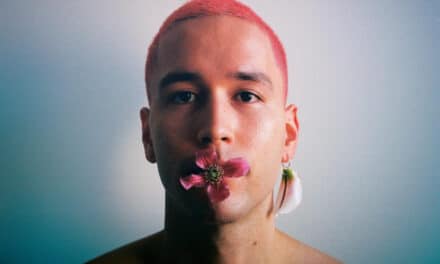
On Use Once Then Destroy, the LA-born, London-based songwriter and producer turns dead heroes, obsessive lovers, self-destructive teenagers and rock ’n’ roll mythology into a darkly funny exercise in reinvention—and discovers that sometimes the best way forward is to stop polishing the rough edges.
Every once in a while, Veronica Bianqui wants to bleach her hair.
Not because she particularly needs blonde hair.
Because some primitive corner of the brain remains convinced that changing what you see in the mirror might somehow rearrange whatever is happening behind it.
New hair.
New person.
Problem solved.
Obviously, it doesn’t work like that.
But the impulse is revealing enough that when it resurfaced during the writing of “All My Heroes Are Dead,” Bianqui decided not to follow it.
She made it somebody else’s problem instead.
“I could feel my self-destructive side creeping in again—so instead of acting on it, I turned it into a character.”
Enter the bratty teenager.
She’s pissed off.
Everything is a bit shit.
And rather than attempting to regulate her emotions like a well-adjusted adult, she turns the chaos all the way up.
“There’s a lot of me in her, but she’s exaggerated—the volume turned all the way up.”
That character became the center of “All My Heroes Are Dead,” the first glimpse of Bianqui’s sophomore album, Use Once Then Destroy, arriving November 13 via NX Records.
And in many ways, she provides the perfect introduction.
Because Use Once Then Destroy is populated by people who probably shouldn’t be trusted with your phone after midnight.
Obsessive lovers.
Antiheroes.
Rock stars.
Self-destructive brats.
People consumed by desire.
People intoxicated by power.
People turning themselves into myths because reality isn’t dramatic enough.
Bianqui takes familiar rock ’n’ roll archetypes, exaggerates them until they become slightly ridiculous, and then searches the ridiculousness for something painfully recognizable.
It’s satire with an emotional hangover.
All My Heroes Are Dead. Now What?
There is an enormous difference between destroying something and allowing it to disappear.
Bianqui seems fascinated by that distinction.
The title Use Once Then Destroy immediately suggests disposability: objects made for temporary consumption, identities exhausted after serving their purpose, relationships treated as replaceable, cultural icons built up only to eventually be discarded.
But Bianqui’s record is also about what happens when destruction becomes creative.
Instead of suppressing a darker impulse, she turns it into a character.
Instead of treating rock mythology as sacred, she plays with it.
Instead of hiding obsession, vanity, self-destruction and desire behind tasteful metaphors, she makes them larger.
Sometimes the best way to understand an impulse is to make it absurd enough that you can finally see it.
That’s what makes “All My Heroes Are Dead” more interesting than a straightforward confession.
Bianqui gives herself enough distance to laugh.
“The song became my way of bringing some levity to a heavy subject, and reminding myself not to take every dark thought so seriously.”
There is something liberating about that.
Not every dark thought needs to become prophecy.
Sometimes it can become a three-minute rock song instead.
Before London, There Was a Boombox
Bianqui has apparently been inventing worlds for herself for almost as long as she has been able to operate a recording device.
She started recording songs when she was six.
Growing up in California’s San Fernando Valley, she made boombox mixtapes containing original songs and covers.
But apparently music wasn’t enough.
There were invented radio segments.
Imaginary talk shows.
Bianqui wasn’t simply recording herself singing.
She was producing an entire broadcast universe from her childhood bedroom.
Looking at Use Once Then Destroy now, those early experiments feel strangely relevant.
The record is again populated by characters.
Again, Bianqui is moving between performance and reality.
Again, the studio isn’t merely documenting a song that already exists.
It is somewhere identities get invented.
The technology improved.
The instinct didn’t change much.
Learning Rock ’n’ Roll Before She Was Supposed to Be in the Room
As a teenager, Bianqui began performing in Los Angeles clubs including the Rainbow Bar & Grill and Cat Club before she was technically old enough to be inside them.
That education continued through LA’s eastside underground.
Garage rock.
Psych.
Punk.
Loud guitars.
Rooms where performance mattered as much as polish.
She later toured the United States, Europe and South America with multiple bands, including The Blank Tapes and Suo, and was touring in support of The Growlers shortly before the pandemic stopped everything.
Those years built the version of Veronica Bianqui most associated with her earlier music.
Big hooks.
Big riffs.
Big performances.
At one point, her live band expanded to as many as eleven people.
Rhythm section.
Horns.
Backup singers.
Go-go dancers.
It was unapologetically theatrical.
Her 2020 self-titled debut captured much of that sensibility, including songs such as “Aah, Paris…” and “If Love’s a Gun, I’m Better Off Dead.”
The DNA came from classic rock and pop.
The guitars were loud.
The hooks mattered.
Showmanship wasn’t something to apologize for.
Then life changed.
Sometimes Reinvention Isn’t a Branding Exercise
A series of personal losses altered the direction of Bianqui’s life.
Eventually, she found herself clearing out the same childhood apartment where she had made those first boombox recordings.
It’s difficult to imagine a more literal confrontation between past and present.
The room where you first started constructing yourself eventually becomes a room you have to empty.
After grieving, Bianqui followed an instinct that would reshape both her life and her work.
She moved to England.
The transition from Los Angeles to London wasn’t merely geographic.
It coincided with a deeper reassessment of how she wanted to create.
Over four years, the songs that became Use Once Then Destroy developed alongside two graduate degrees at Goldsmiths University: an MMus in Popular Music and an MFA in Creative Practice.
But the most important education may have happened in the studio.
Bianqui stopped treating production as something that happened after songwriting.
Production became songwriting.
The Studio Became Part of the Instrument
Bianqui took a more DIY approach to the second album.
She self-produced it.
Played much of the material herself.
Recorded wherever she could keep the project moving.
Other musicians and engineers entered the process—including Omar Yakar, whose credits include Courtney Barnett and Warpaint, on mixing—but the record’s central creative authority increasingly belonged to Bianqui.
That changed the way songs were allowed to develop.
Rather than arriving in the studio with an idea that needed to be faithfully executed, she started using the recording process to discover what the idea actually was.
A sound could redirect a song.
A production mistake could become an arrangement.
An unfinished thought didn’t have to know where it was going before she followed it.
That freedom matters.
Particularly for someone coming from traditions so heavily surrounded by mythology.
Garage rock has mythology.
Punk certainly has mythology.
Classic rock might have more mythology than music at this point.
There are rules about authenticity everywhere.
How raw something should sound.
How much production is too much production.
What counts as real.
What counts as commercial.
Bianqui seems considerably less interested in obeying those divisions now.
Classic pop craftsmanship can sit beside punk energy.
A carefully constructed hook can coexist with a strange production decision.
Satire can become confession halfway through the song.
The record doesn’t have to choose between intelligence and instinct.
Don’t Fix the Rough Edges
Perhaps the most important decision behind Use Once Then Destroy was Bianqui allowing herself not to know.
That sounds small.
It isn’t.
When you’ve been making music since childhood, toured internationally, released an album and developed a recognizable aesthetic, uncertainty can start feeling like regression.
You’re supposed to know what you’re doing.
Bianqui discovered the opposite.
Not knowing became productive.
Curiosity became a method.
The studio became somewhere she could follow an idea without requiring it to justify itself first.
And rather than sanding down everything unusual that emerged, she began allowing the rough edges to remain.
The result appears to occupy a different space from her debut without pretending that earlier Veronica Bianqui never existed.
The garage-rock foundation is still there.
So is her affection for classic songwriting.
So are the hooks.
What’s changed is the relationship to control.
The second record sounds conceptually less interested in proving what Veronica Bianqui is supposed to be.
That leaves more room for figuring out what else she might become.
Rock Stars Make Excellent Fictional Characters
There is also something wonderfully mischievous about using rock ’n’ roll’s own mythology against itself.
Rock has spent decades constructing impossible people.
The tortured genius.
The doomed icon.
The dangerous lover.
The self-destructive star.
The person whose terrible behavior becomes fascinating because they happen to look good holding a guitar.
Use Once Then Destroy doesn’t necessarily reject those archetypes.
That would be boring.
Bianqui exaggerates them.
She pushes them until their absurdity becomes visible.
And then she asks why we’re attracted to them in the first place.
Obsession becomes theatrical.
Desire becomes grotesque.
Power becomes performance.
Self-destruction becomes a bratty teenager threatening to bleach her hair because everything sucks.
The humor prevents the album’s heavier themes from collapsing under their own seriousness.
It also makes the emotional moments hit differently.
You can laugh at the character.
Then realize why she exists.
LA Doesn’t Disappear Just Because You Move to London
Bianqui is now based in London, but Los Angeles remains everywhere in the story.
The San Fernando Valley childhood.
The boombox.
The Rainbow.
The Cat Club.
The eastside garage scene.
The giant live band.
The go-go dancers.
The guitars.
Even the instinct toward theatricality feels tied to a city where self-invention is practically municipal infrastructure.
London didn’t erase that.
It gave Bianqui somewhere else to look at it from.
Distance can do strange things to identity.
Move far enough away from home and the things you assumed were simply normal start revealing themselves as influences.
Maybe that’s part of what makes Use Once Then Destroy feel like reinvention without rejection.
Bianqui isn’t abandoning the artist who made her debut.
She’s producing her differently.
Use Once. Then Destroy. Then Make Something Else.
There is a wonderful violence to the album title.
Use Once Then Destroy.
It sounds like an instruction stamped on something dangerous.
It also sounds like a philosophy for identities that have stopped being useful.
Use the character.
Use the trope.
Use the memory.
Use the fantasy.
Use the bad impulse.
Make something from it.
Then stop worshipping it.
Destroy it if necessary.
The interesting thing about Veronica Bianqui’s second chapter is that destruction doesn’t appear to mean emptiness.
It creates space.
The loss that preceded her move to London eventually opened into education.
The songwriter became more deeply invested in production.
The performer who once stood in front of an eleven-piece band learned what she could build largely by herself.
The darker impulses became characters.
The rock clichés became material.
And the little girl recording imaginary radio shows in the Valley somehow became the woman constructing an entire cast of fictionalized selves inside a London studio.
Maybe “All My Heroes Are Dead” isn’t really about having no heroes left.
Maybe it’s about discovering what happens after you stop needing them to tell you who to become.
Veronica Bianqui already knows the answer.
Make something.
Turn the volume up.
And if the impulse to bleach your hair comes back?
Write another song.