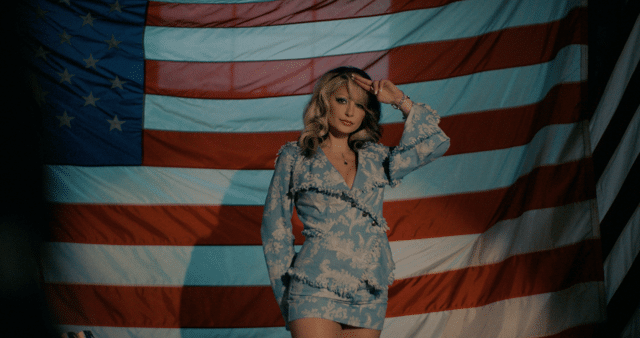
The Houston-born, Nashville-based songwriter has built a world out of Southern grit, feminine rage and the mythology of the modern outlaw woman. But on “Good Bad Day,” Ridley discovers something unexpectedly radical: you can stop fighting every difficult feeling without letting it win.
Lou Ridley used to think being in a good mood was part of her job.
Not her job as a musician.
Her job as a person.
“I was always in a good mood out of obligation or a feeling that it was my job to keep everyone else in good spirits.”
That sounds exhausting.
It also sounds familiar.
There is a particular kind of person who becomes extremely skilled at monitoring the emotional weather in a room.
Is everybody okay?
Is somebody uncomfortable?
Should I make a joke?
Should I lighten this?
Should I be easier?
Happier?
Less complicated?
Eventually, keeping everybody else comfortable can become such an automatic reflex that you forget to ask how you’re actually doing.
Ridley doesn’t operate that way anymore.
Or at least, she’s trying not to.
Her new single “Good Bad Day” sounds deceptively simple in its philosophy:
Sometimes things are shitty.
There might still be something good in there.
Both can be true.
“Sometimes life can feel heavy but finding the good even when it’s tough is the point of this whole thing,” she says.
Importantly, Ridley isn’t talking about pretending the heavy part doesn’t exist.
She’s learning to let it move.
“These last few years of therapy and mushrooms have really opened up my mind to the flow of this whole thing.”
There are more conventional opening lines for a country profile.
This is not that profile.
Apparently the Emotion Is Allowed to Leave
Ridley’s revelation is almost annoyingly straightforward.
Feelings pass.
If you let them.
“I’m still learning, but I’ve realized the power is in letting the emotions pass through instead of dwelling.”
This isn’t the Instagram version of optimism where everything terrible secretly happens for a reason and every breakdown eventually becomes an inspirational carousel.
Sometimes a bad day is simply bad.
“Good Bad Day” is interested in the possibility that recognizing something beautiful inside it doesn’t require denying the rest.
For Ridley, that represents a psychological shift.
Her optimism has always existed.
What’s changed is its motivation.
Before, positivity could be obligation.
Now?
“It’s just genuinely how I feel!”
That’s a very different kind of happiness.
One isn’t really happiness at all.
It’s emotional labor.
The other belongs to you.
Feminine Rage Is Easy. Try Vulnerability.
Ridley’s artistic universe isn’t exactly short on attitude.
Her music has been built around heartbreak, Southern grit, feminine rage and an outlaw sensibility that doesn’t ask politely before entering the room.
Songs like “Hoedown,” “Little Black Thong” and “Red Clay” reveal different versions of her, while her broader visual identity plays with Americana and Western mythology.
But anger can become armor.
Vulnerability requires taking it off.
Ridley says that once terrified her more than it does now.
“I think at one point in my life vulnerability was a lot scarier than it is now.”
What changed isn’t that she suddenly stopped caring what people know about her.
She started seeing openness as useful.
“I like to let people in on every aspect of who I am because I want to remove shame from other people.”
That motivation comes from experience.
“Shame controlled me for a very long time.”
There is a crucial difference between confession as spectacle and vulnerability as permission.
Ridley isn’t interested in revealing herself simply because exposure generates engagement.
She wants somebody else to see the thing they’re embarrassed about reflected back without judgment.
Maybe then it becomes slightly less powerful.
Lou Ridley Has Not Received Media Training
This becomes obvious fairly quickly.
“I’ve never had media training, nor do I want it.”
Excellent.
Ridley understands that refusing the protective polish of entertainment has consequences.
“I know being as authentic as I am removes the shield that many people in entertainment have.”
The shield exists for a reason.
Say less.
Reveal less.
Don’t create unnecessary controversy.
Give the answer that can survive being extracted from context.
Become sufficiently visible to maintain an audience while remaining sufficiently guarded that nobody can actually reach you.
Ridley has chosen a different problem.
“To be honest it’s too much work to pretend.”
That’s perhaps the most compelling argument for authenticity anyone can make.
Not moral superiority.
Efficiency.
Pretending sounds exhausting.
“I enjoy being accessible.”
And when accessibility becomes too much?
She has a solution.
“When I get to feeling weird, I go to the woods and recalibrate.”
Media strategy by forest.
Could be worse.
Nashville Does Not Get to Decide What Country Means
Ridley was born in Houston and now works inside Nashville’s songwriting ecosystem.
But her relationship with country music isn’t particularly deferential.
Her sound pulls from Americana, Western imagery and contemporary pop without worrying too much about whether every ingredient satisfies somebody else’s definition of the genre.
Asked what Texas contributed to the artist she’s become, Ridley doesn’t respond with a sentimental story about cowboy boots.
She goes directly for the argument.
“I don’t find the acceptable Nashville sound to BE country music in some cases, regardless of how the industry chooses to identify it.”
There it is.
Ridley doesn’t believe she’s reinventing country music.
If anything, she sees herself as drawing from sounds and lyrical traditions that were already central to the genre.
“I don’t think I’m reinventing the wheel by any means; I just incorporate the same sonics and lyrics that once dominated our genre.”
Then she adds:
“And then sometimes an 808.”
Right.
Because it is 2026.
The horse can have sub-bass.
Women Are Supposed to Make Sense
“Hoedown.”
“Little Black Thong.”
“Red Clay.”
Put them next to each other and Ridley’s refusal to present one perfectly coherent version of femininity becomes part of the appeal.
Country music has historically loved archetypes.
The sweetheart.
The rebel.
The heartbroken woman.
The party girl.
The outlaw.
The traditionalist.
The crossover star.
Ridley would prefer not to choose.
Does she think women in country are still expected to present a more easily defined identity than men?
“Yes, I do.”
Then, efficiently:
“Thank god we aren’t listening.”
Good.
Next question.
The Modern Outlaw Has Wi-Fi
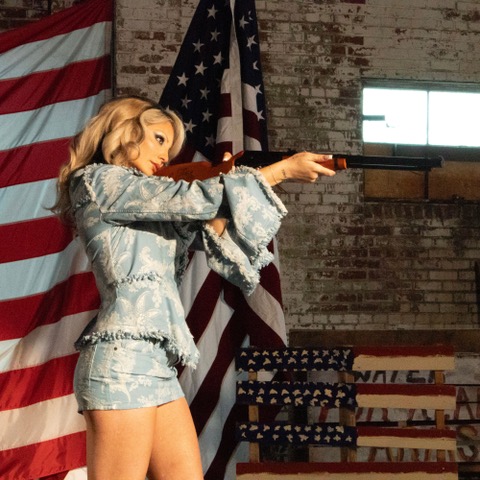
Ridley’s forthcoming album expands the mythology she’s been developing around what she calls the modern outlaw woman.
But what exactly makes an outlaw modern?
Her answer is surprisingly practical.
“The only thing that modernizes anything anymore is the ability to do it online.”
The frontier has changed.
So has rebellion.
“At one time, being an outlaw was physically involved.”
The contemporary version operates through different systems.
“These days, outlaw is stepping on the necks of the oppressor just the same, but in a different modality.”
For Ridley, the internet complicates outlaw mythology because artists are simultaneously constructing and surrendering control over their identities.
You can create the persona.
Build the visual language.
Tell the story.
Establish the mythology.
Then release it into a machine where everybody else gets to decide what it means.
“Creating a persona and a brand is challenged much more now than it used to be.”
The modern outlaw doesn’t disappear into the desert.
She has a comment section.
Unfortunately, You Cannot Control the Comment Section
Ridley understands the contradiction.
She’s built a distinctive Southern feminine world online.
The visuals matter.
The mythology matters.
The identity matters.
But the larger the audience becomes, the less control she has over what “Lou Ridley” means inside somebody else’s head.
“I know I can’t control other people’s perception of Lou Ridley no matter how large she might become.”
Her defense is the same strategy she uses everywhere else.
Honesty.
“The best I can do is just continue to be honest.”
That won’t stop misunderstanding.
“People misconstrue everything, all the time, online.”
Correct.
But perhaps authenticity isn’t really about guaranteeing accurate interpretation.
Maybe it’s about ensuring that whatever gets misinterpreted was at least yours to begin with.
She Doesn’t Write Your Song Without You
Ridley also writes for other artists, with cuts including work for Bryan Andrews and Atlus.
Songwriters frequently face the question:
Is this one mine?
Or should I give it away?
Ridley largely avoids the problem because of a rule she created before people were particularly interested in writing with her.
“I wouldn’t write for others without them being in the room.”
The rule changes the intention of the session from the beginning.
She’s not digging through her personal catalog later wondering which piece of herself she can tolerate surrendering.
“All my cuts have been WITH the artist, so I never have to decide whether it’s for me or not.”
She enters knowing the purpose.
“I’m going in with the intention of giving them something.”
There is generosity in that.
But also boundaries.
Your story gets written with you.
Hers stays hers.
Being Okay Looks Different When People Are Watching
Something else has changed recently for Ridley.
People are paying attention.
“This is the first time in my life anyone is paying attention.”
Success is usually described as increased opportunity.
Ridley also experiences it as increased accountability.
“There’s more accountability to live exactly as I say I do.”
That is an interesting consequence of building an artistic identity around radical honesty.
Eventually people remember what you said.
Your philosophy stops being private.
If you’re going to tell people to embrace the mess, you have to allow yourself to be messy.
If you’re going to reject shame, you have to notice when you’re hiding.
If you’re going to construct the modern outlaw woman, you eventually have to live with her.
Ridley says her personal evolution over the last few years has been considerably more dramatic than the decade preceding it.
“It’s like my spirit pushed the gas in 24 lol.”
Spiritual acceleration.
Sure.
Why not.
She Used to Clean Houses
Ridley mentions something almost casually when explaining how her definition of “okay” has changed.
“Being okay now looks different than when I was cleaning houses to get by.”
That’s the kind of sentence that can get lost inside an artist narrative once momentum arrives.
Suddenly there are releases.
Shows.
Press.
Followers.
People paying attention.
A mythology develops.
The person before the mythology can disappear.
But Ridley seems determined not to let that happen.
Maybe that’s why accessibility matters.
Maybe that’s why the lack of media training matters.
Maybe that’s why the woods matter.
Lou Ridley can become larger.
The person inside her still has to be allowed to exist.
A Good Bad Life
There is a funny tension between Ridley’s mythology and what “Good Bad Day” actually proposes.
The modern outlaw woman sounds enormous.
Cinematic.
Defiant.
She steps on the necks of oppressors.
She wears the outfit.
She says the thing.
She doesn’t listen when country music asks her to become easier to categorize.
But the revelation underneath “Good Bad Day” is almost painfully ordinary.
Sometimes you feel bad.
Don’t panic.
Sometimes you feel good.
Don’t turn it into an obligation.
Sometimes both happen before dinner.
Ridley has spent years learning how not to be controlled by shame.
How not to perform happiness for everybody else.
How to reveal vulnerability alongside feminine rage.
How to let an audience see her without letting that audience entirely determine her.
How to build a persona without becoming trapped inside it.
How to be optimistic without lying.
Maybe that’s the actual modern outlaw.
Not someone who never breaks.
Someone who finally stops believing every uncomfortable emotion needs to be defeated.
Let it arrive.
Let it hurt.
Let it leave.
Go to the woods if necessary.
Tomorrow can be another good bad day.
In Conversation With Lou Ridley
“Good Bad Day” is built around accepting that life can feel heavy while still choosing to recognize what’s good within it. Did writing this song represent a shift for you from fighting difficult emotions to learning how to coexist with them?
Yes, I think so! These last few years of therapy and mushrooms have really opened up my mind to the flow of this whole thing. I’m still learning, but I’ve realized the power is in letting the emotions pass through instead of dwelling.
Your music is often associated with heartbreak, Southern grit, and what you describe as “feminine rage,” while “Good Bad Day” exposes a softer, more vulnerable side. Is vulnerability ever more intimidating for you to reveal than anger?
I think at one point in my life vulnerability was a lot scarier than it is now. I like to let people in on every aspect of who I am because I want to remove shame from other people. Shame controlled me for a very long time.
You’ve said, “finding the good even when it’s tough is the point of this whole thing.” Is that optimism something that comes naturally to you, or is it something you’ve had to consciously practice during harder periods of your life?
It’s always been there, but recently I’ve made it a focus. At one point, I was always in a good mood out of obligation or a feeling that it was my job to keep everyone else in good spirits. Now it’s just genuinely how I feel!
Your work frequently turns personal experiences into something closer to mythology, particularly through this image of the modern outlaw woman. How do you balance creating that larger-than-life Lou Ridley universe with allowing listeners to see the ordinary person underneath it?
I do my best to just be honest. I’ve never had media training, nor do I want it. I know being as authentic as I am removes the shield that many people in entertainment have, but to be honest it’s too much work to pretend. I enjoy being accessible. And when I get to feeling weird, I go to the woods and recalibrate.
You were born in Houston and are now part of Nashville’s songwriting community, but your sound deliberately incorporates Americana, Western imagery and contemporary pop rather than fitting neatly into traditional country. What parts of your Texas identity have followed you most strongly into the artist you’ve become?
I don’t find the acceptable Nashville sound to BE country music in some cases, regardless of how the industry chooses to identify it. I don’t think I’m reinventing the wheel by any means; I just incorporate the same sonics and lyrics that once dominated our genre. And then sometimes an 808.
Songs like “Hoedown,” “Little Black Thong,” and “Red Clay” reveal very different sides of your personality. Do you think women in country music are still expected to present a more easily defined identity than male artists are?
Yes, I do. Thank god we aren’t listening.
Alongside writing for yourself, you’ve written songs for artists including Bryan Andrews and Atlus. What makes you realize that a song contains too much of your own story to give to somebody else?
A rule I made for myself back when no one gave a shit to write with me is that I wouldn’t write for others without them being in the room. It’s happened on occasion by accident, but all my cuts have been WITH the artist, so I never have to decide whether it’s for me or not. I’m going in with the intention of giving them something.
Your upcoming album explores love, loss, rebirth, and the mythology of the modern outlaw woman. Who is that woman to you, and what makes her specifically modern, rather than simply a continuation of country music’s traditional outlaw archetype?
The only thing that modernizes anything anymore is the ability to do it online. Creating a persona and a brand is challenged much more now than it used to be. At one time, being an outlaw was physically involved. These days, outlaw is stepping on the necks of the oppressor just the same, but in a different modality.
You’ve built a devoted following not only through the songs but through visuals and a very distinct Southern feminine identity online. As that audience grows, how do you make sure the world surrounding Lou Ridley remains an authentic extension of you rather than becoming a character you feel obligated to perform?
I know I can’t control other people’s perception of Lou Ridley no matter how large she might become, but I think the best I can do is just continue to be honest. People misconstrue everything, all the time, online.
If “Good Bad Day” is about recognizing that joy and difficulty can occupy the same day, and perhaps the same person, has making this upcoming album changed your definition of what it actually means to be doing okay?
Yes! This is the first time in my life anyone is paying attention, so there’s more accountability to live exactly as I say I do. Not that I haven’t always, but my evolution over the last few years has been much more extreme than the 10 before it. It’s like my spirit pushed the gas in 24 lol. So being okay now looks different than when I was cleaning houses to get by.