On Inner Forest, three singular musicians turn silence, space and deep listening into a quiet form of resistance—and ask what might happen if we stopped trying to fill every empty moment.
One of the hardest things a musician can do is nothing.
Leave the note unresolved.
Don’t fill the silence.
Don’t immediately answer what somebody else has played.
Don’t prove how technically capable you are.
Listen.
Julien Tassin has been thinking about this problem far beyond music.
“I feel that one of the hardest things in life is really being able to listen to other people,” he says. “To be genuinely present with what someone is saying, without already thinking about what you’re going to say next.”
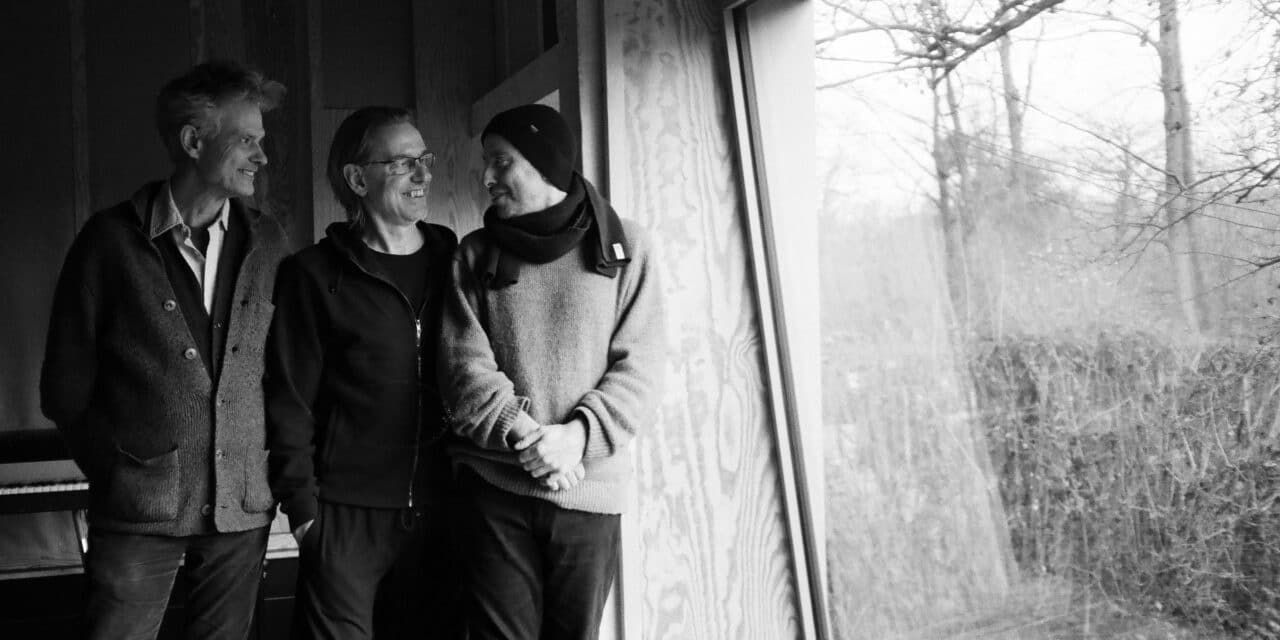
That deceptively simple observation sits somewhere near the center of Inner Forest, the collaborative album bringing Belgian guitarist and composer Tassin together with saxophonist Erwin Vann and French-Belgian drummer Jean-Marc Butty.
Produced and shaped alongside John Parish, whose extensive credits include collaborations with PJ Harvey, the record moves through jazz, ambient, experimental and contemporary classical territories without appearing particularly concerned about belonging to any of them.
Its first single, “Northern Light,” provides the entrance.
Inspired by Tassin’s memories of touring through Finland, the composition evokes vast northern landscapes through an instrumental language in which emptiness becomes almost as significant as sound.
But Inner Forest isn’t really asking listeners to travel to Finland.
It’s asking whether we still know how to create that kind of space inside ourselves.
We Have Forgotten How to Leave Things Empty
The memory behind “Northern Light” is remarkably simple.
Tassin was touring Finland with guitarist Heikki Ruokangas.
Between performances came extraordinarily long drives.
Hours could pass without houses.
Without people.
Just trees.
For someone coming from Belgium—a small, densely populated country where one city seems almost immediately to become another—the experience was startling.
“You can drive for hours without seeing anything—no houses, no people, just trees,” Tassin remembers. “It really cleared my head, in a way.”
What stayed with him wasn’t simply the beauty of the landscape.
It was the space.
Physical space became mental space.
And eventually mental space became music.
“This song is above all an allegory for that search for space.”
That search extends throughout Inner Forest.
The musicians aren’t merely interested in what happens when three people play together.
They’re interested in what happens when three people resist playing simply because there is room to do so.
Listening Is Harder Than Playing
Anyone can wait for another person to stop talking.
Listening is something else.
Tassin sees the distinction clearly.
We’re often preparing our responses before the person in front of us has finished expressing themselves. Conversation becomes alternating transmission rather than actual exchange.
Music can suffer from the same problem.
So Tassin repeatedly asks himself questions that have little to do with virtuosity.
“Have I left enough space? Have I left enough air? Have I left enough silence and room for what has just been said to settle?”
And perhaps most importantly:
Has the listener actually been given enough time to feel it?
Those questions come naturally within this trio because all three musicians share an awareness of space beyond its compositional usefulness.
Vann’s engagement with meditation and yoga informs his musical presence. Butty’s interest in mindfulness similarly intersects with his approach to sound. Tassin describes music itself as his version of meditation.
Together, they approach listening not as passive inactivity but as a discipline.
“It’s a lifelong process, I think—learning how to listen and how to leave space.”
Inner Forest turns that process into music.
The Inner Forest Is Not Necessarily a Peaceful Place
The album’s title suggests retreat.
But the forest Tassin describes isn’t simply somewhere beautiful to hide from the world.
It’s inward.
“I think that for the three of us, Inner Forest is above all an invitation to take an inner journey.”
That invitation arrives in response to a culture Tassin sees as increasingly hostile to introspection.
Information arrives constantly.
Notifications demand attention.
Work demands productivity.
Digital culture rewards speed.
Connectivity is treated almost unquestionably as progress.
And somewhere inside that relentless outward movement, Tassin believes we risk losing contact with ourselves.
“We forget ourselves. We forget to look at what’s happening inside us and to ask ourselves who we really are.”
In that context, slowing down becomes more than wellness language.
It becomes resistance.
“Inner Forest is a gentle way of resisting this pressure.”
The word gentle matters.
This isn’t rebellion through confrontation.
Nobody is smashing anything.
The resistance lies in refusing acceleration.
Taking time.
Paying attention.
Allowing silence.
Music Taught Tassin How to Be Present, Not the Other Way Around
It’s easy to imagine mindfulness influencing music.
For Tassin, the relationship works almost in reverse.
Unlike Vann, who maintains a daily meditation and yoga practice, Tassin doesn’t necessarily approach composition after cultivating mindfulness elsewhere.
Music itself teaches him mindfulness.
“When I’m composing music, practicing, or playing with other people, it’s easy for me not to be distracted by a million different thoughts.”
The instrument demands presence.
There is the sound happening now.
The musician opposite you playing now.
The note decaying now.
The decision about whether to respond now.
For those moments, the usual mental noise disappears.
“Music made me realize it’s possible to be truly present.”
The more interesting challenge is carrying that state back into ordinary life.
Rather than meditation making him a more attentive musician, music shows Tassin what attention feels like.
Then he tries to become that attentive person outside the room.
Sometimes You Have to Make Your Own Instrument Unfamiliar
Presence also requires disrupting habit.
Tassin has found one particularly effective way to do that:
Change the guitar until he no longer entirely knows where everything is.
Alternative tunings gradually became fundamental to his compositional language. What began with changing one or two strings eventually became considerably more extreme.
“Now I sometimes change the tuning for every piece on stage.”
The practical consequence is disorientation.
Familiar shapes no longer produce familiar results.
Muscle memory becomes less useful.
Patterns accumulated over years of playing suddenly stop behaving the way they’re supposed to.
And that’s exactly the point.
“It makes me lose my usual reference points and habits.”
Rather than immediately placing his left hand on the fretboard and relying on known shapes, Tassin might begin by allowing open strings to resonate.
He listens.
Changes a note.
Listens again.
Experiments.
Eventually the instrument begins suggesting where the composition wants to go.
“The combination of harmonics and open-string resonance, without even putting my left hand on the fretboard, can already give me a taste, a color, an image.”
The technique transforms composition into discovery.
Instead of forcing the guitar to execute an idea he already has, Tassin changes the instrument and waits to discover what possibilities it offers back.
Three Musicians Without a Compromise
Finding musicians capable of inhabiting that space required more than assembling impressive résumés.
Tassin had known Erwin Vann and admired his work for years.
What interested him wasn’t simply Vann’s technical ability but his apparent ability to strip playing down to something essential.
“Honest, wholehearted, intimate, as close to the truth as possible.”
Eventually, Tassin began composing specifically with Vann’s musical voice in mind.
The two spent roughly a year allowing the material to develop.
Then they realized something was missing.
Drums.
But not conventional jazz drums.
They considered percussionists and musicians outside the usual expectations of the format until Vann suggested Jean-Marc Butty, with whom he’d previously worked in Vénus.
They traveled to Montpellier.
The three played.
And almost immediately, Tassin says, there was a sound.
“The music came together incredibly naturally, and right away, the three of us had a sound.”
That naturalness remains crucial.
Tassin rejects the assumption that collaboration inherently requires compromise.
“I don’t feel that anyone is making compromises in this project.”
Instead, he sees successful collaboration as creating a space large enough for three distinct identities to remain intact while contributing toward the same musical objective.
“Music should be a space where everyone can really be themselves, without compromise, while still serving the same project.”
Unity doesn’t require sameness.
Genre Is Useful Until It Starts Telling You What to Do
Trying to describe Inner Forest inevitably produces a collection of genre labels.
Jazz.
Ambient.
Experimental.
Contemporary classical.
There are echoes of the emotionally expansive instrumental worlds associated with artists like GoGo Penguin and Portico Quartet, while the project’s spaciousness also gestures toward musicians for whom restraint becomes compositional architecture.
Tassin doesn’t object to genre terminology.
He simply doesn’t find it particularly useful while composing.
“Genre itself isn’t really important to me. What matters is having a clear sense of what the project should sound like.”
That distinction is important.
Rejecting genre doesn’t mean rejecting direction.
Tassin often begins with what he describes as a distant but relatively clear image of the finished music.
He may not know exactly how he’ll reach it.
But he recognizes its atmosphere.
As compositions develop, he returns to the earliest pieces created for the project because they frequently contain the original DNA—the textures, mood and musical vocabulary that first suggested what the project could become.
The objective isn’t to ask whether something sounds sufficiently like jazz or ambient music.
It’s simpler.
Does it still belong to this world?
John Parish Heard Something They Couldn’t
When Tassin sent demos to producer John Parish, there wasn’t an elaborate conversation explaining how the record should sound.
Parish apparently understood it almost immediately.
“He came back with a mix without us having talked about it all that much beforehand, and it was pretty much exactly what we were looking for.”
Except Parish also made decisions the musicians themselves probably wouldn’t have made.
That difference became important.
Musicians accumulate assumptions.
A voice should occupy this position.
An arpeggiated guitar should have this degree of clarity.
This instrument should be louder.
That one should remain distinct.
These decisions can begin to feel like objective rules when they’re actually habits.
Parish disrupted some of them.
“These are habits and automatic choices that John sometimes deliberately turned on their head.”
In doing so, he wasn’t merely polishing recordings.
He was interpreting them.
“By doing that, he brought his own reading of the music, and I think that gave the album a much stronger personality and a much stronger sonic identity.”
Perhaps appropriately for an album suspicious of fixed categories, Tassin believes Parish’s perspective works because his production instincts don’t belong neatly to any particular genre either.
The Point Is Not to Escape. It’s to Return Lighter.
Inner Forest begins with “Northern Light.”
Trees.
Distance.
Cold landscapes.
Space.
The album then turns inward.
Not toward some dramatic revelation, but toward a slower recalibration of attention.
There is something distinctly unfashionable about that proposition.
We live in a culture optimized for interruption. Songs compete for attention within seconds. Silence can feel dangerous. Empty space becomes something waiting to be monetized, populated or filled.
Inner Forest asks what might happen if we don’t fill it.
If we allow a note to decay completely.
If we listen to another person without preparing our answer.
If we temporarily abandon the familiar tuning.
If three musicians enter the same room without demanding that any of them become less themselves.
If music isn’t another thing competing for our attention but an opportunity to practice giving attention.
Tassin doesn’t expect listeners to reach the end of Inner Forest transformed into different people.
His hope is considerably gentler.
“I’d love for people to feel a little lighter by the end of the album.”
Perhaps as though they’ve traveled somewhere.
Through the record.
Through the trees.
Or somewhere less easily mapped.
“Somewhere inside themselves.”
In a culture constantly asking us to absorb more, produce more and say more, maybe that’s enough.
Leave a little room.
And listen to what happens inside it.
In Conversation With Julien Tassin, Erwin Vann & Jean-Marc Butty
Inner Forest brings together three musicians with very distinct musical histories. When did you realize those individual voices could become one musical language?
I’ve known Erwin for a long time. I know his work, and I’ve always been moved by his world, but also by the way he plays—which, to me, goes straight to the essential. It’s a way of playing stripped of all artifice: honest, wholehearted, intimate, as close to the truth as possible. So I’d had this idea of working with him for a long time.
Then came the moment when I wrote this music with his voice in mind—his musical voice, the way he plays. We started working together, and for a year we developed and let the music grow naturally.
Then we started asking ourselves what the music needed. We realized we needed a drummer, but not someone who played in the conventional way. We were looking for a drummer who came from outside the jazz world, and we considered percussionists and other possibilities.
Erwin had worked with Jean-Marc in the past, notably with the band Vénus, so for him it was obvious we had to try working with him. We went all the way to Montpellier to meet him, and the connection was immediate. The music came together incredibly naturally, and right away, the three of us had a sound.
The album explores nature, contemplation, healing, and interconnection. What does the title Inner Forest mean to each of you?
I think that for the three of us, Inner Forest is above all an invitation to take an inner journey.
In today’s society, we’re constantly bombarded with demands, pressure, and information to process. We forget ourselves. We forget to look at what’s happening inside us and to ask ourselves who we really are. We live in a society that pushes us toward productivity, speed, and constant connectivity—at the expense of our individuality.
Inner Forest is a gentle way of resisting this pressure. It’s an invitation to slow down and reconnect with ourselves.
“Northern Light” was inspired by a profound connection with cold northern landscapes. What specific memories or emotions shaped the track, and how did you translate them into instrumental music?
“Northern Light” is a reminiscence from a memory I had while touring in Finland with Heikki Ruokangas, a Finnish guitarist I collaborate with in a duo.
When you travel and tour in that country, the distances between cities are huge. You can drive for hours without seeing anything—no houses, no people, just trees. It really cleared my head, in a way. In my own country, Belgium, it’s completely the opposite. Everything is very dense; cities are right next to each other, and there are very few places where you can find physical space, but also mental space.
This song is above all an allegory for that search for space. I’m trying to capture this idea of space within the composition, but it’s also something that runs through the whole album and the way the trio plays. It’s something that’s always very present in our subconscious, and something that’s really important to us.
There’s an idea behind this project that listening is as important as playing. How important are silence and space when the three of you perform together?
I feel that one of the hardest things in life is really being able to listen to other people—to be genuinely present with what someone is saying, without already thinking about what you’re going to say next. That takes a lot of work. First, becoming aware of it, and then actually doing it. Some people have it more naturally than others, but it’s something we tend to lose as human beings, especially in Western societies.
Music is often a reflection of the people who make it, and more broadly, of the society we live in. So it’s something I’m constantly trying to work on as a musician, even when I’m playing solo.
Have I left enough space? Have I left enough air? Have I left enough silence and room for what has just been said to settle? For the listener to really have time to feel the depth of what I’m trying to express?
These came quite naturally between the three of us, because I feel that each member of the group is very aware of this. We’re all trying to work on it in our everyday lives. It’s a lifelong process, I think—learning how to listen and how to leave space.
Mindfulness and contemplation seem deeply connected to this project. How do those practices influence the way you compose, improvise, and respond to one another?
Unlike Erwin, who practices meditation and yoga every day, I try to make music my own form of meditation. Maybe it’s not meditation in the strictest sense, but for me, it’s one of the few moments in my everyday life when I can truly think about nothing else.
When I’m composing music, practicing, or playing with other people, it’s easy for me not to be distracted by a million different thoughts. It’s a moment when I can really stay within the present moment.
So I’d say that music made me realize it’s possible to be truly present. And it’s music that teaches me to try to bring that into my everyday life, rather than the other way around.
Your use of prepared guitar, alternative tunings, and unconventional techniques challenges what we expect a guitar to sound like. What attracts you to transforming familiar instruments into something unfamiliar?
I gradually started experimenting with different tunings on the guitar. When I first started playing solo, I would maybe just change one or two strings. But little by little, it became more extreme. Now I sometimes change the tuning for every piece on stage.
It makes me lose my usual reference points and habits. Sometimes, a particular tuning gives you the vibe of a song straight away. I let the open strings ring and search by trial and error—changing one note, then another, improvising. That can quickly give me a sense of where the music is going.
The combination of harmonics and open-string resonance, without even putting my left hand on the fretboard, can already give me a taste, a color, an image. If it speaks to me, the composition usually comes naturally.
I don’t prepare the instrument much in this project, but in my solo work, it allows me to explore sounds that can be shorter, more percussive, more aggressive, or smoother. The sound of an instrument can really shape the way a musician plays. That’s probably why we become attached to certain instruments—their particular sound can lead us in one direction rather than another.
Changing the tuning and altering the guitar’s sound changes the way I respond to it and brings a lot of inspiration and freshness.
** Inner Forest moves between jazz, ambient, experimental, and contemporary classical music without fully belonging to any of them. How important—or unimportant—is genre to you when creating music?**
Genre itself isn’t really important to me. What matters is having a clear sense of what the project should sound like.
Usually, when I’m composing for a project, a band, or for myself, I have a distant but fairly clear image in my mind of what the final piece might become. Whether it’s more jazz, ambient, or something else, I don’t really think in terms of labels. But my choices naturally tend to follow that image.
During the composition process, I try to stay as close as possible to my initial idea—to the sound and texture I’m aiming for. When I’m composing for a project, I often go back and listen to the first pieces I wrote. They usually contain all the elements and the vibe I had in mind when I started. And I try to stick to that, to stay as close as possible to that original idea.
What did John Parish bring to the project as producer, and was there anything he heard in your music that changed the way you understood the collaboration?
I sent the demos to John Parish, and he very quickly understood the essence of the music. He came back with a mix without us having talked about it all that much beforehand, and it was pretty much exactly what we were looking for.
He made choices that we probably wouldn’t have made ourselves. We sometimes have preconceived ideas about how things are supposed to sound—a voice has to be right up front, a guitar has to be very distinct, an arpeggiated guitar has to be very clear. These are habits and automatic choices that John sometimes deliberately turned on their head.
By doing that, he brought his own reading of the music, and I think that gave the album a much stronger personality and a much stronger sonic identity. That’s probably the main strength of working with him: he didn’t just mix the music, he brought a much broader producer’s vision to it. And that vision doesn’t really fit into any particular genre, which is actually very consistent with the music itself.
The album balances three very recognizable individual musical identities. How do you distinguish between collaboration and compromise when creating together?
I don’t feel that anyone is making compromises in this project. We don’t really want to compromise anyway, whether it’s in the music we play as a trio or in the way we each play individually.
Music should flow naturally, both in the composition and in the way you play. If things don’t flow, then the work is about finding a way to let things happen naturally, without anyone having to force themselves or hold themselves back.
Music should be a space where everyone can really be themselves, without compromise, while still serving the same project.
If “Northern Light” is the entrance into the world of Inner Forest, where do you hope listeners have arrived emotionally by the end of the album?
I’d love for people to feel a little lighter by the end of the album. Maybe they’ll feel like they’ve been on a journey—both through the music and somewhere inside themselves.