Some experiences become more meaningful after they’re over.
Not necessarily because they were perfect, but because memory has a strange way of transforming ordinary moments into something almost mythical.
For Toronto-based singer-songwriter and filmmaker David Jane, a year spent studying at Vancouver Film School became precisely that kind of experience.
What began as an attempt to escape creative paralysis turned into a period of friendship, love, artistic discovery, and freedom that seemed to exist outside the responsibilities of everyday life.
“It felt like all of us were existing in this miracle lapse, as if the rest of the world was on hold,” Jane recalls.
But the year eventually ended, and returning home meant confronting the uncomfortable realization that something extraordinary had become impossible to recreate.
That feeling became the foundation of Ambleside, his five-track EP exploring the complicated relationship between memory and the present.
When Memory Becomes More Powerful Than Reality
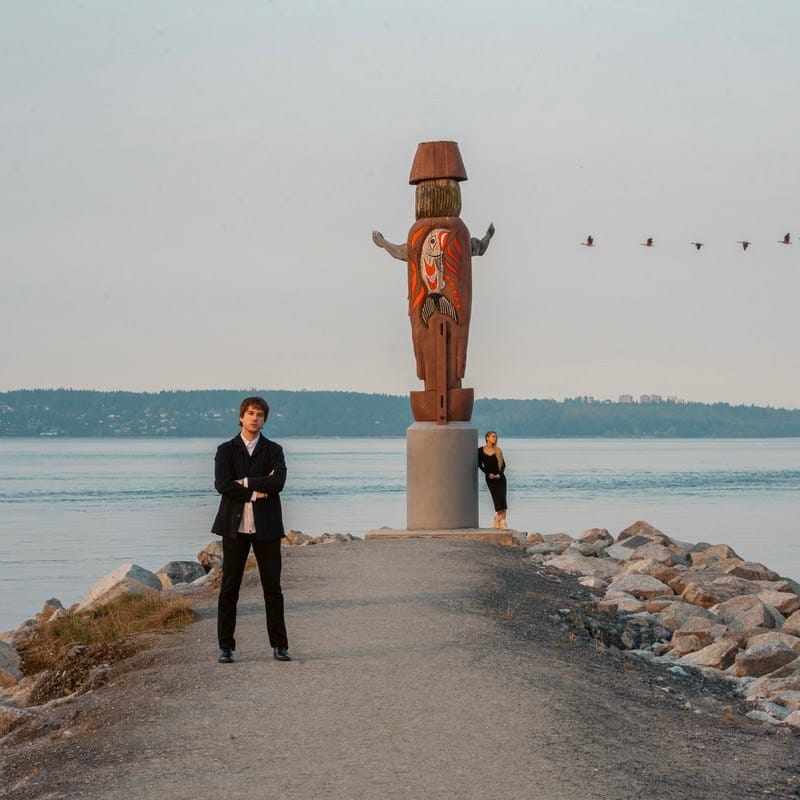
Named after Ambleside Beach in North Vancouver, the project examines how a physical place can become an emotional landscape.
Unlike the energetic atmosphere of Kitsilano or English Bay, Ambleside offered Jane a different experience: stillness.
It was a place populated by fishermen, families, students, and locals going about their ordinary routines. Somewhere he could watch the sun disappear over the water and briefly feel removed from the world.
That contrast became central to the EP’s emotional identity.
Jane wasn’t simply missing Vancouver. He was trying to understand why that particular period continued to occupy so much space in his imagination.
More than four years later, he has begun questioning whether his memories have taken on a life beyond the experiences themselves.
“I almost think I value the actual ‘longing’ more than the ‘being,’” he admits.
It’s a revealing distinction, particularly for an artist whose work revolves around the impossibility of returning to something that no longer exists.
Inspired partly by T.S. Eliot’s Burnt Norton, Jane began exploring the idea that past, present, and future aren’t entirely separate experiences.
Instead, memory allows them to coexist, continuously reshaping how we understand our lives.
But he also rejects the romantic simplicity often associated with nostalgia.
“Nostalgia is a simulacrum,” he argues. “It polishes the past like some kind of shiny facade without ever engaging with the weight or sincerity of it.”
For Jane, Ambleside is less interested in romanticizing the past than confronting its emotional consequences.
Turning Lost Time Into Sound
Across five tracks, Jane approaches that experience from different perspectives.
“Garden Out Back” searches for a lost love, while “Concussion” explores the idealization of memories already slipping away. “Five and Dime” finds refuge in art, and “Story of a Night” examines a present overshadowed by what came before.
The title track brings those ideas together through an atmospheric arrangement built around four persistent chords.
Working with producer Sam Arion, Jane places his raw, acoustic songwriting within expansive layers of synths, ambience, and recordings of actual waves.
The resulting tension between intimacy and atmosphere mirrors the emotional contradictions of the project.
The music feels suspended between remembering and moving forward.
Jane credits his filmmaking background with teaching him that images and sounds can communicate emotions that language alone cannot.
Rather than explaining every feeling, he increasingly allows scenes and sonic textures to speak for themselves.
And perhaps that’s the real purpose of Ambleside.
Not to recover a lost chapter, but to transform it into something new.
“I’m less interested in returning to that than I am in finding something totally new that inspires me the way that year did.”
The past remains important.
But it no longer has to be the only place where something extraordinary can happen.
In Conversation With David Jane
Ambleside comes from wanting to return to a period of your life that you already understood could never truly be recreated. When did you realize that the EP wasn’t really about getting Vancouver back, but about understanding why you needed to return to it so badly?
I had a conversation the other day with a friend about whether anything will ever amount to that year and I started to realize that maybe nothing will but that’s largely because I’ve given these memories a life of their own, a life beyond what they may have actually been worth. It’s been over four years now since that time ended and as time passes, I remember how the creative period of “Ambleside” felt, the desire to return, better than I remember the actual feeling of being there. In that sense, I almost think I value the actual “longing” more than the “being.” Even in my current life, I feel far more immersed in the busy-ness and mundanity of everyday life than I think I did in Vancouver, but if I were to enter another “lull,” I wonder if I’d look back on this time with a similar longing…
You describe your year at Vancouver Film School as a kind of “miracle lapse,” where normal life seemed temporarily suspended. Do you think part of what made that period so powerful was knowing, consciously or not, that it couldn’t last?
Yeah I think that’s a fair thing to say – when you know something is temporary it relieves you of the burden of “permanence.” Some things are meant for a time and place and not having to analyze them in the shadow of “forever” lets them shine a little brighter, at least for their moment. I’m always torn between the sanctity of comfort and the desire to continue searching, to keep moving, and so to find something that’s both beautiful and temporary, you don’t need to square it with the prospect of permanence, you can just enjoy it for what it is in that moment. I think the burden of permanence is a lot heavier than that of transience – day-to-day feels less mundane when you’re not questioning whether that’s all there is.
There’s an interesting paradox behind the project: you used music to try to preserve something that was disappearing, but creating the EP inevitably transformed those memories into something new. Do you think art actually preserves the past, or does it inevitably rewrite it every time we revisit it?
I think memory inevitably rewrites the past every time we revisit it, and art in some ways, at least to me, is just a way of consciously re-contextualizing memories… or influence. I sometimes wonder, if there was a way to insert memories in people’s minds, even if they were never real, would they be enough for people to re-contextualize how they feel about their present? I think so, and in that case, rewriting the past is kind of always an attempt to rewrite the present.
“Ambleside” turns a very specific physical location into an almost psychological space where time behaves differently. What was it about Ambleside Beach—as opposed to the more active parts of Vancouver—that made it become the emotional center of the record?
“Ambleside” had a stillness to it. When I was in the city, or at Kitsilano, I looked around and saw dozens of people who looked like me, I felt an energy similar to mine, as if life was one big party and we were all just attendees. At Ambleside, it was like the whole world took a collective deep breath. Ambleside felt more like a part of people’s routine than an excursion. It was full of old men fishing at the crack of dawn, middle school students on their bikes after class, mothers on mat leave, locals chatting up the storeowners… it didn’t feel like anyone was just passing through. It took me out of that transience I was talking about above and made me really question if it were possible to take that chaotic blend of freedom, passion and adventure I’d been living with and bottleneck it into something simpler but something that could last. I could never really shake that thought in the year’s wake.
T.S. Eliot’s Burnt Norton influenced your thinking about past, present and future existing within us simultaneously. Has that idea changed the way you experience nostalgia—less as looking backward and more as something that is continuously happening inside the present?
If anything it’s given me a distaste towards nostalgia – I think reminiscing is beautiful but nostalgia is corny. Nostalgia is a simulacrum, it doesn’t tell you anything about how the past felt, only a vague impression about what it may have looked like. That’s why “nostalgia” is so empty and so marketable – it polishes the past like some kind of shiny facade without ever engaging with the weight or sincerity of it. When writing “Ambleside,” the past was as present and pressing as the present or future have ever been, and I think that comes across in the depth of emotion throughout the record.
Each song seems to approach memory differently: “Garden Out Back” wants to resurrect a lost love, “Concussion” romanticizes something already disappearing, “Five and Dime” escapes through art, and “Story of a Night” examines a present overshadowed by what came before. Were these songs different attempts at answering the same question: how do you continue living when the past feels more vivid than the present?
Yeah, I think that’s a fair way of putting it – a part of me can never fully let go of my academic background and if the EP had to have a thesis, I’d narrow it down to a line from the bridge of Ambleside: “Nothing feels different but everything’s changed” – how do you move on in the face of that? It’s an uncanny and disorienting state. In that sense, every other track is a part of that journey, each approaching and working through it from a different angle – the emptiness and desperation, the overwhelming idealization, grievance and coping. The final track, Ambleside, remains fixed on returning but, in many ways, the completion and release of the project itself is emblematic of a kind of transformation, taking this experience and turning it into something entirely new.
You initially returned to film because you felt creatively paralyzed by music, yet that experience eventually brought you back to songwriting. What did filmmaking teach you about music that you couldn’t have learned by simply forcing yourself to write another record?
Songwriting is at its most potent when it invokes an emotion or an idea but those only exist within the mind of the listener – written sentiments can direct a listener to a feeling or an idea but, even then, are limited to the emotions or thoughts the writer had in mind. I came to music as a writer first so I LOVE words and, as you can probably tell by listening to my music, write a LOT of them, but music alone, or an image alone, can often invoke emotions deeper than words ever could and when both of those work in tandem, as they do in a great film, there’s a real magic.
This was heavy on my mind while writing and a lot of my favourite lyrics throughout the EP are very imagistic – using words to paint a scene and allowing that scene the space to breathe on its own with any indicative or didactic influence:
Garden Out Back
“Cold water rushing down my face / Blood stains upon an idol stage”
“There’s a ghost hiding in the garden out back”
Ambleside
“Rental bikes in our Hawaiians / Across the Lions we would ride / Silhouettes on the horizon”
None of these lines express an emotion, and yet these images evoke a more mysterious, intriguing and penetrating feeling than anything I could try to elucidate.
Sam Arion surrounds your relatively raw, folk-rooted songwriting with synths, ambience and actual recordings of waves. How did you approach the tension between something as immediate as an acoustic song and production that feels almost dreamlike or unreal?
I think that tension is what makes the songs so special, and the production so unique. Working with Sam was a dream—in his solo project, Mute Choir, he’s a master of creating maximalist soundscapes that serve as a perfect, complimentary counterpoint to my raw, acoustic songwriting. Every session was its own struggle to find that ethereal, ambient soundscape without stepping on the raw vulnerability of the songwriting, as well as a constant barrage of me telling Sam the song didn’t feel big or “full” enough while simultaneously not wanting to add any new instrumental “parts.” I’m using “part” here to describe any piece of the production that asserts its presence (ie. the Garden Out Back solo, the Ambleside post-chorus riff, etc). These are deliberately sparse throughout the project because I’m not trying to include anything that doesn’t serve or emphasize the songwriting. Luckily, Sam’s a magician and would always find his way to just the right sound or ambience that somehow tied everything together and whenever that moment clicked there was never a doubt.
The title track remains anchored to four chords for nearly five minutes, creating a feeling of being suspended rather than pushed toward a conventional resolution. Was repetition a way of recreating that experience of sitting by the water and temporarily losing your sense of time?
I think the strumming patterns and repetitive un-resolving chords lull you into a kind of trance, one where you can really enter that reminiscent, meditative state, a state where memories take on a life of their own, where they’re no longer tethered to the reality they came from. I hope it leads people to their own “Ambleside.”
The only interruption is in that final chorus where we skip the home chord – I don’t think I actually thought about that when writing, it’s one of those things that just instinctively made sense that I’m happy to take credit for after the fact.
You’ve said you’re still unsure whether making Ambleside actually succeeded in recapturing that lost period. After finishing the EP, do you think its real purpose might have been something different—not recreating the past, but finally creating a place where you could leave it?
I’ll always look back on that time with a sense of blissful reminiscence but the way I’ve idealized it no longer feels real to me. I miss the freedom and the persisting passion that existed when I was there, but I’m less interested in returning to that than I am in finding something totally new that inspires me the way that year did so yeah, I think that’s a fair conclusion to draw. All that said, I still deeply miss the west coast and Vancouver itself. Every time I return it feels like a breath of fresh air (maybe because it actually is).
Listen to David Jane’s Ambleside EP and explore more of his work at his official website.