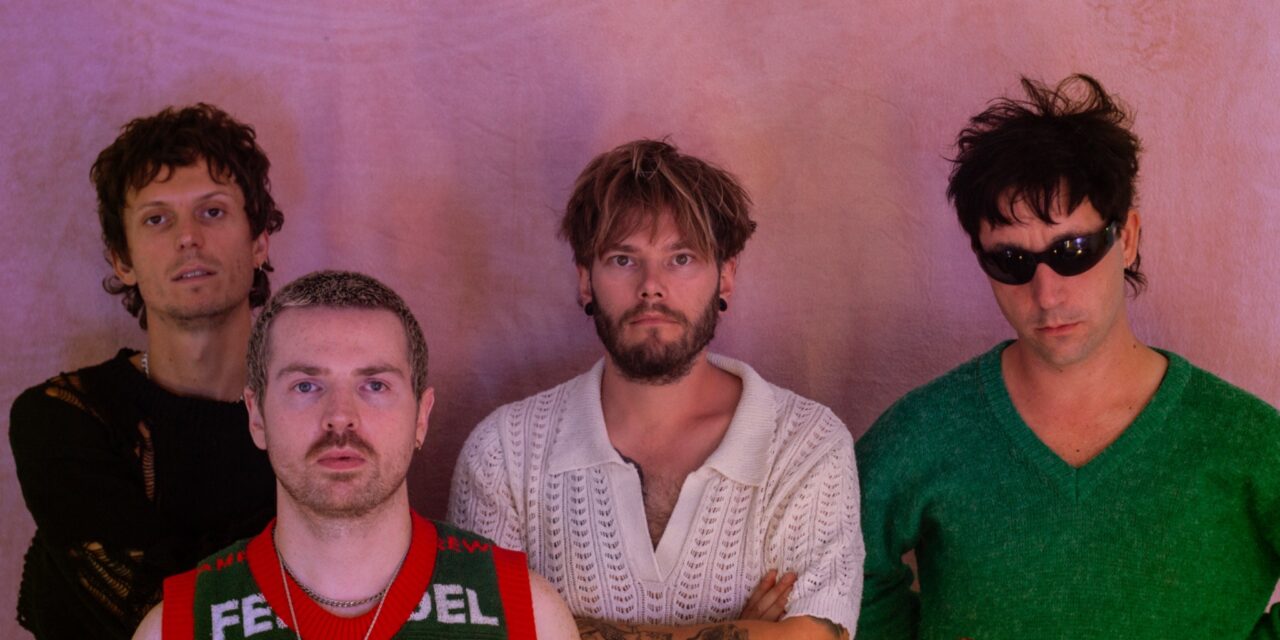
On their debut EP At The Nepo, the London-based post-punk provocateurs turn the music industry’s obsession with privilege, inherited opportunity, and cultural gatekeeping into a grotesque fictional nightclub. Blending industrial electronics, rave culture, and punk aggression, Body Horror are exposing the absurdity of a scene that claims to celebrate outsiders while making sure the right people always get inside.
Imagine a nightclub where the guest list was written before you were born.
The music is loud, the lights are flashing, and everyone inside seems to know someone important. The people at the front of the queue don’t need to explain why they belong there. Their names are already on the list.
Outside, everyone else is trying to figure out what it takes to get in.
Welcome to The Nepo A Go Go.
It’s a fictional venue dreamed up by London-based post-punk band Body Horror, but its inspiration is painfully real.
On their single “The Nepo a Go Go,” released September 25, the band transforms the music industry’s culture of nepotism into a grotesque, darkly comedic nightclub, populated by people whose greatest qualification might be the family they happened to be born into.
The track serves as an introduction to their debut EP, At The Nepo, arriving October 30, a four-track, fourteen-minute collision of industrial electronics, post-punk confrontation, and the physical abandon of London’s rave culture.
Produced by Syd Kemp, whose credits span The Horrors, Thurston Moore, Jessie Ware, Olivia Dean, and Crack Cloud, the project captures a band interested in making music that is as uncomfortable intellectually as it is irresistible physically.
Led by Welsh vocalist Gethyn Thomas, Body Horror combine relentless rhythms, abrasive guitars, and biting social commentary into something that exists somewhere between The Prodigy, Viagra Boys, and The Birthday Party.
But beneath the distortion and dark humor is a surprisingly nuanced question.
How do you criticize a system of privilege without pretending you’re entirely outside it?
For Body Horror, the answer begins by turning the whole thing into a nightclub.
And then making everyone dance.
The Club Where Everyone Knows Someone
Nepotism isn’t exactly a new subject in conversations about the creative industries.
From music and fashion to film and contemporary art, the relationship between talent, family connections, wealth, and access has become increasingly difficult to ignore.
Yet the discussion often collapses into predictable arguments about who deserves their success and who doesn’t.
Body Horror wanted to approach the subject differently.
Rather than delivering a straightforward denunciation of the industry, Thomas imagined a fictional venue where the absurdity of inherited privilege could become something physical, theatrical, and grotesque.
“The short answer is, it’s a lot more fun and interesting for me to write than an angry Instagram post,” he explains.
It’s a revealing distinction.
For Thomas, fiction offers the opportunity to examine social structures without reducing them to a single argument.
And nepotism, he suggests, is particularly suited to satire because of the contradictions embedded within the conversation itself.
“It’s such a ridiculously privileged problem to have in the first place,” he says.
The idea was partly inspired by a peculiar tradition in popular songwriting: songs about fictional or semi-fictional places.
Barry Manilow’s “Copacabana” is one reference point.
The Eagles’ “Hotel California” is another.
Both create recognizable worlds through the image of a location, allowing the setting to become a vehicle for something larger than its literal description.
Thomas was drawn to that tradition precisely because of its theatrical excess.
A song about a nightclub can be ridiculous, glamorous, sinister, or all three.
And the world of cultural nepotism, with its invisible hierarchies and carefully managed appearances, lends itself naturally to that kind of exaggeration.
But Thomas also wanted to avoid the temptation to treat the London music industry as the center of the universe.
As he points out, much of the debate involves people who already occupy relatively privileged positions arguing about the advantages enjoyed by people who are even more privileged.
“One level of highly privileged people wanting what the next level of highly privileged people were born with,” he explains.
It’s a perspective that complicates the band’s critique.
The unfairness of nepotism is real.
But so is the broader global inequality that makes the ability to pursue an artistic career a privilege in itself.
Body Horror aren’t interested in resolving that contradiction.
They’re interested in making it impossible to ignore.

A Womb With a View
The most disturbing image in the band’s fictional universe appears in the lyric:
“A womb with a view, the heirloom umbilical.”
It’s grotesque, funny, and remarkably effective.
Thomas imagined the nightclub itself as a womb, its walls flesh-pink and its inhabitants permanently connected to the circumstances of their birth.
The people inside haven’t simply benefited from inherited advantages.
They remain attached to them.
“I kind of imagined the whole venue as a womb, with flesh-pink walls,” he explains.
“Like, the people inside can’t really ever escape the womb.”
It’s an especially fitting image for a band called Body Horror.
The genre of body horror traditionally explores the instability of physical identity, transforming the human body into something unfamiliar, disturbing, or grotesquely exaggerated.
Here, the horror isn’t simply biological.
It’s social.
The umbilical cord becomes a symbol of inherited access, an invisible connection between family background and cultural opportunity.
The club’s inhabitants appear independent, but their position within the room depends on a system that existed before they did.
Thomas also slips in a reference to A Room with a View, E. M. Forster’s novel examining class, social convention, and the restrictions of privileged society.
The literary allusion adds another layer to the band’s fictional world.
Because the horror of The Nepo A Go Go isn’t that its guests have inherited advantages.
It’s that the entire environment has been constructed to make those advantages appear natural.
The Privilege of Criticizing Privilege
Perhaps the most interesting decision Body Horror make is refusing to position themselves as morally untouched observers.
“The Nepo a Go Go” is the second part of a two-song sequence.
The first, “At The Nepo,” introduces the fictional nightclub.
The second turns the criticism inward.
Thomas describes himself in the lyrics as “just another Westerner with a seriously privileged appendage.”
It’s a deliberately uncomfortable admission.
Although he didn’t grow up in a musical family or benefit from industry connections, Thomas recognizes that his own circumstances have afforded him opportunities unavailable to many others.
He moved to London at eighteen, hoping that the arts might offer something resembling a meritocracy.
Instead, he discovered an industry shaped by many of the same inequalities present elsewhere in society.
“I didn’t come from a musical family. Zero industry ties,” he explains.
“Moved to London at 18, thinking the arts might be the one place fit for a meritocracy.”
The reality proved more complicated.
But Thomas is equally unwilling to present his struggle as equivalent to every other form of disadvantage.
“The fact I can even choose to do that and pursue that hard work means I’m in a position of privilege.”
That acknowledgment gives the band’s satire an important degree of self-awareness.
It’s easy to criticize a system when you imagine yourself standing entirely outside it.
It’s considerably more difficult to recognize the ways you might benefit from structures you also find unfair.
Body Horror don’t pretend to have solved that problem.
Instead, they allow the contradiction to become part of the music.
And in doing so, they make their criticism more interesting than a simple division between deserving outsiders and undeserving insiders.
Punk Music That Actually Wants You to Dance
Musically, Body Horror approach confrontation through movement.
Their sound draws from post-punk, industrial electronics, and London’s rave culture, combining aggressive guitar lines with rhythms designed to make bodies move.
“The Nepo a Go Go” embodies that approach.
Built around a relentless central riff, the track combines punishing electronic textures, distorted guitars, and the pointed, rhythmic delivery of Thomas’s vocals.
Its tightly wound verses build toward increasingly frantic choruses, where repetition becomes almost hypnotic.
There’s a physical urgency to the arrangement, but also an unmistakable sense of theatricality.
The song doesn’t simply describe a grotesque nightclub.
It attempts to recreate the experience of being inside one.
For Thomas, the dance element is essential.
He wants audiences to participate in the music rather than simply observe it.
“Music people feel they can actually dance to, rather than standing still and bobbing their heads,” he explains.
“Gives them a chance to express themselves rather than just us doing that.”
That philosophy connects the band’s punk instincts with the communal experience of rave culture.
Both traditions have historically provided spaces where people could temporarily escape conventional social expectations.
But Body Horror introduce an uncomfortable irony.
Their fictional club is supposedly a place of pleasure and liberation, yet its social structure is built around exclusion.
The music invites everyone to dance.
The venue doesn’t necessarily let everyone through the door.
It’s a contradiction that becomes even more provocative when the audience is physically enjoying a song about inequality.
Thomas doesn’t expect people to analyze every lyric while they’re dancing.
But he hopes the themes eventually register.
And perhaps that’s the point.
Sometimes the most effective way to communicate an uncomfortable idea is to make it impossible to resist.
The Warehouse That Became a Band
Body Horror’s identity is also inseparable from the environments that brought its members together.
With roots in Powys, Tottenham, Birmingham, and Sweden, the band emerged from a mixture of geographical backgrounds and shared experiences within London’s alternative music culture.
Three members met after independently moving into the same warehouse.
That environment became an important influence on their sound.
Rather than developing exclusively through traditional rehearsal spaces or guitar-driven punk scenes, the band absorbed the atmosphere of warehouse culture and the electronic music surrounding it.
The result is a sound that treats guitars, synthesizers, percussion, and vocal performance as equally important components of a larger physical experience.
Their influences are deliberately difficult to contain within one genre.
The Prodigy’s electronic aggression, Viagra Boys’ confrontational post-punk, and The Birthday Party’s theatrical intensity all offer useful reference points.
But Body Horror’s appeal lies in the way those elements collide.
They aren’t simply a punk band experimenting with electronic sounds.
Nor are they an electronic act borrowing punk aesthetics.
Their music occupies the unstable space between those traditions.
And the instability is part of its character.
Turning Chaos Into Something Precise
To produce At The Nepo, Body Horror worked with Syd Kemp, whose extensive credits span artists from remarkably different musical worlds.
That breadth of experience proved valuable for a band whose sound depends on balancing abrasive intensity with rhythmic precision.
According to Thomas, Kemp understood that the band’s aggression needed structure.
“He brought a real attention to detail to what, in the wrong hands, could be just intense noise,” he explains.
The goal was to preserve the immediacy of a live performance while ensuring that the electronic elements remained central to the recordings.
That balance is particularly important for music as rhythmically driven as Body Horror’s.
Too much polish could undermine the band’s rawness.
Too little attention to detail could allow the arrangements to collapse into undifferentiated distortion.
Kemp helped them find a middle ground.
The result is a project that embraces rough edges without treating chaos as an excuse for carelessness.
And despite its brevity, the EP is intended to function as a complete experience.
“The two Nepos are definitely parts one and two of the same song,” Thomas explains.
“The whole thing is meant to feel like an intense 14 minutes.”
That sense of cohesion distinguishes At The Nepo from a conventional collection of unrelated singles.
The project is designed as a concentrated encounter with the band’s sound and worldview.
Four tracks.
Fourteen minutes.
Very little breathing room.
Who Gets Through the Door?
Body Horror have already attracted attention from BBC Radio 6 Music, BBC Wales, So Young, Hard Of Hearing, and Still Listening, alongside mentions in Mojo.
Steve Lamacq of BBC Radio 6 Music has described their sound as a savage, electro-driven form of rhythmic post-punk, while So Young has highlighted the hedonistic chaos at the center of their music.
The band have also toured extensively across Europe, including dates with Alabama 3 and performances opening for Maquina.
Their connection to The Horrors extends beyond sonic comparisons: they’ve previously recorded with Faris Badwan, and The Horrors have played Body Horror’s music during their BBC Radio 6 Music residency.
That growing recognition places the band in an interesting position.
After all, At The Nepo is partly concerned with the difficulty of gaining access to cultural institutions.
As Body Horror become more visible within the music industry, they’ll inevitably encounter some of the same systems their songs satirize.
But perhaps that tension is precisely what makes the project worth paying attention to.
The band aren’t claiming that artistic success can exist entirely outside social structures.
They’re questioning how those structures operate, who benefits from them, and how easily people convince themselves that their advantages are entirely self-made.
And they’re doing it through music that refuses to sacrifice pleasure for political commentary.
When asked who would actually be allowed into The Nepo A Go Go if it existed, Thomas offers an appropriately evasive answer.
“Oh, that’s for the doorman to decide, not me.”
But he adds one final observation.
“The people who get let in know who they are, even though they never admit it.”
It’s the perfect ending to the band’s fictional nightmare.
Because the most effective gatekeeping systems rarely need to announce their rules.
Everyone inside already understands them.
And everyone outside is left wondering why the door won’t open.
In Conversation With Body Horror
1. “The Nepo A Go Go” turns nepotism in the London music scene into a fictional nightclub. What made you want to address something so real through an invented place rather than writing about the industry directly?
The short answer is, it’s a lot more fun and interesting for me to write than an angry Instagram post. That’s not to say it’s just self-serving. Fiction has a way of exploring a subject in ways that non-fiction can’t quite get to. Also, nepotism in music is such a ridiculously privileged problem to have in the first place that it definitely lends itself better to a song than, say, a two-part Channel 4 documentary exposé.
2. You’ve cited songs about places like “Copacabana” as part of the inspiration. What interested you about taking that almost theatrical, slightly kitschy tradition and twisting it into something darker and more confrontational?
They’re a really fun subgenre of songs, and you do get the odd dark one. “Hotel California” is a really kitschy place song, but as it unfolds, it gets pretty creepy.
For me, the subject fitted the kitschy ridiculousness of it because, ultimately, the problem is a ridiculous problem to have. One level of highly privileged people wanting what the next level of highly privileged people were born with. That microcosm of privilege lent itself really well to a place song, ’cause it is a place too, really. To me, if you’re born in a first-world country and don’t have to worry about food or bombs, you’re already very privileged. That doesn’t mean nepotism is OK. But I guess I just wanted to step back and see the bigger picture.
3. The line “A womb with a view, the heirloom umbilical” is particularly vicious. How did the idea of inheritance—socially, financially and culturally—shape the world of At The Nepo?
Yeah, it’s a bit twisted, that one. I kind of imagined the whole venue as a womb, with flesh-pink walls. Like, the people inside can’t really ever escape the womb. Always attached to it by this umbilical cord passed down the generations. Snuck in that A Room with a View reference, which is also a satire of privileged society.
4. The second half of the concept turns the criticism back on yourself with “just another Westerner with a seriously privileged appendage.” Why was it important not to position yourselves completely outside the system you’re criticising?
I think you can’t ignore that stuff. If you’re born a man in a first-world Western country, you’re already in a position a lot of people work so hard to be in. For me not to address that would be crazy.
I didn’t come from a musical family. Zero industry ties. Moved to London at 18, thinking the arts might be the one place fit for a meritocracy. But it’s basically the same as everything else, so I’ve had to work really hard. But the fact I can even choose to do that and pursue that hard work means I’m in a position of privilege.
5. Your music sits somewhere between post-punk, industrial electronics and London rave culture. What does club music allow you to communicate that a more conventional punk setup couldn’t?
The dance element. Music people feel they can actually dance to, rather than standing still and bobbing their heads. Gives them a chance to express themselves rather than just us doing that.
6. There’s something interesting about making a song criticising privilege that is also extremely danceable. Do you like the idea of people losing themselves on a dancefloor before realising what they’re actually dancing to?
Yeah, although I’m not sure they’re thinking of that in the moment. But I’d hope they’re into the themes.
7. Syd Kemp has worked across remarkably different musical worlds, from Thurston Moore and The Horrors to Jessie Ware and Olivia Dean. What did he bring out of Body Horror while producing this EP?
He brought a real attention to detail to what, in the wrong hands, could be just intense noise. Think he really got the songs. Wanted it to feel live, but with all the electronics still really feeling present too.
8. Body Horror has roots stretching across Powys, Tottenham and Birmingham. How have those different environments—and particularly your experiences of London—shaped the personality of the band?
Our drummer, Dan, is from Sweden too. Think we all just came to London for the same reason. Three of us met randomly ’cause we all moved into the same warehouse. Really got into that world, which kinda influenced the music.
9. At The Nepo is only four tracks, but you’ve described it as unpredictable and uncompromising. Did you approach the EP as four individual songs, or as one interconnected world with its own characters, spaces and ideas?
The two Nepos are definitely parts one and two of the same song. The whole thing is meant to feel like an intense 14 minutes, yeah.
10. If The Nepo A Go Go were a real club, who gets waved straight through the door, who gets left standing outside, and what happens inside once the night really gets going?
Oh, that’s for the doorman to decide, not me. Although the people who get let in know who they are, even though they never admit it.
Body Horror’s single “The Nepo a Go Go” was released September 25, 2026. Their debut four-track EP, At The Nepo, arrives October 30, produced by Syd Kemp.
Listen: “The Nepo a Go Go” on Spotify