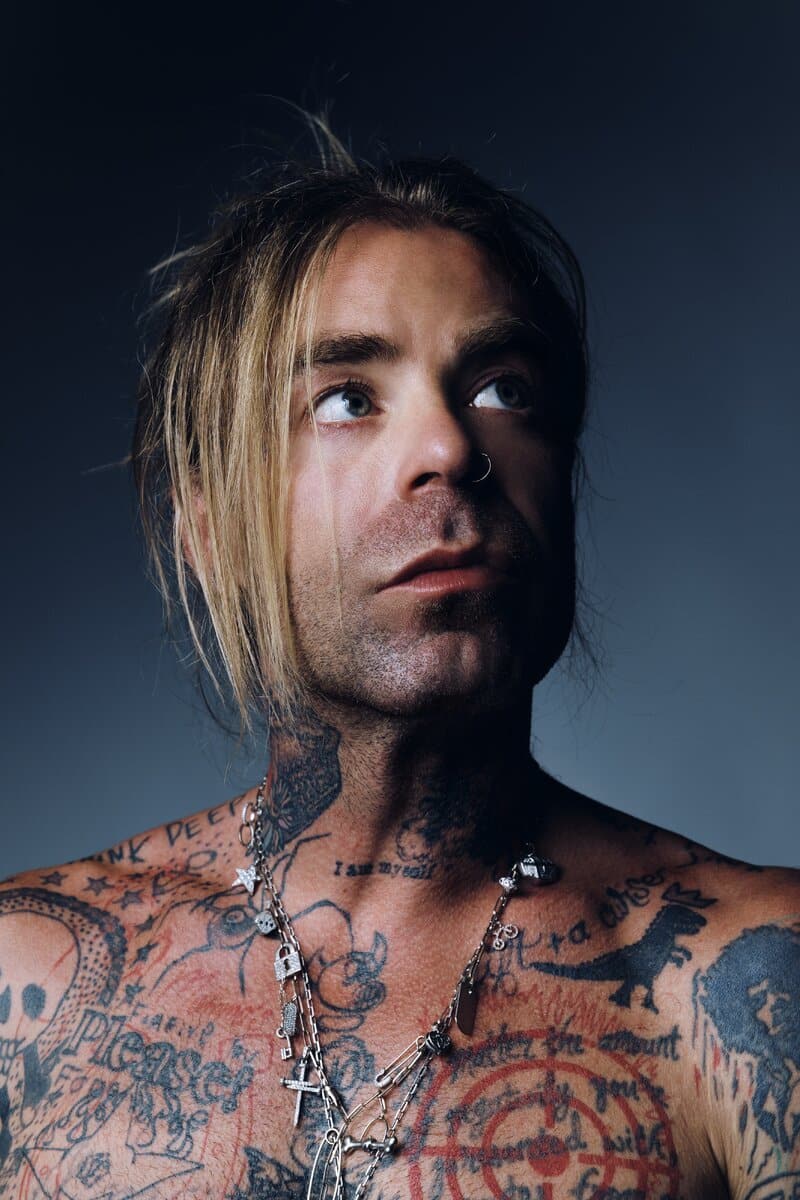
Seven years into sobriety and approaching a new chapter with Big Loud Rock, MOD SUN confronts addiction, grief, and the limits of love on his deeply personal single “Silverline.” But beneath the heartbreak is an artist discovering a different kind of freedom: one rooted in acceptance, self-awareness, and the realization that sometimes the most important person you can save is yourself.
There’s a particularly painful kind of heartbreak that doesn’t come from falling out of love.
It comes from realizing that love, no matter how unconditional, cannot always save someone.
You can show up. You can offer support. You can forgive, understand, and hold on long after everyone else has walked away.
And sometimes, none of it changes the outcome.
For MOD SUN, that realization sits at the center of “Silverline,” his new single released September 25 via Big Loud Rock.
The song explores a friendship pushed to its breaking point by addiction, confronting the complicated relationship between love, responsibility, grief, and regret.
It’s one of the most emotionally exposed moments in the multi-platinum songwriter’s career, but it also represents something larger than a single painful experience.
Seven years into sobriety, MOD SUN is approaching music, relationships, and his own identity from a fundamentally different perspective.
The artist who once built his public persona around relentless energy, excess, and an almost defiant optimism is now discovering that growth doesn’t always mean moving faster.
Sometimes it means learning to sit with feelings you spent years trying to escape.
“I have nowhere to hide,” he says of his sobriety. “I can’t run from the emotions.”
It’s a striking admission from someone whose career has been defined by constant movement.
Across five albums, billions of streams, and collaborations spanning punk, hip-hop, alternative rock, and pop, MOD SUN has made emotional intensity a central part of his artistic identity.
But “Silverline,” the third release from his forthcoming Big Loud Rock album expected in early 2027, suggests a new level of reflection.
The song is still driven by the urgency and melodic instincts that have defined his work.
Yet beneath that familiar energy is a more complicated understanding of what it means to love someone.
And what happens when love isn’t enough.
The Difference Between Loving Someone and Saving Them
The emotional foundation of “Silverline” is a friendship shaped by addiction.
But MOD SUN isn’t interested in presenting the experience as a straightforward narrative about one person trying to rescue another.
For him, the distinction between love and responsibility is more complicated.
“I think love can be eternal whether close to someone or growing apart,” he explains.
Responsibility, however, exists in the actions we choose to take.
Showing up.
Being available.
Allowing someone to know that, even after a relationship changes, they haven’t necessarily lost every form of connection.
MOD SUN describes this as one of the more beautiful aspects of growing older.
Relationships don’t always remain what they once were.
People change, circumstances evolve, and sometimes distance becomes unavoidable.
But the end of a particular chapter doesn’t have to erase everything meaningful that came before it.
“You let the past be the past and understand how precious life is,” he says.
It’s a perspective that suggests a shift away from the all-or-nothing emotional language often associated with his earlier work.
Love doesn’t necessarily require constant proximity.
And caring about someone doesn’t mean having the power to determine their choices.
The difficulty lies in accepting that distinction without becoming indifferent.
For MOD SUN, “Silverline” exists within that uncomfortable space.
It’s a song about wanting a different outcome while recognizing that the past cannot be rewritten.
And about learning to carry love without allowing regret to define everything that remains.
When the Most Personal Story Becomes Everyone’s Story
MOD SUN has spent much of his career writing directly from personal experience.
His songs rarely hide behind elaborate fictional narratives or emotional ambiguity.
But “Silverline” surprised him in the way listeners began interpreting it.
Although the song emerged from a specific relationship and experience, people connected it to entirely different parts of their own lives.
Some heard a song about an ex-partner.
Others thought about their parents.
Still others recognized the complicated emotions of friendships that had changed or ended.
For MOD SUN, that response represented something he’d been trying to achieve throughout his career.
“A song so personal to me, but it’s somehow more relatable to others because of that,” he explains.
He doesn’t claim to fully understand why it happens.
But he recognizes something almost mysterious about the relationship between artistic specificity and emotional universality.
When someone describes a childhood home, for example, we rarely imagine the exact building they’re talking about.
We picture our own.
The details of another person’s experience become a doorway into our memories.
Music can work the same way.
A songwriter offers a particular story, but the listener brings an entirely different emotional history to it.
And somewhere between those two experiences, the song acquires a meaning neither person could have created alone.
For MOD SUN, that process is one of the most powerful things art can accomplish.
He resists the idea that it can be reduced to a formula.
“It’s almost like magic,” he suggests.
The more precisely an artist communicates something genuine, the more room there can be for someone else to recognize themselves.
But he’s also learned that sharing personal experiences requires boundaries.
While he remains comfortable revealing intimate details through his music, he no longer necessarily tells people when a particular song was written about them.
He’s discovered that identifying the subject can shift control of the narrative.
And that distinction matters.
The song belongs to the artist.
But once released, its emotional meaning belongs partly to everyone who hears it.
Seven Years Sober, and Nowhere Left to Hide
Sobriety has fundamentally changed MOD SUN’s relationship with difficult emotions.
He describes seven years without substances not as a period in which life has become easier, but as one in which he’s become more capable of experiencing it fully.
The difference is significant.
Without substances to numb emotional discomfort, he has had to develop a different relationship with sadness, frustration, grief, and uncertainty.
“I have to let them come as they please and stay as long as they please,” he explains.
It’s a philosophy built around acceptance rather than avoidance.
And while he acknowledges that the process can be difficult, he believes it has made him healthier.
“There’s an art form to acceptance and that’s what I try to get better at now.”
That perspective has also transformed his creativity.
For an artist whose public identity was once closely associated with excess, the idea that sobriety might deepen rather than diminish artistic expression carries particular significance.
MOD SUN is emphatic about the difference.
He feels more connected to his creative instincts than he did while using drugs.
His performances have become more present.
And his everyday life is no longer filtered through the need to escape or alter his emotional state.
It’s not that difficult feelings have disappeared.
It’s that he no longer sees them as something he must immediately silence.
That shift gives “Silverline” much of its emotional weight.
The song doesn’t attempt to resolve grief through a dramatic declaration of triumph.
It allows the experience to remain complicated.
And in doing so, it reflects an artist who is increasingly comfortable with the fact that healing doesn’t necessarily provide clean endings.
Why a Sad Song Doesn’t Have to Sound Sad
Despite its subject matter, “Silverline” doesn’t abandon the musical momentum that has defined MOD SUN’s career.
The track balances emotional vulnerability with the energy of alternative rock, creating a contrast between the weight of its themes and the forward movement of its arrangement.
That decision was deliberate.
MOD SUN didn’t want the song to become a conventional acoustic ballad.
Nor did he want the production to remain entirely within the darkness of its subject matter.
“I always have an underlying message of optimism in my art,” he explains.
Sometimes that optimism is obvious.
Sometimes it’s buried beneath the surface.
But he considers it an essential part of his creative identity.
For “Silverline,” the challenge was finding a sound that acknowledged the gravity of the story without allowing it to become emotionally static.
The song was co-produced by MOD SUN alongside Malay, Ryan Carpenter, and Todd Spadafore.
Each collaborator contributed to a production approach that prioritized emotional clarity over unnecessary complexity.
Carpenter’s guitar playing became especially important.
MOD SUN describes him as the best guitarist he’s worked with, not simply because of his technical ability, but because of the emotional character of his performances.
“He’s a broken kid and I can feel that when he creates,” MOD SUN says.
The guitar part helped establish the emotional foundation of the song, influencing both the lyrics and the overall atmosphere.
Spadafore contributed additional sonic depth without overwhelming the arrangement.
Malay, whose work includes collaborations with Frank Ocean, approached the production from a philosophy of subtraction.
MOD SUN recalls Malay describing himself as a “reducer” rather than a producer.
The goal wasn’t to keep adding elements.
It was to identify what mattered most and remove everything that distracted from it.
For “Silverline,” that meant preserving the humanity of the performance.
A strong vocal.
An emotionally expressive guitar part.
And enough space for the song’s central message to resonate.
It’s a restrained approach that reveals something about MOD SUN’s current artistic evolution.
After years of exploring different genres and increasingly elaborate production possibilities, he’s becoming more interested in what happens when a song has room to breathe.
Leaving Los Angeles and Finding a Different Kind of Success
MOD SUN’s personal transformation extends well beyond the recording studio.
After years associated with the energy and visibility of Los Angeles, he has relocated to the Tennessee countryside.
He now lives on five acres, relatively isolated from the constant social activity that once surrounded him.
The change reflects a broader shift in his priorities.
For much of his life, success was connected to movement.
More music.
More opportunities.
More recognition.
More experiences.
Now, he’s trying to find satisfaction in what he already has.
“I focus on being proud of what I have, not wanting more,” he explains.
It’s a striking statement from an artist whose career has involved extraordinary commercial achievements.
His catalog has generated billions of streams, and his songwriting credits span artists including Avril Lavigne, Lil Wayne, mgk, and TOMORROW X TOGETHER.
Yet he describes his current sense of happiness in terms that have little to do with professional status.
Nature has become an important source of inspiration.
So has solitude.
And his understanding of what constitutes a meaningful life has become less dependent on external validation.
“My heroes went from people to nature,” he says.
It’s a simple observation, but one that captures a substantial philosophical shift.
Rather than measuring his progress exclusively against other people’s achievements, MOD SUN is learning to appreciate experiences that don’t require competition.
He doesn’t pretend that everything is perfect.
He still works intensely.
He still cares deeply about how his music is received.
And he still encounters the frustrations that come with being an artist.
But the underlying emotional experience has changed.
“I’m happy,” he says.
For someone who has spent years navigating addiction, personal upheaval, and public scrutiny, that statement carries its own significance.
Growing Beyond the Genres That Defined Him
MOD SUN has never been particularly easy to categorize.
His career has moved through hip-hop, pop-punk, alternative rock, and mainstream pop, while his collaborations have connected him to artists operating across seemingly incompatible musical worlds.
But his relationship with genre has always been more personal than strategic.
“Genres are families,” he explains.
Having grown up in a broken home, he recognizes that part of him has long wanted to belong to a particular musical community.
Genre can offer that sense of belonging.
It provides a shared language, a history, and a network of artists and listeners who recognize one another.
But it can also impose expectations.
And MOD SUN has gradually accepted that his artistic instincts don’t always align with the boundaries of a single scene.
“I’ve also come to terms that I’m a bit of an outlier,” he says.
“And I actually like it that way too.”
That acceptance reflects the same emotional maturity shaping the rest of his life.
He no longer seems particularly interested in proving that he belongs somewhere.
Instead, he’s focused on making music that genuinely moves him.
The genre becomes a consequence of the creative process rather than its starting point.
It’s an approach that also informs how he writes for other artists.
Despite his extensive songwriting credits, MOD SUN believes certain songs are meant to be delivered by particular voices.
He describes recognizing when he’s the right messenger for a piece of music.
And just as importantly, when he isn’t.
That self-awareness has become an essential part of his creative identity.
Because writing a good song and being the right person to sing it aren’t always the same thing.
A New Chapter With Big Loud Rock
“Silverline” is the third preview of MOD SUN’s forthcoming album for Big Loud Rock, expected in early 2027.
Although he has already released five full-length albums, the project marks his first album with the label.
And according to MOD SUN, the new material reflects a different level of artistic confidence.
He describes the sound as more mature and self-aware than some of his earlier work.
The production is more intricate.
The guitar arrangements are more considered.
And his vocal abilities have developed significantly.
“I’m a way better singer than I was on any previous albums,” he says.
But the most interesting evolution may be his growing ability to translate the sounds he imagines into finished recordings.
After years of experimentation, collaboration, and personal change, he feels increasingly capable of realizing his creative instincts.
That confidence doesn’t come from believing he has reached a final artistic destination.
It comes from recognizing how much he’s learned.
And from understanding that growth doesn’t necessarily require abandoning the qualities that made his music resonate in the first place.
The urgency is still there.
So is the optimism.
But both now exist alongside a more developed sense of emotional responsibility.
The Silver Lining Isn’t Always What You Expected
There’s a temptation to interpret a song like “Silverline” as a straightforward story about overcoming adversity.
But MOD SUN’s reflections suggest something more complicated.
Sometimes there isn’t a satisfying resolution.
Sometimes the person you love continues to struggle.
Sometimes relationships change in ways you never wanted.
And sometimes the only thing you can control is how you respond to what remains.
For MOD SUN, the lesson isn’t that love has limits because it lacks strength.
It’s that love and control are fundamentally different things.
You can care about someone without being able to determine their future.
You can remain emotionally connected without remaining physically close.
And you can carry regret without allowing it to consume every part of your life.
Seven years into sobriety, those distinctions have become increasingly important.
He’s learning to accept difficult emotions rather than escape them.
To appreciate the present without constantly demanding more from the future.
And to recognize that happiness doesn’t require every unresolved part of life to disappear.
Perhaps that’s the real meaning behind “Silverline.”
Not that every painful experience contains a hidden reward.
Not that love can always prevent loss.
But that even after something breaks, the capacity to love, create, and connect can remain.
And for an artist who has spent so much of his career searching for something bigger, louder, and more intense, that realization might be the most meaningful evolution of all.
In Conversation With MOD SUN
“Silverline” comes from the realization that sometimes loving someone isn’t enough to save them. What did writing this song teach you about the difference between loving someone and feeling responsible for them?
I mean wow, that’s a heavy one to start out with. You sure you don’t wanna know my favorite color or something?
I think the way you put it is quite good, there is a difference between the two. I guess I would just add that’s it’s not linear though. I think love can be eternal whether close to someone or growing apart…but the responsibility more so lies within showing up for someone. No matter how far you have grown, being there when they need it or simply letting them know you will always be there as someone to talk to…that’s just a beautiful part of growth. You let the past be the past and understand how precious life is. Remember the good times and see if there’s a way to laugh about the hard ones. That’s at least what I’ve been trying to do.
You’ve said the song deals directly with death, addiction, grief, and regret. Was there a point during the writing process when you wondered whether you were revealing too much?
I wish I could say yes because I know that’s a cool artist thing to say…it’s just not me. I don’t think about that when I write. I just like to talk about what my story is. That’s what makes artists unique in a world of thousands of new artists every week. We all have our own story. Now I have learned that someone can take the narrative away from me if I share with them “hey I wrote this song about you…”
I don’t do that anymore.
You’ve noticed listeners attaching “Silverline” to completely different relationships—partners, parents, friends. Why do you think the more specific and personal you become as a songwriter, the more universal the songs can feel?
I truly don’t know. It’s deep within the human psychology. I just know it’s true because I experience it as well. When someone tells you what to visualize it’s morphed into a visual we’ve experienced. It’s almost like if someone says “my childhood house”…you don’t try to picture what their childhood house would be like…you picture what yours was like. It just what makes artist a form of magic. When people try to turn it into a formulaic science equation, it just feels wrong.
You’re seven years sober now. How has sobriety changed not only your life, but the way you write, create, perform, and process difficult emotions?
I’ll start with the last part…I have nowhere to hide. I can’t run from the emotions. I have to let them come as they please + stay as long as they please. I have nothing to numb them with. So it’s not easier but it’s definitely healthier. Basically I don’t have an off switch. There’s an art form to acceptance and that’s what I try to get better at now. As far as creativity, it’s done nothing but good for me. I’m more connected to the source than I ever was on drugs. Same with performing, I’m just present in my everyday life now, no matter what I’m doing, I’m right there.
There’s an interesting contrast in “Silverline”: the subject matter is incredibly heavy, but the music still carries a sense of momentum and energy. How important was it to avoid making the song sound as dark as its subject matter?
Great question. This is something that I out a lot of thought into. I always have an underlying message of optimism in my art. It might be right out front or it might be buried deep, but it’s always there. I never wanted it to be a ballad, or just an acoustic song…so making sure it delved into that world but didn’t stay too long was very important to me.
You worked with Malay, Ryan Carpenter and Todd Spadafore on the production. What did each of them bring to “Silverline,” and how did you know when you had found the right sonic environment for such a personal story?
Ryan is the best guitar player I’ve ever worked with…not because of what he plays but HOW he plays. He’s a broken kid and I can feel that when he creates, that’s what I try to shine a light on with him. How beautiful his pain can be. We worked really hard on that guitar part. It informed all the lyrics and feeling of the song. Todd is a great soundboard for ideas and also really good at adding a sonic landscape without doing too much. Malay calls himself a “reducer” not a “producer”. He heard the magic and strips away everything that’s getting in the way of it. For this song, it was how can we do a lot with a little. Keep it as human as possible and most importantly get a great vocal performance. If we do that the music will take care of itself.
You’ve described this period as becoming “who you always wanted to be.” Who is that person, and how different is he from the MOD SUN we met at the beginning of your career?
I’m the closest I’ve ever been to inner peace. I left LA and now live in the countryside of Tennessee on 5 acres…pretty isolated from others. I focus on being proud of what I have not wanting more. My hero’s went from people to nature. Thats the best way to describe the feeling.
I’m happy…I’m not done and everything isn’t perfect. I work really hard everyday and care about the art I put into the world and it gets really tough sometimes…but I am happy.
After five albums and years of moving between punk, alternative music, hip-hop and pop, what does artistic evolution mean to you now? Do genres still matter to you?
Genres are families…and came from a broken home so I still have this underlying desire to be accepted into a family of some sort…but I have also come to terms that I’m a bit of an outlier and I actually like it that way too. I only make music that moves me, so whatever comes with that is what gets made.
“Silverline” is the third glimpse of your forthcoming Big Loud Rock album. What does this song reveal about the record that the previous singles haven’t shown us yet?
Maybe a bit more of a grown sound compared to an angsty sound. Much more self awareness. Intricate production and guitar tunings. I’m a wayyyyy better singer than I was on any previous albums. I’m just more capable of getting to things I hear in my head.
You’ve written songs for yourself and for artists across completely different worlds, from Avril Lavigne and mgk to Lil Wayne and TXT. At this stage in your career, what makes you recognize a song as something that has to remain yours?
I know when I’m the messenger for something. I could love a song I make but know very clearly I’m not the one who is supposed to deliver it. It’s very important to have that self awareness for me.
Listen to MOD SUN
“Silverline” — Released September 25, 2026, via Big Loud Rock.
The single was co-produced by MOD SUN, Malay, Ryan Carpenter, and Todd Spadafore, and is the third release from his forthcoming Big Loud Rock album, expected in early 2027.
Photography: Skyler Wagoner.