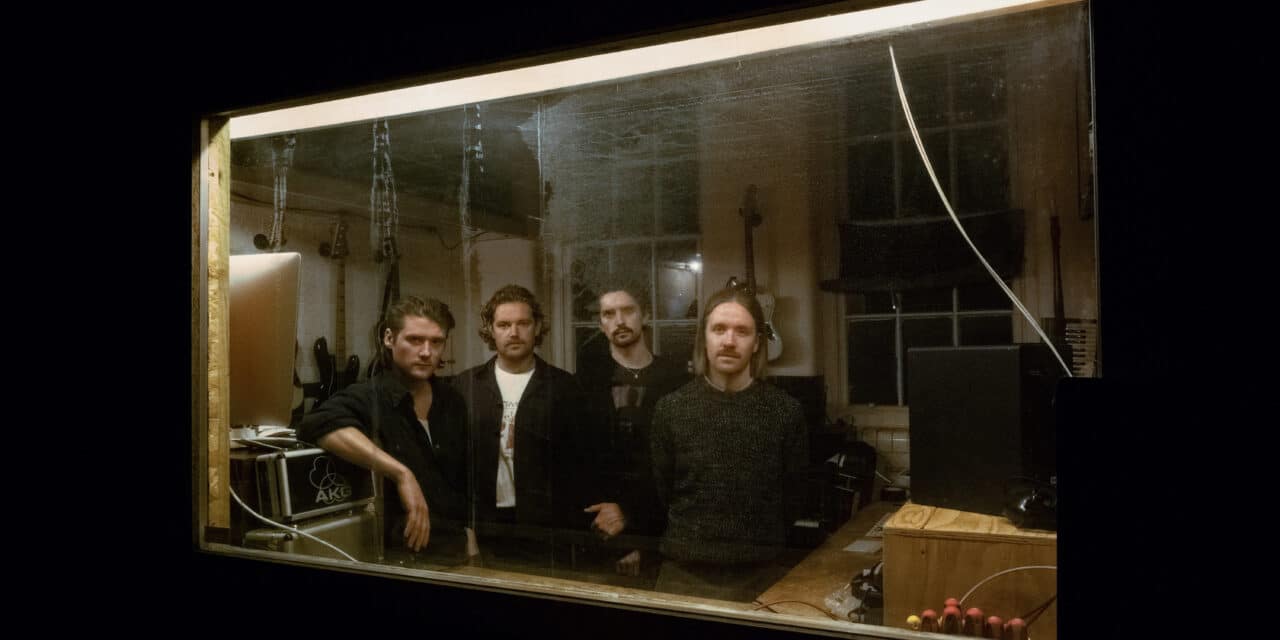
Three years after their acclaimed debut Snake Sideways, Nottingham’s Do Nothing return with Friend World, a darkly funny, strangely comforting exploration of loneliness, social awkwardness, and the peculiar people who exist on the fringes of everyday life. Frontman Chris Bailey opens up about finding inspiration in Andy Kaufman, the ethics of writing about other people’s tragedies, and why sometimes the saddest stories make the best company.
Somewhere at a party, there’s a person standing alone in the corner.
They’re not particularly interested in making small talk. They might be staring at their drink, avoiding eye contact, or wondering how long they need to stay before leaving becomes socially acceptable.
Most people will probably leave them alone.
Chris Bailey wants to talk to them.
“Once I find the depressed dude at the party, I want to talk to that guy the whole night,” the Do Nothing frontman admits.
It’s an observation that reveals a great deal about the Nottingham band’s second album, Friend World, a collection of songs populated by outsiders, social misfits, troubled creatives, and people whose internal lives seem fundamentally incompatible with the world around them.
But while the stories behind the record are frequently bleak, the music itself is anything but uniformly miserable.
Across the album, Do Nothing embrace everything from wiry post-punk and skittering electronic rhythms to warped funk, acoustic balladry, and moments of outright absurdity.
The result is a record that feels more playful, adventurous, and emotionally expansive than its subject matter might suggest.
It’s also an album born from an unexpected creative breakthrough.
After the release of their critically acclaimed 2023 debut Snake Sideways, Do Nothing spent months navigating the momentum surrounding the record, from BBC Radio 6 Music attention to UK shows, European festivals, and SXSW.
But the pressure associated with establishing themselves had begun to affect Bailey’s relationship with songwriting.
Snake Sideways had been described as a self-referential exploration of pressure, and its creation left the band with plenty to process.
Then, somewhat unexpectedly, things changed.
“As soon as that bit was done,” Bailey recalls, “I was able to write new music with no expectations.”
The second album, which might have seemed like the natural place for a band to experience creative paralysis, instead became an exercise in liberation.
And the idea that helped unlock it arrived during an evening involving a takeaway curry, beer, and a very unusual comedian.
Andy Kaufman, a Curry, and the Art of Being an Outsider
The origins of Friend World can be traced to an evening when Bailey found himself alone at home, eating curry and watching videos on the internet.
Among the things he encountered was footage of Andy Kaufman, the American comedian and performance artist whose work frequently blurred the distinction between genuine emotional behavior and elaborate performance.
One particular routine captured Bailey’s attention.
Kaufman appeared to experience an emotional breakdown onstage, only to transform the rhythm of his sobbing into a bongo performance.
The audience was left uncertain whether it had witnessed something deeply uncomfortable, something deliberately ridiculous, or both.
For Bailey, the appeal wasn’t simply Kaufman’s absurdity.
It was his willingness to appear fundamentally disconnected from the people watching him.
Kaufman built an entire artistic identity around making audiences uncertain whether they understood him.
And that uncertainty fascinated Bailey.
He became interested in the idea of the willing outsider: someone who doesn’t necessarily want to be understood, or who approaches human interaction according to a set of rules that nobody else seems to recognize.
From there, he began exploring the lives and work of other unusual figures.
Some were artists.
Others were writers, outsiders, or people whose experiences had left them isolated from the society around them.
What connected them wasn’t a shared biography.
It was a particular relationship with loneliness.
And Bailey found himself recognizing something of his own experience in theirs.
“I guess I just think that contentment doesn’t have the same level of depth that discomfort does,” he explains.
“Problems are more interesting than a lack of problems.”
It’s a deceptively simple explanation for the album’s fascination with troubled characters.
Stories need friction.
And for Bailey, the people who struggle to navigate ordinary life often reveal more about the human condition than those who appear entirely comfortable within it.
Welcome to Friend World. Nobody’s Particularly Happy Here.
The title Friend World sounds like something designed by a committee determined to make everyone feel welcome.
It’s cheerful, accessible, and almost aggressively optimistic.
Which is precisely why Bailey liked it.
The phrase originated with “This Friendly World,” a 1959 song by American singer Fabian that Andy Kaufman frequently performed at the end of his shows.
The song presents the world as an essentially joyful place, overflowing with friendship and happiness.
Bailey found the sentiment almost impossible to take seriously.
“‘This friendly, friendly world’ just struck me as an insane way to describe the planet,” he says.
The contrast between the song’s cheerful message and the complicated reality of human existence became the foundation for the album’s title.
But Friend World isn’t intended as a purely sarcastic statement.
There’s genuine affection beneath the irony.
For Bailey, sadness can offer a peculiar kind of comfort.
Not because suffering is desirable, but because recognizing it can make people feel less alone.
“Sadness can be a comforting thing, weird as that is,” he explains.
“It’s certainly not something to be stuffed down or avoided at all costs.”
That perspective is central to the record.
Rather than treating loneliness, anxiety, and social discomfort as problems that need to be immediately corrected, Do Nothing allow those experiences to exist on their own terms.
The characters inhabiting Friend World aren’t necessarily searching for a way to become more conventional.
Sometimes they’re simply trying to survive their circumstances.
And sometimes, there’s something strangely reassuring about discovering that other people have experienced the same kind of alienation.
In that sense, the album’s title becomes less cynical than it initially appears.
Maybe a friendly world isn’t one where everybody is happy.
Maybe it’s one where people are allowed to be unhappy without having to pretend otherwise.
The Uncomfortable Stories Behind the Songs
The characters and historical references scattered throughout Friend World come from remarkably different circumstances.
On “Smile,” Bailey draws inspiration from an online cartoonist who lived with schizophrenia and created a sprawling comic connected to his obsession with an extraordinarily difficult puzzle book.
The artist eventually died by suicide, leaving behind work that Bailey found both challenging and deeply affecting.
Elsewhere, “Yes” takes inspiration from Helen Palmer, the writer and editor who was married to Dr. Seuss and whose life included serious illness and marital betrayal.
“Stars” draws from Elizabeth Smart’s novel By Grand Central Station I Sat Down and Wept, an intensely emotional account of a destructive romantic relationship.
These aren’t obvious subjects for a post-punk album.
But Bailey is interested in the way their experiences illuminate larger questions about vulnerability, isolation, and the difficulty of connecting with others.
The common thread emerged gradually.
“I just watch and read stuff like anybody does, and the things that particularly stick out to me often end up in songs,” he explains.
“The people referenced on the album are pretty much all outsiders, but in different ways.”
The album wasn’t initially conceived as a carefully structured collection of stories about alienation.
Instead, Bailey began noticing a pattern in the subjects that attracted his attention.
By the time roughly half the music had been written, that pattern had become impossible to ignore.
But writing about real people who experienced profound suffering also raises an uncomfortable ethical question.
When does artistic inspiration become exploitation?
And how can a songwriter draw from someone else’s tragedy without reducing their entire existence to its darkest moments?
Bailey acknowledges the difficulty.
“I’ve thought about this quite a bit,” he says.
His response is rooted in identification rather than detached fascination.
He doesn’t see these figures as strange curiosities to be displayed for an audience.
He feels emotionally connected to them.
“I’m certainly not pointing out their situations and saying ‘oo isn’t that weird and interesting’; I feel very close to them.”
He also recognizes the danger of turning complicated lives into simplified narratives of suffering.
“The danger with taking inspiration from the personal tragedies of others is that you risk reducing the people involved to only their darkest moments.”
It’s a thoughtful distinction, and one that helps explain why Friend World contains so much humor.
These characters aren’t simply symbols of misery.
They’re people whose experiences can be absurd, contradictory, heartbreaking, and occasionally funny.
Just like everyone else.
Why Do Nothing Refuse to Take Misery Too Seriously
Humor has always been an essential part of Do Nothing’s identity.
Even at their most confrontational, the band’s songs tend to contain an element of theatrical exaggeration or surreal comedy.
On Friend World, that sensibility becomes even more pronounced.
“Dog 2” imagines two confused dogs attempting to understand the concept of a party.
“Paris Jesus” features Bailey singing about sending emails in his sleep.
Elsewhere, the album moves through moments of absurdity that sit alongside songs inspired by genuinely devastating human experiences.
For Bailey, the contrast isn’t particularly calculated.
It’s simply how he processes the world.
“I think that’s just how I respond to adversity,” he explains.
“It’s almost certainly a sign of some kind of unhealthy avoidance, but I don’t care.”
The self-awareness is typical of his songwriting.
Bailey isn’t interested in presenting humor as an enlightened coping strategy.
He simply knows that without it, the world becomes considerably harder to navigate.
“If I can’t look around sometimes and laugh at the absurdity of everything, then I’m in big trouble.”
It’s also what prevents Friend World from becoming emotionally exhausting.
The record doesn’t ask listeners to spend its entire duration contemplating tragedy.
Instead, it moves unpredictably between discomfort and amusement.
The jokes don’t erase the sadness.
They make room for it.
And sometimes, by refusing to treat a difficult subject with excessive solemnity, Bailey finds a more revealing way to approach it.
Making the Second Album Without the Second-Album Crisis
After the intense experience of creating and releasing Snake Sideways, Do Nothing might reasonably have approached their second album with some anxiety.
The debut had established a recognizable identity built around angular rhythms, theatrical vocal delivery, and a distinctive mixture of post-punk tension and surreal lyricism.
There was an obvious temptation to preserve that identity.
But Bailey found the process of writing Friend World unexpectedly liberating.
“I was expecting to feel trapped somehow,” he says.
Instead, the songs arrived naturally.
The band became more willing to explore unfamiliar sounds, indulge strange ideas, and abandon the expectation that every new track needed to resemble what had come before.
Bailey now views excessive concern about artistic identity as an obstacle.
“I try not to think about our ‘identity’ or whatever anymore,” he explains. “It’s just a tremendous drag.”
That freedom is audible in the album’s stylistic range.
“Misery” combines skittering beats with abrasive guitars.
“Act Natural” introduces phaser-treated clavinet funk.
“These People Want Blood” moves toward a more delicate, emotionally exposed form of songwriting.
Elsewhere, acoustic textures and synthesizers create unexpected shifts in atmosphere.
Rather than attempting to refine a single recognizable sound, Do Nothing allow the album to move wherever the songs demand.
And that unpredictability feels entirely consistent with the world Bailey has created.
After all, an album about people who don’t fit neatly into social categories probably shouldn’t fit neatly into musical ones either.
Back Home in Nottingham
The recording process reflected that newfound freedom.
Rather than returning to the large London studio used for Snake Sideways, Do Nothing chose to record Friend World at JT Soar, an independent venue and recording space located behind Sneinton Market in Nottingham.
The former fruit-and-vegetable warehouse has long been part of the city’s independent music community.
For the band, working there offered a more familiar and informal environment.
Guitarist Kasper’s home was just seconds away.
The group spent approximately three and a half weeks recording, occasionally having to accommodate the venue’s live events.
Production was handled by Louis Milburn of Folly Group, a band with whom Do Nothing had previously toured.
That existing relationship proved valuable.
Milburn understood the group’s instincts and was able to help them experiment without losing the qualities that made their music distinctive.
The arrangements became more adventurous, incorporating electronic details, unexpected rhythmic ideas, and sharp stylistic transitions.
But the recording process also retained a sense of spontaneity.
The band were no longer trying to capture the pressure of proving themselves.
They were enjoying the possibilities of making music together.
And for Bailey, that enjoyment became one of the defining emotional experiences of the album.
Despite the darkness of its subject matter, he describes Friend World as the most satisfying record the band have made.
It’s another contradiction.
A collection of sad songs created during an unusually happy creative period.
But perhaps that’s what makes the title feel so appropriate.
The Art of Acting Natural
The band’s growing interest in visual storytelling has also given their music another dimension.
The video for “Act Natural” embraces theatrical absurdity, allowing Do Nothing to construct a self-contained fictional world around the song.
But Bailey is careful not to suggest that the band are moving away from music toward an elaborate visual mythology.
He enjoys the possibilities of filmmaking, particularly the opportunity to collaborate with other creative people.
Yet he remains equally comfortable with the simplest possible representation of the group.
Four musicians playing their instruments.
“That’s what we are,” he says.
The visual element is an extension of the music, not a replacement for it.
And Bailey is especially interested in leaving enough room for listeners to construct their own interpretations.
“The important thing is that people can get lost in the music itself, and create their own imagined world around it.”
It’s an approach that mirrors the album’s relationship with its source material.
Bailey begins with real people, historical events, and strange cultural references.
But he doesn’t expect listeners to reconstruct every detail of those inspirations.
The songs are meant to develop lives of their own.
The listener’s imagination becomes part of the experience.
And the fictional world of Friend World remains open to whoever wants to enter it.
The Strange Comfort of Being Alone Together
There’s a line in “Smile” that captures the emotional ambiguity running through the album:
“How good it is to be alone at last.”
Depending on how it’s delivered, the sentiment could be liberating, defensive, sarcastic, or devastating.
For Bailey, even the word smile carries its own discomfort.
He admits that he struggles to smile on command without looking unnatural.
It’s a small confession, but one that speaks to the album’s broader fascination with social performance.
So much of ordinary life involves presenting emotions in ways other people recognize.
We smile when expected.
We participate in conversations.
We pretend to feel comfortable in situations that make us anxious.
And when those performances become difficult, we risk being perceived as strange, unfriendly, or socially inadequate.
The characters in Friend World often seem incapable of performing those expectations convincingly.
But Bailey doesn’t necessarily view that inability as a failure.
There’s something compelling about people whose discomfort remains visible.
They reveal the artificiality of social conventions that others have learned to navigate more smoothly.
And perhaps that honesty is what makes them interesting.
Still, Bailey is reluctant to present any single song as a definitive introduction to the album.
The tracks differ too much in style and mood for one to represent the entire experience.
His solution is characteristically practical.
Listen to the whole record.
Come to a show.
And, naturally, buy a T-shirt.
It’s a fittingly absurd ending to a conversation about loneliness, tragedy, and the ethics of artistic representation.
But it also captures something essential about Do Nothing.
They understand that life can be uncomfortable, unfair, and occasionally unbearable.
They just don’t see why that should prevent anyone from having a laugh.
Or making a very good record.
In Conversation With Do Nothing
“Smile” is such a simple command, but depending on the context it can feel comforting, performative, passive-aggressive or even slightly sinister. What did that word come to represent for you within the song?
There are a couple of references to smiling on the record, potentially because I don’t like smiling very much, haha. I find it difficult to smile on command without looking like a maniac.
Chris, you’ve said, “Once I find the depressed dude at the party, I want to talk to that guy the whole night.” There’s something about Do Nothing that consistently gravitates toward uncomfortable or slightly damaged characters. What makes those people more interesting to write about than the person confidently working the room?
I guess I just think that contentment doesn’t have the same level of depth that discomfort does. Problems are more interesting than a lack of problems. That’s why most books or films are about characters going through hardships of whatever kind, rather than them just being happy the whole time. Even that recent film ‘Perfect Days’ about the peaceful toilet attendant guy contains some jeopardy.
Friend World takes inspiration from some genuinely bleak human stories, but the record itself apparently isn’t relentlessly bleak. Is humor a way of surviving darker subject matter for you, or does comedy actually allow you to say darker things than seriousness would?
I think that’s just how I respond to adversity. It’s almost certainly a sign of some kind of unhealthy avoidance, but I don’t care. If I can’t look around sometimes and laugh at the absurdity of everything, then I’m in big trouble.
The title Friend World sounds almost artificially cheerful—like a place designed to promise connection. What kind of world is Friend World actually supposed to be, and who belongs there?
It comes from a song called “This Friendly World” by a guy called Fabian. Andy Kaufman often used to sing it at the end of his shows. Anyway, “this friendly, friendly world” just struck me as an insane way to describe the planet. (Although to be fair to him, the song came out in 1959). But still.
So yeah, it is artificially cheerful as an album title, but I do find comfort in a lot of the stuff on the record. Sadness can be a comforting thing, weird as that is. It’s certainly not something to be stuffed down / avoided at all costs, anyway.
Some of the references surrounding this record deal with people being trapped inside relationships, bodies, circumstances or even their own minds. Did you find a common emotional thread between these stories, even though they come from radically different lives and periods?
Not in necessarily in a purposeful way, but yeah. I just watch / read stuff like anybody does, and the things that particularly stick out to me often end up in songs. The people referenced on the album are pretty much all outsiders, but in different ways. Once about half of the music was written, that just felt like the core of the whole record.
“Act Natural” pushes the visual side of the band into something absurd and theatrical. Are you increasingly interested in building characters and fictional situations around the songs rather than presenting Do Nothing as four musicians simply performing them?
I think that’s just the fun thing about making music videos. It gives you the opportunity to create a little standalone piece of art, and to work with talented people. However, I’m also totally happy to be shown as four dudes playing music, cause that’s what we are. The visual side is something we enjoy working on, but the important thing is that people can get lost in the music itself, and create their own imagined world around it. That’s the thing I’m really after, and I love it a lot.
After Snake Sideways, did you feel any pressure to establish what a “Do Nothing record” was supposed to sound like, or did making Friend World involve deliberately dismantling some of the identity you’d already established?
Making the second one somehow ended up feeling pretty liberating. I was expecting to feel trapped somehow, but I ended up just writing songs easily and feeling happy with them. It was a much more natural process, and I think you can tell as a listener. I try not to think about our “identity” or whatever anymore, it’s just a tremendous drag.
There’s a danger when drawing from real tragedy that suffering becomes aesthetically interesting from a distance. How do you know when a story genuinely gives you something meaningful to explore versus when it simply isn’t yours to use?
This is very well put, and I’ve thought about this quite a bit. I think I’ve ended up feeling okay about it because I identify a lot with the people I draw from. I’m certainly not pointing out their situations and saying “oo isn’t that weird and interesting”; I feel very close to them.
The danger with taking inspiration from the personal tragedies of others is that you risk reducing the people involved to only their darkest moments. I try to be careful not to do that. Now that I think about it, a lot of the people I reference are/were creatives themselves, so I’d hope that they would understand.
If “Smile” is one doorway into Friend World, what does it reveal about the album—and what will listeners misunderstand about the record if they assume that one song tells them exactly what kind of place they’re entering?
Hmm. I’m not sure what it reveals about the album. The songs are all pretty different stylistically, so you could probably get a skewed idea of the record by listening to just one. This is why I encourage everybody to purchase and listen to the record in its entirety. And come to a show. And buy a T-shirt.
Do Nothing’s sophomore album Friend World follows their critically acclaimed 2023 debut Snake Sideways. Recorded at JT Soar in Nottingham and produced by Louis Milburn of Folly Group, the album explores outsider identities, human vulnerability, dark humor, and the strange comfort of sadness.