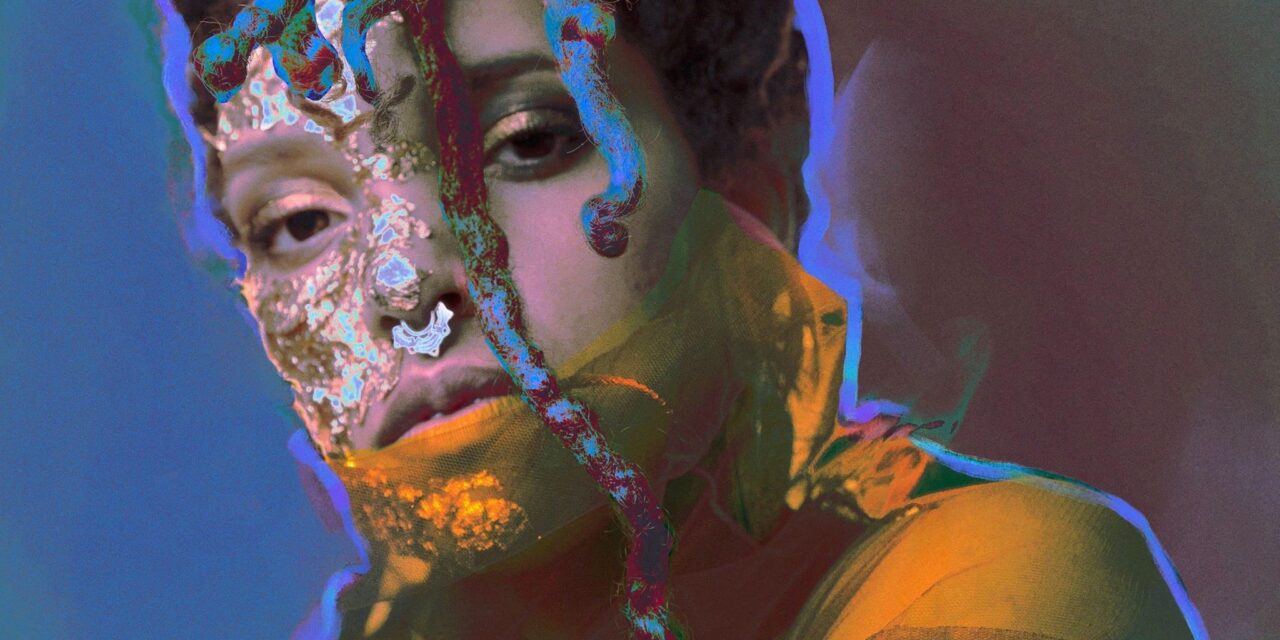
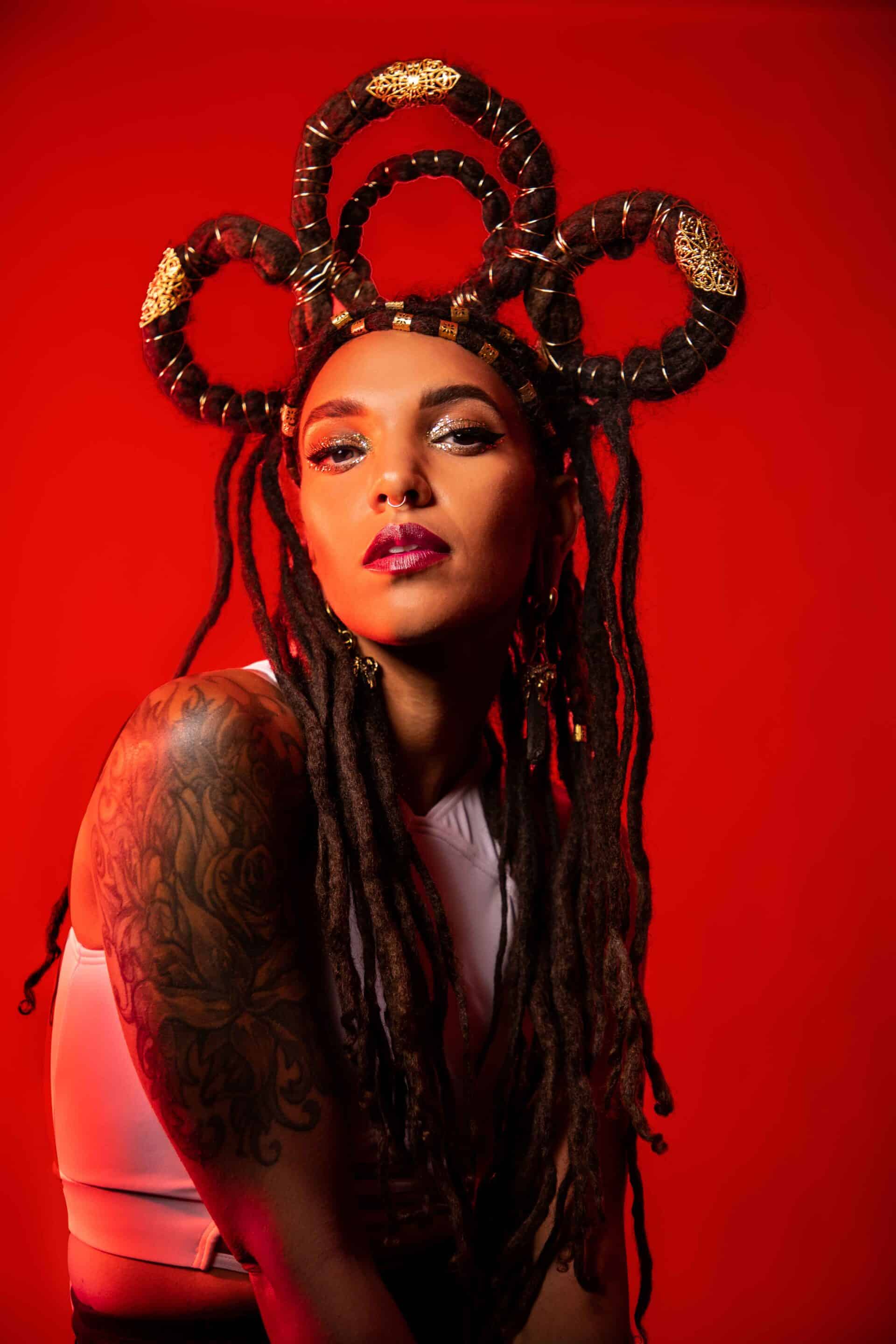
On her debut solo album Archetype, Austin-based alternative electronic artist Amakiya transforms loss, identity, and personal upheaval into a cinematic journey toward self-discovery. Drawing from Afrofuturism, trip-hop, R&B, and her background in interdisciplinary performance, she explores what it means to survive your darkest moments and discover that another version of yourself is waiting on the other side.
Sometimes becoming someone new requires watching everything familiar fall apart.
For Austin-based artist Amakiya, the process wasn’t metaphorical.
A difficult tour, major surgery, the death of her grandmother, and the sudden isolation of the pandemic arrived in devastating succession, leaving her confronting a version of herself she barely recognized.
The experience plunged her into a profound depression, a period she describes as feeling trapped inside a nightmare she couldn’t wake up from.
But somewhere within that darkness, music began to take on a different purpose.
It was no longer simply a form of expression or a way to connect with an audience.
It became a reason to keep going.
“Writing this song is how I processed my grief and alchemized some of the hardest moments of my life,” she explains of “Running In My Dreams,” the single that introduces her debut solo album, Archetype.
Released October 16 through Austin-based nonprofit label Spaceflight Records, the project marks a significant new chapter for the artist born Chantell Moody, who previously performed with The Digital Wild and Fort Never.
But Archetype is more than the beginning of a solo career.
It’s the culmination of a deeply personal transformation, one that has forced Amakiya to reconsider her relationship with grief, identity, creativity, and the possibilities of life after loss.
Across the record, alternative electronic production meets trip-hop, R&B, cinematic textures, and melodies that move between delicacy and explosive catharsis.
Each song represents a different archetype: a symbolic reflection of an aspect of herself that she has had to confront, understand, or reclaim.
Together, they form what Amakiya describes as her own hero’s journey.
A descent into the deepest recesses of the psyche.
A confrontation with the identities we construct to survive.
And, eventually, a return to the world with a clearer understanding of who we are.
“I didn’t just have an album,” she explains. “I had a much clearer picture of who I am underneath all the roles I’ve played just to survive.”
When Everything Falls Apart
In tarot, the Tower card represents sudden upheaval.
It’s associated with disruption, the collapse of familiar structures, and the uncomfortable revelation that something we believed to be permanent was never as stable as it seemed.
For Amakiya, the image became a way of understanding a period when several foundations of her life appeared to collapse simultaneously.
After a difficult tour and major surgery, she experienced the loss of her grandmother just as the world entered the isolation and uncertainty of the pandemic.
The accumulation of those experiences left her struggling with grief and depression.
“Running In My Dreams” emerged from that emotional landscape.
But rather than approaching the song as an attempt to escape her circumstances, Amakiya began using creativity as a way to confront them.
“Music became a tool I really had to lean on for myself, without thinking about how anyone else would experience it,” she explains.
For an artist accustomed to collaboration, performance, and communicating with audiences, that shift was profound.
She stopped worrying about whether the music would resonate with listeners.
She stopped treating creativity as something that needed to produce an externally meaningful result.
Instead, she made music because she needed it.
“It was something I did purely for myself, out of love, and out of the need to alchemize my pain.”
The word alchemy appears frequently in Amakiya’s artistic philosophy.
Traditionally associated with transformation, alchemy becomes a metaphor for converting emotional suffering into something that can sustain life rather than diminish it.
For Amakiya, that transformation wasn’t immediate.
Nor did it mean that grief suddenly disappeared.
It meant discovering that difficult experiences could become part of a new creative language.
And that creating something meaningful from pain could help restore a sense of purpose.
“These songs became the thing that gave me hope, gave my life meaning, and made me want to keep living,” she says.
It’s a striking admission, one that reveals just how closely the album’s creation was tied to her recovery.
Archetype wasn’t conceived simply as a collection of songs about healing.
The act of making it became part of the healing itself.
Grief Is Love With Nowhere Left to Go
Among the most moving ideas behind “Running In My Dreams” is Amakiya’s understanding of grief.
“Grief is love with nowhere left to go,” she says.
The phrase captures something difficult to articulate about losing someone.
Love doesn’t necessarily diminish when a person dies.
The emotional connection remains, but the familiar ways of expressing it are suddenly unavailable.
There are no more conversations, shared experiences, or ordinary moments together.
And yet the feeling persists.
For Amakiya, losing her grandmother transformed her understanding of time.
She became more conscious of how easily people take relationships for granted, assuming that the people they love will always be there.
“Everything is temporary,” she explains.
“We can’t pretend people are always going to be there, no matter how much we want to believe that.”
That awareness has changed the way she approaches everyday life.
Rather than treating meaningful moments as something to appreciate retrospectively, she tries to recognize their value while they’re happening.
The experience also deepened her empathy.
Having endured a period of profound personal darkness, Amakiya found herself more aware of the struggles other people might be carrying.
And the process of moving through grief gave her a renewed appreciation for ordinary existence.
The result is a philosophy of healing that doesn’t demand forgetting.
Instead, it allows love to change form.
“Love doesn’t stop when someone’s gone,” she says. “It just changes shape.”
In that sense, “Running In My Dreams” isn’t simply about loss.
It’s about learning to live with the presence of someone who is no longer physically there.
And discovering that grief, however painful, can also reveal the depth of our capacity to love.

Archetype: Meeting the Different Versions of Yourself
The conceptual foundation of Archetype comes from Amakiya’s fascination with the different identities and emotional patterns that exist within a single person.
Rather than imagining the self as something fixed and coherent, she approaches identity as a collection of experiences, contradictions, instincts, and roles.
Some of those roles are chosen.
Others develop as responses to difficult circumstances.
And some become so familiar that we stop recognizing them as roles at all.
For Amakiya, the archetype framework offered a way to examine those different parts of herself.
“Each song became its own mirror,” she explains.
The creative process became an opportunity to confront emotions that might otherwise have remained unexamined.
But she didn’t begin by assigning rigid psychological categories to every composition.
Instead, she approached songwriting intuitively, allowing each piece to reveal what needed to emerge.
“A big part of the process was simply allowing myself to be a channel,” she says.
That willingness to relinquish control became central to the album’s emotional honesty.
Rather than forcing songs to communicate predetermined ideas, Amakiya allowed the music to guide her toward experiences she needed to process.
The album’s journey moves symbolically from the spiritual realm into the complications of earthly existence, descending into the psyche before returning toward wholeness and self-expression.
It’s a narrative structure familiar from mythology, spiritual traditions, and stories of personal transformation.
But for Amakiya, the hero’s journey isn’t about defeating an external enemy.
It’s about confronting the parts of ourselves that we have learned to hide, suppress, or misunderstand.
And recognizing that wholeness doesn’t necessarily mean eliminating contradiction.
Sometimes it means accepting that multiple versions of ourselves can coexist.
The Alternative Black Girl Who Refused to Fit Into One Box
Long before she began developing Archetype, Amakiya was learning to navigate the contradictions of identity through music.
Growing up in Des Moines, Iowa, she moved between subcultures that weren’t always expected to coexist.
She listened to Korn, underground trip-hop, folk music, and artists such as Kimya Dawson and Endless Blue.
She wore a mohawk, stretched ears, and combat boots.
And she describes herself as an alternative Black girl who felt like a “glitch in the matrix.”
It’s a memorable image.
But beneath its humor is a familiar experience for anyone whose interests or appearance have challenged the expectations placed upon them.
Amakiya didn’t see herself reflected in one particular scene.
Instead, she found fragments of herself across several.
Folk music offered a language of storytelling.
Trip-hop provided emotional atmosphere and vulnerability.
Heavier music created space for anger and intensity.
Hip-hop culture introduced her to new forms of movement, rhythm, and creative expression.
As a teenager, she participated in poetry slams and immersed herself in local hip-hop and breakdancing communities, learning from the dancers and graffiti artists around her.
Those experiences became the foundation of an artistic identity that refuses to separate music from movement, visual culture, or personal expression.
“Being an outsider absolutely gave me more freedom in developing my own artistic language,” she explains.
Rather than choosing one genre or identity, she began assembling a vocabulary from everything that resonated with her.
And what initially felt like social displacement eventually became a source of creative possibility.
“Since I didn’t feel like I fit in a lot of the time, I wanted to create a space for people who felt the same way.”
That desire remains central to her work.
“My music is for people who always felt like a bit of a misfit.”
Afrofuturism as a Way of Reimagining What Is Possible
Amakiya’s artistic world also draws heavily from Afrofuturism, a cultural and philosophical framework that explores Black identity, imagination, technology, and alternative visions of the future.
But for her, Afrofuturism isn’t simply an aesthetic.
It isn’t limited to futuristic imagery, electronic soundscapes, or science-fiction references.
It’s a way of challenging the narratives that determine who people are allowed to become.
“Afrofuturism to me means imagining futures where Black people are living and thriving, in a world that’s more just, and in harmony with our creativity and with nature,” she explains.
That vision connects personal liberation with collective possibility.
For Amakiya, imagining a different future requires questioning the limitations imposed by social expectations, historical circumstances, and internalized beliefs.
It’s also a spiritual practice.
A way of claiming space for joy.
A way of insisting that identity isn’t confined to what the past has made possible.
And a way of envisioning relationships between humanity, creativity, and the natural world that are more compassionate and sustainable.
This philosophy runs through Archetype.
The album’s exploration of personal transformation becomes part of a larger question about freedom.
What happens when we stop allowing inherited narratives to define the limits of our lives?
And what might become possible if we begin imagining ourselves differently?
For Amakiya, those questions are inseparable from the act of creating art.
Making Music With the Body, Not Just the Mind
Sonically, Archetype occupies a space between alternative electronic music, trip-hop, R&B, and cinematic composition.
Delicate melodies expand into explosive passages.
Electronic rhythms create moments of physical release.
And atmospheric production allows emotional tension to develop without always resolving immediately.
Much of that dynamic comes from Amakiya’s background as a dancer.
She doesn’t approach music exclusively through melody, harmony, or lyrical content.
She experiences it physically.
“As a dancer, I’m always deeply connected to how music moves through me,” she explains.
That connection influences how she determines whether a piece of music feels right.
Rather than forcing herself to sing over a track, she looks for rhythms that naturally provoke movement.
“I only want to sing over songs that move my body without me having to think about it.”
It’s an instinctive approach to songwriting, one that places physical sensation alongside emotional expression.
The contrast between restraint and intensity emerges through that relationship.
Sometimes a particular emotion requires space.
Sometimes it demands release.
And sometimes the rhythm itself determines how the feeling should be expressed.
Amakiya describes allowing her body to guide those decisions.
The result is music that treats emotional transformation as something that can be experienced physically, not merely understood intellectually.
And that connection between sound and movement has been developing throughout her career.
A Creative Partnership Built on Trust
A central figure in the creation of Archetype is Austin-based producer and composer Croom.
The two have collaborated for nearly a decade, developing a creative relationship shaped by shared interests in film, poetry, futuristic imagery, and electronic music.
Croom’s work spans recorded music and screen composition, with credits connected to From Dusk Till Dawn: The Series, ESPN, UFC, Realm of Shadows, and Professor Kimmer’s Initiation.
His production approach combines cinematic influences with analog and digital synthesizers and beat-driven electronic arrangements.
For Archetype, that background provided a sonic foundation for Amakiya’s emotional storytelling.
But the collaboration’s most important quality may be the trust that has developed between them.
“Croom has given me a lot of confidence,” she explains.
Rather than attempting to control her creative instincts, he has encouraged her to explore ideas even when they lead in unexpected directions.
That openness has allowed them to experiment across different genres and musical approaches.
Some ideas work.
Others don’t.
But the partnership is grounded in a shared willingness to follow what genuinely excites them.
“He’s really just been watering and nurturing my own expression,” Amakiya says.
The relationship has also helped her become more comfortable creating vulnerable work with another person.
Trust makes it possible to explore personal material without feeling the need to protect or explain every instinct.
And after years of collaboration, Archetype represents the point where their shared interests have converged most completely.
For Amakiya, the album is deeply personal.
But it’s also the product of a creative relationship that has made that personal expression possible.
Beyond the Stage: Building Immersive Worlds
Before establishing her solo identity, Amakiya performed with The Digital Wild and Fort Never, developing her musical practice through collaborative projects.
Her background also includes interdisciplinary performance.
After moving from Des Moines to Austin, she became involved with Crash Alchemy, a collective combining dance, circus, music, fine art, and technology.
She performed the lead role in Gratitud Infinita, directed by Agent Red.
The same director later created Praxis, a rock opera built around music by Fort Never.
Those experiences helped shape Amakiya’s understanding of what a live performance could become.
A concert, in her view, doesn’t have to be limited to musicians performing a sequence of songs.
It can be an immersive environment.
A place where sound, movement, visual storytelling, and technology work together to create a more expansive emotional experience.
“I see my concerts as immersive environments where people can experience their own emotional transformations,” she explains.
That ambition is particularly fitting for Archetype.
An album built around symbolic identities and psychological transformation naturally invites a visual and physical dimension.
But Amakiya is realistic about the resources required to realize that vision.
For now, her live project remains relatively stripped back.
As it develops, she hopes to incorporate more performance elements.
The long-term goal is to create something that extends beyond the traditional boundaries of a concert.
A world audiences can enter.
And perhaps leave feeling slightly different from when they arrived.
Music for People Who Have Never Felt Like They Belonged
For all the elaborate ideas surrounding Archetype, Amakiya’s motivation for making music remains remarkably simple.
She wants people to feel less alone.
Growing up, music provided a sense of companionship when she struggled to find belonging elsewhere.
It introduced her to artists who seemed to understand emotions she couldn’t easily articulate.
And it gave her permission to exist outside conventional expectations.
“Music was my best friend growing up,” she recalls.
That experience inspired her to begin creating songs of her own.
She wondered whether she could offer someone else the same comfort that music had given her.
And despite the changes in her life and career, that motivation hasn’t disappeared.
Today, she sees music as a way of creating connections across experiences that might initially seem unrelated.
The digital world may be fragmented, but a song can still create a moment of shared recognition.
“There’s something about a song that cuts through the noise and reminds people they’re not alone,” she says.
It’s a belief that connects her early experiences as an outsider with the emotional purpose of Archetype.
The album may document her own journey through grief and transformation.
But she hopes its significance won’t be limited to her personal story.
If someone recognizes their own experience within the music, the record becomes something larger.
A form of companionship.
A reminder that survival is possible.
And perhaps an invitation to imagine a different future.
Healing Isn’t a Destination
By the time Archetype reaches its conclusion, Amakiya has moved through an extensive emotional landscape.
Loss.
Isolation.
Identity.
Anger.
Spiritual reflection.
And the difficult process of rebuilding a relationship with herself.
But she doesn’t present healing as a final achievement.
There is no moment when every contradiction disappears and life becomes permanently peaceful.
Instead, she has come to understand healing as an ongoing practice.
“I don’t think healing is really a destination,” she explains.
“It’s more about finding a bit of peace and joy amongst the chaos of being alive in this world.”
That perspective also expands her understanding of what healing requires.
It’s not simply about individual emotional well-being.
For Amakiya, genuine transformation involves empathy, creativity, compassion, and a sense of responsibility toward other people and the natural world.
She speaks about caring for animals, protecting nature, and recognizing the importance of collective well-being.
Healing, in that sense, becomes inseparable from the way we choose to live.
It’s not merely something we do for ourselves.
It’s something that shapes our relationship with everything around us.
And perhaps that’s the most important realization at the heart of Archetype.
The album begins with an artist struggling to survive an intensely personal period of darkness.
But it ends with a broader understanding of connection.
The relationship between pain and empathy.
Between personal freedom and collective responsibility.
Between the person we once were and the person we’re still becoming.
Amakiya hasn’t emerged from her experiences with the belief that life will never become difficult again.
She’s emerged with a deeper appreciation for its possibilities.
And with a clearer understanding of why she wants to keep creating.
For someone who once described herself as a glitch in the matrix, that transformation feels particularly meaningful.
She no longer needs to find a place within someone else’s system.
She’s building a universe of her own.
In Conversation With Amakiya
Your debut solo album Archetype is described as a journey through different aspects of your identity, with each song representing a part of yourself you’ve had to confront. What inspired you to approach the album through the concept of archetypes, and did the process reveal aspects of your personality or emotional life that you hadn’t fully understood before?
This album was about understanding my own inner world, and staying open to a transformation that felt deeply healing. The archetype framework gave me a way to actually look at the different parts of myself instead of just moving through them on autopilot, each song became its own mirror.
A big part of the process was simply allowing myself to be a channel, creatively showing up for each song and letting whatever needed to come through me do exactly that. Whatever I needed to process found its way out through the music. By the end, I didn’t just have an album, I had a much clearer picture of who I am underneath all the roles I’ve played just to survive.
“Running in My Dreams” emerged during an extraordinarily difficult period marked by grief, surgery, and personal upheaval. You’ve described that experience as a Tower card moment in your life. How did those events fundamentally change your relationship with creativity, and was there a moment when making music began to feel less like an escape from pain and more like a way of understanding it?
Those events changed my relationship with creativity because music became a tool I really had to lean on for myself, without thinking about how anyone else would experience it. It was something I did purely for myself, out of love, and out of the need to alchemize my pain.
Making music during that time was a way for me to process what I was going through, and to do something that felt genuinely life affirming. I wasn’t always sure what to hold onto for hope, and these songs became the thing that gave me hope, gave my life meaning, and made me want to keep living.
It also helped me understand that these are things other people go through too. It broadened my empathy for other people’s experiences, going through hard things in general. I think it created a lot of depth in my life, but also a lot of genuine gratitude and appreciation for getting through hard things, for making it to the other side. After being in that kind of darkness and coming out of it, I’m a lot more appreciative, and a lot more present with what is.
You’ve described grief as love with nowhere left to go, a particularly powerful way of understanding loss. How has losing your grandmother changed your understanding of love, memory, and the relationships that continue shaping us even after someone is gone?
Losing my grandmother taught me to appreciate every moment as much as I can, and to really cherish the time I have with the people I love. Everything is temporary, and we can’t pretend people are always going to be there, no matter how much we want to believe that.
It was a reminder to stop taking those moments for granted. Love doesn’t stop when someone’s gone, it just changes shape, but you only get so much time to experience it with someone while they’re physically here, so I try to hold onto that now.
Your work draws heavily on Afrofuturism, spirituality, and the idea of transforming emotional pain into something empowering. What does Afrofuturism mean to you beyond its visual and musical aesthetics, and how does imagining alternative futures help you challenge the limitations that society or personal history might impose on your identity?
Afrofuturism to me means imagining futures where Black people are living and thriving, in a world that’s more just, and in harmony with our creativity and with nature. It gives me permission to challenge the stories I’ve been told about who I’m allowed to be, it’s not just an aesthetic, it’s a spiritual practice, a way of claiming space for joy and possibility.
Growing up in Des Moines, you described yourself as an alternative Black girl who felt like a “glitch in the matrix,” moving between metal, underground hip-hop, trip-hop, and folk music. How did navigating those different subcultures influence your sense of belonging, and do you think being an outsider ultimately gave you greater freedom to develop your own artistic language?
Being an outsider absolutely gave me more freedom in developing my own artistic language. I got to pull from a lot of different influences, the storytelling of folk music, the haunting, emotionally deep vocals of trip-hop, and heavier music that let me fully express rage and anger.
Being able to integrate all of those favorite parts of different styles let me reflect who I actually am, a complex, sensitive, emotional, deep-feeling person. It really allowed me to see the many different sides of myself, instead of having to pick just one box to fit into.
Since I didn’t feel like I fit in a lot of the time, I wanted to create a space for people who felt the same way. My music is for people who always felt like a bit of a misfit.
Your music blends alternative electronic production, trip-hop, R&B, and cinematic soundscapes, often moving between delicate melodies and explosive moments of release. How do you translate complex emotional experiences into sonic textures, and what role does the contrast between restraint and intensity play in the storytelling of Archetype?
I show up for my creative practice by letting whatever emotion needs to be processed come through me. I let my body guide the restraint, holding back when that feels somatically right, and the intensity tends to come out depending on the beat I’m working with, something about certain rhythms just pulls that release out of me naturally.
As a dancer, I’m always deeply connected to how music moves through me, and I’m constantly feeling out what kind of movement a song invokes. I only want to sing over songs that move my body without me having to think about it, that’s usually how I know something’s right.
You’ve collaborated with producer Croom for nearly a decade, and Archetype represents a culmination of your shared interests in film, poetry, technology, and futuristic imagery. How has your creative relationship evolved over the years, and what does he understand about your artistic instincts that allows you to explore such personal material together?
Our creative relationship has evolved in the sense that I’ve gotten so much more comfortable creating with someone else. Croom has given me a lot of confidence, he’s always been encouraging of pretty much all of my ideas, and he’s willing to let me go down certain rabbit holes without trying to control the sound too much. He’s really just been watering and nurturing my own expression.
We’ve explored a lot of different genres together, some things work, some don’t, but we keep allowing ourselves to chase what we’re genuinely excited about. He’s also done so much behind the scenes, countless hours most people will never see. Working with him has been a creative dream come true, expansive in ways I didn’t even know were possible. We work incredibly well together, and we’re both hard workers who follow through on what we say we’re going to do.
I think he understands that he can trust me, and that trust goes both ways. That’s probably what makes it possible for us to go to such personal, vulnerable places in the music together. I’m just so grateful we found each other.
Before launching your solo career, you worked with The Digital Wild and Fort Never and participated in interdisciplinary productions combining dance, circus, music, and technology. How have those experiences shaped the way you envision Amakiya as a live performer, and do you see your concerts as musical performances or as immersive environments where audiences can experience their own emotional transformations?
Each project I’ve been part of has had a huge impact on me, and I see my concerts as immersive environments where people can experience their own emotional transformations, not just musical performances, though they’re that too. Working across dance, circus, and technology taught me a live show can hold so much more than songs performed in a row.
Right now things are pretty bare bones as the project grows and gets more support, but I envision it evolving into something with a lot more performance elements woven in over time.
You’ve said that music was your best friend growing up and that you began writing because you wanted other people to feel less alone. How has your understanding of connection changed as you’ve grown older, and do you think the relationship between an artist and their audience can create a genuine sense of community in an increasingly fragmented digital world?
As I’ve gotten older, I’ve come to appreciate connecting with people more and more. I love hearing people’s stories, and I appreciate the common threads that connect us all together, no matter how different our lives might look on the surface.
I do think music is something that fights through all that fragmentation and actually connects us. Even in a digital world that can feel so scattered, there’s something about a song that cuts through the noise and reminds people they’re not alone.
Archetype represents both your debut as a solo artist and what you’ve described as your personal hero’s journey, moving through darkness toward wholeness and self-expression. Now that you’ve transformed these experiences into a complete body of work, what does healing mean to you today, and have you come to see it as reaching a destination or learning to live with the contradictions that make us human?
I don’t think healing is really a destination. It’s more about finding a bit of peace and joy amongst the chaos of being alive in this world. There are a lot of contradictions I’m sure we all hold.
But tapping into creativity, having empathy, and looking at things through the eyes of love, that’s what feels healing to me. It’s caring about each other, about nature and animals, about our collective well-being rather than just the individual. It’s standing up and fighting for what’s right in this world, and truly wanting the best for one another.
Discover Amakiya
Archetype, the debut solo album by Amakiya, was released October 16, 2026, via Spaceflight Records. The album was produced by Croom and includes the single “Running In My Dreams.”
Listen and follow: Bandcamp | Spotify | Instagram | YouTube | Patreon
Photography: Ava Bergen.