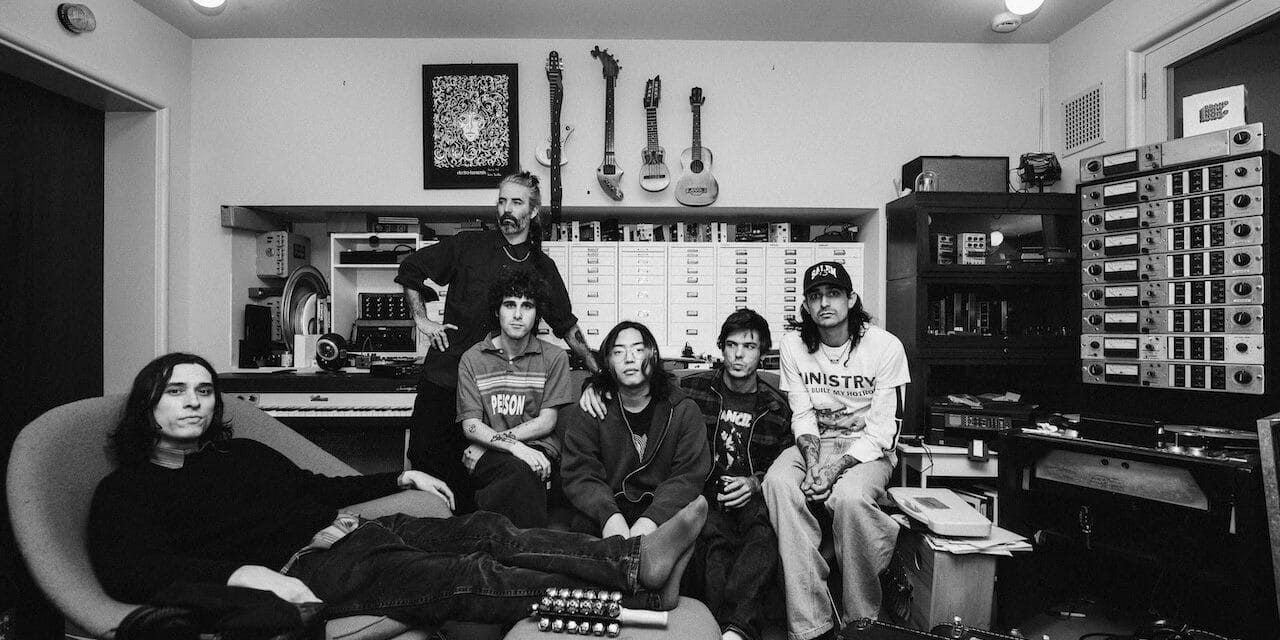
Born out of a Brooklyn squat and shaped by the city’s underground music scene, New York six-piece Gnarcissists return with Paradise Aquarium, a surreal and emotionally charged EP exploring illness, disconnection, intimacy, and the unsettling experience of becoming a stranger in your own life. Recorded at Sean Lennon’s home studio and produced by Ben Romans Hopcraft, the project finds the band confronting personal trauma and a changing city through abrasive guitars, dark humor, and an unexpectedly vulnerable perspective.
There’s something particularly unsettling about the moment when the things that once made your life feel familiar suddenly become unrecognizable.
The city you thought you knew begins to change. Relationships that once provided comfort become sources of uncertainty. Even your own body, the one thing you might expect to remain constant, can begin to feel like something foreign.
For New York band Gnarcissists, that experience of alienation lies at the center of their latest EP, Paradise Aquarium, out now via Killphonic Distro.
Across the project, the six-piece transforms personal upheaval into a collection of songs that move between punk aggression, surreal imagery, dark humor, and moments of startling emotional vulnerability.
Its accompanying single, “Space Ghost,” offers a particularly revealing introduction to the record’s psychological landscape.
Described by the band as an exploration of becoming an alien in your own life, the track captures the disorienting experience of watching relationships and familiar environments collapse while feeling powerless to intervene.
“Wanted ‘Space Ghost’ to feel like finding some fucked up home video of someone’s failing relationship at 3 in the morning that you weren’t supposed to find,” the band explains.
“We like aliens and tried to bury it beneath some tongue-in-cheek imagery, but underneath it is really about feeling like an alien in your own life—watching things fail from the outside and trying to figure out where you fit.”
It’s a description that captures the strange emotional territory Gnarcissists inhabit.
Their music can be abrasive, absurd, confrontational, and deliberately uncomfortable.
But beneath those qualities lies a remarkably human concern: the desire to feel understood, connected, and cared for.
With Paradise Aquarium, that tension becomes impossible to ignore.
From a Brooklyn Squat to New York’s Underground
Gnarcissists’ origins are deeply connected to the independent music culture that has long defined New York’s creative identity.
The band’s story began in a Brooklyn squat during the late 2010s, an environment that reflects the improvisational, communal, and frequently unpredictable nature of the city’s underground scene.
Featuring members associated with Malice K, Pretty Sick, Navy Gangs, and Taraneh, the six-piece emerged from a network of musicians whose creative identities developed outside conventional industry structures.
That background is important to understanding the band’s sound.
Rather than approaching music through a rigid stylistic framework, Gnarcissists have built their identity around experimentation, spontaneity, and the unpredictable chemistry of live performance.
Over the years, they have shared stages with acts including Fcukers, The Voidz, OSEES, Gibby Haynes, Sufbort, and Viagra Boys, placing them within a broader community of artists who challenge the boundaries between punk, alternative rock, noise, and experimental music.
Those connections also reflect the cultural environment from which the band emerged.
New York’s underground has historically thrived on the exchange of ideas between musicians, visual artists, performers, and unconventional creative spaces.
For bands like Gnarcissists, that environment provides more than an audience.
It offers a community in which experimentation can become a shared language.
But the city that helped shape the group has also become one of the sources of instability explored throughout Paradise Aquarium.
As neighborhoods change, relationships evolve, and the spaces that sustain independent culture become increasingly precarious, the idea of home can begin to feel less certain.
That uncertainty runs throughout the record.
When the Body Becomes Unfamiliar
The creation of Paradise Aquarium was marked by a particularly difficult period for the band.
Lead singer Matthew Orr was diagnosed with a connective tissue disorder after a near-fatal accident that resulted in hospitalization.
The experience introduced a profoundly personal dimension to the group’s songwriting.
Illness can alter the relationship between identity and the physical body in ways that are difficult to articulate.
Something ordinarily experienced as an extension of the self can suddenly become unpredictable, painful, or frightening.
The body, once familiar, begins to feel like an unstable environment.
For Orr and the band, that experience became part of the emotional foundation of Paradise Aquarium.
The record’s recurring imagery of bodily horror and alienation reflects the unsettling realization that even our most intimate sense of belonging can be disrupted.
But the circumstances surrounding the album also changed the band’s relationships with one another.
Rather than allowing the experience to fracture the group, the members developed stronger personal connections during the difficult period.
That shift influenced their creative process.
Previously, Gnarcissists had often relied on improvisation and writing material during live performances.
For Paradise Aquarium, they moved toward a more controlled approach, developing songs primarily within the studio.
The change suggests a different relationship with their material.
Where spontaneous live writing allows ideas to emerge through immediate collective energy, studio-based composition provides opportunities to examine, reshape, and refine them.
For a project dealing with illness, loss, and emotional disorientation, that additional space may have been particularly important.
The resulting EP feels rooted in the chaos of the band’s experiences while reflecting a more deliberate approach to translating them into music.
The Strange Desire to Be Seen
At its emotional core, Paradise Aquarium explores a deceptively simple human need.
The desire to be loved.
But rather than presenting intimacy as something uncomplicated or inherently comforting, Gnarcissists examine the ways it can become unsettling.
Across the EP, affection and alienation frequently coexist.
A familiar gesture can evoke the memory of a relationship that no longer exists.
An ordinary domestic interaction can become emotionally overwhelming.
The act of being watched can feel simultaneously validating and invasive.
And the desire to be understood can require exposing parts of ourselves that we would rather keep hidden.
The record moves between breakup songs, surreal imagery, bodily horror, and moments of almost absurd humor.
Rather than following a single narrative, the songs reflect the fragmented emotional logic of someone trying to understand what remains after familiar relationships and environments have changed.
One of the project’s most compelling ideas is that loss isn’t always experienced through dramatic moments.
Sometimes the things we miss most are extraordinarily ordinary.
A cup of tea with someone we used to love.
The presence of another person in a room.
The comfort of sharing an uneventful afternoon.
Those seemingly insignificant moments can become emotionally enormous once they’re gone.
It’s a perspective that gives Paradise Aquarium a surprising tenderness beneath its abrasive exterior.
The record isn’t simply about losing love.
It’s about losing the small, everyday structures through which love becomes recognizable.
“Space Ghost”: Watching Your Own Life From the Outside
If Paradise Aquarium explores the instability of identity and intimacy, “Space Ghost” offers one of its clearest expressions.
The song’s central metaphor is that of alienation taken almost literally.
To become an alien in your own life is to experience familiar relationships and environments as though observing them from somewhere else.
You recognize the people and places around you, but your connection to them has changed.
The world continues moving.
You remain present.
Yet something essential feels missing.
Gnarcissists translate that experience into a deliberately surreal visual and musical framework.
The band’s description of the song’s video is particularly evocative: a disturbing home recording discovered in the middle of the night, documenting the breakdown of a relationship.
The image suggests intimacy without permission.
A private moment that has somehow become visible to an outsider.
But it also reflects the experience of looking back at your own life and struggling to recognize the person you once were.
The alien imagery adds another layer of absurdity.
It’s an intentionally strange way of approaching a deeply familiar emotional experience.
And that combination of humor and discomfort is central to Gnarcissists’ creative identity.
Rather than explaining alienation through straightforward confession, the band allows it to emerge through imagery that feels unsettling, fragmented, and occasionally ridiculous.
The result is a song that treats emotional disconnection as something both tragic and absurd.
Because sometimes the experience of losing your sense of belonging is so strange that conventional language doesn’t seem sufficient to describe it.
Recording at Sean Lennon’s Home Studio
The production of Paradise Aquarium represents another important development in Gnarcissists’ creative evolution.
The EP was recorded at Sean Lennon’s home studio and produced by Ben Romans Hopcraft.
For a band whose origins are rooted in spontaneous performance and underground experimentation, the studio environment offered an opportunity to approach songwriting with greater structure.
That doesn’t necessarily mean abandoning the unpredictability that defines their music.
Instead, it suggests a willingness to explore how controlled production can coexist with emotional instability.
The record’s themes lend themselves particularly well to that tension.
Illness, grief, and changing relationships often involve experiences that feel impossible to control.
Yet the act of creating music requires making decisions, shaping arrangements, and finding ways to communicate those experiences to others.
The studio becomes a place where disorder can be translated into form.
For Gnarcissists, the process also reflects the growing importance of collaboration within the band.
The difficulties surrounding Orr’s health strengthened the group’s relationships, and that renewed sense of connection became part of the record’s creative foundation.
In this context, Paradise Aquarium is not simply the product of individual trauma.
It’s the result of a collective attempt to process experiences that affected the entire group.
Finding Humor in the Horrific
One of the more distinctive qualities of Paradise Aquarium is its willingness to place absurd humor alongside genuinely disturbing themes.
Bodily horror, emotional isolation, and the breakdown of relationships might suggest a relentlessly bleak record.
But Gnarcissists refuse to treat those subjects with uninterrupted seriousness.
Instead, surreal imagery and tongue-in-cheek references create moments of distance from the emotional intensity.
That contrast is particularly apparent in “Space Ghost.”
The band’s fascination with aliens becomes a vehicle for exploring disconnection, allowing a painful experience to emerge through an almost comically exaggerated metaphor.
But the humor doesn’t necessarily make the subject less serious.
In some ways, it makes the emotional contradictions more recognizable.
People frequently respond to uncomfortable experiences through irony, exaggeration, and absurdity.
Humor can become a way of acknowledging something painful without having to confront it directly.
Gnarcissists seem interested in that psychological space.
Their music allows conflicting emotional responses to coexist.
A listener might laugh at an image before recognizing the vulnerability underneath it.
Or feel unsettled by a passage that initially appears playful.
That instability mirrors the record’s broader exploration of identity.
Nothing remains entirely fixed.
The familiar becomes strange.
The comforting becomes threatening.
And the horrific occasionally becomes funny.
A Changing City and the Search for Home
Although Paradise Aquarium is rooted in intensely personal experiences, the record also reflects the broader environment in which Gnarcissists have developed.
New York has long attracted artists seeking creative freedom, community, and the possibility of building lives outside conventional expectations.
But the city is also defined by constant transformation.
Neighborhoods change.
Communities disperse.
Venues disappear.
And the places that once represented stability can gradually become unfamiliar.
For a band whose origins trace back to a Brooklyn squat, those changes carry particular significance.
The group’s early identity was shaped by an environment in which music and community were closely intertwined.
As the city evolves, maintaining those connections can become increasingly difficult.
The resulting sense of displacement parallels the emotional experiences explored throughout the EP.
Losing a relationship, confronting illness, and watching a familiar neighborhood transform may appear to be very different experiences.
But each can challenge a person’s understanding of where they belong.
In that sense, Paradise Aquarium is as much about the instability of home as it is about individual loss.
It asks what happens when the people, places, and even physical body that once provided a sense of identity can no longer be relied upon.
And rather than offering an easy resolution, the band remains inside that uncertainty.
The Emotional Logic of ‘Paradise Aquarium’
Perhaps the most interesting aspect of Paradise Aquarium is its refusal to organize difficult experiences into a neat narrative.
There is no single story that explains the record.
Instead, the EP moves through a series of emotional states that reflect the fragmented nature of grief, illness, and personal transformation.
One moment may evoke the tenderness of an ordinary memory.
Another introduces the unsettling experience of being observed.
Elsewhere, bodily horror transforms physical vulnerability into surreal imagery.
The transitions aren’t necessarily logical in a conventional storytelling sense.
But emotionally, they belong to the same world.
Each reflects a person trying to understand what it means to feel connected when the foundations of that connection have become unstable.
The title itself suggests an intriguing contradiction.
An aquarium is a contained environment, a place where life exists behind glass.
It allows observation but also creates separation.
Paradise, meanwhile, implies comfort, beauty, and an ideal state of existence.
Placed together, the words evoke a world that might appear inviting from the outside while remaining strangely isolated within.
Whether or not the band intended that precise interpretation, the tension feels appropriate for a record concerned with visibility, intimacy, and disconnection.
The desire to be seen runs throughout the project.
But being seen isn’t always the same as being understood.
And sometimes the longing for recognition can expose the very vulnerabilities we are most afraid to reveal.
When Everything Falls Apart, What’s Left?
For Gnarcissists, Paradise Aquarium represents more than a new collection of songs.
It’s a document of a period in which the band’s personal and creative lives were profoundly disrupted.
Illness, loss, changing relationships, and the instability of New York became part of a shared experience that ultimately reshaped their approach to music.
The result is an EP that feels simultaneously abrasive and intimate.
Its surreal imagery and moments of dark humor provide a distinctive creative language, but the emotions underneath remain recognizable.
The desire for affection.
The fear of abandonment.
The discomfort of inhabiting a body that no longer feels entirely familiar.
And the strange loneliness of watching your own life change without knowing how to stop it.
These are experiences that resist simple explanations.
Perhaps that’s why Gnarcissists approach them through fragmented narratives, unsettling imagery, and musical experimentation.
The band doesn’t attempt to resolve every contradiction.
Instead, it allows those contradictions to become the substance of the record.
And in doing so, Paradise Aquarium reveals an unexpectedly tender side of a group whose musical identity has been shaped by the chaos of New York’s underground.
At its heart, the EP is about the desire to remain connected even when connection feels impossible.
It’s about missing the ordinary moments that once made life meaningful.
And it’s about the uncomfortable possibility that understanding ourselves sometimes requires confronting the parts we would rather keep hidden.
With “Space Ghost,” Gnarcissists offer a particularly vivid expression of that experience.
A surreal home video.
An alien watching from the outside.
A relationship falling apart.
And somewhere beneath the absurdity, a person hoping that the world might eventually begin to feel familiar again.
As the band puts it, the hope is that “eventually things will become familiar if you sit with them long enough.”
It’s a modest aspiration, but perhaps a profound one.
Because sometimes, after everything changes, the most meaningful thing we can hope for is simply to feel at home again.
Gnarcissists’ new EP Paradise Aquarium is available now via Killphonic Distro, alongside the single and music video “Space Ghost.”
Listen: Paradise Aquarium EP
Watch: “Space Ghost” Official Music Video
Listen: “Hi”
Watch: “Hi” Official Music Video
Photography: Jenna Murray