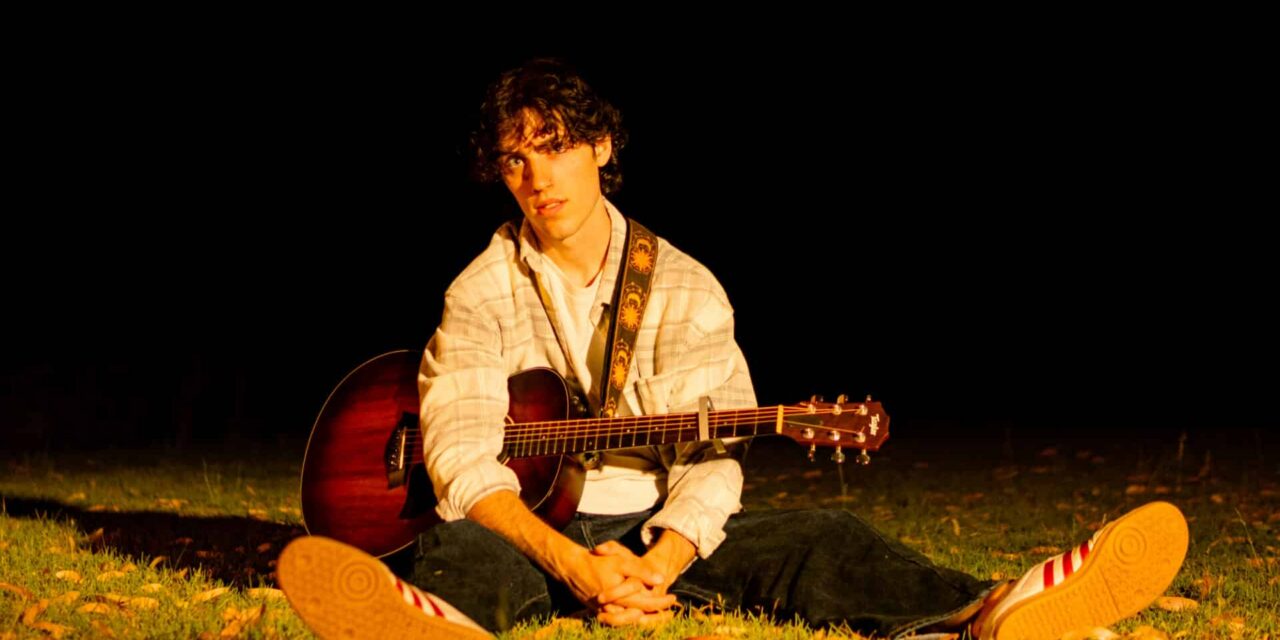
CAFFA is a singer-songwriter born in 2003 and raised in Ostia, Italy. He began studying guitar, singing and songwriting at the age of 12, developing a sound that moves between contemporary Italian singer-songwriter music, indie pop and folk influences. His direct, personal writing often explores themes of growth, relationships and identity.
He began releasing music in 2020, the same year he met renowned Italian producer and talent scout Claudio Cecchetto, who produced his debut EP, Ho solo 16 anni (I’m Only 16). Since then, CAFFA has built extensive live experience, performing both in traditional venues and as a street musician. His career has also brought him to Italian television, including appearances on Amici di Maria De Filippi in 2021 and Fiorello’s Viva Rai 2 in 2023.
His single “Maturità” has surpassed 100,000 streams on Spotify, becoming his most-streamed release to date. Now, CAFFA returns with “Tiritera,” out September 18 via Aurora Dischi / Virgin Music Group Italia. Blending indie pop, folk pop and contemporary Italian songwriting, the track captures a relationship that has reached breaking point without ever quite ending. Attraction, frustration, nostalgia and complicity coexist as two people repeatedly move between walking away and choosing each other all over again.
“Tiritera” tells the story of a relationship that seems to have reached its end, yet neither person can truly walk away. What interested you about exploring that limbo between breaking up and inevitably continuing to choose each other?
“Tiritera” came from the meeting of an impulsive, emotional side and a more rational one. In the middle are two people who know they aren’t what the other person truly needs. And yet they keep choosing each other, partly because they’re drawn to the beautiful disaster they create together.
The song brings together attraction, frustration, nostalgia, provocation and complicity. Are you more interested in exploring love through its contradictions rather than simply dividing relationships into healthy and unhealthy ones?
Absolutely. I don’t think there’s such a thing as a static version of love. We express it in so many different ways, sometimes even through our flaws. If everything were always perfect and ideal, maybe it wouldn’t affect us nearly as much. This song is also about how chaos can make a relationship more confusing and, at the same time, more intriguing.
Humor seems to allow you to confront an emotionally complicated situation without turning it into a traditional dramatic breakup song. How important is it for you to make people smile while talking about something that actually hurts?
I’m a very positive person in everyday life, and using a little irony helps me give experiences like this a more ordinary, everyday tone. When we’re hurting, we don’t necessarily go straight into hysterical crying. There are so many different ways and nuances through which we experience pain.
I wanted to write something different from the classic tearjerker. Even the chords sound happy and seem to be moving in a completely different direction from the lyrics, but that contradiction was also part of the idea that inspired me while I was writing.
Your songwriting moves between the Italian singer-songwriter tradition, indie pop and folk—genres with a strong emphasis on storytelling. When you write a song like “Tiritera,” do you begin with the story you want to tell, with a particular phrase, or does the music suggest the characters and situation?
This song came together one afternoon at Pocsh’s house. He’s a friend I released a five-track EP with years ago, which also includes my most-streamed song. Even now, whenever we see each other, we always end up writing something together.
“Tiritera” was originally supposed to be an experiment: a song mixing Italian, Roman dialect and a little bit of English. Then we became obsessed with it, and once again, this song reminded us that beautiful things sometimes happen when you aren’t even looking for them.
You began studying guitar, singing and songwriting at 12 and released your first EP while you were still a teenager. Now that you’re 23, how has the way you write about love, growth and identity changed compared with the teenager behind Ho solo 16 anni?
A lot. At 16, I was writing with the emotional awareness I had at that moment, and then life kept surprising me. I discovered new sides of myself, started caring about different things and began paying more attention to what was happening around me. That naturally led to songs that are very different from the ones I was writing back then.
What still moves me, though, is that I can recognize myself in lyrics I wrote so many years ago. I wouldn’t know how to write those same things today, but I know that kid was me.
An important part of your development came from performing live, not only in venues but also as a street musician. What did performing for people who, unlike a traditional audience, aren’t necessarily there to hear you teach you?
It taught me how important it is to find an environment where I feel comfortable singing. For years, I tried bringing my songs into venues where live music ultimately became background noise.
The street, on the other hand, is very honest. If people aren’t interested in what you’re doing, they don’t stop. But when someone decides to stop and listen, that moment is genuinely authentic.
You’ve experienced very different environments, from street performance to television appearances on Amici and Viva Rai 2. After moving through such different contexts, what have you learned about the version of yourself you actually want to bring to the stage?
The person playing guitar and singing is always me. In all of these situations, I’ve performed songs that I wrote and experienced firsthand. Every experience can teach me something, but I don’t feel that it changes the essence of who I am when I step onto a stage.
“Maturità” became your most-streamed song, surpassing 100,000 streams. When a song receives a particularly strong response from listeners, are you tempted to figure out the formula and repeat it, or do you prefer to see that kind of success as something that can’t—and perhaps shouldn’t—be replicated?
Yes, I’ve definitely felt the temptation to repeat that result. But I’ve never really felt inspired by the idea of chasing algorithms. More often than not, it ended up holding back my need to show the world who I am artistically.
If we only listened to the numbers, so many beautiful songs would remain sitting in drawers instead of being released on Spotify. Over the years, I’ve realized that my greatest need isn’t to receive attention, but to give a voice to the part of myself that emerges through my songs.
Maybe if I’d made different choices, I would have achieved different numbers. But what scares me much more is the idea of no longer recognizing myself artistically in what I create.
“Tiritera” is about people who keep returning to one another despite knowing perfectly well what isn’t working. Looking instead at your artistic journey, which older versions of CAFFA do you feel you need to let go of, and which ones will inevitably keep returning in your songs?
I’d like to let go of the version of myself that is constantly trying to understand which way things are going. As emerging artists, we sometimes give too much importance to the tools and platforms and risk losing sight of why we make music in the first place.
What will keep returning in my songs is the desire to write beautiful ones. I want to keep doing it because it’s one of the things that makes me feel most connected to life and to my own growth.