For a project that has spent the last decade refusing to sit comfortably inside one genre, Empires in Orbit has always treated evolution as part of the point. Founded in 2015 by multi-instrumentalist Gary Mann, the project has moved through electronic music, soundtrack work, collaborations, film placements, and even ballet, accumulating six albums and more than three million plays along the way. But its newest chapter feels less like another stylistic pivot and more like a fundamental expansion of what Empires in Orbit can be.
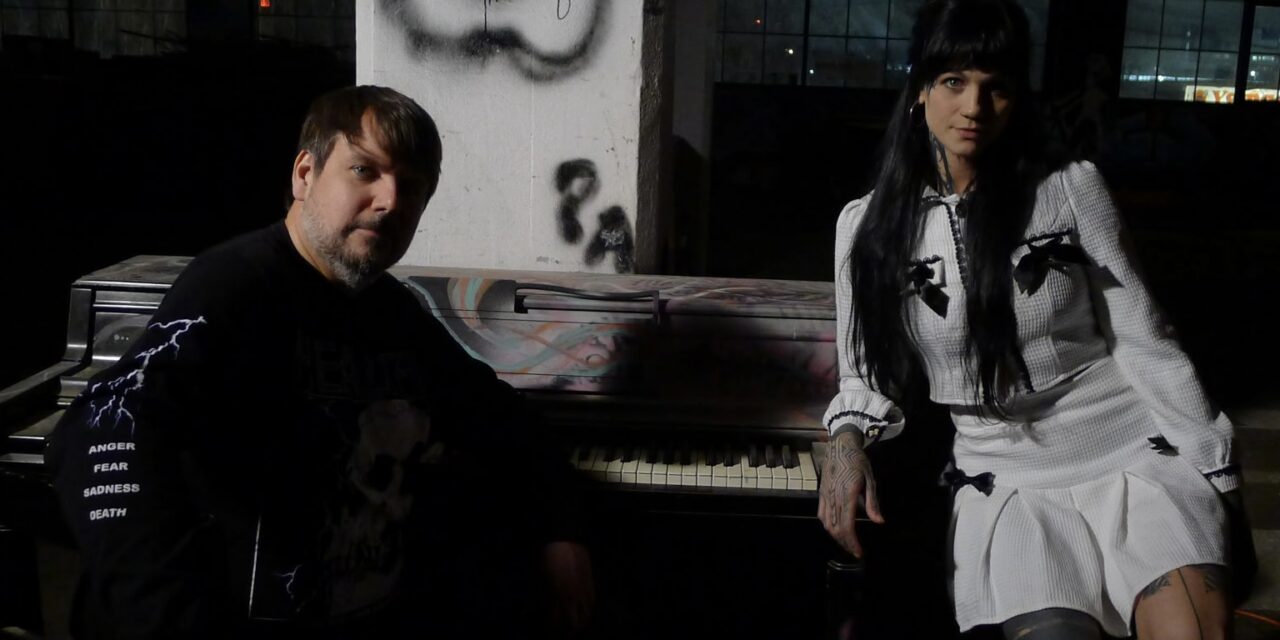
That shift comes with the permanent addition of German vocalist Fe Malefiz, whose presence gives Mann something the project had never fully possessed before: another voice inside the world rather than simply another collaborator passing through it. The result is music that retains Empires in Orbit’s atmospheric electronic foundations while opening itself to gothic textures, heavier guitars, expansive vocal arrangements, and a more direct form of emotional storytelling.
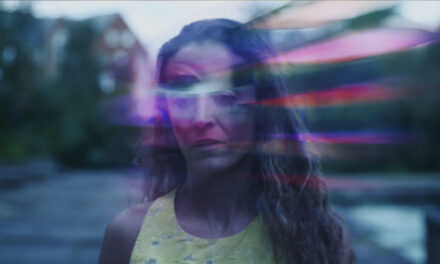
Their first single together, “Mother!”, makes that evolution immediately clear. The track exists somewhere between dread and comfort, imagining a world that threatens to consume you while simultaneously longing for the unconditional safety of a mother’s embrace. Its accompanying horror-inspired visual pushes that tension even further, turning emotional trauma into something physical, unsettling, and deliberately difficult to look away from.
For Mann, who spent years communicating primarily through instrumental music and conceptual records, Malefiz’s arrival creates the possibility of saying explicitly what previously had to remain hidden in texture. For Malefiz, Empires in Orbit offers an unusually unrestricted space where the voice can become character, atmosphere, instrument, and narrator at once.
Together, they’re preparing a new album that moves away from the tightly plotted concept records of Empires in Orbit’s past and toward something more instinctive: songs shaped by whatever the pair are living and feeling in the moment. We spoke with Gary Mann and Fe Malefiz about the evolution of the project, horror as emotional language, turning pain into immersive sound, and why their next ambition is to take this new incarnation of Empires in Orbit onto the stage.
Empires in Orbit has spent the last decade pushing beyond traditional genre boundaries. Looking back on six albums and millions of streams, how has your artistic vision evolved since the project’s inception in 2015?
Gary: My favorite part of this project lasting this long is that it gets to take its time evolving. Without labels chirping in your ear about directions they’d like you to go in and opportunities you should say no to, I’ve gotten to follow my heart fully.
Never ever would I have thought I’d be involved in ballets and soap operas and audiobooks, let alone get to sound exactly how I want doing it all. If possible, I want to do everything possible that music is a part of.
The addition of Fe Malefiz as a permanent member marks a major turning point for the band. How has her presence changed the creative dynamic, both in the studio and in shaping the band’s identity moving forward?
Gary: Finding Fe felt necessary. The only thing I felt like I missed from being in more traditional bands is having people, or a person, to bounce ideas off of and that kind of creative energy.
So I knew I needed a partner to bring out whatever came next the way it should be, and I got lucky that she also ended up being endlessly talented. We’ve now proven that writing songs won’t be a problem, so we hope to build toward playing live together. The vision we have for the stage will be powerful, so hopefully we get that chance.
Your new single “Mother!” explores emotional vulnerability, survival, and the desire for safety in an increasingly overwhelming world. What personal experiences or emotions inspired the song?
Fe: While singing back and forth and creating the melody, the word “Mama” somehow slipped out. Then a story started appearing in my mind like a movie, and I followed that imagery to build the framework of the song.
It made me think about this world and how, from the very beginning, we’re exposed to this strange society and its ideas, to the system and its lies—to our demons.
Visually, I found it interesting to imagine retreating back to the warmth of a childhood bed, being tucked in by your mother. The world can be a cold place, and I often find myself wondering why we, as humanity, choose to live the way we do.
There’s a fascinating tension in “Mother!” between darkness and comfort, fear and longing. Was it important for you to embrace those contradictions rather than offer a clear resolution?
Gary: This is another “thank God I found Fe” concept for me! Ha. I’ve never been able to put my feelings and experiences into words. Historically, I hope the listener can feel what I meant by my instrumentals, and it’s worked to some degree over the years.
But to have someone in my own band be comfortable putting those tough thoughts to paper and WAV files is another level. Even without giving a stitch of input on lyrics, she captures what I dreamed she would.
Fe: When I write melodies, create songs, and write lyrics, I never approach it from a theoretical perspective. I simply follow what I feel, and whatever comes out in the end is usually an expression of my energy, my thoughts, and my emotions.
I don’t make notes or think about which literary devices or stylistic elements I want to include. It all happens naturally on its own, and that’s exactly why I love making music so much.
To me, music is a flow that needs to keep moving. And whatever meaning people find in the finished song should belong to the listener as much as it belongs to me.
The accompanying music video leans heavily into horror-inspired imagery. What drew you to horror as a visual language for this song, and how does the video expand on the track’s themes?
Gary: Most of our songs’ themes are difficult subject matter, and dealing with scary emotions should look scary. It’s not a surprise that both of us are horror movie fans and that we wanted our lead-off single to look that way.
We want to be as honest as possible about what pain and trauma feels and looks like—and it looks fucking scary!
Empires in Orbit has contributed music to films, soundtracks, and even ballet productions. How do those experiences influence your approach to storytelling when creating your own records?
Gary: The ballets are what really opened my mind to what music can be. I’ve been in touring metal bands for most of my life, so music always felt like the cycle of write songs, record songs, play songs, repeat.
So the fact that someone heard my album and their thought was, “This is a ballet,” blew my mind. Witnessing it in person really solidified it to me—it was a ballet.
That proved to me that sonically it doesn’t matter what genre or direction I want to go in, someone will like it and they will interpret it how they want to, and that’s beyond special.
So now I want everything. We want to score movies, be the song for Olympic figure skating, WWE introduction music—who cares. We want to be part of everything.
Fe, you’ve collaborated across numerous projects throughout your career. What was it about Empires in Orbit that made you want to fully commit and become a permanent member?
Fe: I love my job as a singer and songwriter. I can dive into any kind of music, whether it’s the wildest genre imaginable or the most ordinary piece ever written. Singing, interpreting songs, and recording covers is my profession, and I’m incredibly grateful that people connect with my voice, my lyrics, and my work.
But when Gary first presented his idea, I immediately realized this wasn’t just a collection of songs on a tracklist. This was music that I genuinely feel, live, and identify with on every level.
There’s something so atmospheric and playful about it. It gives me complete freedom to throw myself into a song with both my voice and my words. His music creates space for strange and beautiful sounds, new vocal approaches, endless harmonies, and vocal interactions I had never explored before.
Every time I step into these songs, I feel like an elf, a witch, a goddess, or a mischievous little goblin weaving herself into the music. There’s something deeply imaginative and magical about it—something truly special.
And yet, at the same time, there’s the power and heaviness of metal. It exists somewhere between delicacy and strength, between softness and a distinctly feminine energy. That’s exactly where I want to be as an artist. It’s exactly the kind of music I’ve always wanted to create.
The electronic and gothic worlds often prioritize atmosphere, but your music also carries strong emotional and narrative elements. How do you strike a balance between creating immersive soundscapes and telling a compelling story?
Gary: That’s part of what makes this record unique. We know what we’ve gone through and what it’s done to us, so now it’s our job to paint that world correctly.
Fe and I might live a literal ocean apart, but we’re kindred spirits, especially in the sadness department.
Sometimes sadness is heavy, so we need seven-string guitars and four-part harmonies yelling that at you. Sometimes sadness is quiet and personal, so we’ll strip it down to only necessary instruments and vocals.
We want you to be able to scream our lyrics in desperation and be able to internalize what we make you feel in a dark closet—all within the same song.
Fe: Sometimes there isn’t one specific story at all. Sometimes it’s just a collection of words, sounds, or a simple melody, and yet the song still says something. It can still transport you somewhere else, into another world.
Not everything has to be expressed through explicit lyrics. What’s important is conveying the feeling that there’s life within the song. Or death. Or nature. Or perhaps a little caterpillar that forgot its rainy boots.
Sometimes the story is told through words, sometimes through sounds. In the end, the story lives in the listener’s imagination.
You’ve hinted that this upcoming album represents the beginning of a new era for the band. In what ways does the record differ from previous Empires in Orbit releases, both sonically and thematically?
Gary: All of my solo records have been concept albums. I had a plot in my head and needed to figure out how to sonically tell that story without words.
Now I have an angel with a megaphone, so I just need to make sure I write songs that stay true to how I’m feeling at the time and that they make sense for Fe’s voice and vibe.
So Empires doesn’t have to have a cohesive “plot” to get powerful messages out there. You’d think having a vocalist would take away from the listener experience because they don’t get to make up their own meaning, but I think it turned out opposite.
Every time I got a new demo sent back to me during the writing process for Audiodrome, all I could think of was, “YES! Exactly!” So I think future listeners will jump right on board with our direction.
After ten years, multiple albums, and a constantly evolving sound, what still excites you most about making music, and what do you hope listeners discover when they step into the world of this new record?
Gary: The thought of taking this to the live stage someday is the most exciting to me. I’ve played probably 1,000 shows in my life and it’s been amazing, but not like the potential of this.
When Fe and I first met in person to film these videos, we didn’t 100% know we’d get along so well or have that spark on stage until we got rolling.
This can be as big as opportunities can give us, and we’ll make it pay off 1,000-fold. Fe’s voice can carry a club or stadium on its waves, and I can’t wait to hear a crowd sing her words back to her.