For Jonathan Plevyak, nostalgia is less about looking backward than remembering how to be present.
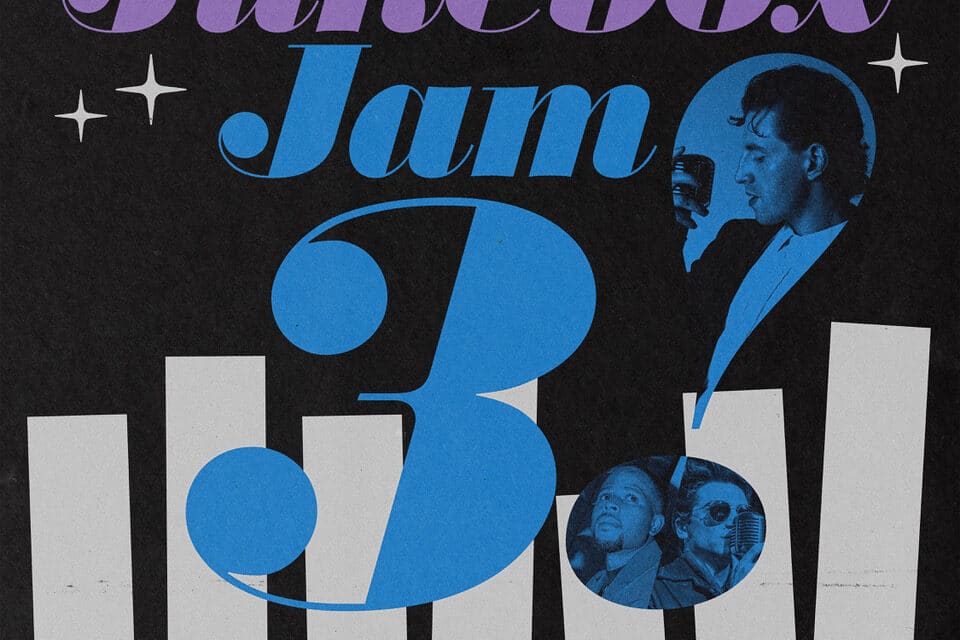
The Nashville crooner has turned that idea into Jukebox Jam, his recurring retro prom night where vintage date-night attire, old-school romance, dancing and live music transform contemporary Nashville into something resembling another era. Classic oldies sit alongside Plevyak’s own ’50s- and ’60s-inspired songs, while a revolving cast of musicians turns the stage into a living jukebox.
Now entering its third year, Jukebox Jam 3 arrives at Cannery Hall on October 10, continuing an event that Plevyak and his brother and co-creator Joseph have built into something much larger than a themed concert.
“When I started putting out this 1950s-inspired music with ‘Wild, Love,’ I realized that there was a deep community of people out there that craved that old-school human-to-human connection and touch,” Plevyak says. “Folks that wanted to be away from the digital, noisy world we are navigating through.”
That desire became the foundation of Jukebox Jam: an annual escape where the aesthetic might belong to the past, but the need it addresses feels distinctly contemporary.
Rather than enforcing a strict no-phone policy, Plevyak encourages audiences to keep their devices in their pockets and participate in what is happening around them. The distinction matters. Jukebox Jam isn’t about pretending technology doesn’t exist; it’s about discovering what can happen when it temporarily stops demanding everyone’s attention.
“You can see it and feel it,” he says of the change in the audience. “Everyone just is more light, more social, more free, more loose, more present.”
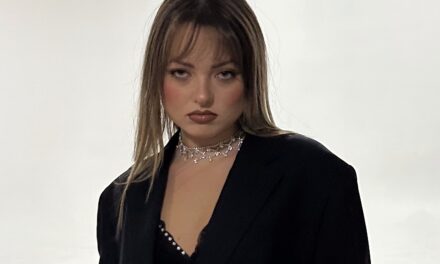
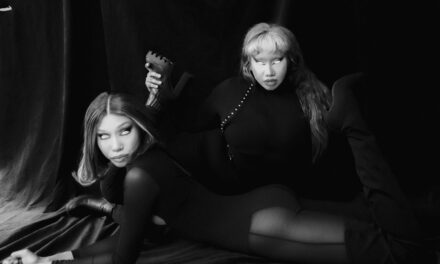
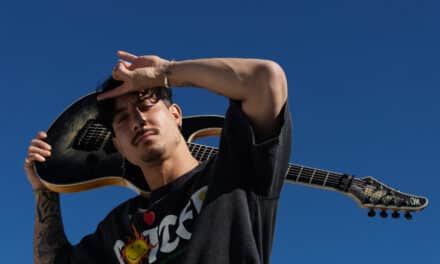
Collaboration has become equally fundamental to the experience. Previous editions have welcomed artists including Bird and Byron, Bre Kennedy, Arts Fishing Club and Kenny Sharp. For Plevyak, that revolving cast isn’t simply a way of expanding the lineup—it completes the metaphor at the heart of the event.
“You walk up to a jukebox and what’s a jukebox? Every page is a different artist, album, song, vibe, genre,” he explains. “We wanted the event to feel like what flipping through a jukebox would look and sound and feel like if it came to life.”
As Jukebox Jam moves into Cannery Hall, Plevyak is thinking about how to make that world bigger without sacrificing what made it meaningful in the first place. And if the night succeeds, the real impact might only become apparent once everyone walks back outside.
We spoke with Plevyak about modern romance, the disappearing communal experience of concerts, making new music from old influences and why sometimes the best response to contemporary life is simply to dance.
Jukebox Jam combines your original music with classic oldies and asks people to arrive in vintage date-night attire while encouraging them to put their phones away. What were you trying to recreate emotionally when you first imagined a night deliberately disconnected from contemporary life?
When I started putting out this 1950s-inspired music with “Wild, Love,” I realized that there was a deep community of people out there that craved that old-school human-to-human connection and touch. Folks that wanted to be away from the digital, noisy world we are navigating through.
I thought, what if there was a one-night-only event once a year in Nashville where those people could all unite and come together for a night of connection, community and collaboration? An escape to a bygone era, both visually and from a feeling perspective. That’s where Jukebox Jam was born!
Nostalgia can sometimes become purely aesthetic, but Jukebox Jam seems more interested in recreating the social experience surrounding older music—dancing, romance, dressing up and actually being present with other people. What do you think we’ve lost from the way previous generations experienced music together?
Absolutely. I think we just lost the presentness of a beautiful but fleeting moment. Everyone at shows now is on their phones filming, posting, or scared to let loose and dance and feel the music because they know they are probably in someone’s Instagram story.
From hearing about concerts from my parents, grandparents and other folks, it just seems that shows used to be so much more of a communal experience, shared together fully present in the moment. That’s what we are trying to make people feel with Jukebox Jam.
You write original songs within the same musical universe as the classics you perform. How do you create something that feels authentically connected to an earlier era without allowing nostalgia to become creative imitation?
I think it’s about letting the music be as much of all parts of me as I can. My influences are from the ’50s and ’60s, but I’m also a writer and human living in 2026, listening to music and currently inspired by things happening in 2026.
I like to honor the classics through tones, song structures, production and mixing techniques, but the music also feels modern because it is modern. Additionally, my bandmates who play on these records with me have such an array of influences and genre backgrounds that I think it helps keep things really fresh each time we record.
Asking an audience to put their phones away feels almost radical in a culture where concerts are constantly documented. Have you noticed people behaving differently once they stop thinking about creating a digital record of the night?
Oh yes! You can see it and feel it. Everyone just is more light, more social, more free, more loose, more present. It’s almost as if that’s how human beings were created to exist—free and without a mini computer in our face.
We are not specifically asking people to leave their phones in their cars! We are just encouraging people to have them in their pockets and join us in the present moment. Obviously, some videoing is extremely welcomed, as that creates FOMO for people who couldn’t make it, ha!
But I do think there’s no coincidence that when you go to a comedy club and they take your phone or make you put it in one of those locked bags, you can just see and feel that everyone in the room is so much more present. Because they have to be. It’s a fun social experiment to watch.
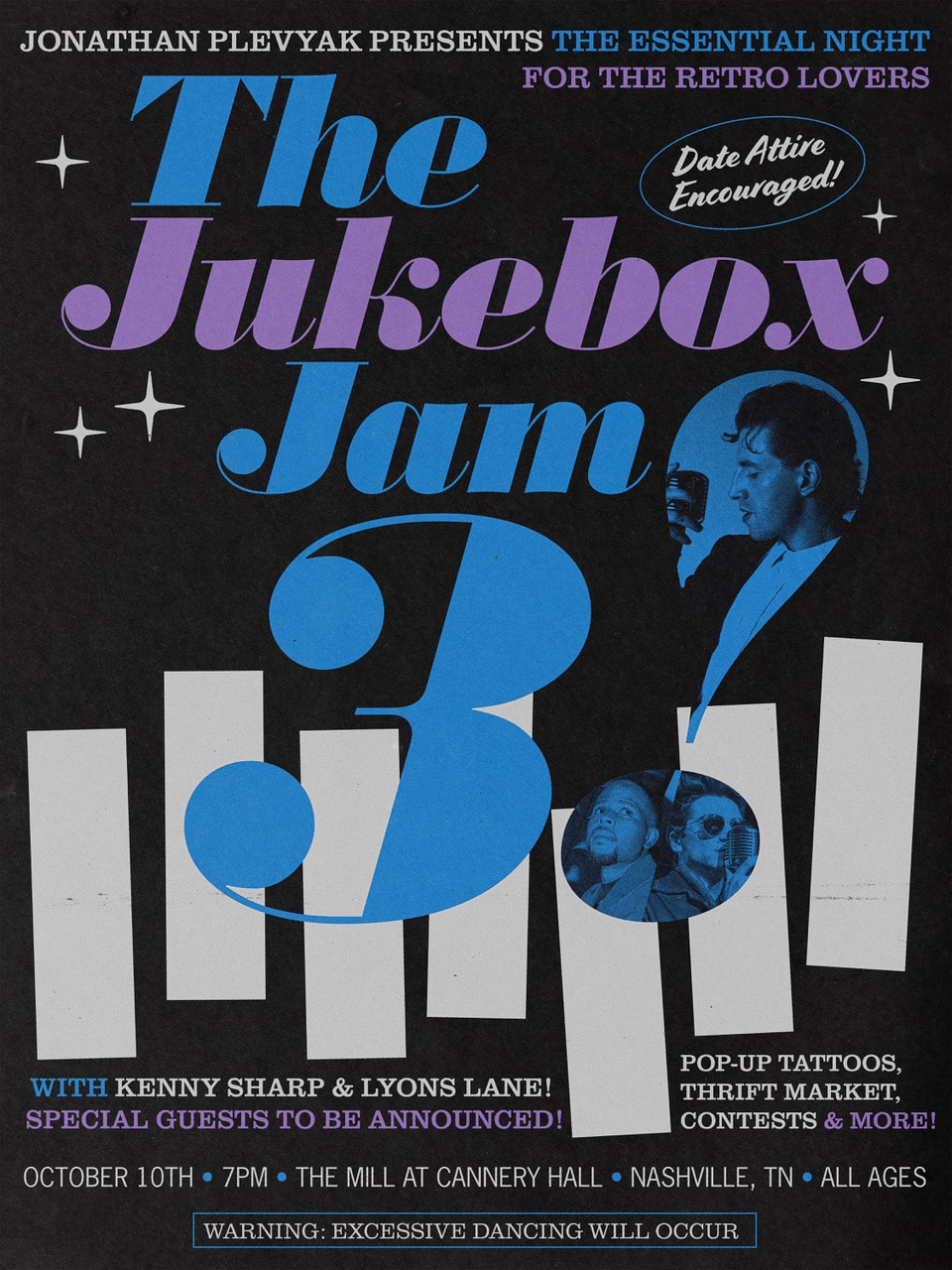
Nashville is a city where musicians are constantly surrounded by other musicians, but you’ve turned that ecosystem into something genuinely communal by inviting artists like Bird and Byron, Bre Kennedy, Arts Fishing Club and Kenny Sharp onto the Jukebox Jam stage. Why was collaboration essential to the identity of the event?
We’ve had an incredible roster of artists be a part of the first two Jukebox Jams, and I’m so excited for this third year’s lineup. When we started this, we knew we had to have a revolving door of artists.
There were so many sounds and styles and flavors of music from that era. My band and I could have never pulled it off ourselves. We wanted and needed that rich artistic and human diversity.
Also, you walk up to a jukebox and what’s a jukebox? Every page is a different artist, album, song, vibe, genre, etc. We wanted the event to feel like what flipping through a jukebox would look, sound and feel like if it came to life!
The word “crooner” carries a very specific romantic mythology with it. What does being a modern crooner mean to you when relationships, dating and even the ways we communicate affection look so different from the eras that originally produced that archetype?
I think a modern crooner obviously has to evolve with the times and be modern and relevant to today’s crowd, while still honoring the legends who pioneered the genre.
I do think that to be a modern crooner in 2026 carries a responsibility to be a gentleman with class if you are representing love and romance in a musical genre form.
There’s something inherently vulnerable about sincere romantic music today, particularly when so much contemporary culture relies on irony. Do you think creating a space specifically for “romantics” gives people permission to embrace emotions they might otherwise feel slightly embarrassed to express?
I think giving an event or a night a certain theme is always so fun and exciting. I think an audience member attending knowing it’s going to have a theme allows them to slip into a different mindset. It encourages a different perspective. It’s almost like role-playing and escapism combined.
Jukebox Jam has evolved into a recurring Nashville event rather than simply a concert. At what point did you realize you weren’t just building an audience for Jonathan Plevyak—you were building a community with its own rituals and identity?
I think in the moment of the first one in 2024. We all saw it and felt it, both from the musicians onstage and the folks in the crowd.
Jukebox Jam 2 proved that the first one wasn’t a fluke or us getting lucky. I think Nashville needs an event like this. I think every city needs an event like this, to be honest. People want and deserve to have fun. Life is tough out there sometimes!
Jukebox Jam 3 moves into Cannery Hall on October 10. As the event becomes larger, how do you preserve the intimacy and spontaneity that made people fall in love with the concept rather than allowing it to become simply another big Nashville show?
I’m so excited about it being at Cannery this year. The space is incredible and feels so warm and inviting. We also have a big LED screen behind us that I’m excited to play with and integrate into the experience.
My brother and co-creator on the event, Joseph, and I are still the only ones running it, and our “team” is truly just our friends who love and believe in the event. So I know we will always preserve the intimacy, joy and care that this event has demonstrated because we care so much about it. It’s a labor of love.
If someone walks into Jukebox Jam 3 dressed for another era, spends several hours dancing without constantly looking at their phone and then returns to contemporary Nashville afterward, what do you hope feels different about the world outside when they leave?
That life doesn’t need to feel too heavy or serious all the time. That it’s okay to have fun and loosen up. That they know they have the ability to breathe and be grounded in a present moment, even if it’s a fleeting one.
That they should say hi to their fellow stranger or neighbor next to them. That no matter what’s going on in their lives, sometimes the best medicine is to let loose, dance and sing by yourself—regardless of whether that’s at home, in the shower, in the car or in a room packed with strangers.