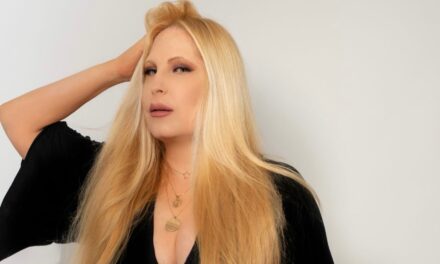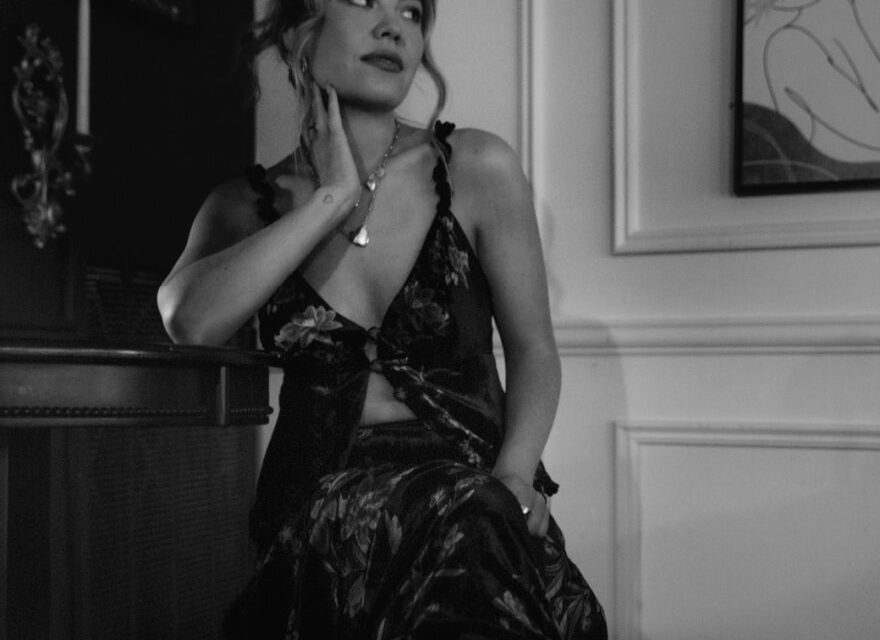
For Bri Fletcher, strength no longer means pretending everything is fine.
On her latest single, “Salt Water,” the Fort Worth-born, Nashville-based singer-songwriter dismantles the familiar image of the “tough girl” and replaces it with something considerably more human: someone willing to cry, admit when she is hurting and trust that vulnerability can be its own form of resilience.
“I realized that holding it in was affecting me way more than letting it out and being vulnerable,” Fletcher says. “I can only be my true, authentic self—as an artist, songwriter, friend, wife, etc.—when I am being honest with how I feel.”
That realization becomes the emotional center of “Salt Water,” an R&B-leaning country track that transforms tears from evidence of heartbreak into a kind of medicine. Its central metaphor is both sincere and knowingly playful: salt water cleans wounds, so perhaps crying has healing benefits too. Even a lyric about turning to WebMD in the middle of an emotional spiral finds Fletcher refusing to separate pain from humor.
It is an approach that feels increasingly representative of Fletcher’s evolving artistic identity. Raised in Texas and now embedded in Nashville’s songwriting community, she initially believed making country music meant adhering to a particular idea of what country was supposed to sound like. Experimentation gradually led her elsewhere, toward a space where country storytelling can coexist naturally with R&B vocal freedom and pop instincts.
That evolution has already taken Fletcher from The Voice, where she competed on Team Chance the Rapper, to Nashville stages including Song Suffragettes and Whiskey Jam. Her debut EP, Chapter One, has surpassed 3.5 million streams. Yet “Salt Water” suggests that the most interesting part of her growth may be less about numbers than what she is increasingly willing to reveal.
The accompanying video takes that vulnerability to Malibu, placing Fletcher’s emotional unrest against tranquil waves, sunlight and open coastline. The result captures the contradiction at the heart of the song: healing doesn’t necessarily begin once the crying stops. Sometimes crying is part of the healing itself.
“Salt Water” starts from the realization that you don’t always have to be the “tough girl.” When did strength stop meaning holding everything together for you and start meaning giving yourself permission to fall apart sometimes?
I think I realized that holding it in was affecting me way more than letting it out and being vulnerable. I realized that I can only be my true, authentic self—as an artist, songwriter, friend, wife, etc.—when I am being honest with how I feel!
There’s a clever contradiction at the heart of the song: tears represent heartbreak, but you turn their salt water into something cleansing and restorative. Were you consciously trying to reclaim crying as an act of healing rather than evidence that someone has defeated you?
Absolutely! I’ve heard all my life, “You cry too much” and “You’re so sensitive,” but I actually think that’s what makes me who I am. That empathetic side is what makes me a good songwriter, and I don’t ever want to lose that. Crying can be therapeutic and healing, and I think we could all use a good one every once in a while.
The lyric about crying online and checking WebMD brings humor into an otherwise vulnerable moment. Do you find that humor helps you write about emotions that might feel too exposed if you approached them completely seriously?
I’ve always leaned on humor when I’m having to be a little more honest than normal. I’m the first to call myself out in my songs, and I think I learned from a young age that it’s better to make people laugh first than for them to point something out.
The video places you against the tranquility of Malibu while the song deals with the messiness of heartbreak. What interested you about surrounding an emotionally unsettled character with an environment that looks almost completely peaceful?
I had the vision for the music video the day we wrote the song. I wanted to lean into the more “literal” take on the song and let the lyrics really speak for themselves.
“Salt Water” leans further into R&B while keeping country storytelling at its center. What does R&B allow you to communicate vocally or emotionally that you perhaps couldn’t express in exactly the same way through a more traditional country arrangement?
I think R&B gives me the freedom to vocally express myself without any limits. It provides this feeling of floating for me, and I feel like I really just feel and connect to the lyrics more. Country lyrics and storytelling will always be the center of who I am, but I’m trying to encourage myself to try new sounds that feel authentically me.
You’re originally from Fort Worth and now creating within Nashville, but your music incorporates country, R&B and pop rather than remaining inside one lane. Do you think your definition of what a country artist can sound like has changed as you’ve developed your own identity?
When I started in Texas, I was making very country music because I thought that’s what I was supposed to do. I grew up in the country around horses and thought that’s the sound people wanted. And while that’s true, the more I experimented and leaned into a little more freedom, I found a lane that felt more comfortable to me and more authentic.
You appeared on The Voice as part of Team Chance the Rapper. Did working within that environment—and specifically alongside someone coming from outside traditional country—change anything about how confidently you embraced the R&B side of your music?
Yes! It gave me a fresh set of ears when I approach anything, specifically if there are any elements that you normally wouldn’t think to add to the song to bring a sense of “newness” to it.
Your debut EP Chapter One has surpassed 3.5 million streams, while you’ve continued releasing music and playing Nashville institutions like Song Suffragettes and Whiskey Jam. Has that growing audience made vulnerability easier because people understand you better, or harder because increasingly more people are listening?
That was such a huge accomplishment for me and only encouraged me more to lean into the vulnerability and push the limits even further. It means so much to me that people are listening and responding well to my music.
I just want to give them relatable stuff. We all go through different seasons of our lives, and it’s so important to feel heard and seen.
Country music has a long tradition of transforming heartbreak into storytelling, but “Salt Water” isn’t really about the person who hurt you—it becomes about your own relationship with your emotions afterward. Are you becoming more interested in writing about who heartbreak turns you into rather than who caused it?
I’m always interested in taking a new approach to songwriting and revolutionary ideas. The Nashville songwriter way is to always come up with a new way to say things, so I love that perspective.
The song ultimately says, “yeah I’ll be okay,” but it doesn’t require you to already be okay. Is that distinction—between healing and being healed—something you want to explore more deeply in this next chapter of your music?
I think we are all in the process of constantly healing different parts of ourselves. We don’t have to be perfect or immediately healed or fixed. The process is beautiful, and leaning into that is something I’m passionate about because, like I mentioned earlier, we all go through different seasons, and it’s important to know that you have someone who understands it.