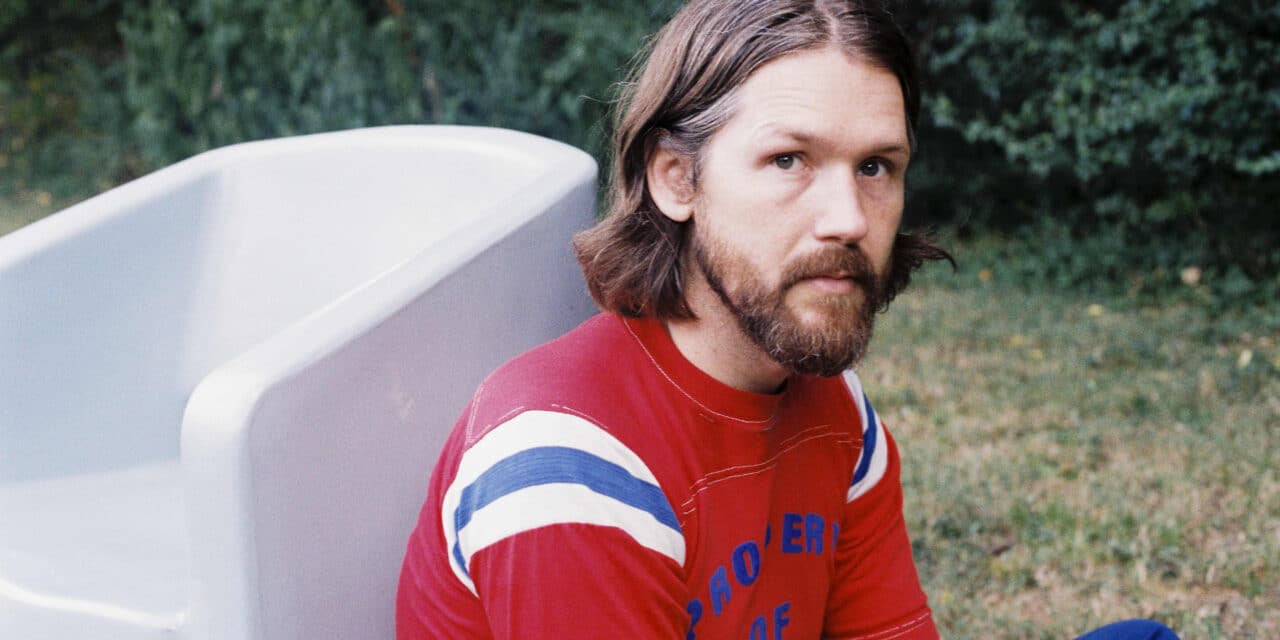
After nearly two decades spent helping shape other artists’ music, Kyle Ryan has reached the logical next step: finishing an album alone, questioning every decision, and transforming the entire process into a maximalist pop fever dream.
Under the name Junior Pro, the Nashville-based songwriter, producer, and longtime Kacey Musgraves collaborator has announced the new album Cool, arriving September 18 through Easy Does It Records.
The announcement comes alongside lead single “SPORTS!”, a high-energy, angular track about relationships, changing intensity, and one of the most reliable forms of conversational avoidance in American life.
Junior Pro – “SPORTS!” Stream
“I was tired of my distant stare when the topic came up,” Ryan explains. “I decided to finally mine deep for my contribution to our favorite number one small-talk time suck. Sports!”
That description captures much of what makes Junior Pro immediately compelling.
The project is playful without being careless, musically sophisticated without becoming self-serious, and built by someone who has spent enough time inside the machinery of professional music to understand exactly how absurd it can be. “SPORTS!” takes a culturally familiar subject and turns it into something nervous, explosive, and slightly surreal, using the language of competition as a way to examine interpersonal dynamics.
The song follows previously released tracks “Queen of Never,” “Coq Au Vin,” and “The Other End,” each offering another glimpse into the unstable, genre-blurring world of Cool.
For Ryan, the album represents the result of years spent moving between styles, artists, and creative roles.
“After years of collaboration with every type of artist, musically, I am a confused chameleon,” they say.
That confusion is not presented as a weakness. It is the record’s foundation.
Ryan has worked across Nashville’s indie-pop ecosystem since 2006, writing, producing, recording, and performing with artists including Natalie Prass, Zac Farro, Liza Anne, Dr. Dog, Molly Tuttle, Eric Slick, Mikky Ekko, Rayland Baxter, Morgxn, and Josh Gilligan.
They also spent roughly a decade touring and recording with Kacey Musgraves, serving as her musical director and producing A Very Kacey Christmas and its accompanying television special.
When the pandemic and the birth of their daughter brought life back toward the studio, Ryan began turning the lens inward. Junior Pro became a space to explore what happens when someone accustomed to translating other artists’ ideas finally has to confront their own without a client, collaborator, or external vision providing direction.
The answer, apparently, involves maximalism, solitude, genre collision, and the occasional loss of sanity.
“I worked by myself writing, recording, and mixing in the cracks of normal life over the course of the last two years,” Ryan explains. “Alone was tough, with only my own delusion to bounce ideas off of. I knew I needed help. So the only logical conclusion was to finish the record alone and lose my goddamn mind.”
The resulting album is not the work of someone discovering music for the first time. It is the work of someone attempting to forget the rules accumulated through decades of professional experience long enough to hear what remains underneath them.
A Confused Chameleon Steps Forward
Ryan’s musical foundation was fragmented from the beginning.
Growing up in pre-internet Lincoln, Nebraska, they moved between playing NOFX songs in middle-school basements and performing Duke Ellington standards from the Real Book for country-club audiences.
Punk and jazz were not treated as incompatible worlds. They were simply different musical languages available to be learned, absorbed, and eventually recombined.
After studying at Berklee College of Music, Ryan moved to Nashville as part of a duo with Madi Diaz. From there, they entered an unusually broad creative network, working across indie pop, alternative rock, country, folk, and experimental music.
That range made Ryan useful to other artists.
It also made the question of their own sound increasingly complicated.
A producer’s job frequently involves becoming fluent in someone else’s instincts. The best collaborators understand when to lead, when to disappear, and how to turn an artist’s partially articulated idea into something audible.
After years of working that way, making a personal album can feel almost confrontational.
There is no one else’s identity to serve.
No one is waiting for a specific emotional register, radio format, sonic reference, or career strategy. The possibilities become liberating, but also paralyzing.
Junior Pro appears to embrace that uncertainty rather than resolve it.
The project’s “pop-in-a-blender” identity does not attempt to prove that Ryan has finally selected the correct genre after years of experimentation. Instead, it suggests that the inability—or refusal—to choose may be the most honest expression available.
The Strange Utility of “SPORTS!”
At first glance, “SPORTS!” appears to address a simple cultural gap.
Ryan had spent years disengaging whenever conversation moved toward athletics and finally decided to create an artistic contribution to the subject.
Yet the song’s description suggests something more relational.
It is framed as a reflection on the strange nature of relationships as they evolve in intensity. Sports become both topic and metaphor: alliances change, attention sharpens, competition enters, momentum shifts, and the emotional stakes become more difficult to interpret.
The title’s exclamation point turns the word into an announcement, an interruption, or perhaps an attempt to perform enthusiasm convincingly enough to participate.
That performative quality makes “SPORTS!” especially fitting for a record concerned with identity.
Small talk often requires people to occupy simplified versions of themselves. They choose familiar subjects, repeat expected opinions, and build temporary connections through shared cultural references. Sports may be one of the most efficient examples, capable of creating immediate belonging between strangers.
For someone who does not naturally connect with that language, the experience can be alienating.
Rather than remaining outside the conversation, Ryan responds by creating an exaggerated musical version of it.
The result feels less like learning to love sports and more like translating the social mechanics around them into their own vocabulary.
Making Music in the Cracks of Life
Cool was created over two years, not inside an isolated artistic retreat but within the gaps of ordinary life.
That context matters.
Ryan was no longer a young musician able to organize every day around experimentation. The album emerged alongside parenthood, professional work, responsibilities, and the continuous fragmentation of attention.
Writing and recording “in the cracks” gives the project a different relationship with creative freedom.
Time becomes scarce, which can make every decision feel more urgent. Yet the lack of uninterrupted space can also prevent over-planning. Ideas arrive when they can, are developed when life allows, and accumulate gradually into a record.
The solitary process intensified that uncertainty.
Collaboration provides friction, reassurance, correction, and the simple relief of hearing another person react. Working alone removes those external markers. Every instinct must be tested against the same mind that created it.
Ryan’s joke about finishing the album alone and losing their mind contains a recognizable creative truth.
Sometimes asking for help would simplify the process.
Sometimes continuing alone becomes part of understanding what the work actually is.
The presence of longtime collaborator Natalie Prass on the title track “Cool” suggests that the album is not entirely sealed off from Ryan’s creative community. But the larger experience remained one of self-confrontation: an established producer learning how to trust the artist beneath the technical expertise.
Expertise Versus Instinct
Professional experience can make music better.
It can also make spontaneous creation more difficult.
After years of producing and arranging records, Ryan likely understands how a song is expected to function. They know where structure can tighten, where a vocal should sit, how instruments occupy frequency space, and which ideas might be perceived as excessive or inaccessible.
Junior Pro appears interested in what happens when that knowledge is used but not obeyed.
The project’s maximalism is important because it suggests permission to leave conflicting ideas inside the same song. Rather than reducing arrangements toward efficiency, the album allows density, collision, and excess to become expressive tools.
This is not maximalism as decoration.
It reflects the mind of someone carrying decades of references at once.
NOFX and Ellington. Indie pop and country. Nashville songwriting and experimental production. Tour arrangements, studio instincts, parenthood, pandemic isolation, and the residue of countless collaborators.
A cleaner record might have hidden that complexity.
Cool appears determined to expose it.
The Producer Becomes the Subject
There is an important difference between being visible and being central.
Ryan has spent years on stages, in studios, and inside major projects. Yet in those contexts, their role often involved supporting another artist’s identity.
Junior Pro changes the direction of attention.
The producer becomes the subject. The musical director becomes the source of disorder. The person usually responsible for helping a project cohere allows their own project to remain unstable, contradictory, and difficult to classify.
That reversal gives Cool its tension.
Ryan knows how to make polished music. The more interesting question is whether they can make music that surprises them.
The album’s development suggests that surprise was essential. Without collaborators offering immediate responses, Ryan had to follow ideas beyond the point where professional caution might normally intervene.
The resulting sound has been described as maximalist and feverish, which may be less an aesthetic choice than a psychological record of the process itself.
What Does “Cool” Mean Now?
The album title carries obvious irony.
Coolness traditionally depends on control. It suggests effortlessness, confidence, restraint, and the ability to appear untouched by the labor behind the result.
Ryan’s account of making the record describes the opposite.
There is confusion, isolation, delusion, overwork, and a willingness to keep following the project after the process becomes unreasonable.
Perhaps that is precisely the point.
After decades in music, coolness may no longer mean appearing certain. It may mean allowing uncertainty to become visible.
It may mean refusing to simplify a career’s worth of influences into a tidy personal brand.
It may mean making an album that could only come from someone who knows the rules well enough to become bored by following them.
Ryan’s musical life has involved continuous adaptation. As a collaborator, they have entered different worlds and helped strengthen them from within.
Junior Pro offers the inverse: a world built from everything that adaptation left behind.
The Freedom to Be Inconsistent
Contemporary artists are frequently encouraged to define themselves quickly.
Genres, aesthetics, social identities, and promotional narratives need to be understandable at a glance. Consistency becomes essential not only for audiences but for platforms, playlists, algorithms, and industry positioning.
Ryan’s description of being a “confused chameleon” resists that pressure.
A chameleon changes in response to its environment. Confusion enters when the environment is removed and the artist must decide which color belongs to them inherently.
Junior Pro’s answer seems to be all of them.
That freedom allows a song called “SPORTS!” to exist beside “Coq Au Vin,” “Queen of Never,” and “The Other End” without requiring a single explanatory genre label.
The coherence may lie not in sound but in sensibility: sharp humor, emotional instability, melodic instinct, and the collision of technical skill with deliberate unpredictability.
A Solo Record That Still Contains a Community
Although Cool was largely made alone, it carries the imprint of many artistic relationships.
Every collaborator Ryan has worked with contributed indirectly to the instincts behind the record. Years of producing other artists inevitably change how a person hears rhythm, melody, voice, and arrangement.
The album’s solitude therefore does not mean isolation from influence.
It means processing an entire creative history without placing one specific collaborator at the center.
Natalie Prass’s appearance on “Cool” feels significant within that context. A longtime friend and collaborator enters not to define the album’s direction, but to appear inside a world Ryan has already constructed.
It is a small reminder that artistic independence does not require pretending influence or community no longer matter.
The difference is authorship.
For once, Ryan is not disappearing into someone else’s vision.
From Silent Half to Maximalist Center
Ryan first moved to Nashville as what the press release describes as the “silent half” of a duo.
The phrase feels almost prophetic.
Their career has involved extraordinary creative presence alongside a willingness to remain outside the primary spotlight. That invisibility is common among producers, musical directors, and multi-instrumentalists whose decisions shape the music audiences recognize without their names becoming equally familiar.
Junior Pro reverses that dynamic.
The silence becomes noise.
The support role becomes a persona.
The musical chameleon turns the lens inward and discovers not a single stable identity, but a fever dream assembled from every room, stage, style, and artist that came before.
Cool may be Junior Pro’s album title, but it does not appear interested in convincing anyone of its composure.
Its appeal lies in the opposite possibility: that after decades spent making sense of music for other people, Kyle Ryan has finally created a project where confusion itself is allowed to lead.