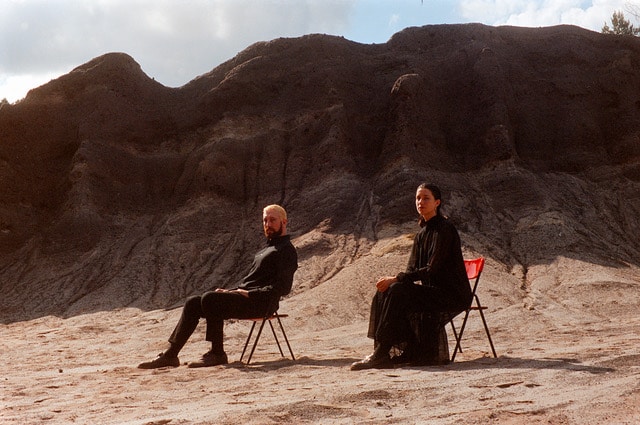
Splitting their time between Melbourne and Berlin, Kino Motel have quietly built one of the more intriguing identities in the current independent underground. The duo of Ed Fraser and Rosa Mercedes call their sound “Beach Goth,” a phrase that feels half-joke, half-perfect diagnosis: sunlit but uneasy, romantic but frayed, cinematic but scrappy. It is a label that makes immediate sense once you sit inside their music, where Australian Gothic, slacker-rock looseness, post-punk tension, and noir atmosphere coexist without ever feeling forced.
Since forming in 2020, Kino Motel have carved out a space that feels distinctly their own. After a run of singles and the release of their acclaimed 2024 debut Visions, they now return with news of their second album, Symbolism, due in 2026, led by the first single “I’m Your Scene,” arriving March 25.
Recorded in Melbourne and produced in Berlin, “I’m Your Scene” is both lament and warning. It reflects on the increasing use of AI and technology to flatten personal experience in music, to replicate feeling without ever having lived it, and to turn scenes built by real people into something synthetic and hollow. But the song is not just a complaint. It is also a defense of the fragile ecology that sustains independent music: artists, fans, bartenders, merch sellers, drivers, technicians, promoters, and the venues that hold them all together. In that sense, “I’m Your Scene” feels less like nostalgia than an urgent plea to remain present, to support human-made culture before it disappears into simulation.
That tension between dread and devotion runs through what Kino Motel do best. There is always something emotionally slippery in their work: beauty arriving through abrasion, distance making feeling sharper, ambiguity becoming its own kind of sincerity. If Visions introduced their world, Symbolism seems set to deepen it, not as a strict concept record but as a collection of moments that gain power in accumulation. Each song stands on its own, but together they create a set of signs, fragments, and emotional codes.
What makes Kino Motel compelling is that none of this feels theoretical. Their music still moves like something lived. It comes from two cities, two sensibilities, and two artists willing to let contradiction remain unresolved. Their songs do not tidy themselves up. They wander, brood, shimmer, and collide. They feel handmade in the truest sense.
Ahead of the release of “I’m Your Scene,” we spoke with Kino Motel about “Beach Goth,” AI anxiety, Berlin and Melbourne, live transformation, and what still matters in a world becoming increasingly synthetic.
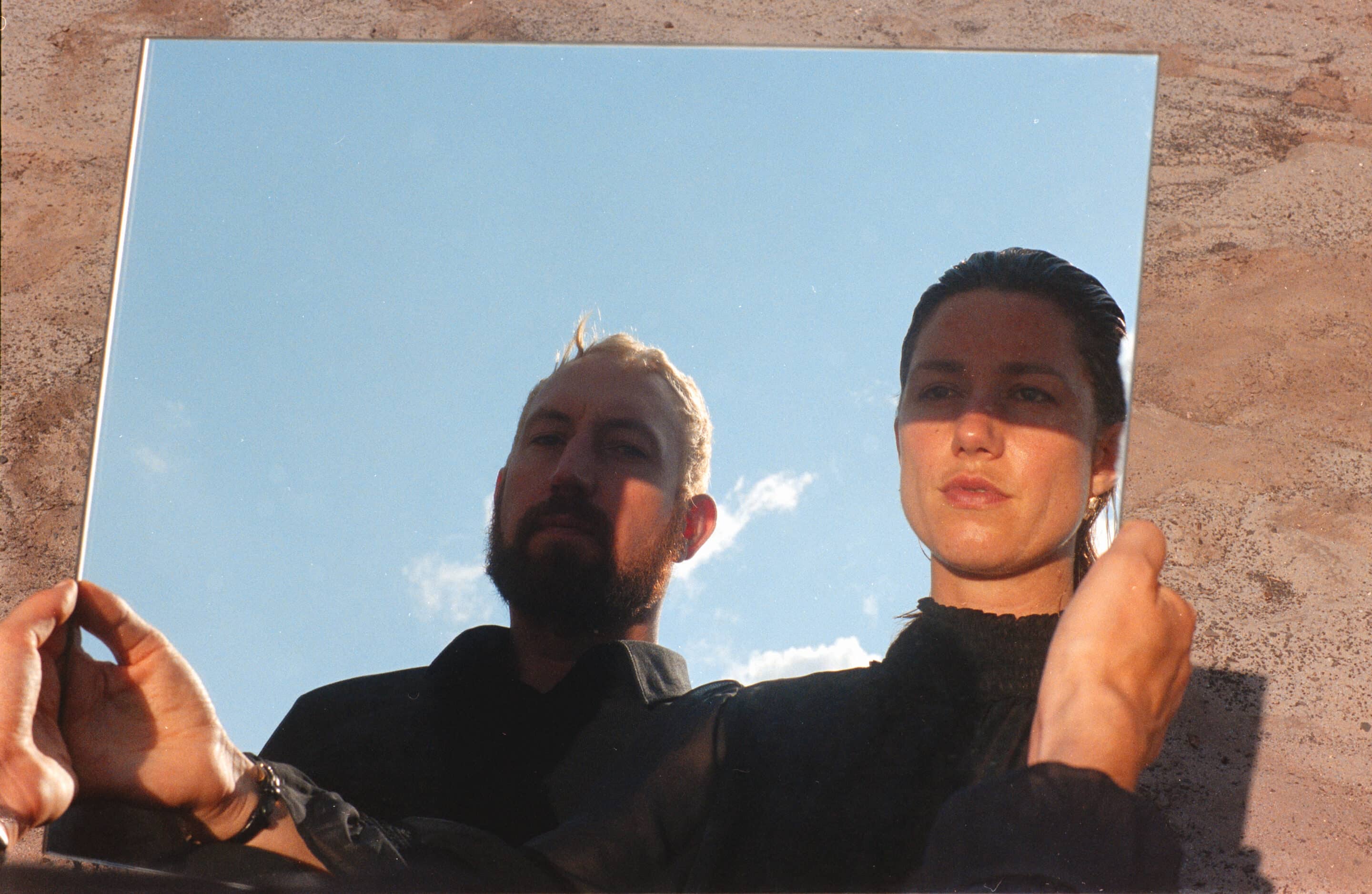
You describe your sound as “Beach Goth,” which feels both evocative and contradictory. What does that term capture that other genre labels don’t?
Ed: Yeah it is pretty contradictory, which for us was kind of the point. We’re often trying to find those places in the music where things clash, or meet each other in ways that resonate unexpectedly or surprisingly, so calling ourselves beach goths felt like it really captured that idea of what we’re often trying to do with our songs. Labelling it beach goth was also a way for us to describe the moodiness and sunniness that’s often happening all at once; the music is often dark and light, moody songs with a light subject matter and vice versa. It’s like crying on a surfboard; we’re in touch with our emotions, we’re moody, and yet we’re still having a great time haha.
Splitting your time between Melbourne and Berlin introduces two very different cultural energies. How do those cities shape the emotional tone of your music?
Rosa: We met living in Berlin, and started this project before I had ever been to Melbourne. Eddie was long ago forged in the fires of the Moonee Valley teenage rock scene. So our working together already comes with its own mix of cultural energies. I came from the land of quiet Roland jazz choruses and strange performance elements like eating pickles on stage as part of a song, and I was in shock at how loud everything was in Melbourne. But also stunned by this scene of avant-garde pub-rock and experimental tradie poets, I just love all the angular guitars and gravelly vocals Eddie’s Melbourness brings. I don’t think we plan too much – we just incorporate everything we love and have been exposed to. And because we move around between scenes, I guess we also just do our own thing for better or for worse.
Symbolism suggests a more conceptual approach compared to Visions. What are you trying to decode—or encode—through this new record?
Ed: I guess the main theme through the record is that each song is its own moment in time. Symbolism is definitely not a concept album though, it’s more this idea that each song is an individual piece and when looking at all the songs as a whole they felt like a group of symbols to us. Each song has its point, its thing that it’s trying to say.
“I’m Your Scene” directly addresses the erosion of authenticity through AI and tech. Was that frustration something that built over time, or did a specific moment trigger the song?
Ed: Yeah both things happened really. Feeling that frustration is something that’s definitely built for me over time, but there’s also a very specific moment I can remember that triggered this kind of “oh musicians are all doomed” feeling in me. A few years ago some mates in Melbourne put on this record called AISIS, which was supposed to be this lost OASIS record from the 90s but made using AI you know? And even in the early stages of this AI replication stuff it still sounded good enough to me that I could barely tell the difference between AISIS and OASIS, which may be a reflection on my limited OASIS knowledge, I’m not really sure. It hit me though, and I had this realization that anybody will be able to just instantaneously make songs in the future, no experience required, and that felt to me like it completely misses the point. To me it seems that one of the reasons a song is valuable is because it’s been written by actual people based on real things, real feelings, real thoughts, real stuff that happened. If that’s then just been duplicated and replicated without any of the realness involved then it all feels meaningless to me.
There’s a cinematic quality to your work—almost like each track exists in its own visual universe. Do you think in images when writing music?
Rosa: Yes! We watch so many films together. We get inspired by soundtracks. I’m also a visual artist and I always go between painting and song-writing. Eddie makes tons of videos and designs for us as well as other bands. I also think the cinematic feel comes from wanting to create an atmosphere and a space for a listener to inhabit that feels expansive or new or epic and we want it to end up somewhere different to where it started.
Your sound blends post-punk tension with slacker-rock looseness and noir atmospheres. How do you maintain cohesion while pulling from such different sonic worlds?
Rosa: Absolutely no idea. Sometimes you write a song and just think – that sounds very Kino. Also, Eddie and I equally put into this and can veto or change things, so the style is whatever we both really like, which thankfully narrows it down a bit. On his own, Eddie gets more abrasive and heavy, or totally ambient too. On my own I get very folksy or off-beat. In Kino, we stick to where both of us want to go, which is usually a little dark, romantic, scenic etc.
The idea of “supporting real artists” is central to your new single. Do you feel like we’re at a tipping point where the human element in music is at risk?
Ed: Yes I think so. The music industry is already hard enough for indie musicians, and a lot of musicians are just scraping by already with almost all their music being streamed essentially for free now and touring costs being higher than ever, and now the artistic creative side of it and the reason why a lot of artists make music, the expression, is being usurped and replicated and stolen by some people using AI. I also think artists who are real need to be protected. “I’m Your Scene” is very much a love letter to the actual people and spaces in music scenes. In part the song laments the increasing use of tech in music, but at the same time it also celebrates the scenes that do exist, and just wants to remind people to cherish and protect and support the things they care about, not only for the artists but also for the merch person, the bartender, the fan, the stage tech, the bus driver, and so on; everybody in the scene. It’s this big ecology that everybody exists in, and when a virus is introduced into that ecology it has the power to be very destructive.
Having toured extensively across Europe and Australia, how does performing these songs live reshape their meaning or intensity?
Ed: The songs always evolve once we start playing them live. The intensity often ratchets up, like as a tour goes on new songs start to take the form they were supposed to have, or something. I often don’t like recording songs until they’ve made it through at least one tour because I know they’re going to change and find their shape once they’ve been on stage for a while. There’s a couple songs on the new record we’ve been playing live for a few years and I’m so glad we didn’t record them earlier, they’ve only recently found this spot where it feels like they were supposed to be all along. The songs can start to feel more authentic once they’ve been played live, it’s like all the excess that doesn’t need to be there gets slowly removed. It’s like a filtration process that happens without you thinking about it or guiding it, the song just slowly morphs into its true form.
There’s often a sense of distance or detachment in your music—emotionally and sonically. Is that a reflection of modern life, or a deliberate aesthetic choice?
Rosa: I guess a certain level of detachment or space allows me to feel more, and I think that’s what we’re going for. And maybe we’re both quite stubborn! Without ambiguity I feel claustrophobic. I think the detachment might come from the fact that we love ambiguity. Maybe it’s also the kind of music that comes out of a writing process that is very reflective. We think about it a lot, write songs and come back to them, so many songs are many steps removed from the original idea because we like pushing ourselves and seeing if we can come up with something new for us.
As you step into this next era with Symbolism, what do you want listeners to hold onto in a world that feels increasingly synthetic?
Rosa: Your attention and where you put it. The love of making things, no matter how unproductive. Going places and seeing people in person. Getting dirty outside. Going on adventures. Venues and centres that provide a space for people to be together. Not taking things for granted. Buying and listening to whole albums on Bandcamp. Going down weird rabbit holes to see where they take you. Going to the library. Kindness.