Brooklyn-based band LAPÊCHE return with “Double Knotted,” the latest single from their forthcoming album Autotelic, out February 6 via Tiny Engines.
Hypnotic and quietly resolute, “Double Knotted” pairs alt-pop propulsion with introspective, elliptical lyricism. It’s a song about boundaries, persistence, and holding yourself together without demanding resolution—grounded beneath the waves rather than defined by them. The track debuted via Flood Magazine and lands as a steadying presence within a record that values process over payoff.
Fronted by Krista Holly Diem, LAPÊCHE have long carved space for emotional nuance in indie rock. On Autotelic, that instinct sharpens into a patient, immersive sound world—trading post-punk edges for gothic shimmer, shoegaze drift, and melodic minimalism. Recorded in Joshua Tree and produced by Alex Newport (At The Drive-In, Bloc Party, Death Cab for Cutie), the album absorbs the desert’s stillness: arrangements breathe, repetition becomes mantra, and restraint carries a quiet spiritual charge.
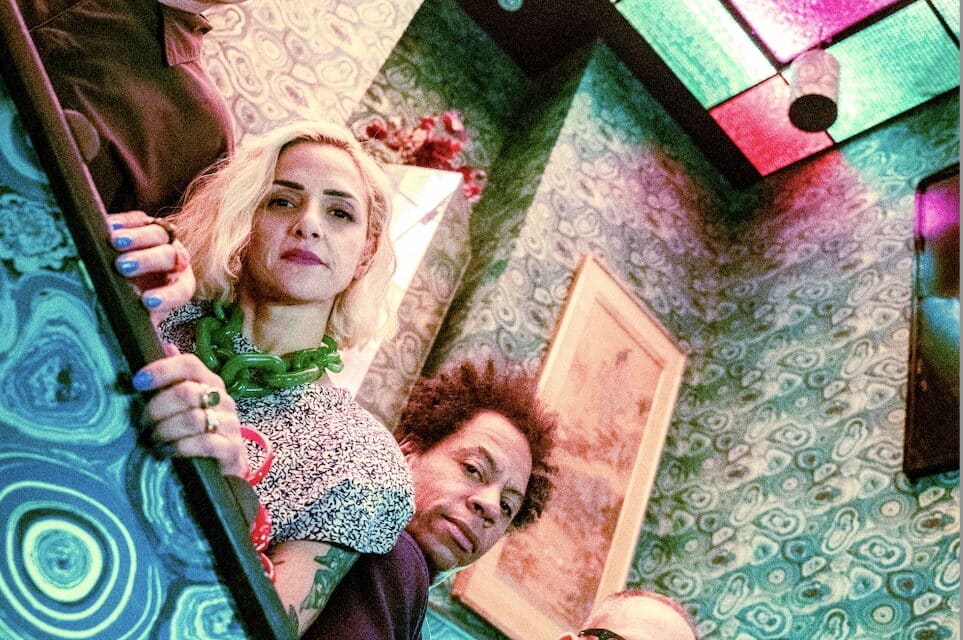
Formed in 2016 as Diem’s solo project, LAPÊCHE has evolved into a fully collaborative band with longtime members Dave Diem (bass) and Drew DeMaio (guitar), joined by drummer Colin Brooks (Samiam). Much of Autotelic’s clarity is rooted in lived experience—Krista and Dave’s shared sobriety informing a songwriting language built on care, honesty, and presence. The result is a record that doesn’t rush to explain itself, inviting listeners to feel more than they understand.
Below, LAPÊCHE discuss grounding amid chaos, writing without chasing outcomes, and why Autotelic asks listeners to remain—rather than arrive.
“Double Knotted” feels suspended between motion and stillness. How did you translate grounding amid chaos into the song’s rhythm and structure?
“Double Knotted” came from trying to stay steady without freezing. We weren’t focused on resolution or release, but on persistence and learning to be comfortable with uncertainty and with being right where you are. The rhythm holds a sense of forward motion without acceleration—like staying upright while everything else shifts. Structurally, the song circles instead of building for building’s sake. It’s less about arriving somewhere and more about remaining present while things move around you.
You describe the track as persistence and presence rather than control. How has that mindset changed how you write—and live—now?
Earlier work was more attached to outcomes: clarity, feeling “better,” or hoping enough people liked the music. Now we’re more comfortable staying inside uncertainty without trying to master it. Persistence feels quieter than control. It’s about continuing without demanding proof that it’s working. That shift has changed how we write and live—more listening, more patience, less pressure to resolve what can’t be resolved yet.
Autotelic is rooted in doing something for its own sake. What does that look like in practice in the studio?
We don’t rush ideas toward usefulness. Parts are allowed to exist before deciding what they need to become. Sometimes something stays because it feels true, not because it serves momentum or payoff. Writing this way requires trust—in each other and in the process we shared with Alex Newport. The work becomes less about productivity and more about allowing.
The album trades post-punk edges for gothic shimmer, shoegaze drift, and melodic minimalism. Was that intuitive or experimental?
It felt intuitive—but only because we allowed restraint and trusted our producer. We weren’t stripping things back as an aesthetic move; we were trying to hear what was already there. Once we stopped pushing against space, the shimmer and drift emerged naturally. It felt less like a shift and more like uncovering something waiting underneath the noise.
How did recording in Joshua Tree shape the album’s emotional pacing?
The desert doesn’t reward urgency. It asks you to slow down and listen longer than you want to. That shaped the pacing—sonically and emotionally. There’s room for things to linger, repeat, and breathe. Being there gave us permission to let songs move at their own speed, even within a deadline. Multiple things can be true at once.
Alex Newport’s production feels patient rather than explosive. What was that collaboration like?
Alex trusts what’s already working. He pushed the writing without forcing bigger moments, helping us notice the small ones. The dynamic was calm and attentive. He trusted repetition, texture, and quiet—and that patience shaped both the sound and the emotional tone.
Shared sobriety and healing inform the record. How does that affect trust and vulnerability in the room?
Krista and Dave’s shared sobriety created a foundation of honesty. There was a common language around care that didn’t need explaining. That clarity extended to the rest of the band—less performance, more listening. Vulnerability felt safer, not because it was easy, but because it was understood and protected.
Why does restraint resonate for you as an emotional tool?
Restraint feels closer to how emotions actually behave. Life moves through expansion and contraction, not constant escalation. Feelings loop, soften, or stay. Repetition and space mirror that rhythm, creating room for movement and pause. The music invites listeners in without telling them what to feel.
“Happy 4U” holds joy and grief side by side. How do you write complex emotions without resolving them?
We let emotions stand next to each other without forcing meaning or hierarchy. Joy and grief often arrive together, and resolving that tension can feel dishonest. Naming the feeling can be enough. Not everything needs a conclusion to be true.
After spending time with Autotelic, what do you hope listeners sit with—rather than understand?
We hope listeners feel less alone in their contradictions. The record doesn’t need to be understood so much as lived with. If it offers a sense of connectedness—a place to sit without fixing or explaining—that’s enough.