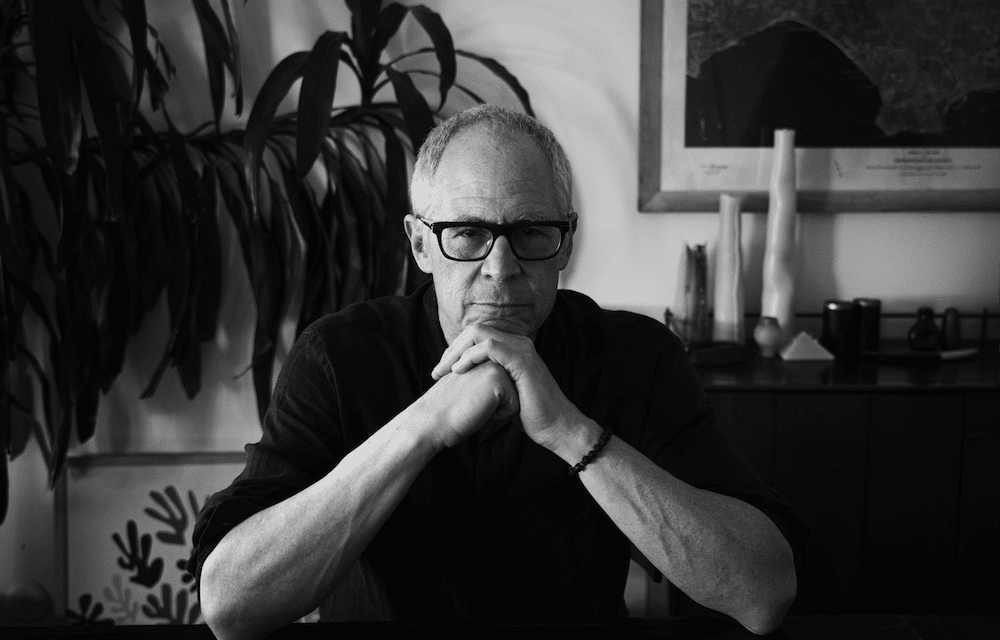
After decades composing for film, television and theater, the grandson of Richard Rodgers is preparing his first album of his own songs. “Still Here,” written in the aftermath of the 2018 Montecito debris flow, reveals what changed when Melnick stopped serving somebody else’s story and began using music to make sense of his own: disaster, inherited trauma, healing, family and the strange privilege of surviving.
Peter Melnick knows how to serve somebody else’s story.
He has spent much of his life doing exactly that.
Film.
Television.
Musical theater.
More than three dozen screen productions.
Broadway-bound work.
Orchestras.
Arrangements.
Scores.
Characters who aren’t him.
Stories that belong to somebody else.
“When I’m composing a film score, I’m there to serve someone else’s vision,” he says. “I’m helping them tell their story.”
It’s a skill that has taken him through projects including L.A. Story, The Only Thrill, Convicts, Farce of the Penguins, Cinema’s Exiles: From Hitler to Hollywood, Indictment: The McMartin Trial, Grand Avenue and Lily Dale.
But now, after a lifetime of helping other people tell stories, Melnick is doing something surprisingly radical.
He’s telling his own.
His debut album Cave Art for Modern Times is due in 2027.
And its latest glimpse, “Still Here,” begins with one of the most fundamental stories imaginable.
Something terrible happened.
People died.
Others survived.
And afterward, nobody was quite the same.
First, the Mountain Came Down
In January 2018, an intense rainstorm triggered the catastrophic Montecito debris flow.
Boulders and an enormous wall of mud descended from the hills above the California community within minutes.
Hundreds of homes were destroyed.
Twenty-three people died.
For those connected to Montecito, the disaster permanently divided time.
Before.
After.
Melnick was thousands of miles away when the flood happened, but distance did not insulate him from what it did to his community.
Later that year, another rainy season approached.
The memories returned with it.
And eventually, without necessarily deciding in advance that this experience should become a song, Melnick found himself writing one.
“Seriously… when I found myself writing it.”
That’s his answer when asked when he realized the disaster needed to become music.
There wasn’t a meeting with himself.
No intellectual decision that the event would make compelling material.
The feeling arrived first.
“A lot of my songs start that way, with a feeling that’s too big to know what to do with.”
Then comes the mysterious part.
Something appears in his head.
Or his hands find the piano.
Or the guitar.
He follows.
“At that point, I try to ride that first wave of energy as far as it will take me, without thinking about it too much.”
Eventually that wave became “Still Here.”
Disaster Used to Happen Over There
One of the most unsettling things catastrophe can destroy is the imaginary distance between us and them.
Before Montecito, Melnick says he could read about a disaster and care.
He could understand intellectually that something terrible had happened.
But it remained elsewhere.
“Something that happened over there, to someone else.”
Montecito collapsed that distance.
“Everyone who survived that deadly night was transformed by it,” Melnick has said. “If until then you had been lucky enough to live a life untouched by disaster, you just received a crash course in the fragility of human existence.”
That lesson changed how he processes the statistics accompanying catastrophe.
Because numbers do something strange to empathy.
One person is imaginable.
Twenty-three people begin becoming a statistic.
Thousands become almost abstract.
“The bigger the numbers, the harder it is to comprehend, because each human being touched by a disaster is a whole universe of pain and sorrow.”
A whole universe.
That idea sits at the emotional center of “Still Here.”
Not disaster as spectacle.
Disaster at human scale.
One life.
One family.
One house.
One absence.
One person still standing afterward trying to understand why.
Compassion Is a Muscle
Melnick doesn’t believe compassion is simply something you either possess or don’t.
He describes it as a muscle.
Something that can be strengthened.
That framing matters because it turns empathy from personality trait into practice.
“It’s something that can be strengthened by a conscious decision to try to understand what’s happening on a human level.”
Disaster taught him to look past scale and toward individuals.
But “Still Here” doesn’t stop at devastation.
Because the Montecito story didn’t.
Melnick remembers the stories of people helping one another during the terror.
People showing up.
People giving.
People continuing to care for one another long after the immediate emergency ended.
“There’s so much darkness in the world, but also so much that’s miraculously good.”
The catastrophe revealed both.
And leaving either one out would have made the song less truthful.
“The debris flow put an entire community of people in touch with the finest qualities of humanity, and that’s something worth singing about.”
A Song About Survival Needed a Village
There’s a lovely irony to the construction of “Still Here.”
It’s an intimate song about community.
And it took a community to make.
Produced by Joseph E-Shine, the recording gathers an extensive ensemble around Melnick’s songwriting.
Curtis Kelley plays drums.
Randy Tico plays bass.
Tommy King plays piano.
Davy Nathan handles organ and keys.
Melnick plays acoustic guitar.
E-Shine contributes electric guitars and mandolins.
Philip Glenn plays accordion and violin.
Giovanna Clayton plays cello.
Drew Taubenfeld contributes pedal steel and mandolin.
Adam Levy plays electric guitar.
Melnick himself arranged and conducted the horns and strings, with Steven Becknell on horn, Alan Kaplan on trombone and Brad Moller on tuba.
That’s a lot of musical information to place around a vulnerable story.
The challenge is obvious:
How do you make the recording expansive without allowing the arrangement to swallow the human being inside it?
For Melnick, the answer begins with E-Shine.
“He has a gift for harnessing the music to the storytelling.”
That word—harnessing—is useful.
The instrumentation isn’t there to display how many accomplished musicians can fit inside a recording.
Everything has to remain subordinate to the story.
The Voice Had to Sound Lived In
Interestingly, Melnick isn’t the person singing “Still Here.”
That role belongs to Mark Campbell.
For a songwriter finally placing his own stories at the center of his work, handing the vocal to someone else might seem like creating distance.
Melnick hears the opposite.
Campbell possesses the quality the song requires.
Warmth.
Experience.
A voice that sounds as though it has already lived through something.
“His voice is a powerful, beautiful instrument, but its greatest strength is its ‘lived in’ quality.”
That’s particularly important for “Still Here.”
The song doesn’t need somebody to demonstrate grief.
It needs somebody who can inhabit it without theatricalizing it.
Melnick puts it considerably more simply.
“I love Mark’s voice!”
Sometimes analysis can stop there.
The Song Arrived. Then the Composer Went to Work.
Melnick describes feeling “privileged” that “Still Here” came through him.
It’s a revealing choice of language.
Not:
I invented it.
Not:
I engineered it.
It came through.
That could sound romantic coming from someone without Melnick’s background.
But he’s spent a lifetime immersed in composition and arrangement.
He knows perfectly well that songs require craft.
His point is that intuition and technique aren’t enemies.
The mysterious first impulse is only part of the process.
“Yes, I think that’s true. But there needs to be a seamless blending of that natural flow and craft.”
The ideal is to erase the seam.
“If you’re doing it right, no one should be able to tell where the intuitive process lets off and where the craft part begins.”
That’s perhaps the composer’s version of magic.
Something can feel inevitable precisely because an enormous amount of skill has gone into making the machinery invisible.
Which brings us, inevitably, to Richard Rodgers.
Yes, His Grandfather Is Richard Rodgers
There is no particularly casual way to mention that your grandfather wrote “Blue Moon,” “My Funny Valentine” and “My Favorite Things.”
Or that he helped create Oklahoma!, Carousel, The King and I, South Pacific and The Sound of Music.
Peter Melnick’s grandfather was Richard Rodgers.
His father, Daniel Melnick, was also a formidable creative figure, producing films including Straw Dogs, All That Jazz, Altered States and Footloose, as well as the television series Get Smart.
That is an absurd amount of artistic history to inherit.
But Melnick doesn’t speak about the lineage as a burden he has spent his life attempting to escape.
He loves their work.
He feels fortunate.
“They passed on some pretty terrific genes, which I do not take for granted.”
What matters more, though, is the standard they passed down.
Not a sound.
Not a genre.
Not instructions to imitate Rodgers and Hammerstein.
A belief in specialness.
Melnick remembers his aunt Mary describing Richard Rodgers’ music as:
“Surprising but inevitable.”
His father’s proudest films similarly shared a quality of singularity.
All That Jazz.
Altered States.
Footloose.
L.A. Story, which Peter himself scored.
“They were all one-of-a-kind achievements.”
That’s the inheritance Melnick seems most interested in carrying.
“Creating something wonderful that could only have come from them.”
Not:
Sound like your grandfather.
Rather:
Make something that could only have come from you.
That’s a much more difficult legacy.
His Favorite Song in the Universe Is Still Rodgers and Hammerstein
For all the discussion of artistic independence, Melnick isn’t pretending his grandfather’s music doesn’t live deeply inside him.
His favorite piece of music “by anyone, anywhere in the known universe” is “Something Wonderful” from The King and I.
There is something touching about that.
Melnick doesn’t need to diminish the family legacy in order to establish his own identity.
He can adore it.
Carry it.
Learn from it.
And still make something else.
Legacy becomes dangerous only when inheritance turns into instruction.
Melnick seems to have inherited the standard rather than the formula.
Make it special.
Make it yours.
You’re Going to Have to Serve Somebody
When discussing the difference between songwriting and scoring, Melnick invokes Bob Dylan:
“You’re going to have to serve somebody.”
Film composers know this intimately.
A score is not autonomous.
It serves picture.
Character.
Pacing.
The director.
The emotional architecture of a story that already exists outside the music.
Melnick has spent decades becoming fluent in that form of service.
Songwriting retains the storytelling but changes who chooses the story.
“The difference is, as a songwriter I’m engaged in telling the stories that matter most to me.”
And something else happens.
The process talks back.
“Sometimes the process reveals things to me that help me make sense of my own life.”
That may be the real shift happening as Melnick approaches his debut album.
He isn’t simply moving from commissioned composition to personal songwriting.
He’s using the craft that spent decades interpreting other people’s narratives to interpret himself.
Musical Theater Taught Him What Not to Say
Melnick is simultaneously working toward Broadway with an adaptation of Snow in August alongside lyricist Mindi Dickstein and librettist Roberto Aguirre-Sacasa.
He’s a Drama Desk-nominated musical theater composer.
Ask what theater teaches him about writing a self-contained song and his first response is:
“Great question! Got an hour..?”
Fair.
The condensed answer is about terms.
Every story establishes its own rules.
Genre.
Tempo.
Feel.
How much information the audience requires.
What should be stated.
What should only be suggested.
What should never be explained.
The craft changes between a musical and an individual song, but Melnick believes two obligations remain universal.
“You need to make the listener feel something.”
And:
“If you want to do that, you damn well better keep them interested!”
Richard Rodgers would probably recognize the principle.
This Isn’t Journalism
Melnick’s debut album will tell us more about him than his previous work has.
But he makes an important distinction.
“The songs draw deeply on my life, but they’re storytelling, not journalism.”
The album isn’t an affidavit.
Memory becomes material.
Experience gets shaped.
Facts become songs.
But there is a through line.
And it is considerably bigger than one disaster.
Trauma.
Family.
Generations.
The ways pain travels forward.
And the possibility that healing might travel forward too.
“In some sense, Cave Art for Modern Times is a love letter to my family—all of them, past present and future.”
Suddenly the title feels especially appropriate.
Cave art was one of humanity’s earliest attempts to leave evidence.
We were here.
This happened.
This mattered.
Here are the animals we saw.
Here are the lives we lived.
Here is what our hands looked like against the wall.
Melnick’s modern version appears interested in a similar impulse.
Leave something behind.
Tell the story.
Maybe understand it better by telling it.
Still Here
There is one phrase in Melnick’s conversation about the album that quietly reframes everything around it.
“Getting to a place where I like myself and love myself, that’s been the gift of a lifetime.”
Not the credits.
Not the artistic lineage.
Not scoring L.A. Story.
Not Broadway.
Not six decades of accumulated musical knowledge.
Learning to love himself.
And perhaps that is where “Still Here” becomes larger than the event that produced it.
Survival is physical.
But it’s also emotional.
Familial.
Creative.
Generational.
You survive what happened to you.
Then you try to understand what happened before you.
Then perhaps you try not to hand all of it unchanged to whoever comes next.
Melnick isn’t pretending life stops hurting once you understand that.
“I think it’s a given that life is going to be painful some of the time, one way or another.”
But pain isn’t the only inheritance.
Neither is disaster.
Neither is trauma.
There is also music.
Family.
Community.
Compassion.
The stranger who shows up when everything collapses.
The producer who understands the story.
The singer whose voice has lived enough life to carry it.
The musicians who gather around the song.
The grandfather whose music taught you that something can be surprising and inevitable.
The father whose films taught you that the goal is to make something nobody else could have made.
And, eventually, gratitude.
“I doubt you’ll meet anyone who feels more grateful than me for what life has given them.”
After a lifetime spent helping other people tell their stories, Peter Melnick is finally telling us his.
The title of the first chapter says almost everything.
He’s still here.
In Conversation With Peter Melnick
“Still Here” emerged after the 2018 Montecito debris flow and the return of the rainy season brought those memories back. What was the moment when you realized that experience needed to become a song?
Seriously… when I found myself writing it. A lot of my songs start that way, with a feeling that’s too big to know what to do with. What happens next is kind of a mystery. I hear something in my head, and try to bring it out. Or I find myself noodling at the piano or on a guitar. At that point, I try to ride that first wave of energy as far as it will take me, without thinking about it too much.
You’ve described the disaster as a “crash course in the fragility of human existence.” How did living through something so devastating change your understanding of gratitude, community, and what it means to feel safe?
Before that, when I read about a natural disaster, I think I responded with a degree of care and concern, but it was something that happened over there, to someone else. Today I connect more with the enormity of the lives upended, the lives lost. The bigger the numbers, the harder it is to comprehend, because each human being touched by a disaster is a whole universe of pain and sorrow. I don’t think compassion is an absolute thing, and it’s not the same for everyone. It’s a muscle, something that can be strengthened by a conscious decision to try to understand what’s happening on a human level.
Rather than focusing solely on tragedy, “Still Here” also captures the humanity that emerges in the aftermath of disaster. Why was it important for resilience and connection to sit alongside grief in the song?
Because that’s what the experience was. I was thousands of miles away on the night the flood happened, but there are so many stories of people showing up for one another in the midst of the terror, in extraordinary ways. And that kind of caring and giving continued in the aftermath of the disaster. There’s so much darkness in the world, but also so much that’s miraculously good. The debris flow put an entire community of people in touch with the finest qualities of humanity, and that’s something worth singing about.
The recording has a warm, Roots-inspired quality and features an extraordinary ensemble of musicians. How did you approach the arrangement so that all of those instrumental voices could enrich such an intimate story without overwhelming it?
Thank you! That has everything to do with my producer, Joseph E-Shine, who has a gift for harnessing the music to the storytelling. Joseph brought so much to the project. In addition to being a marvelous guitarist, he is also highly crafted in the recording arts, which isn’t necessarily true of everyone calling themself a music producer. Joseph also happens to be a superb human being, who naturally brings enormous emotional nuance to the music-making.
You’ve spent much of your career composing music in service of film, television, and theater. What feels different about finally placing your own experiences and songwriting voice at the center of the work?
I’m thinking of the Dylan lines, “You’re going to have to serve somebody.” When I’m composing a film score, I’m there to serve someone else’s vision. I’m helping them tell their story. On one level, the job is the same when I’m writing a song: it’s musical storytelling. The difference is, as a songwriter I’m engaged in telling the stories that matter most to me. And sometimes the process reveals things to me that help me make sense of my own life. I have occasionally had that experience while working on a film or when writing a show, but lots more in songwriting.
You said of “Still Here,” “I feel privileged that it came through me.” Do your most personal songs feel less like something you consciously construct and more like something you discover?
Yes, I think that’s true. But there needs to be a seamless blending of that natural flow and craft. And if you’re doing it right, no one should be able to tell where the intuitive process lets off and where the craft part begins.
Mark Campbell ultimately became the voice telling this particular story. What did you hear in his performance that made you feel he could communicate the emotional weight of the song?
That’s who Mark is, just the way he sings. He brings so much warmth to the party. His voice is a powerful, beautiful instrument, but its greatest strength is its “lived in” quality. I love Mark’s voice!
You come from an extraordinary artistic lineage, from your father Daniel Melnick to your grandfather Richard Rodgers. As you prepare to release your debut album, how do you think about that legacy without allowing it to define what your own music is supposed to sound like?
I’ve come into my own as an artist in a very organic way, and I’m really fortunate that I have a strong sense of my own creative voice. My father and grandfather’s legacies to the world are incredible, and I deeply love their work. I do feel a personal legacy from both of them, which I experience in purely positive ways. They passed on some pretty terrific genes, which I do not take for granted.
But more than that, their creative legacy to me is the thing they had in common. It has to do with, I dunno, specialness. My aunt Mary talked about my grandfather’s music as “surprising but inevitable.” And my father’s pride in his best work—films like All That Jazz, Altered States, Footloose and L.A. Story, which I scored—was that they were all one-of-a-kind achievements.
That’s what engaged them—creating something wonderful that could only have come from them—and by example, that’s the bar they set for me. “Something Wonderful,” by the way, is the title of a Rodgers and Hammerstein song from The King and I that is my absolute favorite piece of music by anyone, anywhere in the known universe.
At the same time, you’re working toward Broadway with Snow in August. What does musical theater teach you about storytelling that you find yourself carrying into a song as personal and self-contained as “Still Here”?
Great question! Got an hour..?
The craft required is very different, certainly. And with Snow in August, I’m just writing the music. The short-ish answer is that every song and every show is a story that sets its own terms, and you need to pay attention to that—decisions about genre, feel, tempo, etc.
But as a storyteller, you have certain obligations that apply across the board. It’s your job to choose how much information to share, how much to suggest, and what to leave out entirely. And two things are universally true: You need to make the listener feel something. And if you want to do that, you damn well better keep them interested!
Your 2027 debut album represents years of songwriting finally coming together as one body of work. After spending a lifetime composing across so many different mediums, what are we going to learn about Peter Melnick the person through this record that we couldn’t learn from your previous work?
The songs draw deeply on my life, but they’re storytelling, not journalism. That said, there is a through line to the album, and it has to do with the idea of trauma going through the generations of a family, and also with belief in the possibility of healing.
In some sense, Cave Art for Modern Times is a love letter to my family—all of them, past present and future. I think it’s a given that life is going to be painful some of the time, one way or another. But my life has given me so, so much. And getting to a place where I like myself and love myself, that’s been the gift of a lifetime.
I doubt you’ll meet anyone who feels more grateful than me for what life has given them. And working on the album this past year, that’s been a huge part of that.