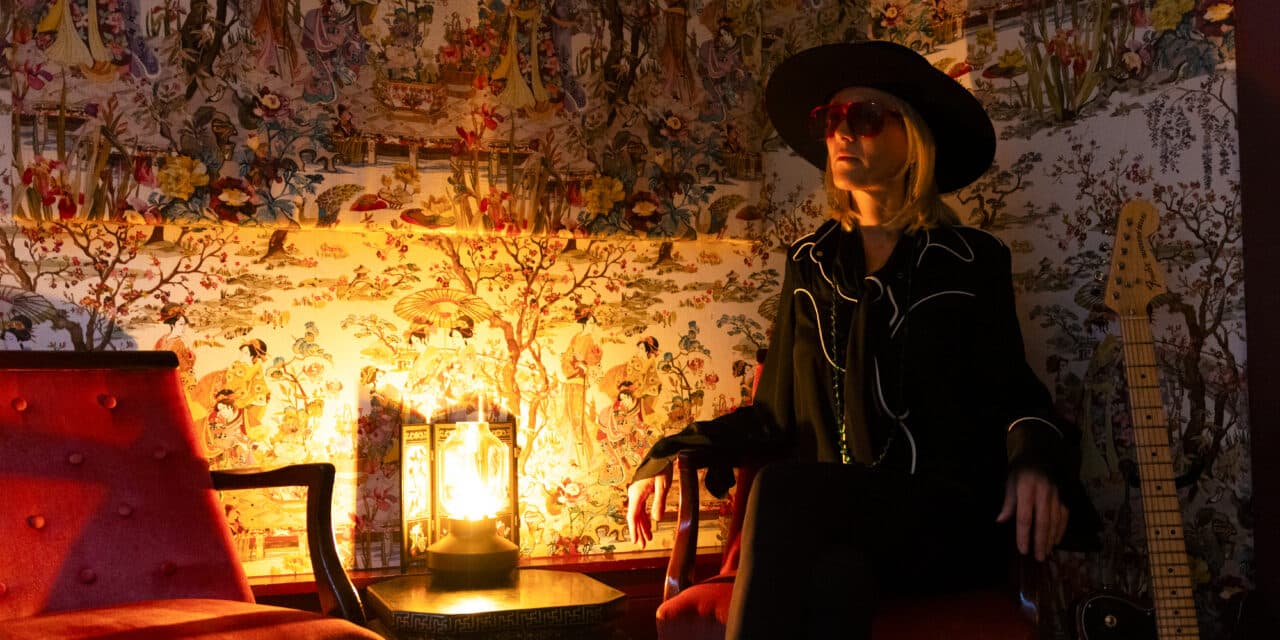
A birthday in New Orleans, a morning walk with her best friend, an unexpected tarot reading and a soundtrack that reminded her of her teenage goth years became “The Lady Who Reads The Cards.” For Bird, the encounter is the beginning of another musical chapter—and proof that sometimes the best stories begin with something you’re not supposed to know.
Bird is not going to tell you what the tarot reader said.
This is mildly frustrating.
She will tell you where it happened.
New Orleans.
She will tell you when.
During a trip to the United States earlier this year, where she had been invited to perform at the Folk Alliance Conference.
She will tell you that it happened around her birthday.
That her best friend had flown over to celebrate with her.
That they were walking around town one morning when she noticed a sign advertising tarot readings.
She will even tell you what was playing when she entered the shop.
Something that reminded her of Fields of the Nephilim, a band she loved during her teenage goth period.
But the actual reading?
Absolutely none of our business.
“I’m not going to tell you what the lovely lady I spent half an hour with said.”
Fair.
Fortunately, Bird did something considerably more useful with the experience.
She wrote “The Lady Who Reads The Cards.”
New Orleans Has a Way of Making Reasonable Decisions Seem Boring
Bird—born Janie Price, a half-Irish, half-English singer-songwriter, filmmaker and classically trained multi-instrumentalist based between Tuscany and London—had never had a tarot reading before.
Then New Orleans happened.
Maybe it was the city.
Maybe it was the birthday.
Maybe it was having her best friend there.
Maybe some experiences simply become more plausible when you’re walking through a place already saturated with mythology, music and the suggestion that the border between ordinary life and something stranger might be temporarily negotiable.
“Something about the New Orleans vibe, the birthday, my best friend being there too… made me decide I should give it a go.”
So she walked inside.
And apparently the universe had also decided to score the scene correctly.
“When I walked into the shop I noticed they were playing something that reminded me of Fields of The Nephilim, which I loved during my goth period as a teenager.”
It’s almost suspiciously perfect.
The former teenage goth.
The tarot shop.
New Orleans.
The mysterious woman.
The birthday.
If Bird had written this scene for a film, someone might have suggested making it slightly less obvious.
Reality declined the note.
The Reading Stays Secret
What happened over the next half hour belongs to Bird.
That’s actually what makes the story interesting.
Because “The Lady Who Reads The Cards” isn’t an exposé of the reading.
Bird doesn’t hand listeners a transcript.
The private experience stays private.
What survives publicly is the atmosphere it created.
“I do know that I wouldn’t have this song without that experience.”
That’s the transaction.
The tarot reader gave Bird something we don’t get to know.
Bird turned the emotional residue into something we do.
A song.
Maybe that’s how storytelling often works.
The facts themselves aren’t necessarily the art.
What the facts disturb, awaken or rearrange inside somebody becomes the art.
Bird describes the encounter as “strange but beautiful.”
And then she did what songwriters do when reality hands them something too evocative to leave alone.
She opened the lyric book.
From New Orleans to Belgium
The song didn’t emerge fully formed inside the tarot shop.
First came the sketch.
“First I sketched the lyrics out.”
Then the story traveled.
Later, during a writing week in Belgium, Bird reunited with longtime friend and collaborator Jeroen Swinnen.
Together, they finished the song.
Their creative relationship already extends beyond Bird’s own catalog. The pair have written for other European artists, including Chiara Dubey’s “Secrets and Lies,” which reached the Swiss national Eurovision finals, and Stan Van Samang’s “Hot Shot,” a 2026 Zomerhit finalist.
But “The Lady Who Reads The Cards” began somewhere much less structured.
A sign.
A decision.
Thirty minutes with a stranger.
A few lines in a lyric book.
Then another country.
Another room.
Another collaborator.
Songs are weird like that.
Then Darryl Jones Shows Up
The geography of the recording expands even further.
“The Lady Who Reads The Cards” was recorded partly across Nashville, Texas and London.
And somewhere along that journey, Darryl Jones ended up playing bass.
Yes.
That Darryl Jones.
The musician known for his longstanding work with The Rolling Stones and his earlier work with Miles Davis.
Which is an impressive amount of musical history to suddenly introduce into a song that began because Bird impulsively walked into a tarot reading while celebrating her birthday.
But the international construction makes sense within Bird’s broader practice.
Her most recent album, Held Here Together, released in June 2026, was itself recorded across Tuscany, Nashville and Austin and included collaborations with Andy Dunlop of Travis, Ally McErlaine of Texas and Hal Lindes of Dire Straits.
Bird’s songs appear to enjoy collecting passports.
A Country Beat Walks Into a Ghost Story
Musically, “The Lady Who Reads The Cards” doesn’t settle neatly into one tradition.
There is a foot-stomping country beat.
Handclaps.
Triangle percussion.
Layered vocals.
Sweeping strings.
Folk and Americana.
And an atmospheric quality designed to evoke the heat, color and mystery surrounding the story’s American setting.
That combination makes particular sense for Bird.
She began classical cello training at six.
She played in UK youth orchestras.
Her first professional recording session came at 18, composing and recording strings for a UK rap act.
Since then, she’s moved between songwriting, session work, arranging, touring and her own records.
She has composed and recorded string sections for Just Jack, performed live with Emeli Sandé and toured with violinist Vanessa Mae.
So when strings enter Bird’s music, they aren’t decorative evidence of seriousness.
They’re part of her first musical language.
But that language has spent years colliding with others.
Folk.
Indie.
Americana.
Pop.
Rock.
And now, apparently, the spiritual residue of a New Orleans tarot shop.
The Teenage Goth Never Really Left
Perhaps the funniest detail in the entire story is Fields of the Nephilim.
Because artists rarely move cleanly from one version of themselves to another.
The teenage goth doesn’t disappear when someone becomes an adult folk songwriter.
The classically trained cellist doesn’t disappear when the country beat arrives.
The session musician doesn’t disappear when the singer-songwriter steps forward.
The filmmaker doesn’t disappear when she’s writing lyrics.
Everything stays somewhere in the building.
Then one morning you’re in New Orleans, walk into a tarot shop, hear something that reminds you of music you loved as a teenager and suddenly several versions of yourself are occupying the same room.
That’s the kind of coincidence songwriters are professionally incapable of ignoring.
Bird Collects Stories
“The Lady Who Reads The Cards” also makes more sense when you consider Bird’s work outside music.
She’s an award-winning filmmaker.
Her documentary You Found A Friend In Elvis has appeared at international and American film festivals, including the Lighthouse International Film Festival.
Different medium.
Same instinct.
Find the character.
Find the strange human detail.
Find the story hiding inside the encounter.
Her music operates similarly.
A lived moment doesn’t have to remain documentary reality.
It can expand.
A tarot reader can become The Lady Who Reads The Cards.
A private half hour can become an entire sonic landscape.
New Orleans can become more than a location.
It becomes atmosphere.
The best stories tend to do that.
They begin somewhere extremely specific and somehow end up larger than the circumstances that created them.
Six Albums In, Another Beginning
“The Lady Who Reads The Cards” arrives only a few months after Held Here Together, but Bird describes it as the beginning of another chapter.
A forthcoming project will be fully announced early next year.
For an artist already six albums into her career, that matters.
Bird has released The Insides, Girl and A Cello, Figments Of Our Imagination, Beat, Wider Than The Sky and Held Here Together.
There is enough history there to settle into a recognizable formula.
Instead, the new single begins with an impulsive encounter thousands of miles from home.
Maybe longevity requires remaining interruptible.
Still willing to walk into the strange shop.
Still willing to follow the weird idea.
Still willing to let an unfamiliar place change the next thing you make.
Don’t Ask What the Cards Said
There is an obvious temptation to return to the mystery.
What did the tarot reader actually tell Bird?
Good news?
Bad news?
Career?
Love?
The future?
Some devastatingly specific observation that caused her to stare silently into the middle distance for the rest of the afternoon?
We don’t know.
And we probably shouldn’t.
Because revealing the reading would almost make the story smaller.
The interesting part isn’t whether the cards accurately predicted something.
It’s what happened because Bird decided to walk through the door.
A half-hour encounter became lyrics.
The lyrics traveled to Belgium.
The music traveled through Nashville, Texas and London.
Jeroen Swinnen entered the story.
Darryl Jones entered the story.
Strings arrived.
Handclaps arrived.
A country beat arrived.
And eventually a private birthday memory became a song strangers can hear anywhere.
Whether or not you believe tarot cards can predict the future is almost beside the point.
These ones apparently predicted a record.
That’s not bad for a morning off.