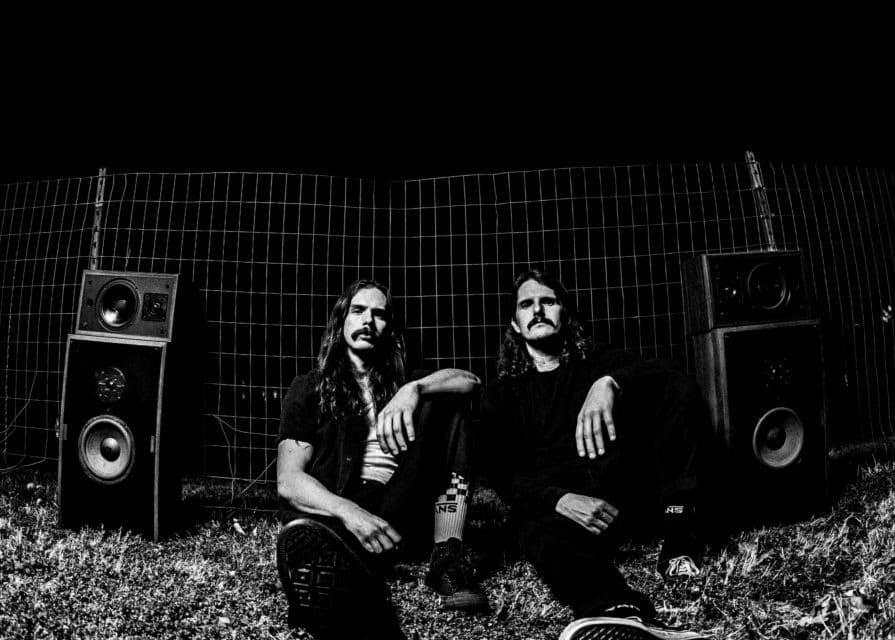
When The Swell Fellas changed, brothers Conner and Chris Poole decided not to pretend the band was still the same thing. They closed the chapter instead. On Materializer’s debut As The Body Flies, the Nashville duo turn that ending into their heaviest music yet—and discover that heaviness means considerably more when there’s something weightless on the other side.
There are several ways to deal with a band changing.
Replace somebody.
Reconfigure.
Keep the name.
Announce a “new era.”
Continue playing the songs.
Maybe change the logo.
Conner and Chris Poole chose something more definitive.
They ended it.
After eight years with The Swell Fellas—years of DIY shows, endless road miles, creative evolution and tours alongside bands including King Buffalo, All Them Witches, YOB, Cave In and ASG—the brothers found themselves facing a different equation.
And Conner is surprisingly mathematical about what happened next.
“For us, TSF was a sum of its parts and when the equation changed we knew it was something new that would be born.”
So instead of forcing the old name to contain a new reality, they preserved it.
The Swell Fellas ended.
Materializer began.
Emotionally, the decision wasn’t easy.
Creatively, it apparently was.
“It felt most natural to preserve the legacy we built together by closing that chapter, and giving ourselves the opportunity to enter a new world to be creative in.”
That new world became As The Body Flies, Materializer’s debut full-length, arriving October 2.
It is technically the first album by a new band.
It was made by musicians with years of shared history.
And somewhere between those two truths is the entire point.
The Equation Changed
Reinvention is usually marketed as an act of addition.
New sound.
New look.
New collaborators.
New ambitions.
Materializer began with subtraction.
Two people remained.
That absence could have been treated as a limitation.
Instead, Conner and Chris found themselves staring at all the empty sonic territory suddenly available to them.
“Unexpectedly I think we found some kind of strange freedom in the amount of space we each had to fill to make it work as a two piece.”
A duo has nowhere to hide.
Every guitar part matters.
Every drum pattern matters.
Silence matters.
Weight matters.
If something disappears, you notice.
That forced the brothers to think differently about how a song carries itself.
There was “extra thought” required to make every moment melodically and rhythmically interesting while still maintaining the necessary force.
Which is particularly important when your stated objective is fairly modest:
Make the heaviest record you’ve ever made.
Heaviness Is Useless Without Weightlessness
Materializer operate somewhere around stoner metal, doom, psychedelic rock and the heavier end of alternative music, with reference points including Sleep, The Sword, Monolord and Kyuss.
But As The Body Flies isn’t an exercise in seeing how much sonic concrete two people can pour into forty minutes.
The brothers are equally interested in what happens when the pressure disappears.
Compression.
Release.
Chaos.
Serenity.
Darkness.
Euphoria.
For Chris, those opposites aren’t production tricks.
They’re closer to a worldview.
“Everything that exists is only brought to form with what surrounds it.”
Heavy becomes heavy because something light exists beside it.
Chaos becomes chaos because you’ve experienced calm.
Noise becomes enormous because somewhere before or after it, something leaves room to breathe.
“Our ears lean towards finding a dance between heaviness and weightlessness, the dark and euphoric.”
That word—dance—matters.
Materializer aren’t trying to defeat one side with the other.
They’re trying to let them define each other.
“Dopamine Ravine” Would Like to Discuss Your Bad Decisions
That philosophy gets particularly uncomfortable on “Dopamine Ravine.”
The new single is a swirling, psychedelic three-minute meditation on pleasure, consequence and the unpleasant moment after a decision when you realize:
Right.
I have to live with that now.
“The human ability for self sabotage is fairly inevitable,” Chris says.
Comforting.
“Everyone’s got their vices and it’s important to face the guilt they bring in order to grow.”
The title is almost cartoonishly effective.
Dopamine Ravine.
A place where gratification sends you downhill.
Quickly.
It captures the contradiction at the center of self-sabotage: if destructive behavior didn’t feel good at some point, humans probably wouldn’t keep doing it.
The problem arrives after.
Pleasure becomes consequence.
Impulse becomes memory.
And eventually you’re left sitting with the person who made the decision.
Unfortunately, that’s you.
Every Record Is a Time Capsule
Despite the scale and heaviness of Materializer’s music, the subject matter remains deeply personal.
That isn’t new.
Conner says he and Chris have always written from their own experiences—moments from their lives and their ways of interpreting the world.
But they deliberately leave space around those experiences.
Enough ambiguity for somebody else to enter.
“We like to do it in a way that leaves room for the listener’s imagination.”
That turns each record into what Conner describes as a time capsule.
As The Body Flies captures a particularly complicated period.
The years leading toward the end of one project.
The emotional aftermath.
The uncertainty of starting another.
Two brothers figuring out whether their shared musical language still works when the structure around it changes.
The album doesn’t simply describe transformation.
Its existence is evidence that the transformation happened.
Being Brothers Helps
There is also the small matter that Conner and Chris are brothers.
Which makes the entire two-piece experiment slightly less improbable.
Most bands have to spend years developing shorthand.
These two have had considerably longer.
“I think it definitely makes it easier, and there’s for sure an unspoken element a lot of the time.”
They share life experience.
They share years of writing together.
Their tastes have developed alongside one another.
At this point, Conner says, they can practically finish each other’s musical sentences.
Or at least recognize where the other person is attempting to go before the idea has fully formed.
That becomes crucial when you’re making music dependent on instinct.
An idea doesn’t need to arrive with a PowerPoint presentation.
It can still be embryonic.
Strange.
Half-explained.
The other person can follow.
“We trust each other.”
For Conner, that’s fundamental.
“I think that’s key for everyone in a creative project to fully be themselves.”
Creative freedom, in other words, isn’t necessarily produced by working alone.
Sometimes it comes from working with the person around whom you don’t need to translate yourself.
They Didn’t Burn the Old Rulebook
Starting Materializer didn’t require the brothers to identify every characteristic of The Swell Fellas and ceremonially throw half of them away.
There was no meeting where they decided:
Keep this riff.
Delete that instinct.
Retain 40 percent of the psychedelia.
Increase doom by 17 percent.
The transition was more intuitive.
“I think we’re constantly on a journey of discovery, both in who we are as people and with our creativity.”
Rather than obsess over what belonged to which band, they focused on whether the music still felt truthful.
Stay inspired.
Experiment.
Don’t take yourself too seriously.
Have fun.
That last one can become strangely radical once a creative project has existed long enough to develop expectations.
History creates rules.
Audiences develop preferences.
Musicians discover what “works.”
And eventually the things that once made a project exciting can become instructions.
Materializer gave the Pooles permission to become beginners again without actually losing everything they’d learned.
The Home Studio Became a Laboratory
That freedom extended into how As The Body Flies was made.
The brothers wrote, produced and performed the album themselves while also co-recording and co-engineering it.
Conner handles guitar and vocals.
Chris handles drums and vocals.
The album was recorded with Dave “Squirrel” Covell and Materializer, mixed by Ben McLeod of All Them Witches, and mastered by Mikey Allred at Dark Art Audio.
But the production process begins much earlier than the formal recording stage.
The brothers multitrack demos in their home studio from the moment an idea starts taking shape.
That changes what a demo is for.
It isn’t merely a rough reminder of the song.
It becomes a laboratory.
“Hearing things in a close to finished way from the get go gives us a lot of space to dream and experiment throughout the writing process.”
They can hear what works.
What doesn’t.
What a riff becomes when surrounded by texture.
Where the space disappears.
Where it needs to return.
By the time the official recording happens, much of the conceptual work has already been done.
The question becomes less what is this song?
More:
How do we capture the version we’ve discovered?
Eight Years of Experience, Day One of the Band
Materializer occupies an unusual position.
They’re a new band that isn’t inexperienced.
Conner and Chris already know the road.
They know DIY shows.
They know what it means to spend years developing a project.
They know how to play together.
They know what happens when opportunities get bigger.
They’ve shared stages and tours with bands that helped shape the ecosystem their music exists within.
Then they reset the name to zero.
That could create an identity crisis.
Instead, the brothers seem to view the accumulated experience as fuel.
“All the incredible opportunities we had with the last band definitely have added fuel to the fire.”
There’s no pretending those years didn’t happen.
Why would there be?
The history is useful.
The urgency comes from somewhere else.
“We absolutely love making music and we love touring.”
Once the dust from The Swell Fellas settled, they wanted back in.
Immediately.
The newness isn’t based on ignorance.
It’s based on possibility.
A Debut Album With Ghosts in It
That’s what makes As The Body Flies an interesting debut.
It has ghosts.
The Swell Fellas are inside it.
Not literally as a project being continued under another name, but as eight years of muscle memory, mistakes, instincts, relationships, miles and songs.
Materializer couldn’t exist without that history.
But respecting history doesn’t require living inside it forever.
Sometimes preservation means knowing when to stop adding chapters.
Conner and Chris could have treated personnel change as another era of The Swell Fellas.
Instead, they decided the band’s identity belonged to everyone who had made it.
When the equation changed, the answer had to change too.
There’s something unusually respectful about that.
Ending a band didn’t mean declaring the past unsuccessful.
It meant admitting that the past was specific.
And therefore worth leaving intact.
The Point Is Not to Figure Out Materializer
By the end of As The Body Flies, have Conner and Chris solved the question of what Materializer is?
Yes.
And absolutely not.
The album is a discovery.
But Conner is wary of turning that discovery into another fixed set of instructions.
“As The Body Flies feels equally like a discovery of what Materializer is, but also the beginning of what it will become as we continue to evolve.”
That’s probably the healthiest possible outcome for a debut record.
You need enough identity to know where you’re standing.
Not so much that you become afraid to move.
“The only way we know how to do this thing is to keep at the element of discovery, push forward, and allow the sound to transform as we do.”
Which brings Materializer back to where it started.
Transformation.
Not reinvention for branding purposes.
Not erasing the old band.
Not pretending the past didn’t happen.
Just recognizing when the equation changes.
The Swell Fellas had eight years.
Materializer has one album.
Two brothers.
A lot of amplification.
And, most importantly, somewhere new to go.
In Conversation With Materializer
As The Body Flies emerges directly from the end of The Swell Fellas and the beginning of Materializer. At what point did you realize that what you were creating needed to become an entirely new band rather than simply the next evolution of the old one?
Conner: We actually knew before we ever started writing for Materializer, it was tough emotionally but it was also an oddly easy decision to make. For us, TSF was a sum of its parts and when the equation changed we knew it was something new that would be born. It felt most natural to preserve the legacy we built together by closing that chapter, and giving ourselves the opportunity to enter a new world to be creative in.
You’ve described the album as a vulnerable look at the years leading up to Materializer. What were you processing through these songs that you hadn’t been able—or willing—to address before?
Conner: We’ve always had a tendency to write about very personal subject matter; moments in our lives/how we view and experience the world. Although we like to do it in a way that leaves room for the listener’s imagination. I think that means every record becomes a bit of a time capsule, and that’s definitely the case with As The Body Flies.
Becoming a duo forced you to develop an entirely new writing process and eventually led to different structures, gear and sounds. What did having fewer people in the room unexpectedly allow you to do?
Conner: The writing process was pretty similar in the sense that ideas would mostly start from hitting record on some jams in the room, or a guitar part I stumbled upon on the couch. Unexpectedly I think we found some kind of strange freedom in the amount of space we each had to fill to make it work as a two piece. In the extra thought it takes to make every moment melodically and rhythmically interesting, while carrying the necessary weight.
You set out to make the heaviest record you’ve ever been part of, but you’re equally interested in melody, serenity and release. Why is heaviness more effective for you when it has something softer to push against?
Chris: In a way, I think the dichotomy of the two tends to align with who we are as people and how we view the world. How everything that exists is only brought to form with what surrounds it. I think our ears lean towards finding a dance between heaviness and weightlessness, the dark and euphoric, because it feels organic to us to build a world that shares those balances.
“Dopamine Ravine” deals with the consequences of pleasure and the uncomfortable moment when you have to live with a decision you’ve made. What interests you about the darker side of our pursuit of gratification?
Chris: The human ability for self sabotage is fairly inevitable, and this song is a bit of a meditation on that. Everyone’s got their vices and it’s important to face the guilt they bring in order to grow.
After eight years with The Swell Fellas, there’s inevitably a musical history that follows you into Materializer. How did you decide which instincts were fundamental to who you are as musicians and which ones needed to be abandoned?
Conner: I think we’re constantly on a journey of discovery, both in who we are as people and with our creativity. So it wasn’t as much about what to keep and what to give up as much as it was just making sure we stayed true to ourselves and kept our fingers on the pulse of what was inspiring to us as we went. From more of a philosophical sense with entering the new chapter we talked a good bit about not taking ourselves too seriously, experimenting as much as possible, and making sure we’re having fun.
Being brothers adds another dimension to creating such personal music together. Does that shared history make vulnerability easier because so much goes unspoken between you, or more difficult because you know each other so intimately?
Conner: I think it definitely makes it easier, and there’s for sure an unspoken element a lot of the time. Between all the shared life experience, and years and years of writing together our taste is aligned in a way where we can sort of finish each other’s sentences so to speak. Or at the very least understand the direction one of us is pushing in, even if the idea is in total infancy and we don’t know exactly where we’re going yet. We trust each other, and I think that’s key for everyone in a creative project to fully be themselves.
You wrote, produced, performed, co-recorded and co-engineered the album yourselves before bringing Ben McLeod in to mix it. How important was maintaining that degree of control while establishing exactly what Materializer should sound like?
Conner: It happened pretty naturally that way since we multitrack demos at our home studio from the very onset of an idea. Hearing things in a close to finished way from the get go gives us a lot of space to dream and experiment throughout the writing process, while also knowing what was working and what wasn’t. So when it came time to record it was more about fine tuning some sounds, and getting a take we were happy with.
Years of DIY shows and touring with bands like King Buffalo, All Them Witches, YOB and Cave In gave you the experience of a seasoned band before Materializer technically existed. How do you preserve the urgency of a new project when you’re entering it with so much history behind you?
Conner: All the incredible opportunities we had with the last band definitely have added fuel to the fire, and all that experience gained has been a huge help in getting Materializer up and running. We absolutely love making music and we love touring, so an urgency to get back to doing what we love was pretty immediate when the dust settled. We’re excited for the future, and we’re so grateful there’s people out there following along with us into the new chapter.
As The Body Flies revolves around transformation, resilience and identity while simultaneously documenting your own transformation as a band. By the time you finished the record, did you feel like you had discovered what Materializer is—or did it leave you wanting the project to remain difficult to define?
Conner: As The Body Flies feels equally like a discovery of what Materializer is, but also the beginning of what it will become as we continue to evolve. The only way we know how to do this thing is to keep at the element of discovery, push forward, and allow the sound to transform as we do.