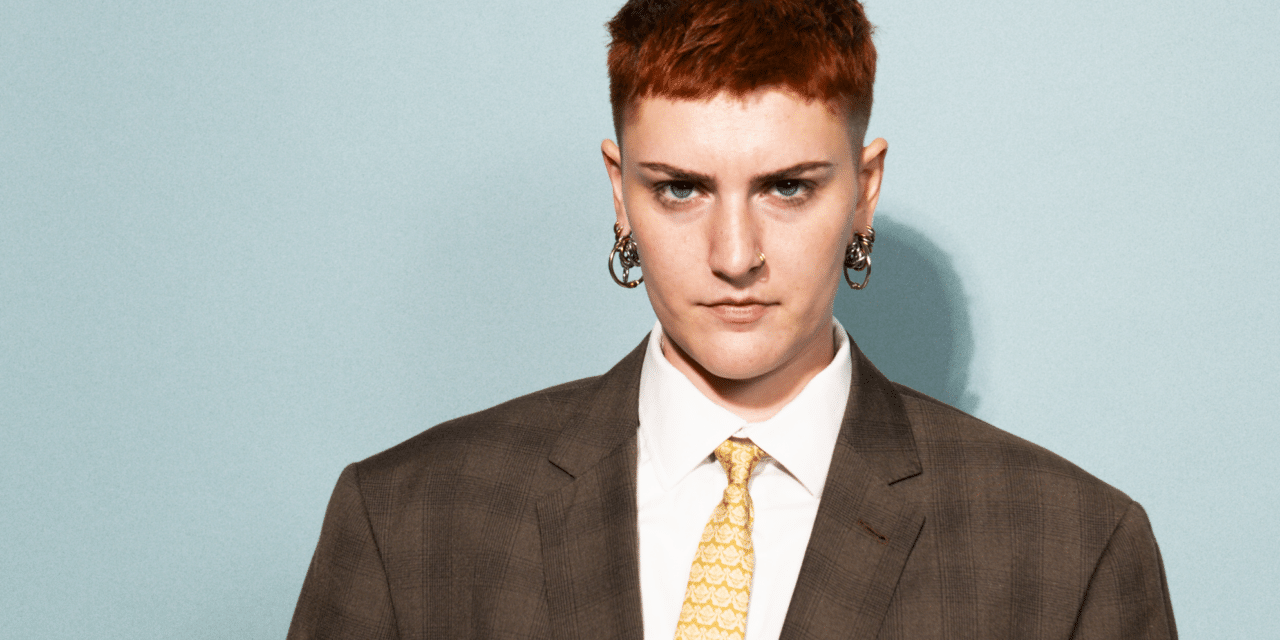
There are artists who emerge through momentum, and then there are artists who emerge through sheer force of survival.
Los Angeles-based butch artist Rio Romeo belongs firmly to the latter.
With the release of “Terminal Lovesick”—a self-described “lesbian banger” landing just in time for Valentine’s Day—Rio steps into a new chapter that feels both sharper and more expansive. Following the critical success of their 2025 debut album Good Grief! (via AWAL), Rio’s work continues to blur genre lines: theatrical, chaotic, tender, and unflinchingly honest.
But behind the scale—over 760K followers on TikTok and hundreds of millions of streams on breakout single “Nothing’s New”—is a story shaped by homelessness, cross-country moves, physical trauma, and a community that didn’t just listen, but showed up.
In this conversation, Rio Romeo opens up about romance, resilience, queerness, and what it means to build an artistic world—even when you’re forced to do it from bed.
On “Terminal Lovesick” and the Shape of Romance
Mundane Magazine: “Terminal Lovesick” is arriving as a Valentine’s release—but through your lens, romance is never simple. What does love look like to you right now?
Rio Romeo:
Romance looks like dedication and chaos.
Theatricality, Punk Energy, and Storytelling as Survival
Mundane Magazine: Your music feels cinematic—musical-theatre scale, but with a raw, punk-like energy. Has that always been part of you?
Rio Romeo:
I have always loved dramatic storytelling. Sharing human stories in a way that is engaging has always been a great tool to build community and understanding.
Looking Back at Good Grief: Endurance as Identity
Mundane Magazine: Good Grief feels like a document of survival—homelessness, relocation, love, injury. When you look back at those years, what version of yourself stands out?
Rio Romeo:
I am most proud of the version of myself that was willing to abandon the life I had and work towards the life I wanted regardless of consequence.
Rebuilding After Trauma: Body, Voice, and Identity
Mundane Magazine: You’ve spoken openly about your accident and the resulting brain and hip injuries. How did that reshape your relationship to your body—and your voice?
Rio Romeo:
It was really hard for a long time to sing, play the piano, or even sit upright—I was in so much pain. After losing the privilege of a healthy, pain-free body, I had to re-examine how I could still live a fulfilling life.
It took learning from other disabled people, understanding their coping mechanisms, and a lot of self-exploration. I had to figure out how to move forward and still be myself, even after losing a big part of my identity as someone very physically active.
I’m a stronger artist now because of it. I was forced to ask: Who am I without movement? And how do I build an artistic world from my bed?
Community, Queerness, and Being Held Up by Others
Mundane Magazine: Your fanbase hasn’t just supported you—they’ve helped you survive. What does community mean to you now?
Rio Romeo:
For a long time I felt isolated—from my accident, from my family dynamics as a queer person. But I’ve come to realize that struggle is what binds us together.
Community means having someone who understands the complexity of what you’re going through—and knowing there’s another side. It also means that one day, you become that person for someone else. You have a responsibility to uplift others the way you were uplifted.
“Nothing’s New” and the Power of Vulnerability at Scale
Mundane Magazine: “Nothing’s New” has reached an enormous audience. Did you expect that level of connection?
Rio Romeo:
No. The first time I played it live in 2022, it actually felt embarrassing—it was so vulnerable.
I never imagined something that raw would resonate so widely. But it taught me that loneliness, isolation, burnout—those are universal. That realization has brought me a lot of hope.
Transparency vs. Mystery
Mundane Magazine: There’s something very unfiltered about how people connect to you. Is that intentional?
Rio Romeo:
I wish I could be mysterious—I’ve just never been able to do it. It’s not my nature.
I like meeting people where they are, being a bit silly. I don’t think about being transparent or mysterious—I just share my life as it is. However it comes across is how it’s meant to be.
On Being a Queer Artist—Without Compromise
Mundane Magazine: Do you ever feel pressure to soften or explain your identity?
Rio Romeo:
No. And I won’t tolerate anyone who tries to make me feel that way.
A New Era: Expansion, Not Reinvention
Mundane Magazine: With new music on the way, does this moment feel like a reset or something else?
Rio Romeo:
It feels like expansion. I have a much clearer idea now of where I’m going, what my goals are, and how I want to use what I have to make the world better.
Then vs. Now
Mundane Magazine: If the Rio of five years ago heard “Terminal Lovesick,” what would they say?
Rio Romeo:
They’d say: that’s fucking awesome—how did you do that?
A Voice That Doesn’t Sand Down the Edges
With “Terminal Lovesick,” Rio Romeo continues to build a universe where contradictions are not resolved—they’re embraced. Romance is chaos. Pain becomes architecture. Community becomes survival.
It’s not polished. It’s not safe. And that’s exactly the point.
As Rio steps into this next phase—new releases, growing momentum, and a deepening artistic identity—one thing remains clear: this isn’t reinvention.
It’s expansion without compromise.