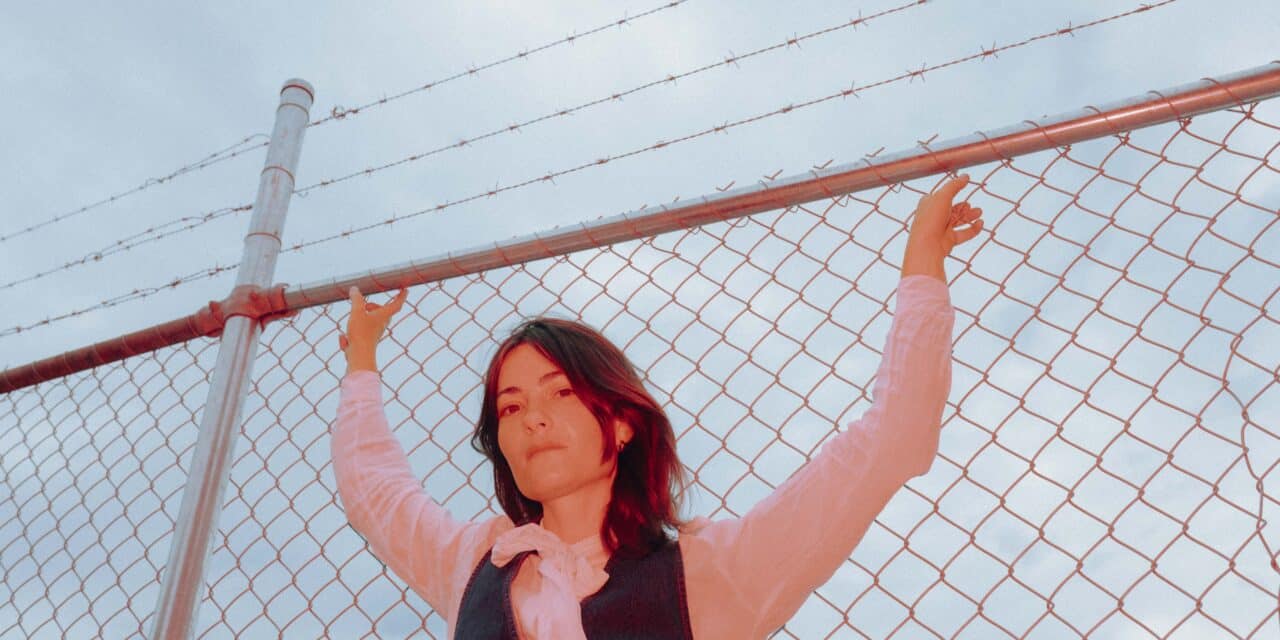
Photo Credit Nick Mckk
The Melbourne singer-songwriter rejects neat redemption arcs on a sophomore album about desire, inherited patterns, emotional contradiction and learning to live without all the answers
There is a particular kind of pressure that follows personal growth.
Once you have survived something, processed it, written about it and supposedly moved forward, there is an expectation that you should know better the next time. That healing should have transformed uncertainty into wisdom. That the person who emerged from heartbreak should somehow be immune to getting lost again.
Rowena Wise is not especially interested in that version of the story.
Her sophomore album, Bad Things Feel Good*, arrived August 7 via Beloved Records / 22Twenty, exists precisely inside the places where those clean narratives fall apart.
“I’d spent years thinking I’d already done the hard work of figuring myself out,” Wise says of the period that informed the album. “Then I realised I was still perfectly capable of getting lost, hurting people, changing my mind, wanting things that complicated my life, and reaching for things that felt good in the moment but weren’t always good for me.”
Even the title carries its own correction.
At first, Bad Things Feel Good felt almost too blunt. Then Wise added the asterisk.
That tiny piece of punctuation became essential: a visual caveat attached to the entire project, quietly insisting that nothing here is quite as simple as its first reading.
The record follows 2024’s Senseless Acts of Beauty, Wise’s acclaimed debut and a deeply vulnerable work concerned with loss, alienation and rebuilding. But if that album documented an attempt to put oneself back together, Bad Things Feel Good* is interested in what happens once you realize the reconstruction was never going to be permanent.
There are relationships that feel liberating and destabilizing at once. Necessary endings that still produce grief. Family patterns that become visible only after they have already shaped you. Desire that conflicts with your own better judgment. New forms of intimacy that offer freedom precisely because they force you to abandon familiar ideas about what love is supposed to look like.
Wise refuses to resolve those tensions for the listener because, when she was writing many of these songs, she had not resolved them herself.
Much of the record emerged while she was touring extensively, writing between trains, planes and strangers’ spare rooms. That displacement created an unexpected emotional distance from her own life. Alienated from home and routine, she found herself observing experiences she might otherwise have rushed to explain.
“I wanted to write in a way that observed my experience before ‘resolving’ it,” she explains. “I didn’t want the album to tidy those contradictions up just to make them easier to digest.”
That philosophy extends directly into the album’s sound.
Wise reunited with producer Rob Muinos, recording the project live over only three days with Richard Bradbeer on bass and Jess Ellwood on drums. Instead of expanding the arrangements until the emotional themes felt appropriately “big,” they did the opposite.
They left space.
The performances breathe, shift and occasionally reveal their imperfections. Wise’s vocal can soar or crumble without either moment being cleaned into submission. The band responds to one another in real time, giving the record an intimacy that feels almost incompatible with overproduction.
For Wise, those imperfections are not flaws to disguise.
“They are more interesting than perfection,” she says.
That belief feels central to Bad Things Feel Good* as a whole.
This is not a record about becoming healed enough to stop contradicting yourself.
It is about becoming honest enough to admit that contradiction might be one of the most human things about you.
Mundane spoke with Rowena Wise about refusing clean redemption arcs, recording an album live in three days, inherited ideas about love and vulnerability, non-monogamy, family, touring, silence in production, and why sometimes growth looks less like finding the answer than becoming comfortable without one.
Bad Things Feel Good* is a title that immediately challenges the idea that healing is linear. What made that contradiction the perfect way to introduce this chapter of your life?
I think it felt right because I was writing the album during a time when growth felt really messy and definitely not linear.
After going through a traumatic relationship in my early twenties, I’d spent years thinking I’d already done the hard work of figuring myself out. Then I realised I was still perfectly capable of getting lost, hurting people, changing my mind, wanting things that complicated my life, and reaching for things that felt good in the moment but weren’t always good for me.
When choosing the album title, I remember writing “Bad things feel good” on the page feeling like it felt too blunt. Then I added the asterisk, which became the whole point of the album—it’s the little caveat saying, obviously, it’s more complicated than that.
For me, this chapter has been about accepting that healing can involve backtracking, grief, desire, contradiction and growth all happening at the same time.
Bad Things Feel Good* gave me a way to hold all of that, to witness my experiences without pretending there was a neat lesson or redemption arc at the end.
The album explores the uneasy space between desire and restraint, certainty and doubt. Were you intentionally resisting the kind of neat emotional resolutions we often expect from records about personal growth?
Yeah, definitely. I think I was resisting the idea that growth has to end with some kind of clean breakthrough.
A lot of these songs were written while I was still inside the confusion, not after I’d figured it out, so it felt more truthful to leave some of that uncertainty intact.
As this album was written when I was touring extensively, all the travelling made me feel alienated from my sense of home and self. Writing on trains, planes and in spare rooms of strangers gave me this strange objectivity. I was able to explore some hard truths more easily with that feeling of displacement within.
I was interested in the fact that you can know something isn’t right for you and still want it, or make a choice that’s necessary and still grieve it, or feel more free and more scared at the same time.
I wanted to be accountable for my own flaws, my own vulnerability. I wanted to write in a way that observed my experience before “resolving” it.
I don’t condone pain, complex relationships and impulsive pleasures to find yourself, but these things shape who you are, and they contribute to self-growth.
I didn’t want the album to tidy those contradictions up just to make them easier to digest. For me, the growth was actually in becoming a bit more comfortable with not having a neat answer.
You recorded the album live over just three days. How did capturing those performances in real time change the emotional honesty of the finished record?
Recording it live made everything feel a bit more exposed, in a good way.
We only had three days, so there wasn’t much room to overthink or tidy things up after the fact. We had to trust the band, trust the songs, and trust the feeling in the room.
There was one song we spent ages on trying to find the right groove, and I remember starting to panic a bit, thinking, if this one is taking this long, how are we possibly going to get through the whole record and make it what we want it to be?
I had a few moments of anxiety, but that’s normal for recording live. It means that I felt creatively challenged, which I reckon is key for self-expansion.
The band kept playing, really listening to each other, and eventually all the songs clicked.
I think that process ended up becoming the spirit of the record: not chasing perfection, but staying with something long enough for it to feel true.
There’s a humanity in hearing flaws; they are more interesting than perfection, they make people go back and listen to a record again if they didn’t immediately comprehend it the first time around.
Your songwriting often feels more like an intimate conversation than a performance. When you’re writing, do you picture a specific person you’re speaking to, or are the songs first and foremost conversations with yourself?
Songwriting is such a wild process to me—trying to take an emotional reality and turn it into something abstract that someone else might recognise themselves in.
It can feel paralysingly esoteric and ineffable, like a puzzle I’m trying to solve, except I think I’m actually building a puzzle with no single solution. I’m just giving people the mechanics and hoping they interact with it in their own way.
A lot of the time I’m writing to myself, but I need to step outside myself a little to speak to her clearly, almost as if she’s taken the form of someone I know.
I’ll imagine that person eventually hearing the song while they’re walking down a street or staring out the window of a car, carrying it into their own life and finding a meaning I never could have planned for them.
That distance helps me get closer to all the unspoken subtext—the shame, tenderness, contradiction, all the stuff that’s harder to say directly.
So the song starts as a conversation with myself, but I’m always writing toward the moment where it stops belonging only to me.
Growing up in a family of musicians—with a father who built your guitars and a mother rooted in folk storytelling—how has that upbringing shaped the way you approach songwriting today?
Growing up in a family of musicians made music feel less like a career choice and more like a way of being with people.
I remember being on tour with my family in Galway, so far from home, and standing onstage with them feeling completely anchored at the same time. I was twelve years old.
There was this strange moment where I felt intensely present in my own body, but also like I’d disappeared into the music—into my family playing beside me, and the audience listening back.
I think that was one of the first times I understood how music can make a room of people feel connected without anyone really knowing why.
That immediacy still shapes the way I write now. I’m always chasing that feeling of making something deeply personal that somehow becomes communal.
Music is one of the only forms of magic in the world that I really relate to.
Throughout the album you explore inherited patterns, family dynamics and the process of unlearning. Did writing these songs change the way you understand your own story?
Yeah, definitely.
Writing these songs made me realise how much of what I thought was simply “who I am” had actually been inherited—from family, culture and the stories I’d absorbed about love and strength.
“Blood Ties” came from watching a close friend go through a mental health crisis and seeing his father struggle to respond because vulnerability seemed almost frightening to him.
I grew up in Margaret River, where emotional repression felt pretty culturally normal, especially for men, so that dynamic felt familiar to me.
With “Unlearning Of Love,” I recognised a similar inheritance in my ideas about intimacy—that exclusivity was proof of love, and that a relationship had to fit a familiar shape to be valid.
Non-monogamy was the context of writing that song, but it’s less about that relationship structure than the idea of loving people in a less possessive way.
The song came from discovering how meaningful less easily defined connections could be, and how freeing, scary and sometimes painful it was to let go of those old rules.
I think the album changed my story by showing me that unlearning isn’t always liberating in a clean way; sometimes it feels like losing part of yourself before you know what’s going to replace it.
Your music finds beauty in contradiction rather than certainty. Do you think audiences are increasingly looking for art that embraces complexity instead of offering simple answers?
Yeah, I think so.
I remember walking through LA after a show one night, feeling weirdly familiar with the medley of people going about their lives. I saw beauty alongside the unadulterated garishness and adversity.
I was feeling really struck by how fractured everything feels at the moment—politically, socially, even just in the way people talk to each other—and how strange it is that we’re still expected to have these neat, certain positions on everything.
I actually think some of the most interesting art comes out of those periods of fracture, because artists are trying to make sense of something that hasn’t settled yet.
That’s the kind of work I’m drawn to as a listener too: art that lets two conflicting things be true at once, or leaves you with a question instead of wrapping everything up.
I think people are hungry for that because real life rarely gives us the clean answer we were taught to expect, and there’s something relieving about encountering art that doesn’t pretend otherwise.
Sonically, Bad Things Feel Good* is remarkably restrained, allowing silence and space to become part of the storytelling. Was it difficult to resist overproducing songs that carry so much emotional weight?
Restraint was really important, because I think a song with a lot of emotional weight needs room to breathe.
It doesn’t always need to communicate that weight through more power, more energy or more sonic complexity. Sometimes the most affecting thing is leaving enough space for the story to speak for itself.
My producer Robert Muinos really understands that, and it shapes the way he produces: getting a live band in a room, encouraging everyone to listen closely to each other, and finding an arrangement that supports the song without crowding it.
Recording live meant the songs could breathe. You hear people responding in real time, little imperfections, the push and pull between us, and that made everything feel much more human to me.
I think with material this personal, overproducing it could have created distance, whereas Robert’s approach was about protecting the intimacy and letting the performance do the storytelling.
Since Senseless Acts of Beauty, you’ve toured internationally and connected with audiences across very different cultures. Have those experiences changed the stories you feel compelled to tell, or simply reinforced that certain emotions are universal?
Touring Senseless Acts of Beauty really reinforced that certain emotions are universal, even when the stories themselves are very specific.
It was such a personal, exposed record, and I was genuinely surprised by how many people in completely different places connected to it and found their own lives inside those songs.
That experience probably didn’t change the stories I feel compelled to tell so much as give me more confidence to keep telling them vulnerably.
It made me trust that if I push toward what feels raw, unfamiliar or a little scary—whether that’s in the subject matter, a melody I wouldn’t normally write, or a chord change that feels unexpected—there’s a good chance someone else will meet me there.
In a way, touring my first record taught me that the more specific and honest I am, the more universal the feeling can become.
Your work consistently reminds listeners that being human means holding conflicting emotions at the same time. If someone walks away from Bad Things Feel Good* feeling a little less alone in their own contradictions, what do you hope they carry with them long after the album ends?
I hope they carry a bit more permission to be complicated.
I think we put so much pressure on ourselves to make sense of our lives in every sense—to know exactly what we want, to love people in the right way, to make the good decision and then feel good about it.
But you can love someone and need distance from them, feel grief and relief at the same time, want freedom and then be terrified when you get it.
I’d love for the record to leave people with the sense that those contradictions don’t necessarily need to be solved immediately.
Sometimes there’s something really valuable in just sitting beside them, being curious about what they’re telling you, and letting yourself be a messy, changing person.
If someone listens to Bad Things Feel Good* and feels a little less ashamed of not having a clean story about who they are, that would mean a lot to me.
There is a moment in Wise’s description of songwriting where she compares the process to constructing a puzzle with no single solution.
It could just as easily describe Bad Things Feel Good* itself.
The record offers pieces—family, lovers, inherited expectations, freedom, shame, desire, grief—but refuses to dictate the final image.
It also refuses to insist that there has to be one.
That may be where the album’s real optimism lives.
Not in the promise that everything eventually makes sense, but in the possibility that a life does not have to become perfectly coherent in order to become meaningful.
You can make the right choice and mourn it.
You can escape something and still miss it.
You can discover freedom and be frightened by how much space suddenly surrounds you.
You can inherit an idea about love, dismantle it, and still feel grief for the structure that once made the world easier to understand.
And maybe adulthood is less about eliminating those contradictions than learning to stop interpreting them as evidence that something has gone wrong.
Wise is not offering permission to romanticize damage. She is doing something more difficult: acknowledging that transformation often happens before we have the language to explain what it is transforming us into.
That is why the asterisk matters.
Bad things feel good.
But obviously, it’s more complicated than that.
And somewhere inside that complication, Rowena Wise has made a record that feels extraordinarily alive.
Bad Things Feel Good* arrives August 7, 2026 via Beloved Records / 22Twenty.