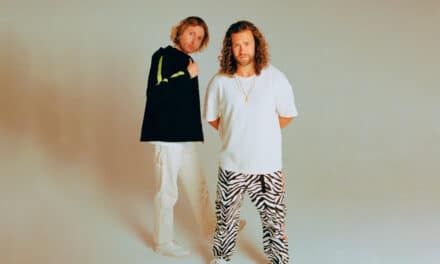
On SPRINTING, Hamburg drummer and producer Silvan Strauss translates the machine-speed rhythms of Chicago footwork onto a live kit without pretending the music belongs to him. Somewhere between jazz lineage, dancers, Instagram algorithms, barista cups filled with water and the impossible task of making a human body behave like a drum machine, he finds something more interesting than originality: context.
There is a wall somewhere between Silvan Strauss and the drum machine.
He knows he’s going to hit it.
A human body can become extraordinarily fast.
Coordination can be trained.
Independence between limbs can become almost freakishly precise.
Practice can move the boundary further and further away.
But eventually:
Wall.
The machine doesn’t have this problem.
It can move faster.
Repeat more consistently.
Stack independent rhythmic layers without worrying about the physical inconvenience of having only four limbs.
For Strauss, that difference isn’t discouraging.
It’s the experiment.
His third album, SPRINTING, begins somewhere inside the impossible proposition of asking a human drummer to interact with rhythmic ideas built through machines.
But the Hamburg-based musician isn’t really interested in winning a speed competition with a computer.
He already knows how that ends.
Instead, he asks a stranger question:
What does the machine’s rhythm feel like inside a human body?
“I had to search more for ways to recreate how these drum sequences are feeling in my body,” he tells MUNDANE, “and try to get close to that with the stuff that feels more natural to me.”
That distinction becomes the key to understanding SPRINTING.
Strauss isn’t trying to prove that a jazz drummer can play footwork.
In fact, he’s unusually deliberate about saying that SPRINTING isn’t a footwork album.
What he’s doing is messier.
And considerably more interesting.
He’s trying to understand what happens when a musical language he has admired for more than a decade collides with the language already living in his hands.
The Drum Machine Always Wins
Strauss’s fascination with Chicago footwork stretches back more than a decade, particularly through Traxman’s Da Mind of Traxman.
The genre’s velocity presented an immediate technical puzzle.
Footwork rhythms can operate at speeds and levels of programmed independence that fundamentally change what percussion can do.
A drummer attempting to reproduce them physically is therefore forced into negotiation.
Some things translate.
Some don’t.
Some mutate.
Strauss initially approached that as a technical problem.
Practice harder.
Increase coordination.
Push the limits.
But eventually the more interesting question became philosophical.
If he could never literally become the machine, why try?
Instead, he began listening for the physical sensation of those patterns and finding ways to reproduce that feeling through his own vocabulary.
That process revealed a connection to jazz.
Strauss points toward Tony Williams, whose playing helped move drums beyond their conventional role as rhythmic foundation and toward something capable of functioning melodically.
He hears a related possibility in footwork.
Samples can provide the rhythmic anchor.
Then the drums become free to move around them.
Dance around them.
Become melodic.
Suddenly the rhythm section isn’t necessarily where the rhythm lives.
Then He Realized Vocabulary Wasn’t Enough
This is where SPRINTING becomes more complicated.
Strauss was trained in European academic environments.
Music schools.
Universities.
Places where traditions can be translated into useful information.
Patterns.
Scales.
Harmonic progressions.
Vocabulary.
Learn this.
Play this.
Analyze this.
The problem, Strauss came to realize, was what sometimes disappeared in the translation.
Culture.
Context.
Lineage.
Purpose.
He describes encountering musicians such as Chris Dave and initially interpreting their eclecticism largely as an extraordinary ability to combine musical vocabularies.
Then he started tracing the references backward.
Effects he had always loved—delay, reverb, modulation—opened into the history of dub.
Decisions that once seemed abstract suddenly had ancestry.
“It was such a revelation,” Strauss says.
The same thing happened with Chicago footwork.
He began recognizing ideas that had already found their way into his own playing without him fully understanding where they came from.
What had felt abstract acquired an anchor.
But that discovery also required a distinction.
Learning the vocabulary doesn’t make the culture yours.
“Knowing about something and maybe even understanding some stuff about musical phenomenons in Black culture like Dub music or Footwork does not automatically make me part of that.”
It’s why Strauss refuses to simply call SPRINTING a footwork record.
“Me using Footwork vocabulary for SPRINTING does not make it a footwork album, or it’s definitely not up to me to decide.”
Instead, he describes Chicago footwork as the music that currently helps him express his own ideas more clearly than almost anything else.
His response is gratitude.
And curiosity.
He wants to learn more.
Sometimes Musicians Should Stop Thinking and Watch People Dance
Footwork isn’t merely music constructed for dancers.
The relationship between producer and dancer is embedded deeply in its development.
That changed how Strauss began thinking about rhythm.
Musicians—particularly academically trained ones—can develop a slightly inconvenient habit.
They analyze first.
Feel second.
Strauss recognizes it in himself.
Dancers have repeatedly disrupted that hierarchy for him.
“When I work with dancers it’s always so fascinating how instantaneously they respond physically, seemingly without analyzing.”
The reaction is brutally useful.
If they feel it, they move.
If they don’t, they don’t.
No theoretical explanation is going to make the body pretend.
And when music fails to generate that response, Strauss has learned to investigate why.
Frequently, the answer is space.
If the dancer becomes another instrument inside the composition, the music has to leave somewhere for that instrument to exist.
That insight changes the drummer too.
Remove the sound from a video of Strauss playing and something else appears.
A kind of dance.
Arms moving.
Weight shifting.
Repetition.
Impact.
Momentum.
He points toward physically expressive drummers like Elvin Jones, where watching the performance becomes inseparable from hearing it.
Maybe drumming was choreography all along.
What Happens When Someone Else Dances Your Drum Fill?
Strauss invited dancers in different cities to interpret music from SPRINTING.
The experiment wasn’t simply promotional.
It changed the way he heard his own compositions.
In the video for “MOSKITOS (Fliegen),” choreography by TXPPY focused on details Strauss had considered almost incidental.
Tiny ornaments.
Chops thrown into a drum performance because they felt good.
Movement enlarged them.
Suddenly a gesture Strauss regarded as peripheral became central enough for somebody else’s body to respond to it.
That changed his listening.
Now comes another problem.
He’s preparing the material for live performance and wants to preserve those moments.
But the more deliberately you reproduce something spontaneous, the greater the risk of killing what made it interesting.
“How do I reproduce these moments without losing spontaneity?” becomes the new puzzle.
SPRINTING is full of those contradictions.
Machine versus body.
Composition versus improvisation.
Influence versus ownership.
Speed versus space.
Online randomness versus deliberate craft.
Instagram Is His Sketchbook
Strauss’s relationship with social media is similarly complicated.
His drum improvisations have circulated widely online, drawing attention beyond the jazz world.
But he insists the experimentation wasn’t reverse-engineered for virality.
He already liked making strange sounds on the kit.
He already approached drums with something closer to a percussionist’s curiosity.
Then the internet reacted.
Strongly.
And Strauss started paying attention to what it was reacting to.
One improvisation involving barista cups filled with water eventually helped generate “All Bosses.”
That’s the internet doing something considerably more interesting than marketing.
It’s entering the composition.
“I now use Instagram as a huge sketchbook from which I then finish bigger pieces.”
Strauss describes it as an “endless concert.”
Play something.
Observe the response.
Notice details in your own playing you hadn’t considered important.
Develop them.
The audience becomes an accidental mirror.
Some of the biggest reactions have come from Strauss repurposing everyday objects as instruments—an impulse he connects partly to free jazz drummers.
Again, the new thing turns out to have history.
The Algorithm Wants You to Sprint
The title SPRINTING works in several directions at once.
Running toward something.
Running away from something.
A body moving at speed.
Footwork dancers.
Footwork drums.
The contemporary artist moving through an online environment of clips, reactions, samples and algorithms.
Strauss has a surprisingly ambivalent relationship with that velocity.
Part of him loves it.
Quick decisions.
Instant reactions.
The feeling that making music starts resembling sport.
“Sometimes it feels exhilarating.”
And SPRINTING genuinely belongs to that pace.
The record isn’t reluctantly fast because social media demanded it.
Strauss wanted to make fast music.
The problem is what happens when speed becomes the only available setting.
“There’s only little space these days to go with the instincts that tell you to write, for example, slow-paced music with long breathing arrangements.”
Algorithms don’t necessarily reveal the full complexity of an artist.
They identify the part that generates reaction and return more of it.
A multifaceted musician can gradually become one optimized fragment of themselves.
Strauss recognizes the danger.
If he decides to make calm music next, he suspects he’ll have to create conditions for slowness deliberately.
“Active deceleration.”
Even slowing down now requires effort.
One Sample. Keep Digging.
Another lesson Strauss took from Traxman was methodological.
Limitation.
Take one sample source.
Don’t immediately add fifty more.
Mine it.
Cut it.
Rearrange it.
Discover how many possibilities were already hiding inside the thing you had.
That restriction changed Strauss’s production process.
His earlier records FACING and FLUKIN’ involved more extensive sessions and band environments.
SPRINTING is more explicitly a producer record.
One artist.
A room.
Tools.
Taste.
Constraints.
Something funny happened.
The restrictions made the music weirder.
“In a good sense,” Strauss adds.
In a band, one musician’s eccentric instinct naturally collides with everybody else’s.
Ideas get balanced.
Moderated.
Negotiated.
Alone, nobody automatically corrects your strange decision.
Strauss found that liberating.
His peculiarities could survive longer.
UFOs, Finnish Insects and Whatever Else Happened This Week
The resulting album doesn’t exactly sound like it was designed around a conventional thematic mood board.
There are UFO testimonies.
Insects.
Voicemails.
Online clips.
Sounds collected almost accidentally.
Collaborators including Petter Eldh, Reuben James, Maria João, FARHOT, Anna-Lena Schnabel, Alex Eckert and others enter its orbit.
Strauss doesn’t necessarily begin by asking whether these things logically belong together.
The workflow creates the logic.
He describes reacting to something in everyday life—a voicemail, an advertisement, a Reel, another piece of music—and almost immediately wondering whether it could enter a track.
During SPRINTING, practice sessions became recordings.
He would work on a drum idea.
Capture a take.
Then begin surrounding it with audio he had accumulated in the preceding days.
Life becomes sample library.
The demos were later refined with friends.
But the original logic remained almost diaristic.
This is what I played today.
This is what I heard yesterday.
Let’s see what happens when they meet.
Stop Trying So Hard to Be Original
Perhaps the most revealing thing Strauss discovered while making SPRINTING has nothing to do with speed.
It’s about originality.
Artists are constantly told to find their own voice.
Develop something nobody has done.
Differentiate.
Innovate.
Become unmistakable.
Strauss has discovered that the deeper he studies musicians he admires, the less useful that pressure becomes.
One artist leads backward to another.
Then another.
Someone you considered astonishingly original turns out to have spent years obsessively listening to somebody else.
That person had heroes too.
The chain keeps going.
“My ongoing journey in the world of jazz drumming and trying to sound like certain drummers has shown me that every time I find an artist I like, there’s artists that this person admired and emulated, and that keeps repeating.”
Instead of diminishing the musician, knowing the lineage makes the work more interesting.
And it reduces the anxiety around invention.
“The pressure to be original decreases.”
That may be one of the most important realizations on SPRINTING.
Originality isn’t necessarily the absence of influence.
It might be what happens when influence passes through a sufficiently specific human being.
Carry Everybody. Still Sound Like Yourself.
Strauss understood that more clearly while watching Traxman perform at Teklife’s 15th anniversary celebration.
What he heard reminded him of jazz.
The greatest musicians can contain history without becoming historical reenactments.
You hear the people who came before them.
But you also hear them.
That’s where Strauss wants to go.
Not toward mastering footwork from a distance.
Toward understanding more.
He hopes eventually to spend time in Chicago and learn more directly from the culture that created the music inspiring him.
For now, he describes SPRINTING as a state of “initial enthusiasm.”
It’s all over the place.
He likes that.
The record captures someone at the beginning of understanding something rather than pretending he has reached the end.
There will be more artists to discover.
More lineages to trace.
More references that suddenly make previous musical decisions make sense.
More questions about what he can contribute in return.
And perhaps that’s the most compelling thing about SPRINTING.
For an album obsessed with speed, it refuses to pretend understanding happens quickly.
Silvan Strauss can learn the pattern.
Practice it.
Move it onto the kit.
Sample it.
Post it.
Watch somebody dance to it.
Turn it into another composition.
But behind the rhythm is history.
Behind that history are people.
Behind those people are more people.
So Strauss keeps sprinting.
Not toward the finish line.
Toward the next person worth listening to.
In Conversation With Silvan Strauss
MUNDANE: SPRINTING began with a fascination with Chicago footwork that stretches back more than a decade. What was it about that rhythmic language that initially challenged or excited you as a jazz drummer?
SILVAN STRAUSS: So there’s two viewpoints for me on this. The really technical side and the more philosophical.
The approach to polyrhythms on the set has some limits concerning speed and coordination that you can definitely push very far, but you’ll hit a wall at some point. These boundaries can be pushed further a lot on machines as far as speed, consistency and the amount of independent layers are concerned.
So there’s the challenge to emulate that in a technical sense, which means a lot of practice, but since it’ll never be the same I had to search more for ways to recreate how these drum sequences are feeling in my body and try to get close to that with the stuff that feels more natural to me.
In a way, I think it’s natural to approach the drums like this because it’s kind of a percussion ensemble’s essence in one instrument, and it definitely is super fun to transfer that to drum machines.
In terms of rhythmic vocabulary and the place of the drums in a lot of footwork tracks, I recognized something that I know from drummers like Tony Williams, who transcended the role of the drums from being the rhythmic fundament to also being a strong melodic force in the music.
As I hear it often in footwork, the instrumental or vocal samples are often the rhythmic anchor and the drums are dancing around that in a very intricate, melodic way, in contrast to a lot of other music.
MUNDANE: Rather than recreating footwork electronically, you’ve translated patterns traditionally associated with drum machines onto a live kit. What happens physically and musically when you force the human body to interact with rhythms designed through programming?
SILVAN STRAUSS: See above.
MUNDANE: You’re very deliberate about saying that SPRINTING is not a footwork album. How did you approach drawing inspiration from a culture with such a specific Chicago history while respecting the distinction between influence and participation?
SILVAN STRAUSS: This takes me back a bit further to the way especially Black music is taught in academic surroundings in Europe, as I did learn drums in music schools and universities.
The focus is a lot on vocabulary like patterns, scales, harmonic progressions. So you’re often left with a lot of very practical input and stuff to play and very little about culture and context, about the lineage, heritage and purpose.
Back then I often thought, listening to very eclectic musicians like Chris Dave, that they just must know how to combine their vast vocabulary in a very brilliant way—which they of course do—but it’s a different process, I guess, than I initially had thought.
It was often a very euphoric moment for me when I could trace stuff that I liked with these musicians to large worlds that I wasn’t aware of.
For example, as a child I always liked effects on recordings—delay, reverb, modulation. It was such a revelation tracing that back to dub and all the amazing pioneers in that musical arena. Everything made way more sense. The delays on Chris Dave’s snare drum in his shows made way more sense for me. A very abstract decision became a very clear and transparent reference.
It was a similar feeling when I encountered Chicago footwork and its heritage in juke and ghetto house. There was a lot of stuff in my playing that was referencing this without me even knowing, and stuff that felt abstract to me suddenly had an anchor and a direction that I could go in and search for meaning.
But what’s becoming more and more clear to me is that knowing about something and maybe even understanding some stuff about musical phenomena in Black culture like dub music or footwork does not automatically make me part of that.
Me using footwork vocabulary for SPRINTING does not make it a footwork album, or it’s definitely not up to me to decide.
What I can definitely say: the sound and feeling of Chicago footwork helps me more than any other music to express my ideas in my art, and I could not be more thankful for that. It makes me super curious to go deeper, to learn why that is and what I can give back with the stuff that I’m good at.
MUNDANE: Seeing how pioneers like DJ Rashad, DJ Spinn and DJ Manny created music in dialogue with dancers seems to have fundamentally influenced this project. What have dancers taught you about rhythm that musicians perhaps cannot?
SILVAN STRAUSS: I think especially academically trained musicians tend to analyze what they hear before allowing themselves to react physically. That’s for sure something that I observe in myself.
When I work with dancers, it’s always so fascinating how instantaneously they respond physically, seemingly without analyzing. If they can feel the music, they can dance to it.
And the thing is, it does not work with everything. Some music that I played for dancers they did not react to, and it’s very interesting to dig deep there to find what it is.
Very often, it’s space.
When approaching the dancers more as an additional instrument, one needs to leave some space in the composition for that element.
I’m also finding other ways of expression from working with dancers. If you’d edit the drums out of a video of me playing the drums, it’s a kind of weird dance performance as well, and cultivating that kind of physicality definitely works wonders.
There are some very physical drummers like Elvin Jones where watching their performances definitely resembles some kind of dance on the drums.
MUNDANE: You’ve invited dancers from Bangkok to Brussels to interpret these tracks visually. You’ve described dance as a way of making your abstract rhythmic ideas visible—have any of their interpretations changed how you understand your own music?
SILVAN STRAUSS: It was super interesting to see, for example, in the video to “MOSKITOS (Fliegen)” how the focus of the choreography by TXPPY often was on little details and ornaments in my performance and totally changed my way of listening to them.
Little chops that I am throwing into my drum performance because they feel good suddenly become a really important part of the composition.
Now that I am preparing my live show, this is a challenge because I want to reproduce these moments without losing spontaneity.
MUNDANE: Social media isn’t simply promotional for you; it actually feeds back into the creative process. “All Bosses,” for instance, developed from a viral improvisation involving barista cups filled with water. How has creating for an online audience changed your definition of what can become a musical instrument or the beginning of a composition?
SILVAN STRAUSS: I always liked experimenting with sounds on the kit and acting more like a percussion player.
So when these viral moments on Instagram happened, it was cool for me because it wasn’t something that I did just to go viral, but something that I love doing anyways.
But I also felt the urge to make something more with these little Reels. Basically, I now use Instagram as a huge sketchbook from which I then finish bigger pieces.
It’s also super fascinating seeing what people react to. A bit like an endless concert.
Sometimes it’s elements in my playing that I was never really conscious of and that are worth cultivating.
The musical repurposing of everyday objects, for example—which I got inspired to do mostly by free jazz drummers—a lot of times got enormous reactions on social media.
MUNDANE: Traxman’s practice of extracting countless possibilities from a single sample became an important methodology for SPRINTING. Did imposing those kinds of limitations ultimately make you more experimental?
SILVAN STRAUSS: SPRINTING is more of a producer album in comparison to FLUKIN’ and FACING, where I did a lot of sessions in band settings.
I was fascinated by the more limited way of one artist in a room with their respective tools and taste.
In my case, it made the music weirder in a good sense because some of my more peculiar ways of approaching music were not automatically balanced like it happens in a band setting.
I really like both methods, and I’m so lucky to be working with a label like Kabul Fire Records that also trusts this side of my music.
MUNDANE: The album moves between everything from UFO testimony on “Orange Glow” to Finnish insects on “Moskitos (Fliegen),” alongside contributions from artists like Petter Eldh, Reuben James and Maria João. What makes a seemingly random sound, story or collaboration feel like it belongs inside the same universe for you?
SILVAN STRAUSS: It’s always exciting for me when I find a new workflow. If good pieces emerge from that, then I’m always super keen on trying it with seemingly abstract or random content.
So if I am reacting to something in real life like a voicemail, an ad, Reel or piece of music, my next thought is immediately to incorporate that in a track.
For SPRINTING, I had these practice sessions where in the end I recorded takes of whatever idea I was working on and then tried to put audio around that—mostly audio that I’d been reacting to and collected in the days prior.
So I had all these demos of drums plus samples that I then refined in sessions with my friends.
MUNDANE: The title SPRINTING connects physical movement, footwork’s velocity and the relentless pace of an online existence built around clips, reactions and algorithms. Do you feel contemporary musicians are increasingly being asked to create at a speed that conflicts with the slower process of actually developing an artistic language?
SILVAN STRAUSS: I feel ambivalent about this. I love the rapid pace, having to make quick decisions and swift reactions, almost as if it’s sports. Sometimes it feels exhilarating.
The problem is more that it’s very one-sided. There’s only little space these days to go with the instincts that tell you to write, for example, slow-paced music with long, breathing arrangements.
That’s really a shame because I think a lot of contemporary artists that we adore are multifaceted, and with the bias of the algorithms everybody only gets to see one side.
I definitely went with the fast-paced instincts for this record, and it really matches what I want to express. But I think it would really require active deceleration if I want to make calm music in the future, which does not come easy these days.
MUNDANE: Watching Traxman perform, you recognized something familiar from jazz: great musicians can carry the history of everyone who came before them while remaining unmistakably themselves. As you continue exploring footwork and hope to eventually spend time learning from its community in Chicago, how do you want that principle to guide where SPRINTING takes you next?
SILVAN STRAUSS: I’m finding more and more music from Chicago that I love, and I’m super looking forward to keeping on diving into this world.
My ongoing journey in the world of jazz drumming and trying to sound like certain drummers has shown me that every time I find an artist I like, there’s artists that this person admired and emulated, and that keeps repeating.
As I’m digging deeper, the pressure to be original decreases because by putting it under the microscope I learn what it really is I love about it.
Very often, it’s artists admiring and emulating artists that came before them and then searching within themselves if they can make that happen with their abilities.
I love that. That’s very hands-on.
I guess SPRINTING shows me in a state of initial enthusiasm, and it’s all over the place in a way that I really love, haha.
But I’m also looking forward to learning about the bigger picture in the future and ultimately to finding more artists to admire.