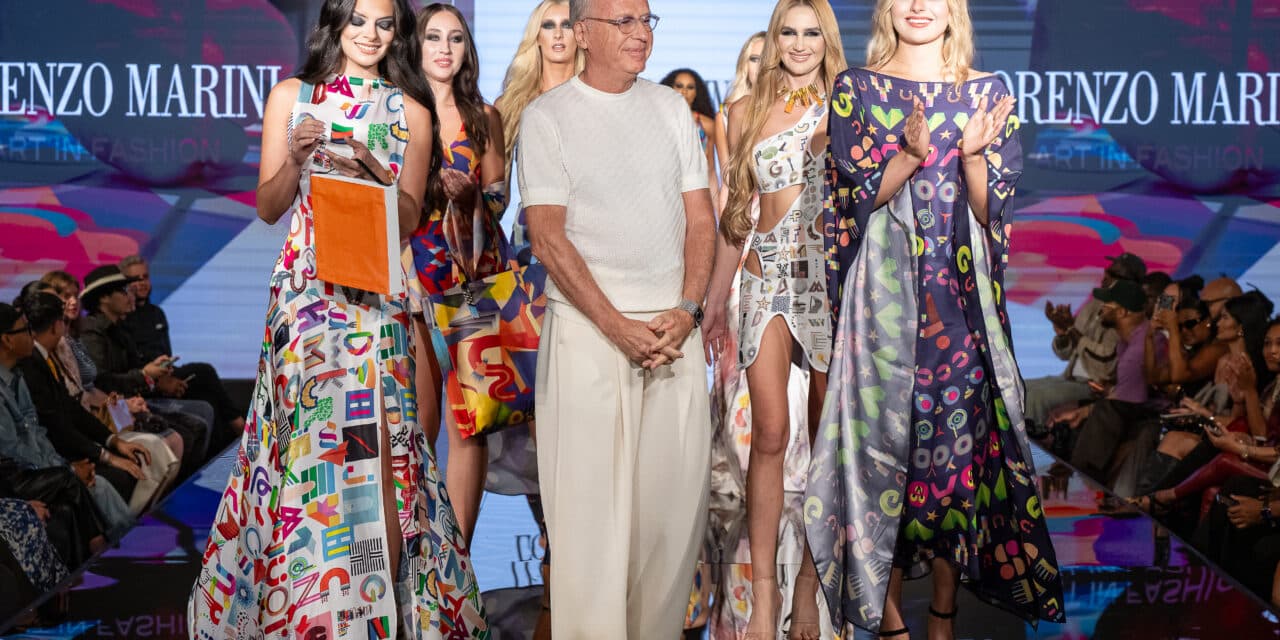
At New York Fashion Week, the Italian artist turned 21 letters into 21 silk artworks and sent them walking through space. But TypeArt isn’t really a fashion collection. It’s the latest stage of Marini’s attempt to answer a stranger question: what happens to a letter when you free it from the obligation to mean something?
A letter has a job. It sits next to another letter. Then another. Eventually they become a word. The word communicates something. Efficient. Useful. Extremely boring, if you’re Lorenzo Marini.
For years, the Italian artist has been trying to interrupt the almost instantaneous process that happens when we encounter written language. See letter. Recognize letter. Move immediately toward meaning. We barely notice the shape we’re looking at.
Marini wants us to stop. Look at the curve. The line. The negative space. The tension. The architecture. Forget, temporarily, what the letter is supposed to say. What does it look like?
And now: What happens if you wear it?
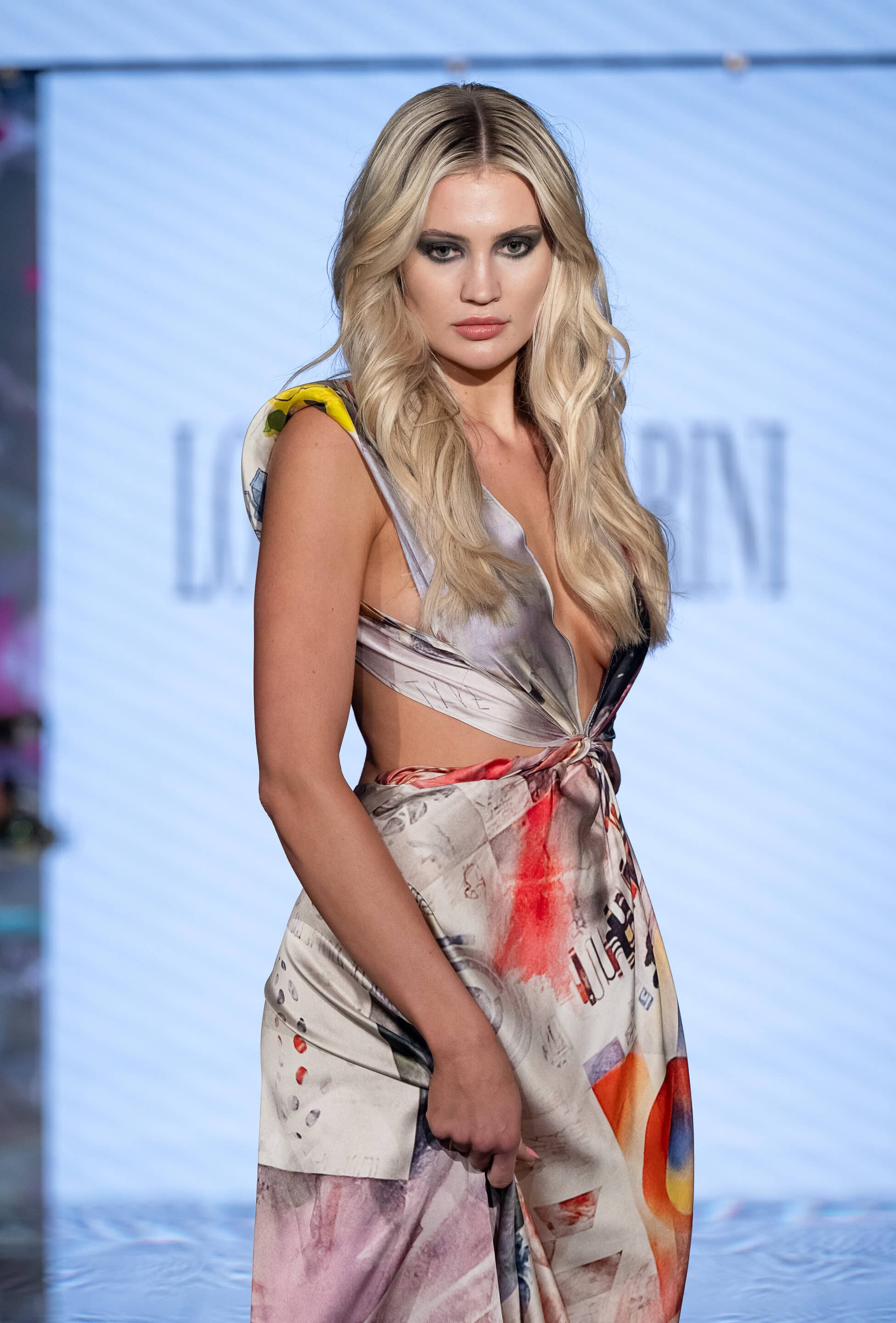
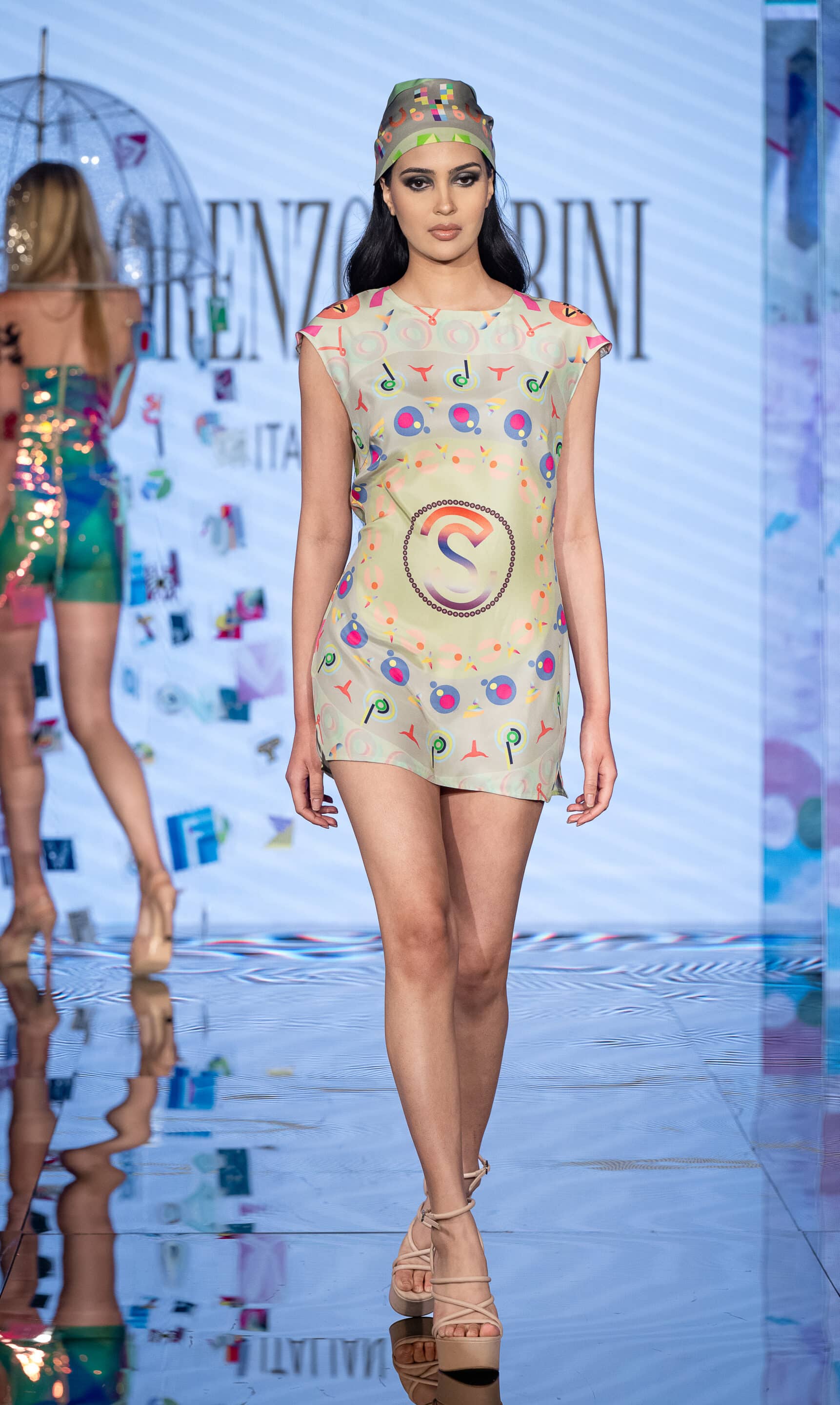
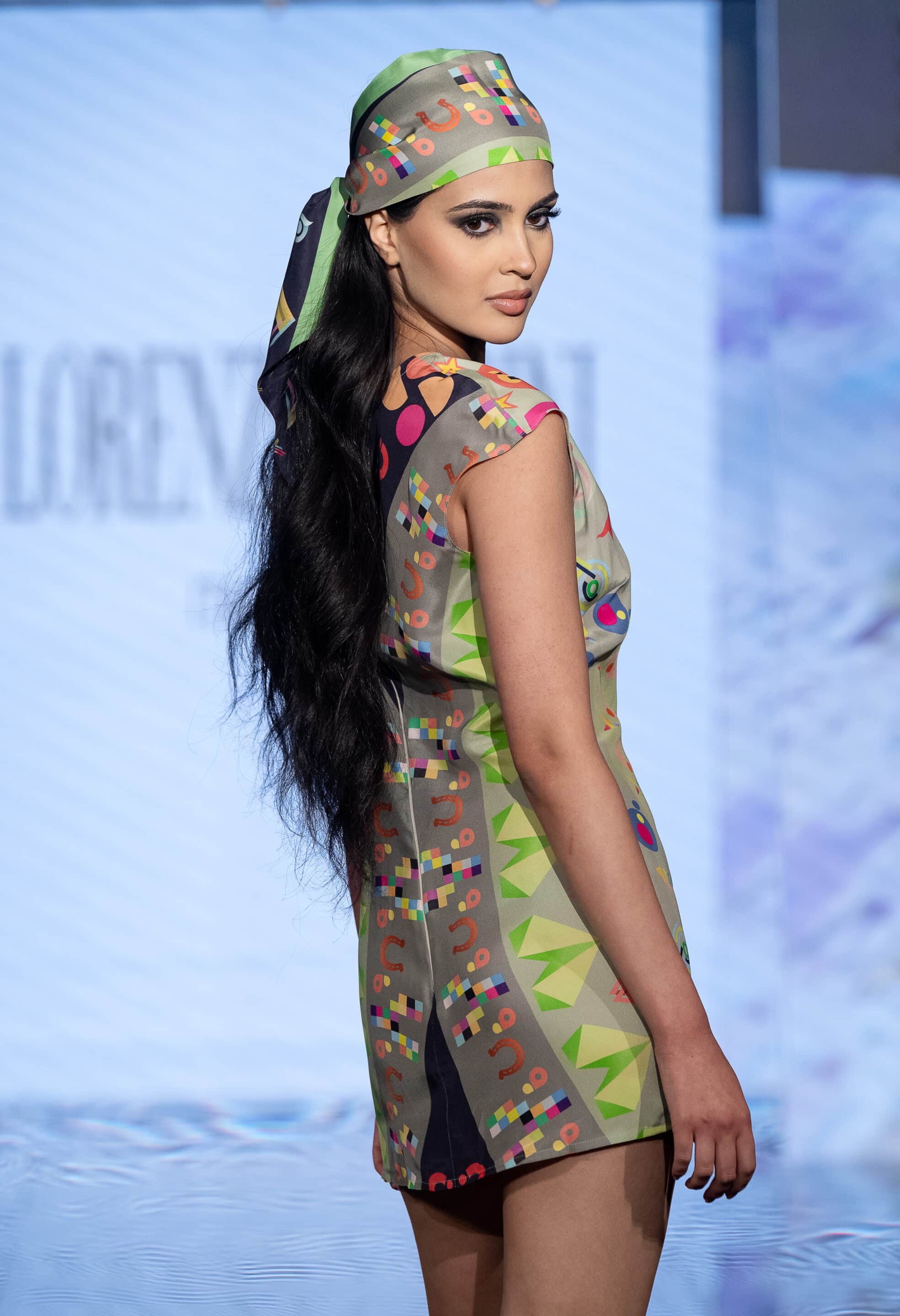
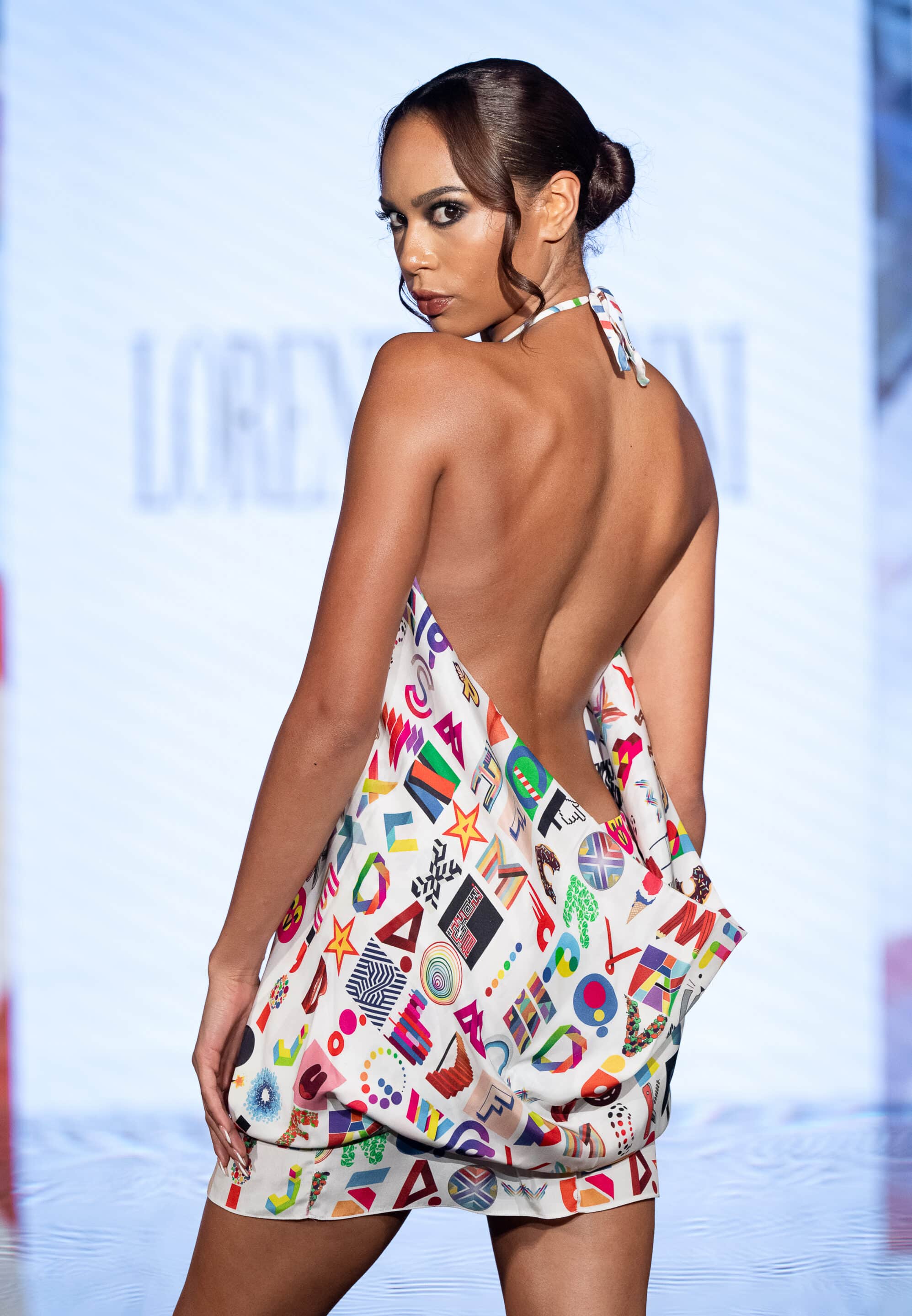
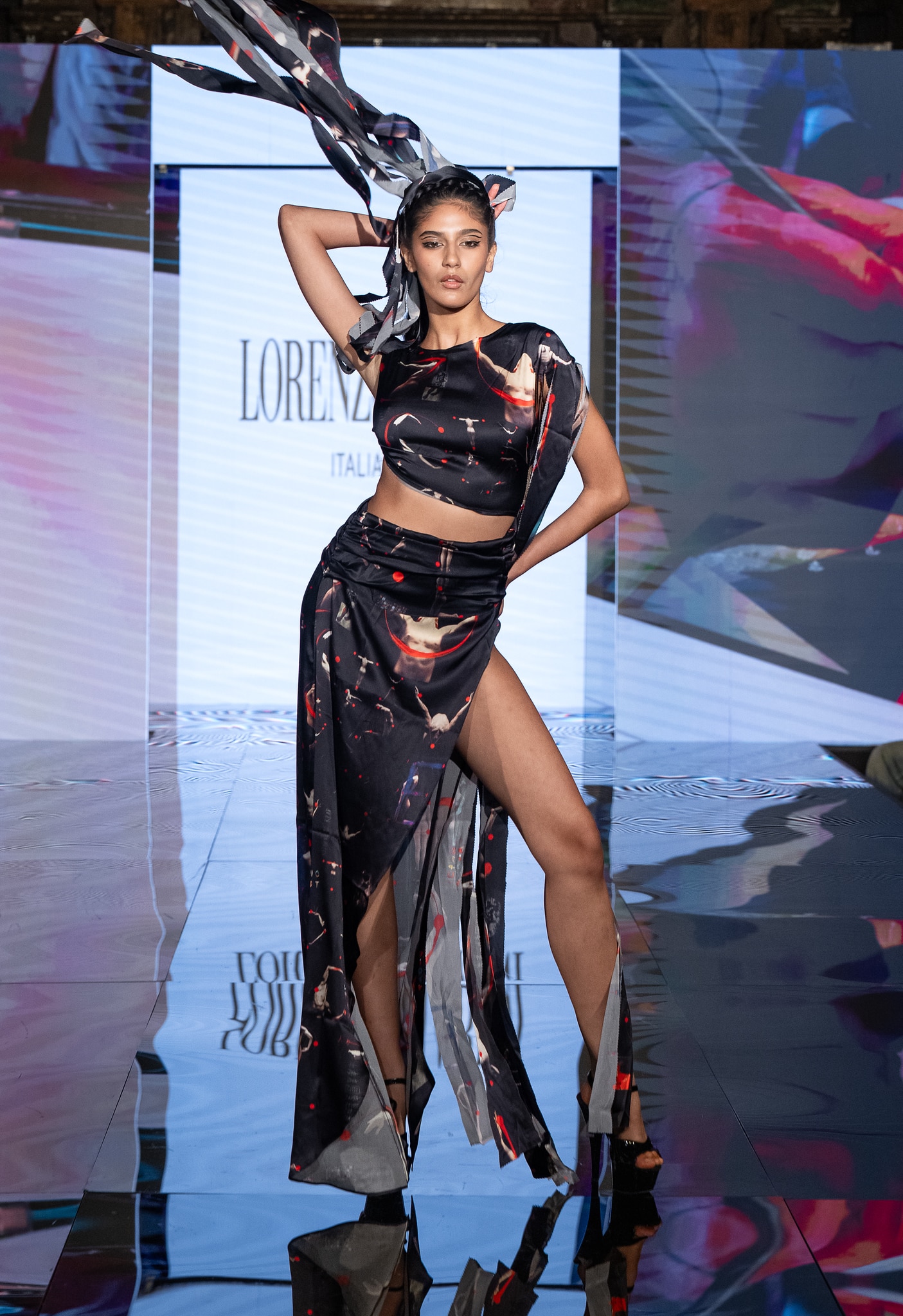
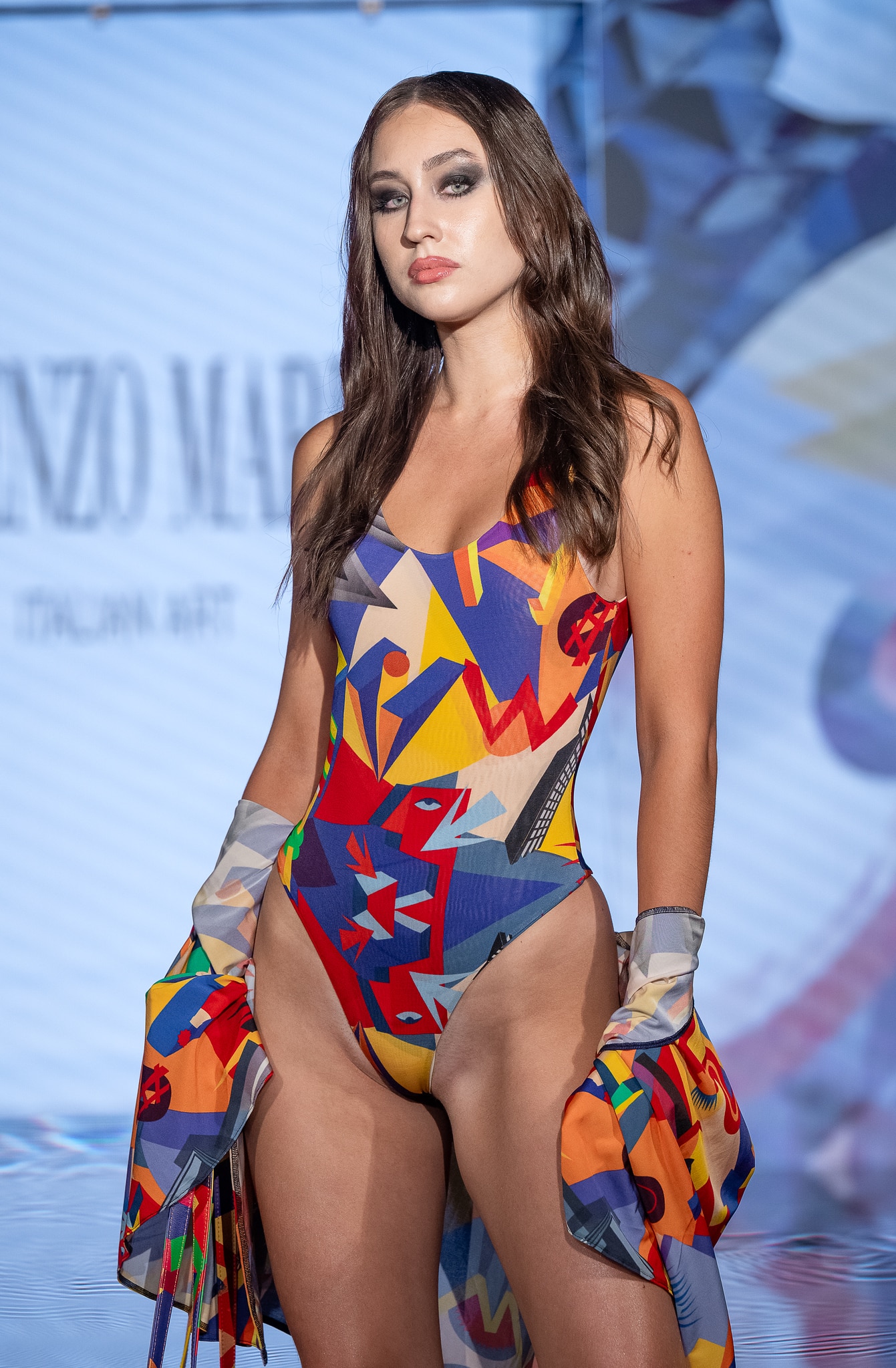
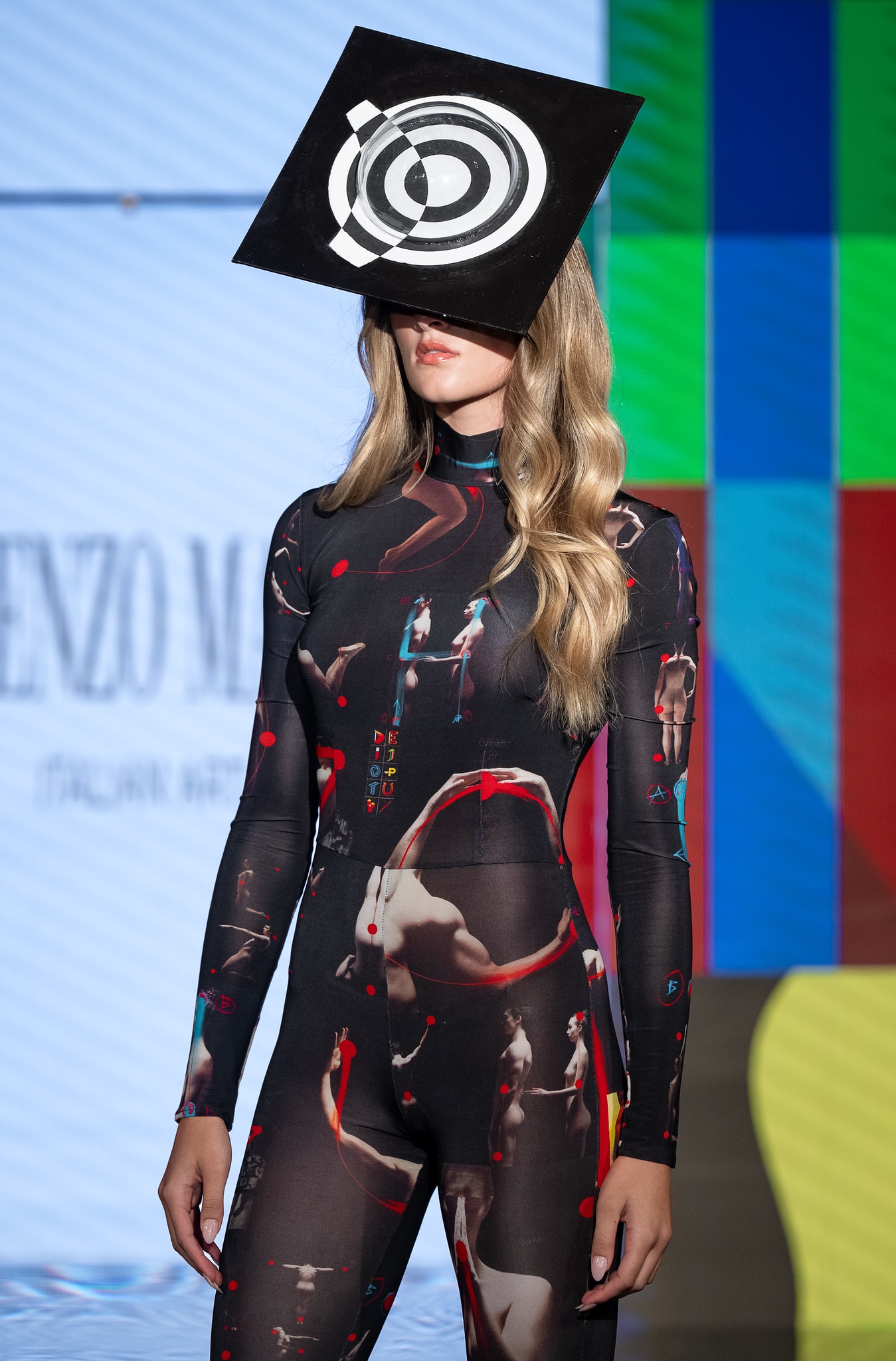
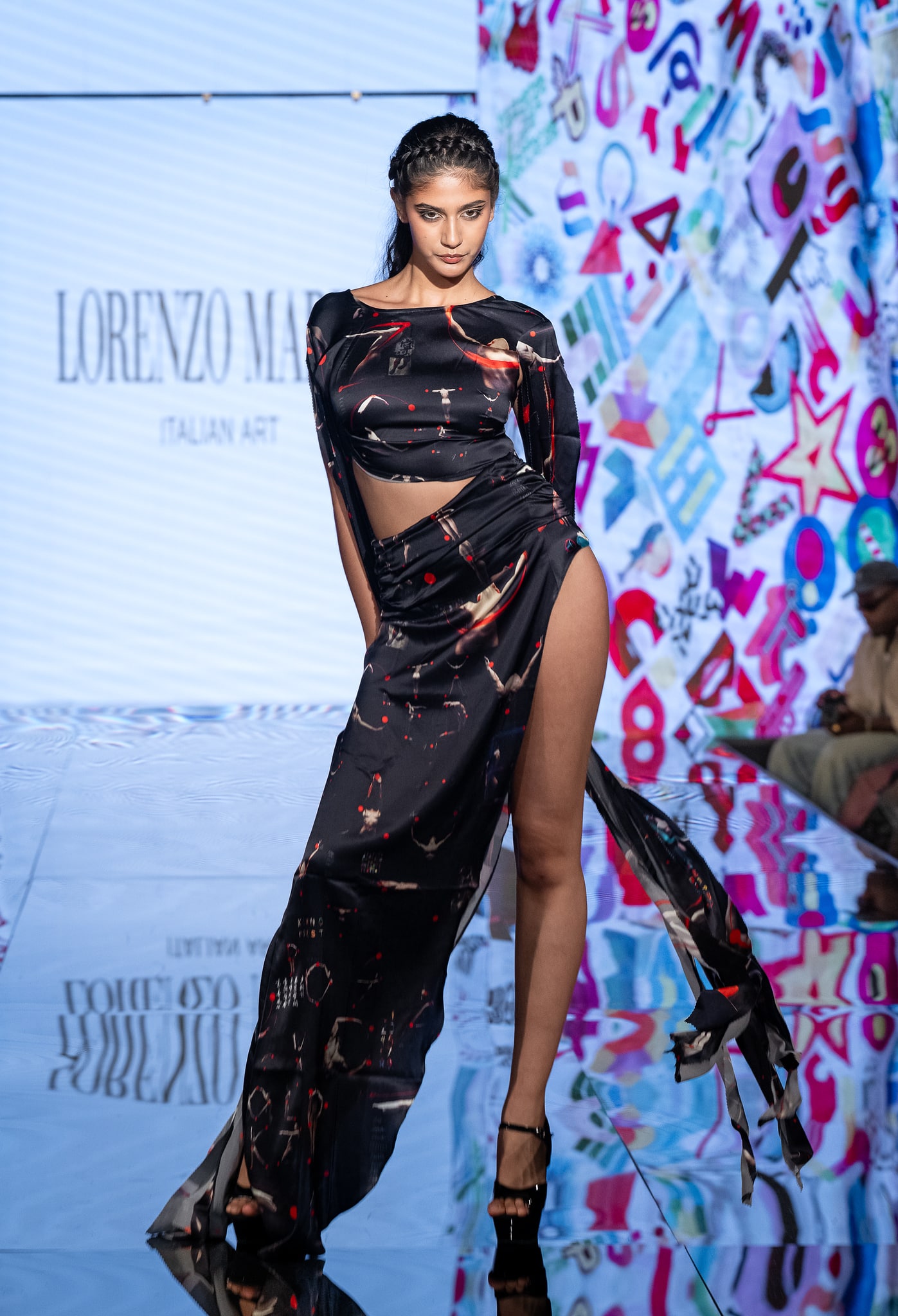
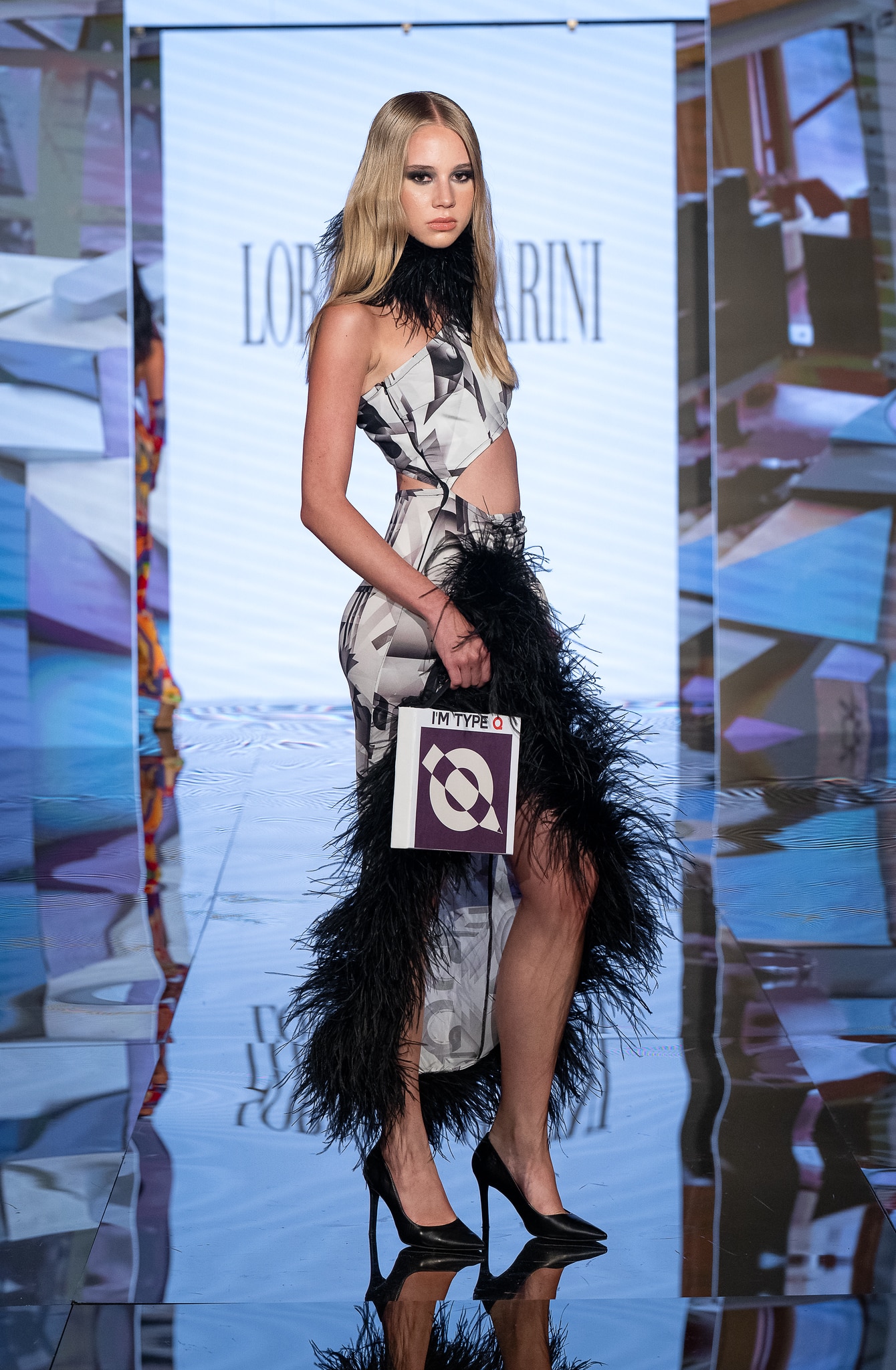
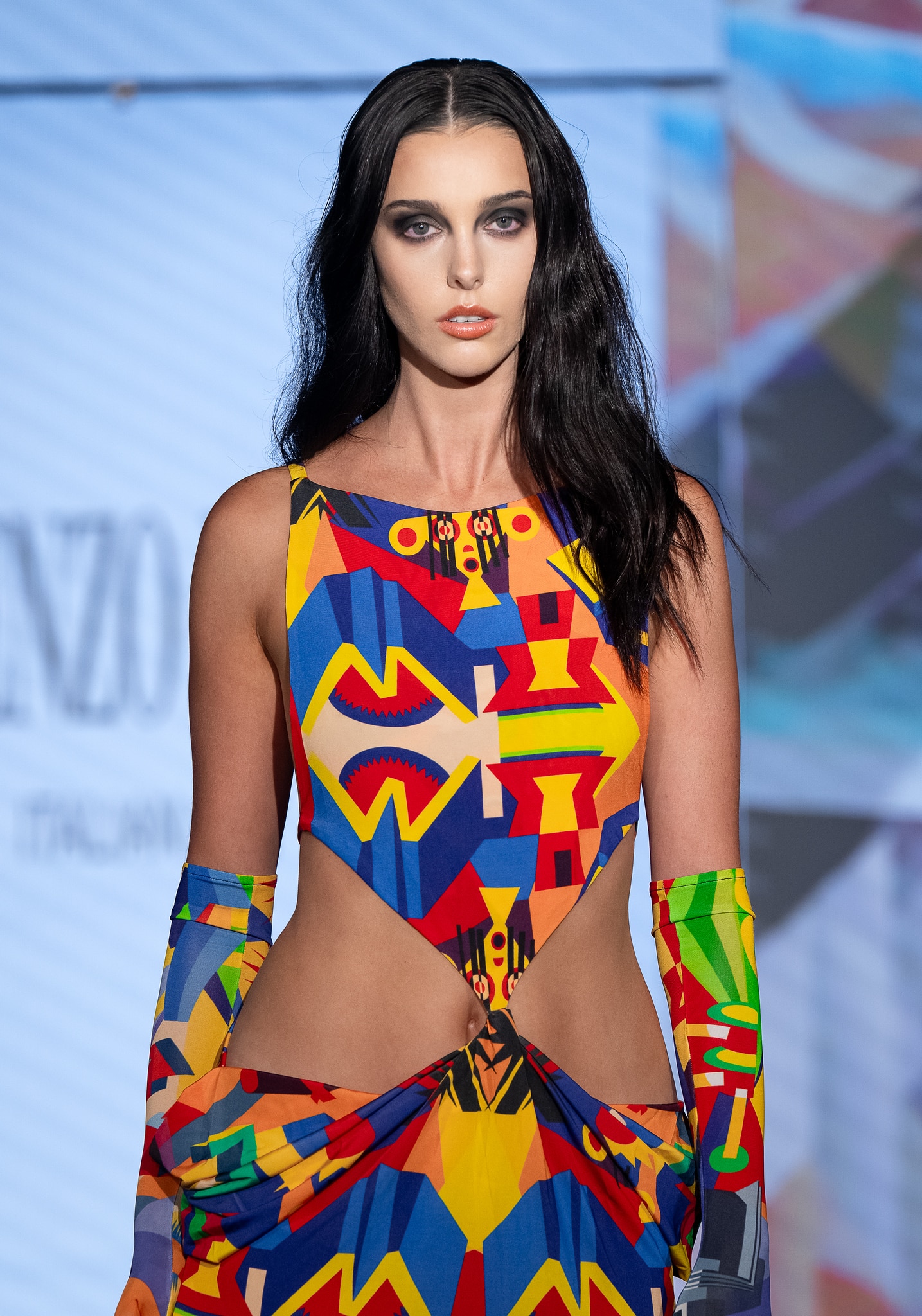
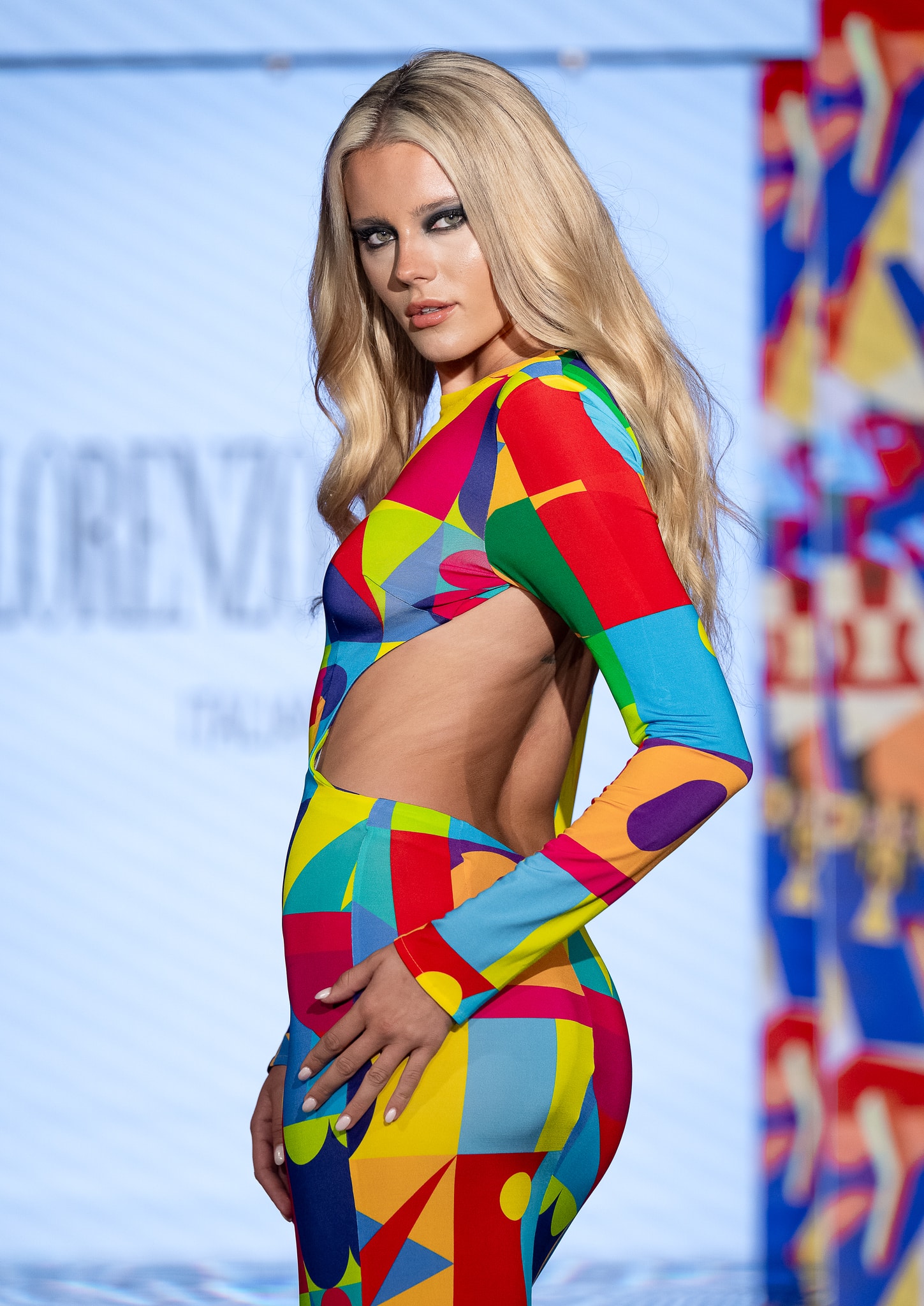
At New York Fashion Week 2026, Marini pushed that question into physical space with TypeArt, transforming 21 letters into 21 silk garments. Except calling them garments doesn’t quite explain what he thinks he’s made.
They’re artworks. And Marini is equally clear about what he has not suddenly become.
A fashion designer. “When they invited me to show as a fashion designer, I needed to clarify that this is not my job,” he tells MUNDANE. “I’m not going to sell any clothes or dresses or accessories because what I care about is mostly art.”
The response from organizers, according to Marini, was essentially: That’s fine. “We’re looking for some artists that can make fashion!”
Challenge accepted.
Please Stop Reading the Letter
Marini’s TypeArt practice began with an act of separation. Remove the letter from the word.
Once isolated, something strange happens.
An A becomes architecture.
An S becomes movement.
An O becomes space enclosed by a line.
An M creates its own rhythm.
The alphabet we learned so early that it became almost invisible suddenly contains 21 individual visual personalities. “We are trained to move through the alphabet very quickly,” Marini explains. “We see a letter, recognize its sound and immediately search for meaning.” TypeArt tries to sabotage that reflex.
“I wanted to interrupt that automatic process and give the letter back its visual presence.” The idea becomes particularly interesting in a world where Marini sees written language increasingly competing with visual shorthand.
Icons. Symbols. Illustrations. Interfaces designed to work across linguistic borders.
While visiting the Getty Museum in Los Angeles, Marini noticed something extraordinarily ordinary: instructions surrounding trash receptacles could be communicated through symbols rather than written language.
A tiny observation. But one that fits his larger thesis. “The more the language becomes international, the more the image becomes stronger than words.”So perhaps the letter’s future isn’t only linguistic.
Maybe it can become image again.
An A Is Not an S
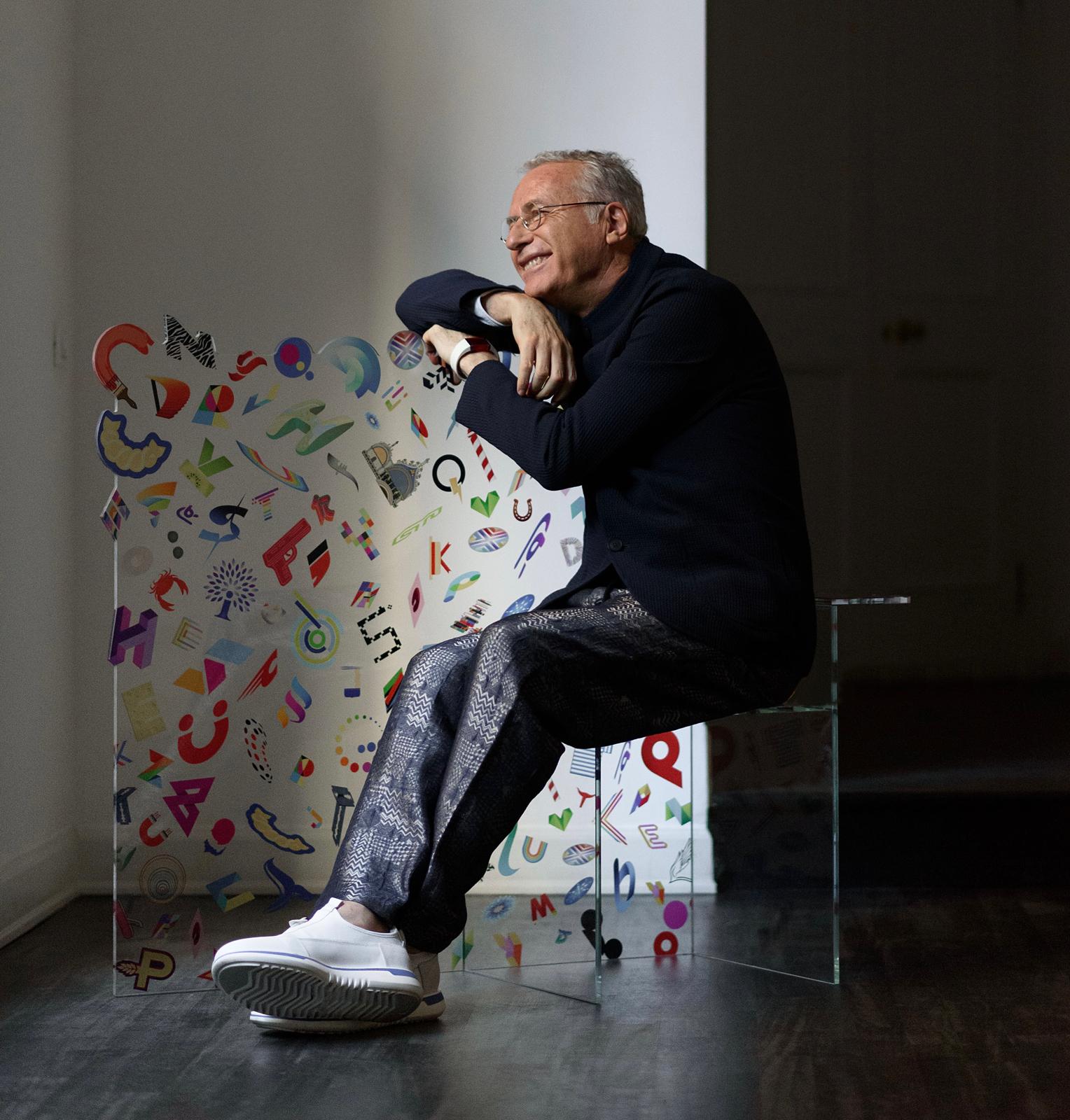
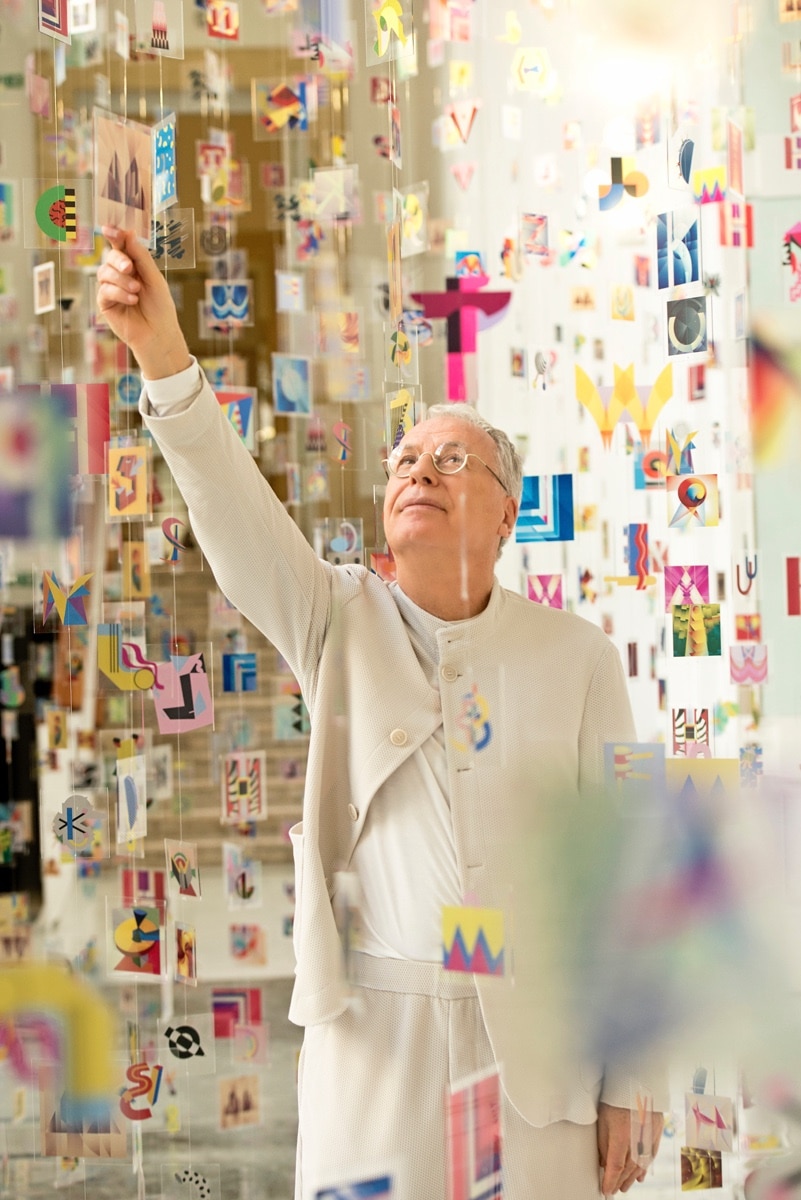
We tend to think of the alphabet as a system. Marini thinks about its inhabitants. “Letters already possess personalities; we have simply become too accustomed to them to notice.”
An A doesn’t occupy space like an S. An M behaves differently from an O. Some letters feel stable. Others seem restless.
Some close themselves. Others remain open. Marini approaches those differences almost as though he were painting portraits.
Proportion. Color. Material. Composition. Movement. Each choice amplifies a personality he believes already exists inside the form. “I do not use the alphabet as decoration.”
That’s crucial to TypeArt. These aren’t dresses with letters printed onto them. “The dresses are not decorated with artworks; they are the artworks.”
The distinction changes everything. Because if the garment is the artwork, the person wearing it isn’t simply modeling clothing. Their body has entered the composition.
Typography Can Apparently Have Choreography
Canvas behaves itself. Put a letter somewhere and, barring intervention, that’s where it stays.
Bodies are less cooperative. They breathe. Turn. Fold. Stretch. Walk.
Stop. Change posture. Fabric reacts. A geometric form that appears complete from one perspective disappears around a shoulder and reappears seconds later. For Marini, that instability revealed something he couldn’t access through static work.
“The body introduced movement, unpredictability and time.” Every step changes the geometry. More importantly, every person changes it differently. “The body does not simply support the artwork; it interprets it.” The wearer becomes something closer to a performer. Or collaborator. Or, as Marini describes it elsewhere, a temporary co-author. A letter acquires choreography.
It walks. Breathes. Disappears. Returns. Same artwork. Never quite the same image.
The Artwork Is Finished Until Someone Wears It
This creates a useful contradiction. The garment can be physically finished. The artwork cannot. “Each time it is worn, it is recreated.”
Different body.
Different gesture.
Different lighting.
Different rhythm.
Different artwork.
For an artist accustomed to determining the composition of an image, that requires surrender. Marini can’t control every shape the fabric will create once another person inhabits it. He likes that. “The moment another person inhabits the work, the work begins to move away from me and acquire its own freedom.”
Which means TypeArt isn’t simply about liberating letters. Marini has to liberate his own work too. Once the garment begins moving, ownership of the image becomes unstable.
Artist. Wearer. Light. Space. Audience. Time. All of them participate. “The runway becomes a moving canvas.”
Is This Fashion?
Sort of. Marini doesn’t want to erase the distinctions between art, design and fashion. He respects them. Each has its own history and internal logic. Design frequently begins with function. Fashion has a particularly intimate relationship with body, time and transformation.
Art, as Marini sees it, occupies a stranger territory because it isn’t necessarily obligated to solve anything. “Art has a larger and more mysterious territory.”
TypeArt isn’t an argument that all of these disciplines are secretly identical. Instead, Marini is interested in the border.
“The boundary therefore remains, but it becomes permeable.” What happens when art borrows fashion’s movement? What happens when fashion acquires the autonomy of an artwork? What happens when a runway becomes a gallery without quite ceasing to be a runway?
Marini isn’t particularly interested in changing careers to answer those questions. He’d rather borrow fashion for a while.
The Future of Art Might Be Multitasking
Marini has a broader suspicion that the traditional ways we encounter art belong increasingly to the previous century.
Artwork. Wall. Viewer. Observe. Next artwork. Repeat. He imagines something more promiscuous between disciplines. Music.
Light. Space. Design. Architecture. Color. Movement.
Not because every artwork needs to become a multimedia spectacle, but because creativity doesn’t necessarily need to remain obedient to the category that produced it. “The next level of artist needs to be creative,” he says, describing a future in which different disciplines become increasingly interconnected. TypeArt becomes one experiment in that direction. Painting doesn’t disappear. It learns how to walk.
New York Is Already One Giant Typography Installation
There was perhaps no more obvious city in which to stage this experiment. New York is covered in language. Street signs.
Storefronts. Advertisements. Screens. Graffiti. Logos. Billboards. Instructions. Names. Warnings. Messages.
“You do not simply walk through New York,” Marini says. “You read it.” He knows the city personally, too.
Marini once lived in SoHo and describes New York as a place that gives “electricity to your mind,” contrasting that energy with the sense of peace he associates with Los Angeles, its palms and ocean sunsets. TypeArt creates a peculiar reversal inside New York’s visual overload.
The city uses letters relentlessly to communicate. Buy this. Go here. Stop. Enter. Look. Remember this brand. Marini arrives and asks the letter to do absolutely none of those things.
“In a city where letters are normally used to sell, direct, announce and persuade, my letters were freed from the obligation to communicate a message.” They can just exist. For once, the alphabet gets the day off.
What Is Left When a Letter Stops Meaning?
Of course, you can’t completely erase language from a letter. An A still carries the ghost of every A you’ve encountered. Even pushed toward abstraction, you sense that the shape belongs to a system. Marini is interested in precisely that threshold.
Recognition versus abstraction. Meaning versus image. Language versus form. “Even when it is no longer immediately legible, a letter retains the memory of language.”Freeing it from words therefore doesn’t destroy meaning.
It multiplies possibilities. A letter can become architecture. Landscape. Body. Rhythm. Emotion. “A word tries to define,” Marini says. “An isolated letter opens possibilities.” That’s a lovely reversal. Language becomes more ambiguous by becoming smaller.
What If the Painting Walked Toward You?
TypeArt also changes a very old power relationship. Usually, the artwork stays put. You approach. The gallery determines where you stand. The wall determines orientation.
You decide how long to look. There is a clear hierarchy. With TypeArt, the artwork approaches you. Then passes you. Then disappears. “There is no single privileged viewpoint.” You might see the front for three seconds. A fold changes.
The model turns. The artwork becomes something else. You follow it with your eyes. Maybe your body. The encounter is temporary.“The artwork is no longer confined to a wall. It shares our time, our movement and our vulnerability.”And because it leaves, attention changes.
Now You See It. Now You Don’t.
The runway taught Marini something about exhibitions he hadn’t fully anticipated. An exhibition doesn’t necessarily have to be a place. It can be an event. A sequence. A passage through time. In a museum, you can theoretically stand before an artwork for twenty minutes. On a runway, you don’t have that luxury.
The work arrives. Approaches. Passes. Gone. “Its disappearance becomes part of the experience.” Scarcity of time intensifies looking.
You know the image won’t remain available, so the encounter becomes sharper. For Marini, the runway therefore wasn’t simply a convenient mechanism for displaying the 21 works. It became the exhibition itself. Painting. Sculpture. Fashion. Performance.
Body. Time.
“I now see an exhibition less as a room containing objects and more as a situation capable of creating an encounter.” Interestingly, the experiment doesn’t appear to have converted him into a touring fashion artist. After the presentation, Marini says he received a proposal to stage something similar in Shanghai.
He hasn’t answered. “I don’t think I can do it because it’s not my real job.” There is something wonderfully consistent about that. He wanted fashion as a new exhibition space. Not a new occupation.
Where Does a Letter Go After It Learns to Walk?
TypeArt is part of a progression.
Word.
Image.
Object.
Body.
Movement.
So naturally, the next question becomes: Where now? Marini’s answer is essentially: Anywhere. Architecture. Urban environments. Landscape. Sound. Light. Digital space. Monumental letters. Nearly invisible ones.
But what interests him most isn’t simply finding another surface to put typography onto. He wants the letters to develop another kind of life. Something responsive. Something capable of changing. Something relational.
“My research began by freeing letters from words. Now I want to discover how far that freedom can take them.” And he doesn’t only imagine the alphabet moving forward. It can move backward too. Human beings were making marks long before the alphabets we recognize today existed. Marini points toward prehistoric cave drawings: image preceding written language.
His alphabet can move along that timeline in either direction.
Past.
Future.
Word.
Image.
Back again.
“The alphabet may be ancient,” he says, “but its journey is not over.” Then he offers an even simpler manifesto. “Freedom has no limit.” Not bad for 21 letters that were supposed to stay on the page.
In Conversation With Lorenzo Marini
MUNDANE: With TypeArt, you take the alphabet—something we normally encounter as language—and transform its 21 letters into 21 silk garments. When did you first realize that a letter could stop being something we read and become something we physically experience?
LORENZO MARINI: It happened when I began looking at letters independently from the words they were supposed to form. We are trained to move through the alphabet very quickly: we see a letter, recognize its sound and immediately search for meaning. I wanted to interrupt that automatic process and give the letter back its visual presence.
If you look around, you see that little by little our life is surrounded by icons, symbols and illustrations. Less words and more images. Yesterday I was at the Getty Museum in Los Angeles and I noticed that the trash doesn’t use letters anymore to give instructions, but symbols. The more language becomes international, the more the image becomes stronger than words.
Once isolated, a letter reveals its own architecture, balance, tension and personality. It is no longer simply a tool for carrying language; it becomes an image and eventually an object.
Transforming my 21 letters into silk garments was the next step in that evolution. The letter left the page, entered physical space and became something that could be inhabited.
MUNDANE: You’ve said, “The letter was born to be read, but it can also be looked at.” At New York Fashion Week, you take that philosophy even further: the letter can now be worn and moved through space. What did the human body allow you to discover about typography that a canvas or static artwork couldn’t?
LORENZO MARINI: The body introduced movement, unpredictability and time. On a canvas, the letter remains where I place it. On a body, it folds, stretches, disappears and suddenly returns. Every step transforms its geometry.
The body does not simply support the artwork; it interprets it. Each woman gives the same sign a different energy through her posture, movement and personality.
I discovered that typography can have a choreography. A letter can walk, breathe and change its identity without losing its essence. It is no longer only something we read or look at—it becomes something we experience.
And I’ll tell you something: when they invited me to show as a fashion designer, I needed to clarify that this is not my job. I’m not going to sell any clothes, dresses or accessories because what I care about is mostly art.
I like to exhibit my art in a different location, in a different world. And the answer was, “But we’re looking for some artists that can make fashion!”
From this point of view, I easily accepted the challenge.
MUNDANE: These pieces aren’t conceived as a conventional fashion collection but as 21 autonomous, wearable artworks. Where do you personally draw the boundary between fashion, design and fine art—and is TypeArt deliberately trying to make that boundary irrelevant?
LORENZO MARINI: I respect those boundaries because each discipline has its own history, language and codes. Fashion relates to the body, time and transformation. Design usually begins with a function.
Art has a larger and more mysterious territory: it is free to exist without providing a solution or satisfying a practical need.
TypeArt does not pretend that these differences do not exist. It allows them to meet.
I did not approach this project as a fashion designer trying to create a collection, but as an artist searching for a new surface and a new exhibition space.
The dresses are not decorated with artworks; they are the artworks.
The boundary therefore remains, but it becomes permeable. I am interested in what happens at that point of contact, when art borrows the movement of fashion and fashion acquires the autonomy of art.
MUNDANE: Movement seems fundamental to the project: the canvas becomes fabric, the painting becomes a dress, and the artwork changes as the person wearing it moves. Does that mean the finished artwork is never actually fixed, but is continually recreated by the body inhabiting it?
LORENZO MARINI: Absolutely. The physical garment may be complete, but the artwork is never entirely fixed.
Each time it is worn, it is recreated. A different body, gesture, light or rhythm produces a different visual experience.
This is not something I can fully control, and that is precisely what makes the project alive.
The moment another person inhabits the work, the work begins to move away from me and acquire its own freedom. The body becomes a temporary co-author, and the runway becomes a moving canvas.
Also, the way we see art comes from the last century. Personally, I think the future of art will be multitasking and the next level of artists needs to be creative.
We need to play with music, light, space, design, architecture, color—with everything connected with soul and a higher mental level.
MUNDANE: Each garment corresponds to one of the 21 letters of the alphabet central to your research, yet you describe them as 21 different identities rather than simply decorative variations. How do you give an individual personality to something as universal and familiar as a letter?
LORENZO MARINI: Letters already possess personalities; we have simply become too accustomed to them to notice.
An A does not occupy space in the same way as an S. An M has a different rhythm from an O. Some letters are open, others closed. Some appear stable and architectural; others seem fluid, fragile or restless.
My work begins by recognizing those hidden temperaments.
Through proportion, color, material, composition and movement, I amplify what is already present in the letter.
I do not use the alphabet as decoration. I approach each letter almost as if it were a portrait—with its own body, character and emotional temperature.
The collection is therefore not a repetition of one idea 21 times, but a gathering of 21 distinct identities.
MUNDANE: You describe New York as a city constructed through signs—manifestos, logos, lettering, images and messages are embedded everywhere in its visual landscape. How did presenting TypeArt in New York change the meaning of a project already so deeply concerned with the visual power of language?
LORENZO MARINI: New York is a city that is constantly speaking. Its buildings, screens, billboards, storefronts, graffiti and signs create an uninterrupted visual language.
You do not simply walk through New York; you read it.
I used to live in SoHo, the center of art. New York gives electricity to your mind, as Los Angeles, with the palms and the sunset on the ocean, gives peace to your soul.
Presenting TypeArt there created a fascinating reversal.
In a city where letters are normally used to sell, direct, announce and persuade, my letters were freed from the obligation to communicate a message. They were allowed simply to exist as forms.
New York also gave the project a particular energy. The city is built through the coexistence of different cultures, accents and identities.
In that context, the alphabet became more than a system of signs: it became a metaphor for individuality and collective life.
Every letter is different, but together they create a language.
MUNDANE: Your work removes typography from its traditional responsibility to communicate words and allows letters to become shapes, colors, rhythms and images. Once a letter no longer needs to be legible, what remains of its original meaning—and what new possibilities emerge?
LORENZO MARINI: Even when it is no longer immediately legible, a letter retains the memory of language.
We sense that it belongs to a system of communication, even if we cannot—or do not need to—decode it. That tension between recognition and abstraction is central to my work.
When a letter is released from the duty of forming words, it gains enormous freedom.
It can become architecture, landscape, body, rhythm or pure emotion. It no longer has to say something specific; it can suggest many things simultaneously.
A word tries to define.
An isolated letter opens possibilities.
It exists at the threshold between meaning and imagination.
MUNDANE: TypeArt seems to ask the audience to stop observing art only from the front: the work walks, changes perspective and occupies the same space as the viewer. Are you interested in challenging the traditional power relationship between artwork, exhibition space and spectator?
LORENZO MARINI: Yes. Traditional exhibition spaces often establish a precise hierarchy: the artwork remains still, the spectator approaches it, and the architecture determines the distance between them.
With TypeArt, that relationship changes.
The artwork moves toward the audience, passes beside it and then disappears. There is no single privileged viewpoint.
The spectator must follow the work with the eyes and sometimes with the body. The encounter becomes more immediate and less ceremonial.
I am interested in art that does not simply wait to be observed, but enters our space and asks us to renegotiate our position.
In this case, the artwork is no longer confined to a wall. It shares our time, our movement and our vulnerability.
MUNDANE: You’ve said that you don’t consider fashion an endpoint but “a new exhibition space.” After seeing these works inhabit the runway during New York Fashion Week, did the experience change your own understanding of what an exhibition can be?
LORENZO MARINI: Yes, because the runway taught me that an exhibition does not necessarily need to be a fixed place.
It can be an event, a passage or a sequence in time.
In a gallery, viewers decide how long to remain in front of an artwork. On a runway, the work appears, approaches and leaves. Its disappearance becomes part of the experience.
That temporary quality gave the pieces an unexpected intensity. The audience knew that each work would be present for only a few seconds, so attention became sharper.
The runway was not merely a platform for displaying the garments; it became a space where painting, sculpture, performance and the human body could coexist.
I now see an exhibition less as a room containing objects and more as a situation capable of creating an encounter.
After this exhibition, I received a proposal to do the same in Shanghai. But I didn’t answer. I don’t think I can do it because it’s not my real job.
MUNDANE: Your practice has progressively moved the alphabet from word to image, from image to object, and now from object to body and movement. Where can the letter go next?
LORENZO MARINI: The letter can go anywhere because it is one of humanity’s smallest and most powerful inventions.
It can enter architecture, urban space, landscape, sound, light or digital environments. It can become monumental or almost invisible.
But I am particularly interested in what happens when letters leave the environments in which we expect to find them and begin interacting with people and places.
Perhaps the next step is not simply to give the letter another surface, but another form of life—one that responds, changes and creates relationships.
My research began by freeing letters from words. Now I want to discover how far that freedom can take them.
The alphabet may be ancient, but its journey is not over.
Humanity started to write its story through drawing. Just remember the primitives in the caves.
My alphabets can go back and forth on the line of time. I can design alphabets from the past or from the future.
Freedom has no limit.