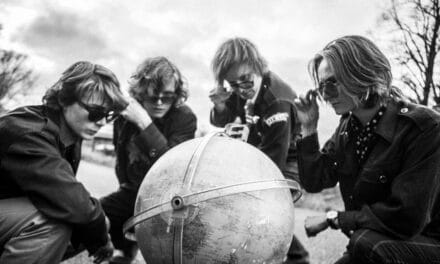
After years of international success, Lukas Graham has stopped trying to prove he belongs anywhere. On Good Times, the Copenhagen songwriter returns to the Irish music of his childhood, the community that raised him, songs built to be sung together and a version of success that increasingly looks like staying home and packing lunch boxes for his daughters.
Lukas Graham has a useful description for how he became a pop star.
“Accidentally pop.”
It’s funny until you think about what it means. Before the international success, before the GRAMMY nomination, before songs traveled around the world carrying his voice with them, there was a kid growing up in Christiania surrounded by music.
And a lot of that music wasn’t pop. It was Irish.
Traveling folk musicians moved through his childhood. His father loved the tradition. Graham absorbed it so completely that decades later, after building an identity associated with soul-pop, it’s still the music he naturally reaches for at home.
“When I cook dinner at home, it’s mostly Irish music on the PA.” That’s probably as useful an indicator of musical identity as anything. Not what you release. Not what performs best. Not what the algorithm thinks you sound like.
What do you play while you’re making dinner? For Graham, the answer eventually became impossible to ignore. Last year, he decided to go home. Not literally. Musically.
“I think I got lost along the way,” he tells MUNDANE. “And I also think we as humans need that. How else do we find our way back home if we don’t get lost first?”
The result is Good Times, a record that reconnects Graham with Celtic and Irish traditions while circling questions that have become increasingly important to him:
Family. Grief. Lineage. Fatherhood. Community. Growing older. And what remains after you’ve spent enough years trying to “make it” that making it no longer feels like the point.
Accidentally Pop
Graham says the idea of leaning into these musical roots has been somewhere inside him since childhood. But careers develop their own momentum. One song leads somewhere. An audience responds. The industry understands something about you and naturally wants more of the thing it understands.
Eventually an artist can look around and discover that what began as instinct has become identity. Graham’s identity became pop. Successfully so.
But Good Times isn’t an attempt to reject that history.
It’s more like remembering there was another history underneath it.
“I grew up around some legendary players,” he says.
Those sounds never disappeared.
They were there at home.
In family memory.
In his father’s influence.
In the music Graham continued listening to privately even as his professional life moved elsewhere.
Then last year:
“It just felt right to start the process of a musical homecoming.”
Process is important.
You don’t simply decide to return home and instantly understand what home means.
Sometimes you have to rebuild the route.
Ireland Gave Him the Language. Christiania Gave Him the Playground.
Graham grew up between two cultural forces.
There was Ireland, connected to him through family and musical tradition.
And there was Christiania.
He gives each a beautifully specific role in his development.
“I guess Ireland gave me the language and songwriting tradition to speak to the world.”
Christiania gave him something else.
“The playground to test the waters.”
And community.
That distinction explains quite a lot about Lukas Graham.
One place offered a songwriting vocabulary.
The other taught him that songs don’t really exist alone.
Neither do people.
Christiania gave him “the sense of community that allowed me to understand the fact that we never accomplish anything alone.”
That principle runs through Good Times.
Even when Graham is writing about intensely private subjects, the music keeps reaching outward.
Which makes sense.
He’s a choirboy.
The Frontman Is Still a Choirboy
There is a fundamental difference between singing to someone and singing with them.
Graham prefers the second.
“I’m a choirboy at heart.”
He’s spent years being the person standing at the front of the stage.
He likes being the frontman.
But the hierarchy disappears when everyone starts singing.
“There is nothing better than singing together.”
Ask whether he consciously writes songs to create that communal experience and Graham isn’t sure he does.
Maybe that’s the point.
Some musical instincts become too old to feel like decisions.
If you grow up understanding music as something people participate in together, perhaps writing toward collective singing doesn’t require a strategy.
It’s already in the architecture.
Songs like “To Know a Girl” and “Loved You Better” can remain emotionally specific while still opening enough space for other people to enter.
The story belongs to Graham.
The chorus doesn’t have to.
What Happens When You Stop Looking for the Radio Single?
The new chapter doesn’t exactly arrive disguised as an obvious attempt to satisfy pop radio.
There are banjos.
Folk instrumentation.
Organic textures.
Narrative songwriting.
That’s not accidental either.
“This whole record is about jumping into the unknown and trusting my instincts.”
That statement sounds simple until you remember that instinct becomes harder to follow after success.
When nobody knows who you are, you can fail anonymously.
Once millions of people associate your name with a particular sound, experimentation becomes public.
There are expectations.
Metrics.
Teams.
Audiences.
Previous successes sitting there reminding you exactly what worked last time.
Good Times required Graham to ignore some of that.
His ambition isn’t to make the most strategically useful album for 2026.
He wants to make something his future self won’t resent.
“To write and release an album I’ll like to still be performing when I’m 70.”
That’s a radically different metric.
Not:
Will this work this summer?
But:
Will I still believe this at 70?
And then comes the harder part.
“Hoping the world will reward me for it.”
You Have to Get Lost
Returning to folk traditions has also made Graham reconsider why he started writing songs.
“Oh, for sure.”
Then comes the admission:
“I think I got lost along the way.”
There is no melodrama around it.
No grand denunciation of pop or success.
Getting lost is part of the process.
Maybe even necessary.
“How else do we find our way back home if we don’t get lost first?”
Then Graham adds another possibility.
“It might also be an age thing.”
Probably.
Music changes when your life does.
The thing you need to prove at 20 may become completely irrelevant later.
The music capable of carrying ambition isn’t necessarily the same music capable of carrying grief.
Or children.
Or memory.
Or the strange experience of becoming old enough to understand your parents differently.
Songs Can Become Grief Before the Grief Happens
One of the record’s most emotionally complicated songs is “Before You Go.”
Graham has been writing through grief for a long time.
He describes songwriting as part of his cathartic process since losing his grandfather in 2009.
But “Before You Go” occupies a stranger emotional space.
He wrote it to a sick friend in 2019.
His friend died in 2025.
The song therefore existed for years before the loss it would eventually come to carry.
“It was grief waiting to happen.”
That’s a brutal phrase.
Songs usually preserve memory after something happens.
This one waited for the future to catch up with it.
Now Graham has to stand onstage and sing words written to someone who was alive when he wrote them.
The meaning has changed even if the lyrics haven’t.
“I get real emotional singing it live.”
Of course he does.
A song can become an archive without changing a single note.
The Third Daughter Changed Something
Fatherhood is another thread running through Good Times.
But Graham’s answer about how becoming a parent changed him isn’t the polished answer artists sometimes give about immediately seeing the universe differently the second their first child arrived.
It took time.
Specifically, it took his third daughter.
“Not until the birth of my third daughter did I experience what a lot of parents talk about after getting their first.”
Before that, another project was still occupying enormous space in Graham’s life.
Career.
Touring.
The world.
Making it.
“I was still caught up with touring the world and ‘making it.’”
Then something clicked.
“With the third, something sort of clicked and a lot of things in life don’t look the same no more.”
Priorities are strange that way.
Sometimes they don’t change because someone tells you they should.
They change because one morning the things that used to feel enormous suddenly don’t.
And something previously ordinary becomes the center.
The Album Is Also a Conversation With His Father
The return to Irish and Celtic music inevitably brings Graham closer to his father’s memory.
But Good Times isn’t interested in lineage as museum preservation.
Graham thinks about generations through participation.
Music should move between them.
He and his family make that literal.
Every summer, he says, they take their children to see somewhere between five and ten bands during the holidays.
Not children’s music.
Not an isolated soundtrack for each generation.
Music together.
“I feel it’s important to listen to music as a family.”
That’s partly what excites him about traditions capable of surviving generations.
A song doesn’t have to belong exclusively to the age group that discovered it first.
“I love when music transcends age gaps.”
Maybe that’s another reason the idea of performing Good Times at 70 matters.
He isn’t trying to make a record that refuses to age.
He’s trying to make one capable of aging with him.

What Makes Something Sound Like Lukas Graham?
Strip away the soul-pop.
Add folk.
Bring in Celtic influence.
Change instrumentation.
Alter production.
What remains?
Ask Graham to define the musical DNA that makes all of it recognizably his and you get possibly the most useful answer imaginable:
“Shiiiiii, I don’t even know.”
Fair.
Then:
“All I can say is I can’t really run away from myself no matter what I’m writing or singing.”
Maybe that’s what artists discover after spending enough time trying to define their sound.
Eventually the definition becomes less important.
If the voice is genuinely yours, genre can’t completely hide it.
You can change instruments.
Production.
Tempo.
Tradition.
But you’re still the person choosing the words.
Still the person singing them.
Still dragging your history into the room.
Graham couldn’t stop sounding like himself if he tried.
And perhaps Good Times happened because he finally stopped trying to determine exactly what “himself” was supposed to sound like.
Nothing to Prove
After years of international success, Graham says he has reached an unfamiliar place.
He feels like he has nothing to prove.
That doesn’t mean he has no ambition.
The album itself argues otherwise.
He’s taking creative risks.
Returning to traditions that matter deeply to him.
But fulfillment has changed shape.
So what does success look like now?
“Honestly, chilling with my kids and packing lunch boxes.”
There it is.
After the tours.
The nominations.
The stages.
The global songs.
Lunch boxes.
But Graham doesn’t see family life and artistic ambition as opposing forces.
Part of fatherhood, for him, is allowing his children to watch him pursue something seriously.
Showing them what it looks like to develop an actual skill.
To leave home.
Make something.
Work at it.
Connect with people.
Have an impact.
“Showing them how to go out into the world doing something you love, honing an actual skill and to have an impact on people is also a very powerful lesson in these digital times.”
That’s perhaps the clearest definition of where Lukas Graham is now.
He doesn’t need to choose between going home and going out into the world.
Good Times exists because they’re part of the same journey.
Ireland gave him language.
Christiania gave him community.
Pop gave him the world.
Getting lost gave him perspective.
His children gave him a different definition of what any of it was for.
And now he’s bringing those things back together.
Maybe you have to accidentally become a pop star before you can intentionally become yourself again.
In Conversation With Lukas Graham
MUNDANE: Good Times feels like a homecoming in every sense—musically, emotionally and culturally. At what point did you realize you wanted to fully lean into your Celtic and Irish roots on this record?
LUKAS GRAHAM: It’s been in my mind since I was a kid, but I ended up “accidentally pop.”
I grew up around some legendary players, and when I cook dinner at home it’s mostly Irish music on the PA.
Last year it just felt right to start the process of a musical homecoming.
MUNDANE: There’s something beautiful about how this album reconnects not only with your heritage, but with people connected to your father’s life and legacy. Did making this project feel like a conversation across generations?
LUKAS GRAHAM: Yeah, bridging the generational gap has always been important to me because I feel it’s important to listen to music as a family.
We do it with our kids every summer—take them to see five to ten bands during the holidays.
I love when music transcends age gaps.
MUNDANE: You’ve spoken about growing up in Copenhagen’s Christiania while simultaneously being deeply connected to Ireland through your family. How did those two very different cultural environments shape your identity as a songwriter?
LUKAS GRAHAM: I guess Ireland gave me the language and songwriting tradition to speak to the world.
Christiania gave me the playground to test the waters and the sense of community that allowed me to understand the fact that we never accomplish anything alone.
MUNDANE: Songs like “To Know a Girl” and “Loved You Better” feel deeply personal while still carrying this massive, communal energy. Do you consciously write songs meant to be sung with people rather than simply to them?
LUKAS GRAHAM: I’m a choirboy at heart, and though I love being the frontman, there is nothing better than singing together.
I’m not sure it’s so conscious, though.
MUNDANE: The decision to avoid chasing a conventional “radio single” and instead introduce this era with banjos, folk instrumentation and a more organic sound feels incredibly intentional. Did this album require a certain creative fearlessness from you?
LUKAS GRAHAM: This whole record is about jumping into the unknown and trusting my instincts.
To write and release an album I’ll like to still be performing when I’m 70, and hoping the world will reward me for it.
MUNDANE: Throughout your career, there’s always been this tension between global pop success and deeply human storytelling. Did returning to folk traditions help you reconnect with why you started making music in the first place?
LUKAS GRAHAM: Oh, for sure. I think I got lost along the way, and I also think we as humans need that.
How else do we find our way back home if we don’t get lost first?
It might also be an age thing.
MUNDANE: “Before You Go” carries an especially emotional weight because of the story behind it. How has performing that song live changed your relationship with grief and memory?
LUKAS GRAHAM: Writing about it has been a part of my cathartic process since I lost my grandfather in 2009.
The difference is, “Before You Go” was written to a sick friend in 2019, and he died in 2025.
So it was grief waiting to happen.
I get real emotional singing it live.
MUNDANE: There’s a recurring theme across the album about family, lineage, fatherhood and becoming more emotionally present. Has becoming a father changed the way you hear or write songs?
LUKAS GRAHAM: Not until the birth of my third daughter did I experience what a lot of parents talk about after getting their first.
I was still caught up with touring the world and “making it” before that, and with the third something sort of clicked, and a lot of things in life don’t look the same no more.
MUNDANE: Even though Good Times explores folk and Celtic influences, it still unmistakably sounds like a Lukas Graham record. What do you think defines your musical DNA regardless of genre?
LUKAS GRAHAM: Shiiiiii, I don’t even know.
All I can say is I can’t really run away from myself no matter what I’m writing or singing.
MUNDANE: You mention finally feeling like you have “nothing to prove.” After years of international success and nonstop movement, what does fulfillment actually look like to you now?
LUKAS GRAHAM: Honestly, chilling with my kids and packing lunch boxes.
But showing them how to go out into the world doing something you love, honing an actual skill and having an impact on people is also a very powerful lesson in these digital times.