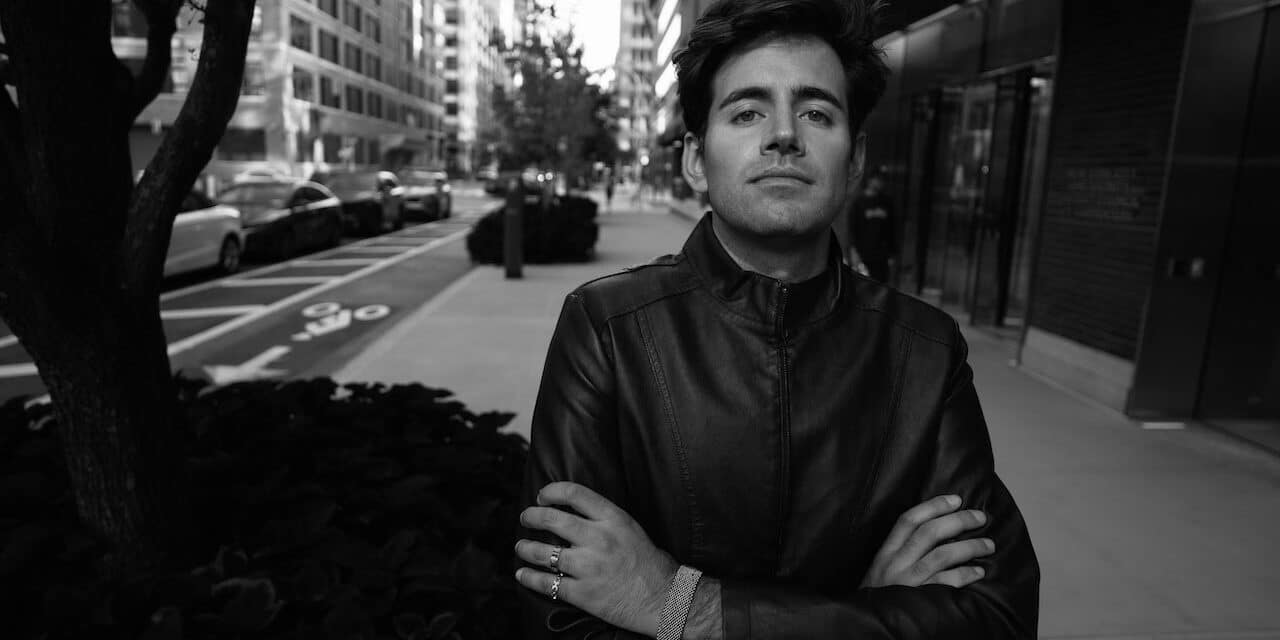
Alone in Central Park during the pandemic, the New York songwriter found himself surrounded by hundreds—maybe thousands—of fireflies. Instead of finding it magical, he was terrified. On “Fireflies,” Morrison turns that absurd moment into a bigger question about adulthood: when did knowing more about the world start making us more afraid of it?
There are moments when adulthood reveals itself not through taxes, back pain or the sudden acquisition of strong opinions about mattresses, but through the realization that something you found magical as a child now scares the shit out of you.
For Alwyn Morrison, it was fireflies.
Hundreds of them.
Maybe thousands.
It was during the pandemic, and Morrison was walking through an almost completely deserted Central Park.
Then suddenly:
Blink.
Blink.
Blink.
Everywhere.
The kind of scene that, under different circumstances, could have been aggressively cinematic.
A childhood fantasy.
Nature putting on a private light show in the middle of New York City.
Morrison’s reaction?
Fear.
“I think it was the absurdity of it,” he tells MUNDANE. “I was surrounded by hundreds, maybe thousands of fireflies, and instead of thinking, ‘This is beautiful,’ I was genuinely afraid of them.”
Which is objectively funny.
Morrison knows this.
But after he got home, the ridiculousness started bothering him.
Because there had been a time when the same insects would have seemed magical.
What happened?
“I kept thinking about how ridiculous it was that I was afraid of something I would have been fascinated by as a kid.”
And somewhere inside that thought, “Fireflies” stopped being about insects.
“It was about what happens to us between being a child and becoming an adult.”
Welcome to adulthood.
The bugs are bigger than you remember.
The Fireflies Didn’t Change
This is perhaps the cruelest part.
The fireflies hadn’t become more threatening.
Morrison had become more informed.
As a child, you see a tiny floating light.
Magic.
As an adult, you see an insect.
A fairly large insect.
Flying unpredictably.
Possibly toward your face.
Knowledge has entered the equation.
And knowledge, unfortunately, is very good at ruining things.
The central tension of “Fireflies,” the third single from Morrison’s forthcoming sophomore EP Trial, isn’t really childhood versus adulthood.
It’s wonder versus awareness.
Children don’t necessarily experience the world more beautifully because the world is more beautiful to them.
They simply haven’t accumulated the same catalogue of reasons to be afraid of it.
Adults know what can go wrong.
We’ve seen things break.
People disappear.
Relationships fail.
Bodies change.
Plans collapse.
Consequences become real.
Eventually caution starts disguising itself as wisdom.
Morrison began wondering whether some part of the original fearlessness could survive all that information.
“Wouldn’t life be better if we were a bit more fearless as we once were?”
Maybe.
Although he isn’t proposing we all become children again.
Growing Up Without Growing Out of Yourself
“The song is not about wanting to literally go back to being a child.”
Good.
Because childhood wasn’t perfect either.
Nostalgia has an impressive ability to edit.
Instead, Morrison is interested in whether certain qualities can survive adulthood.
Curiosity.
Fearlessness.
Imagination.
The ability to encounter something before immediately calculating what could go wrong.
“Maybe you can grow up without completely growing out of the person you were.”
Then Morrison immediately punctures his own optimism.
“But that’s pretty impossible, right?”
Pause.
“Well, one can hope.”
That tension keeps “Fireflies” from becoming a sentimental argument for returning to some idealized childhood.
You can’t.
And Morrison knows it.
The more interesting question is what pieces you can carry forward.
The Whiteboard of Childhood
Morrison wrote “Fireflies” with longtime collaborator Michael Kooman, and at one point the pair attempted something resembling emotional archaeology.
They got a whiteboard.
Then started writing down childhood.
Not one particular memory.
Everything.
Images.
Associations.
Fairy tales.
Animated films.
Fragments of the imaginative universe that surrounds you when you’re young.
The exercise could easily have turned the song into an autobiography.
Instead, something unexpected happened.
Almost none of those literal memories made it into the finished verses.
“All the things we wrote down about our own childhoods stayed on the whiteboard.”
But the emotional atmosphere remained.
That’s an interesting distinction.
Sometimes specificity makes a song personal.
Other times, specificity can shrink it.
Morrison and Kooman weren’t trying to reconstruct a childhood photograph.
They were trying to reconstruct the feeling of remembering childhood.
Those aren’t the same thing.
“Fireflies” therefore exists in that slightly distorted territory where nostalgia usually lives.
Not what happened.
What it feels like now to think about what happened.
Trial Is Not Really About Him Anymore
Morrison’s 2025 debut EP Heartsplit lived largely inside romantic territory.
Love.
Connection.
Heartbreak.
The kind of emotional experiences that can make your own life feel like the only event occurring on Earth.
Trial moves outward.
Morrison describes the EP as a journey “from selfishly obsessing about our own problems to recognizing the ubiquity of the human experience.”
That’s a significant shift.
Not because personal problems stop mattering.
Because eventually you realize everyone has them.
Everyone is scared of something.
Everyone has patterns they inherited or created.
Everyone is trying to understand which parts of themselves came from choice and which were quietly assembled by everything that happened before they noticed.
Morrison says writing “Fireflies” alone didn’t necessarily change him.
Making Trial did.
“There was nothing missing for me. That’s a big part of why I wanted to release these songs together.”
The songs needed each other.
Taken together, they trace a movement away from the self as isolated protagonist and toward something more communal.
“My pain” gradually becomes “pain.”
“My fear” becomes “fear.”
“My survival” becomes part of the strange, repetitive business of being human.
Start With the Lyrics. Then Stop Protecting Them.
Morrison and Kooman have written many songs together over the past several years.
Their process has developed its own rhythm.
Lyrics.
Piano.
Repetition.
Kooman plays variations.
They hum.
Something catches.
Repeat until the emotional architecture begins to reveal itself.
Usually Morrison’s personal attachment to the subject can create fairly strong ideas about where the melody or chords should go.
“Fireflies” was different.
“It wasn’t the most personal song compared to others we wrote together, which allowed me to let go a bit more.”
That distance created freedom.
Rather than protecting an existing melodic idea, Morrison could watch the song move somewhere unexpected.
He credits Kooman with a particularly valuable ability:
Making emotion happen in the music itself.
Not merely in the lyrics.
“Michael is incredible, as a composer, at making the emotion land in the notes, not just in the story.”
That sounds obvious until you hear songs where the production and narrative seem to be having entirely separate conversations.
For Morrison, the goal became making the entire arrangement remember childhood.
Then the Soft Pop Song Needed to Hit Harder
The demo apparently had another problem.
It was too polite.
Morrison didn’t want “Fireflies” to remain simply a soft nostalgic pop song.
He wanted impact.
So the track went through a much longer transformation.
August Eriksmoen orchestrated the song.
Michael Carey helped refine elements of the production.
Then Morrison spent months working on the mix with Alex Aldi.
Months.
“I had never spent so many months working on the mix.”
Which feels almost comically appropriate for a song about trying to recover the uncomplicated instincts of childhood.
Nothing says lost innocence quite like obsessing over a mix for several months.
But eventually something clicked.
“At some point, we got it: the mix that felt like what the song was meant to be.”
The final result sits slightly outside Morrison’s other material while still belonging to the same world.
That’s exactly where he wanted it.
Different enough to reveal another part of himself.
Familiar enough that it doesn’t feel like an escape from himself.
“I am very proud of it.”
Nostalgia Is a Dangerous Little Machine
“Fireflies” works because Morrison doesn’t entirely trust nostalgia.
He enters it.
Enjoys it.
Uses its colors.
But he doesn’t pretend the past is recoverable.
The child who saw fireflies as magical didn’t know what the adult knows.
You can’t unknow things.
You can’t reconstruct innocence simply by deciding to become innocent again.
You can only ask whether knowledge has to control the entire experience.
That’s a more difficult question.
Can you know the insect is an insect and still see the light?
Can you understand danger without allowing fear to determine everything?
Can you become an adult without converting caution into your entire personality?
Can you look backward without living backward?
Morrison doesn’t really answer.
He writes the song instead.
Everybody Bleeds
The broader Trial project makes that uncertainty feel intentional.
Even its song titles sketch a strange emotional progression:
“Puzzle Piece.”
“Everybody Bleeds.”
“Monster.”
“Fireflies.”
Identity.
Pain.
Fear.
Wonder.
The project moves through things that can feel intensely private until you realize how widely shared they are.
Morrison’s alternative-rock instincts have always made room for vulnerability, but Trial appears interested in widening the frame.
What happens when the diary starts noticing other people?
What happens when you stop asking only why something happened to you and start asking why human beings keep repeating the same emotional patterns?
What happens when survival stops being heroic and simply becomes something everybody is doing?
Maybe that’s what adulthood actually is.
Not finally understanding yourself.
Realizing everyone else is equally unfinished.
Central Park, Years Later
It’s easy to imagine Morrison’s pandemic encounter with the fireflies as a tiny film.
New York emptied out.
Central Park unnaturally quiet.
One person walking alone.
Then hundreds of lights begin flickering in the darkness.
Beautiful.
Except the protagonist is terrified.
That’s better.
Because that’s how memory actually works.
The supposedly profound moments often arrive disguised as something stupid.
You get scared of an insect.
You go home.
You laugh at yourself.
Then you realize you’ve accidentally discovered something about who you’ve become.
Years later, it’s a song.
And the song doesn’t ask Morrison to become the child who once chased fireflies.
That person is gone.
Growing up does that.
But perhaps adulthood doesn’t have to mean surrendering every part of him.
Maybe wonder becomes harder.
Maybe fear becomes louder.
Maybe the trick isn’t pretending you don’t know what you know.
Maybe it’s looking at the blinking insect, acknowledging that yes, technically, that thing is kind of huge—
and choosing to see the light anyway.
In Conversation With Alwyn Morrison
MUNDANE: What was it about that night in Central Park that inspired you to turn your experience with fireflies into a song?
ALWYN MORRISON: I think it was the absurdity of it. I was surrounded by hundreds, maybe thousands of fireflies, and instead of thinking, “This is beautiful,” I was genuinely afraid of them.
And there was nobody else around. It was during the pandemic, so Central Park was almost completely empty, which made the whole experience feel even more surreal.
When I went home, I kept thinking about how ridiculous it was that I was afraid of something I would have been fascinated by as a kid. That contrast really stayed with me.
I think that’s when I started realizing it wasn’t really a song about fireflies. It was about what happens to us between being a child and becoming an adult.
MUNDANE: How did writing “Fireflies” change the way you think about childhood and the person you’ve become?
ALWYN MORRISON: The song is not about wanting to literally go back to being a child, but more about whether we can bring some of that attitude with us as we grow up.
Maybe you can grow up without completely growing out of the person you were. But that’s pretty impossible, right? Well, one can hope.
I don’t think writing this song itself changed me, but as part of my EP, Trial, that entire process did.
That’s a big part of why I wanted to release these songs together. There was nothing missing for me.
It is a journey from selfishly obsessing about our own problems to recognizing the ubiquity of the human experience, and looking back at certain patterns, in myself and in others, that shaped who I am today.
MUNDANE: “Fireflies” has a nostalgic feeling to it. Did you find yourself thinking about any specific childhood memories while writing the song?
ALWYN MORRISON: After I wrote the song, Michael and I took the lyrics to a whiteboard and just started writing down everything that came to mind about our own childhoods.
A lot of the imagery in the song came—with the references to fairy tales and animated movies that shaped my imagination as a kid—from that nostalgic, emotional world I was trying to dive into, more so than from any specific childhood memories.
All the things we wrote down about our own childhoods stayed on the whiteboard. We ended up not changing the verses to make the song more personal to us, but the song kept that nostalgic feeling.
MUNDANE: How did working with Michael Kooman and August Eriksmoen shape the final sound and feel of “Fireflies”?
ALWYN MORRISON: Michael and I wrote many songs together over the last few years. Usually he starts playing the piano while looking at the lyrics, and then he plays different variations of something over and over again until we hum a melody that feels right.
“Fireflies” wasn’t the most personal song compared to others we wrote together, which allowed me to let go a bit more and see the sound go in more unexpected ways, instead of sticking to the melody or chord progression I had in mind when I wrote the lyrics.
Michael is incredible, as a composer, at making the emotion land in the notes, not just in the story.
August Eriksmoen’s arrangements gave the song a lift. I am so grateful to have worked with him once again.
On this song, the production, with August orchestrating it and Michael Carey tweaking a few things, was quite a journey.
I wanted the song to hit harder than the soft pop song our demo was. I had never spent so many months working on the mix, with one of my favorite mixing engineers, Alex Aldi.
At some point, we got it: the mix that felt like what the song was meant to be.
Slightly different from my other songs, but definitely a cohesive chapter that flows with the rest of my music, at least to me.
I am very proud of it.