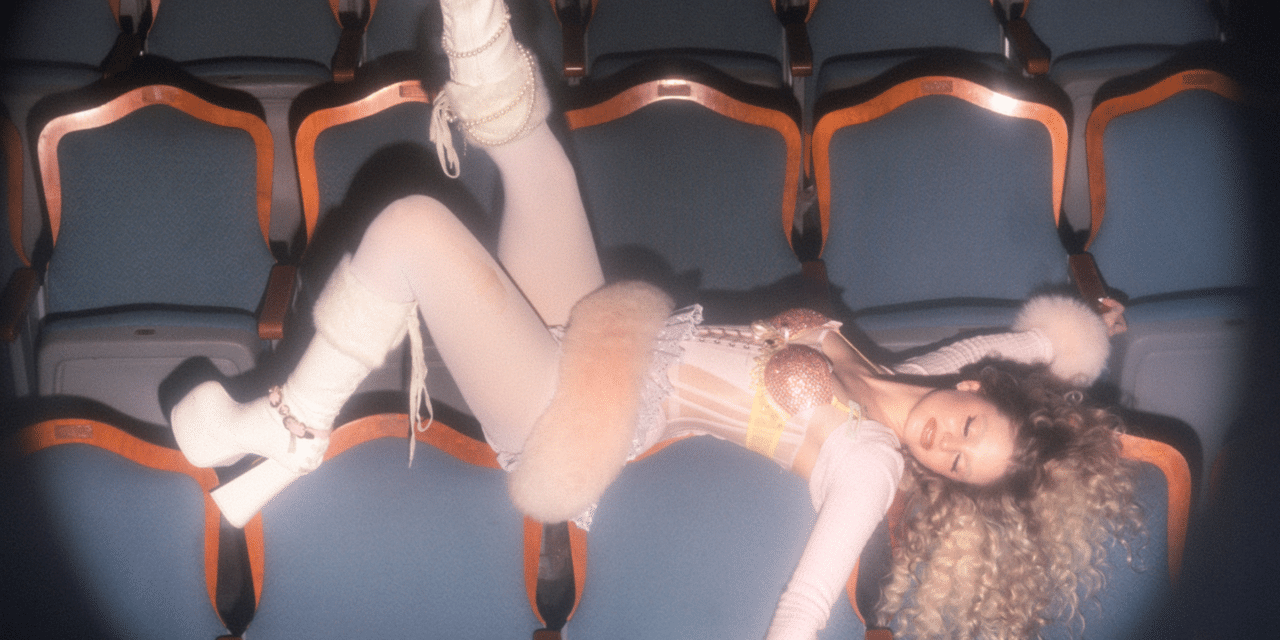
Somewhere between pop star, Broadway heroine, fashion character and one-woman theatre company, RAEGAN has stopped worrying about making herself easier to categorize. On RAEGAN CORE, the completely independent artist turns crying into spectacle, dresses according to her emotions and reconnects with the theatre kid she used to be. Being too much, it turns out, might be the whole point.
There is a version of being an emerging pop artist that involves making yourself extremely easy to explain.
Pick the genre.
Find the reference points.
Develop the aesthetic.
Perfect the elevator pitch.
Give everyone a clean sentence they can repeat in meetings.
RAEGAN appears to be moving in the opposite direction.
Singer.
Songwriter.
Producer.
Actor.
Dancer.
Theatre kid.
Fashion obsessive.
World-builder.
Pop star.
Occasionally some combination of all of them before lunch.
Her forthcoming EP RAEGAN CORE doesn’t attempt to resolve these identities into something more sensible.
It lets them collide.
“Being RAEGAN CORE just means being unapologetically myself!!!” she says. “It’s being vibrant, bold, quirky, silly, dramatic and emotional all at once heheh.”
There are considerably more exclamation points in RAEGAN’s universe than in most people’s.
That feels appropriate.
Because if there is a central philosophy underneath the project, it might be this:
Why experience one emotion quietly when you can turn it into an entire production?
RAEGAN Is RAEGAN. Except When She’s More RAEGAN.
Pop has always enjoyed the unstable relationship between person and persona.
Where does the human end?
Where does the character begin?
RAEGAN’s answer is:
Good luck figuring it out.
“All of the above.”
The character isn’t an alter ego in the conventional sense.
“RAEGAN is completely me and I write through my perspective.”
But the version appearing onstage is naturally amplified.
“Of course she’s exaggerated in certain ways though, because it’s a version of me on stage versus me at home on the couch.”
That’s probably the healthiest definition of pop-star mythology imaginable.
Same person.
Different lighting.
The RAEGAN sitting on the couch doesn’t cease to exist when the theatrical version arrives.
The stage simply gives her permission to turn the volume up.
Crying, But Make It Spectacular
Consider titles like “CRYING IS A GIRL’S BEST FRIEND” and “IT’S SO HARD TO BE ME.”
Subtlety has left the building.
RAEGAN takes emotions that might normally inspire someone to close the bedroom door and instead gives them costumes, production and a spotlight.
For her, theatricality isn’t a mechanism for hiding vulnerability.
It’s how she processes it.
“It’s a form of therapy for me.”
Turning pain into spectacle changes the power dynamic.
The thing that hurt her becomes material.
“I am able to express my feelings and take the power back by making something I love out of them.”
This is where camp and sincerity become difficult to separate in RAEGAN’s work.
Something can be ridiculous and devastating.
Funny and sincere.
Excessive and painfully real.
Those aren’t contradictions she consciously engineers.
“Tbh I have no idea hahah.”
Excellent.
She isn’t sitting down with a formula calculating the appropriate ratio of emotional devastation to camp.
“I am just expressing myself and how I feel.”
Apparently this is simply how her brain processes reality.
“I see the world through my lens and that’s what I put into the music. I’d say that’s something I do in everyday life too.”
For RAEGAN, melodrama isn’t necessarily exaggerating life.
It might just be how life looks from inside.
She Had to Grow Up to Become a Theatre Kid Again
The path toward RAEGAN CORE actually involved going backward.
Her viral debut “TIM BURTON” introduced audiences to her gothic-pop instincts.
FCK RAEGAN* pushed further into chaos, camp and emotional volatility.
But those early songs came from a younger version of her.
“I made those first few songs in high school.”
They documented someone becoming herself in real time.
Coming of age.
Trying identities.
Building a language before necessarily knowing where it was leading.
Then RAEGAN stepped away for a while.
And something shifted.
“I took some time off and found myself, who I am and who I want to be in my early 20s.”
Curiously, becoming older led her toward something younger.
Her inner child.
“I felt very connected to my inner child and I wanted to reconnect with her.”
That reconnection led straight back to theatre.
Not theatre as nostalgic cosplay.
Theatre as an old creative instinct that suddenly made sense again through the person she’d become.
“That’s what led me back to my theatre roots and made that come alive through my perspective today.”
So RAEGAN CORE isn’t exactly RAEGAN inventing a new character.
It’s RAEGAN recovering an old part of herself and giving her adult resources.
The theatre kid got a pop budget.
Or, more accurately at this stage:
The theatre kid is trying very hard to create the illusion of a pop budget.
Please Give Her More Money for Props
Because RAEGAN is independent.
Completely.
Which makes the scale of the project slightly more absurd.
She isn’t merely recording songs and handing them over to a machine that manufactures the surrounding identity.
She’s involved in songwriting.
Production.
Performance.
Visuals.
Stage design.
The universe requires maintenance.
RAEGAN finds that liberating.
“I would say I have a very specific identity. My vision is very clear in my head and my goal is to bring it to life.”
There are obvious dangers to this.
If the entire world lives inside your brain, you become responsible for translating it into reality.
That can be exhausting.
“Sometimes it gets overwhelming but I thrive on being busy heheh.”
Of course she does.
But total control doesn’t mean total isolation.
RAEGAN works with friends and collaborators who bring their own perspectives into the project.
“I also have amazing friends that I work with to introduce their perspectives to my world too which always makes it better.”
That’s an important distinction.
World-building doesn’t have to mean refusing outside ideas.
It means knowing the world clearly enough that other people can enter it without dissolving it.
Pop Needs the Divas
Why theatre?
Why now?
RAEGAN thinks part of the appeal is extremely straightforward.
“We need the divas and the gays to inspire us.”
There you have it.
But her answer points toward something larger happening in pop.
Theatricality is becoming increasingly visible again.
Characters.
Narratives.
Elaborate visual universes.
Pop stars interested in performance beyond simply reproducing songs onstage.
For RAEGAN, the appeal is connected to the emotional function of pop itself.
“We need to be uplifted and supported.”
The world is not exactly suffering from an excess of escapism at the moment.
Sometimes people want fantasy.
Drama.
Costumes.
A chorus that behaves like the final number of a musical.
Something bigger than the room they’re currently sitting in.
“Being theatrical, in my eyes, is expressing yourself loudly.”
And RAEGAN is very interested in being loud.
Clothes Are Feelings With Zippers
Fashion doesn’t exist separately from this philosophy.
RAEGAN has walked at New York Fashion Week and worked with emerging designers, but ask whether styling is another layer of character-building and she immediately corrects the premise.
“I am dressing myself!!!”
Again:
RAEGAN is the character.
The character is RAEGAN.
The distinction keeps collapsing.
“I always say that I love dressing the way I feel.”
Sometimes that’s literal.
An emotion translated into clothes.
Other times it’s about making the exterior body resemble the internal idea of herself.
“I like it to match with my looks heheh!!”
That makes fashion another communication system.
Not:
What should the pop star wear?
But:
What does this feeling look like?
RAEGAN describes working with creative talent in New York to make that possible.
The objective is wonderfully direct:
“Be seen the way I want to be seen.”
Fashion becomes control over perception.
Not control in the sense of hiding.
Control in the sense of making the outside finally resemble the inside.
The Industry Would Like a Category
There is, naturally, a problem with being difficult to categorize.
Categories are useful.
Especially commercially.
They tell playlists where to put you.
They tell audiences what to expect.
They tell teams how to market you.
They allow everyone involved to say:
Oh, she’s this.
RAEGAN gets advice about changing.
“For sure, I get told a lot that I should be different.”
Sometimes it works.
“Sometimes it gets to my head.”
Of course it does.
It’s difficult to remain completely convinced of your weird little universe when people whose job involves understanding the market suggest that your weird little universe might be the problem.
But RAEGAN keeps returning to the original reason she makes music.
Herself.
“I always find myself grounded in why I am doing what I am doing. Which is ultimately for me.”
That isn’t indifference toward an audience.
Quite the opposite.
She cares deeply about the community that has formed around the work.
“Being heard is so powerful and I am so honored to have fostered a community of people that see me and relate to what I am doing.”
But there’s a sequence.
First, make the thing honestly.
Then let people find themselves inside it.
Don’t reverse-engineer yourself into somebody they might theoretically accept.
RAEGAN cites a MARINA lyric that essentially functions as the policy:
“I rather be hated than loved for what I’m not.”
Musical Theatre Pop for People Who Think Pop Stars Should Be Characters
The result is something that doesn’t sit comfortably inside one category.
That’s increasingly the point.
There’s pop.
There’s musical theatre.
There’s performance art.
Fashion.
Camp.
Character.
Confession.
Satire.
Heartbreak.
A little Broadway heroine energy.
A little gothic melodrama.
A lot of glitter.
RAEGAN isn’t treating songs as isolated audio products.
They’re scenes.
Pieces of a larger narrative.
Opportunities to expand a character who is simultaneously not really a character at all.
That distinction is important because the spectacle would mean less if there weren’t a recognizable person underneath it.
RAEGAN can exaggerate herself precisely because there’s something real to exaggerate.
The crying is real.
The costume can still be ridiculous.
Plot Twist: There Is No Label Doing This
Perhaps the funniest misunderstanding surrounding RAEGAN is also one of the most revealing.
Some fans assume she’s signed.
She isn’t.
“As of right now I am completely independent and just chasing my dreams on my own heheh.”
The “heheh” is doing heroic work there.
Because “completely independent” sounds considerably less casual when the project involves music production, choreography, visuals, styling, stage design, touring and constructing an entire theatrical pop universe around yourself.
But maybe that’s what makes RAEGAN CORE a particularly accurate title.
There isn’t some invisible institution behind the curtain manufacturing RAEGAN.
The increasingly elaborate character, aesthetic and mythology are emerging because she keeps insisting they should exist.
And perhaps the most useful way to understand RAEGAN isn’t to solve the genre problem at all.
Pop star?
Yes.
Theatre kid?
Definitely.
Producer?
Yes.
Actor?
Yes.
Dancer?
Yes.
Character?
Sort of.
Actual person?
Unfortunately.
Fashion creature?
When the feeling requires it.
The category is getting crowded.
So maybe RAEGAN CORE is the category.
Vibrant.
Bold.
Quirky.
Silly.
Dramatic.
Emotional.
All at once.
No simplification required.
In Conversation With RAEGAN
RAEGAN CORE sounds almost like a manifesto for your entire creative identity. What does being “RAEGAN CORE” actually mean to you?
Being RAEGAN CORE just means being unapologetically myself!!! Its being vibrant, bold, quirky, silly, dramatic and emotional all at once heheh.
Your work sits somewhere between pop music, musical theatre, performance art and character-building. Do you think of RAEGAN as an extension of yourself, an exaggerated character, or something that exists somewhere between the two?
All of the above, RAEGAN is completely me and I write through my perspective. Of course she’s exaggerated in certain ways though, because it’s a version of me on stage versus me at home on the couch if that makes sense hahah.
“CRYING IS A GIRL’S BEST FRIEND” and “IT’S SO HARD TO BE ME” turn vulnerability into something theatrical and deliberately over-the-top. What interests you about taking emotions that might normally feel private or embarrassing and making them spectacular?
It’s a form of therapy for me. I am able to express my feelings and take the power back by making something I love out of them. I try to turn the negatives into positives for myself and it always leads me to a resolution.
There’s often a collision between camp and genuine emotional pain in your music. How do you make something funny, excessive or absurd without diminishing the sincerity underneath it?
Tbh I have no idea hahah. I don’t really think about that when I am creating. I am just expressing myself and how I feel. I see the world through my lens and that’s what I put into the music. I’d say that’s something I do in everyday life too.
TIM BURTON introduced a gothic-pop world, while F*CK RAEGAN pushed further into chaos and theatricality. What did you discover about yourself between those projects that ultimately led to RAEGAN CORE?
I made those first few songs in high school so that was me coming of age and finding my identity. After those released, I then took some time off and found myself, who I am and who I want to be in my early 20s.
I felt very connected to my inner child and I wanted to reconnect with her. That’s what led me back to my theatre roots and made that come alive through my perspective today.
You’re involved in virtually everything—songwriting, production, performance, visuals and stage design. Is that level of creative control liberating for you, or does being responsible for the entire universe sometimes become overwhelming?
It’s very liberating. I would say I have a very specific identity. My vision is very clear in my head and my goal is to bring it to life.
I also have amazing friends that I work with to introduce their perspectives to my world too which always makes it better. Sometimes it gets overwhelming but I thrive on being busy heheh.
You’ve described a lane that feels like musical-theatre pop, at a moment when pop audiences seem increasingly interested in artists with strong characters and elaborate worlds. Why do you think theatricality is resonating again?
I guess if I am speaking for myself here, I love seeing this in pop music again because right now more than ever we need the divas and the gays to inspire us.
We need to be uplifted and supported and I would say that the pop stars right now are definitely doing a great job of that. Being theatrical, in my eyes, is expressing yourself loudly.
Fashion also seems integral to the project, from NYFW to your collaborations with emerging designers. When you’re developing a RAEGAN look, are you dressing yourself, building a character, or effectively designing another piece of the narrative?
I am dressing myself!!! I always say that I love dressing the way I feel. Whether that’s as literal as my daily emotions or how I feel as a person on the inside, I like it to match with my looks heheh!!
I have had the honor of working with brilliant talent in NYC to create looks that do exactly that, be seen the way I want to be seen heheh.
There can be pressure on emerging artists to make themselves immediately understandable and easily marketable. You seem to be doing almost the opposite. Has refusing to be easily categorized ever felt risky?
For sure, I get told a lot that I should be different and sometimes it gets to my head but I always find myself grounded in why I am doing what I am doing. Which is ultimately for me.
I would make music to express myself even if no one ever listened to it. Being heard is so powerful and I am so honored to have fostered a community of people that see me and relate to what I am doing.
“I rather be hated than loved for what I’m not” – MARINA.
If RAEGAN CORE is the moment where all these different sides of you—singer, producer, actor, dancer, designer and storyteller—fully collide, what do you want audiences to understand about RAEGAN that they might have misunderstood before?
Hmmm that’s a great question, I actually don’t know. I don’t quite know what people’s perspectives of me are so I don’t know what they could possibly be misunderstanding.
But the first thing that comes to mind is a lot of my supporters think I’m signed but I’m not!! As of right now I am completely independent and just chasing my dreams on my own heheh.