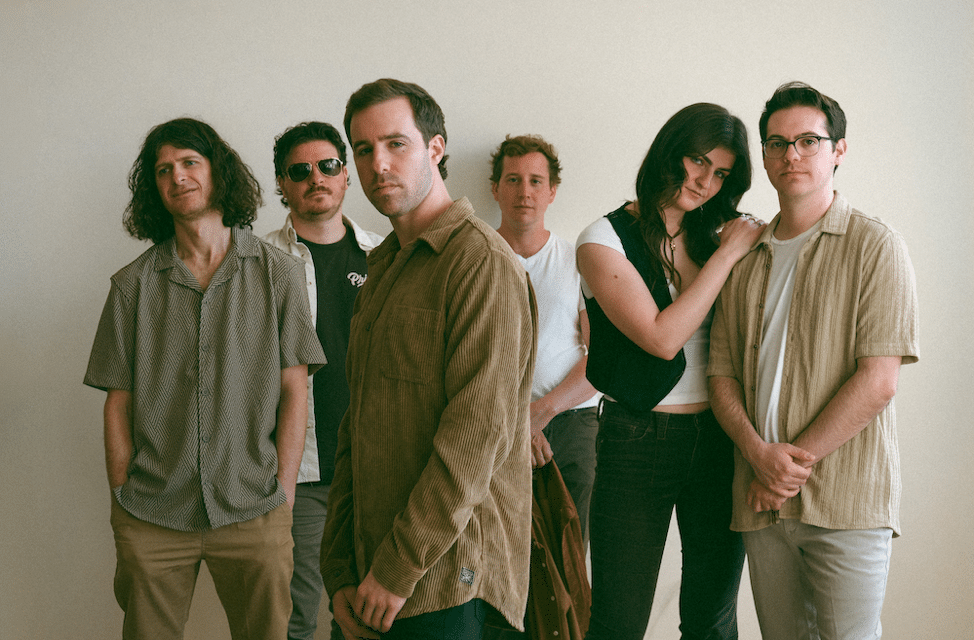
Born on a porch in Asbury Park and now playing festival stages in front of thousands, Surfing for Daisy are building an alternative folk-rock world rooted in friendship, Jersey grit, psychedelic expansiveness, and the belief that songs should follow feeling before genre.
Some bands begin with a strategy.
Others begin because the right people happen to be in the same place at the same time.
For Surfing for Daisy, that place was a porch in Asbury Park, New Jersey.
Friends gathered.
Songs emerged.
A band took shape.
There was no algorithm identifying a market opportunity, no genre brief, no engineered rollout explaining what the project was supposed to become.
That origin still matters.
“I think because of the community we have built, we have an even more intimate connection with our fans,” the band says.
That connection has allowed Surfing for Daisy to grow largely through word of mouth, with people becoming emotionally invested not just in the music but in what surrounds it.
“There’s a sense of community strong enough that we’ve been able to grow this band pretty much independently.”
The band calls that expanding network the SFD family.
And the word family does not feel incidental.
Surfing for Daisy’s trajectory so far—from porch sessions to a sold-out show at The Stone Pony and a performance in front of thousands at Sea.Hear.Now Festival—has been defined less by the traditional story of a band breaking away from its roots than by one taking those roots with them.
The crowds are getting bigger.
The stages are changing.
The emotional architecture appears remarkably similar.
Community Before Audience
The modern language around artist development often reduces people to numbers.
Followers.
Streams.
Engagement.
Conversion.
Surfing for Daisy’s own vocabulary feels noticeably different.
They talk about community.
They talk about word of mouth.
They talk about people wanting “to be a part of what’s going on here.”
That difference matters.
An audience watches.
A community participates.
The band’s early independence has been possible partly because listeners have taken on some of the work themselves—bringing friends, talking about the music, showing up repeatedly, and creating momentum that does not feel entirely imposed from above.
That produces a different kind of responsibility too.
“The SFD family we have created—and that has been continually created by others—gives us an immense amount of motivation to keep pushing forward.”
Success, in that context, stops feeling solely individual.
There are people emotionally attached to the outcome.
The dream becomes shared.
Let the Song Decide What It Is
Surfing for Daisy are commonly described through some combination of alternative folk rock and psychedelia.
The description is useful.
It is also increasingly incomplete.
The band’s own writing process resists starting with genre altogether.
“We tend to write whatever we feel in a particular moment, never aiming for anything specifically.”
That philosophy helps explain why their music can move between intimacy and scale without sounding as if two incompatible identities have been stitched together.
There may be a folk undertone.
But the band does not begin a session deciding to make something “folky.”
“We really just let the song guide us in the direction it wants to go.”
That means arrangement becomes discovery rather than execution.
A song tells them what it needs.
Then they follow.
The first album may have retained slightly clearer stylistic parameters, the band admits.
The forthcoming sophomore record pushes much further.
“The second one really defies everything when it comes to genre.”
Their description is better:
“It’s everywhere in the best ways.”
No rules.
No anxiety about category.
No concern about whether the next track fits neatly beside the previous one.
For Surfing for Daisy, genre seems increasingly useful as a map after the trip has happened—not a route they need to follow before leaving.
The Song Starts Small
Despite the band’s expansiveness, the writing process frequently begins in a remarkably intimate place.
Nick generally develops the original story or central idea acoustically.
At that stage, the material is stripped back.
A chord progression.
A lyric.
An emotional baseline.
Then the band enters.
“The band elevates emotion to the next level.”
That phrasing reveals something essential about their chemistry.
The rest of Surfing for Daisy do not simply accompany the song.
They expand its meaning.
As different instruments arrive, the emotional possibilities of the original idea begin changing.
“Sometimes the story unfolds even more, as well as the emotion.”
This may be why the music can feel simultaneously close and cinematic.
The song begins like someone speaking privately.
Then the band opens the room around them.
When the Crowd Became a Sea
That relationship between intimacy and scale became literal at Sea.Hear.Now Festival in September 2025.
Surfing for Daisy were opening the festival.
They expected a modest early crowd.
Instead, midway through their set, they looked up.
“The sea of people was outrageous.”
For a band that started among friends on a porch, the visual must have bordered on absurd.
Thousands of people.
A festival stage.
The same songs.
“It made something already surreal almost unimaginable.”
But the moment was not simply validating.
It was instructive.
The band realized they had been able to draw and hold that many people despite playing an early slot.
“We knew then, if we could pull and capture this many people at such an early slot, we were doing something right.”
That is one of those moments bands remember because the scale of external recognition finally catches up with something they had already begun to feel internally.
The project had changed.
Not completely.
But undeniably.
Jersey as a Guiding Light
Surfing for Daisy could hardly have emerged from a more symbolically loaded New Jersey music town.
Asbury Park carries generations of musical history.
That kind of legacy can inspire.
It can also become oppressive if every new band feels required to reproduce it.
Surfing for Daisy appear to understand the difference.
They call the Jersey scene a “beautiful template.”
Not a rulebook.
“We always reach back a little to the past, and make sure we don’t forget where we came from.”
For them, the core lesson of Jersey music is not a specific sound.
It is memory.
Grit.
Identity.
“Knowing where you came from, and using that grit to guide you through your journey.”
That leaves space for evolution.
Surfing for Daisy can become more psychedelic.
More expansive.
Less genre-bound.
More cinematic.
The Jersey Shore remains underneath.
“We’re constantly changing and evolving, but the Jersey music scene is always a guiding light for us.”
A guiding light does not tell you exactly where to go.
It just helps you remember where you are.
From Band to Business
Growth has also forced Surfing for Daisy to develop in less romantic ways.
The band speaks openly about becoming more mature in how they operate.
“We’ve become more confident in our playing, and more sincere in our intention to really accomplish this dream.”
The word sincere is interesting.
At some point, a creative project stops being something everyone can pretend is casual.
People begin showing up.
Shows sell out.
Festivals put you on bills.
Fans look to you.
Then wanting it becomes a responsibility.
“People look up to us and we don’t want to let anyone down.”
The result has been harder work and a more professional mindset.
The band credits drummer Steven in particular with helping push that evolution.
“We’ve learned a lot about how to run the band like a business, rather than just a musical ensemble.”
That transition is rarely glamorous.
But it is often the difference between a project capable of generating a moment and one capable of sustaining a career.
The dream does not become less meaningful because somebody has to answer an email.
Sometimes answering the email is how the dream survives.
Psychedelia as Escape, Folk as Memory
There is a compelling conceptual tension at the center of Surfing for Daisy’s sound.
Folk traditions often turn inward or backward.
Memory.
History.
Place.
People.
Stories.
Psychedelia traditionally pushes outward.
Altered states.
Distortion.
Other worlds.
Disorientation.
Escape.
Surfing for Daisy seem drawn to both directions simultaneously.
Their debut album, they say, spent significant time examining the world around them and looking into the past.
The second record expands the timeline.
Past.
Present.
Future.
“There really is an escape-like feeling in this second album.”
Some of the sounds become “otherworldly.”
That does not mean the band has abandoned reality.
It means reality is being processed through imagination.
Perhaps that is why the psychedelic dimension fits so naturally beside their folk instincts.
One remembers where you came from.
The other asks what else might exist.
Landscape as Instrument
Geography has become increasingly important to the band’s songwriting as well.
The forthcoming album contains inspiration drawn from Iceland, Hawaii, Upstate New York, and the Jersey Shore boardwalk.
Those places do not simply provide lyrical references.
They help establish atmosphere.
“I feel I take a very cinematic, landscape approach in general.”
The goal is transportation.
“We want people to feel transported somewhere else.”
That philosophy explains why the band’s music can evoke road trips, seasonal transitions, open spaces, and moments of reflection even when the lyrics are not literally describing them.
Landscape becomes compositional.
The emotional temperature of a place can affect tempo.
Texture.
Arrangement.
Space.
A song can feel like weather.
Or distance.
Or a shoreline.
The band’s increasing genre fluidity actually makes that easier.
If the priority is creating a place rather than satisfying a category, a guitar can become psychedelic when it needs to.
A folk structure can suddenly widen.
The song only has to arrive somewhere emotionally convincing.
Playing Like It’s the Last Day on Earth
Whatever introspection exists in Surfing for Daisy’s writing becomes something far more physical onstage.
The band describes its live chemistry in almost violent terms.
“Every member of the band plays like it’s their last day on earth.”
Nothing is supposed to remain afterward.
“There is no energy left when we leave that stage.”
That intensity works because the band’s individual influences do not disappear.
Each member brings a different musical vocabulary.
The chemistry comes from combining them without requiring one person to erase theirs.
“We work very well infusing them all together.”
Then comes another metaphor.
“We play like we’re going into battle.”
But immediately beside that aggression is affection.
“We love each other like a true family.”
That contradiction probably tells you more about Surfing for Daisy than a genre tag ever could.
Battle and family.
Tenderness and force.
Porch songs and festival stages.
Folk intimacy and psychedelic escape.
Different people trying to become one sound without losing what made them different.
Audiences may not know the individual mechanics.
They can feel the result.
The Part Streaming Cannot Give You
The final goal is not simply for people to enjoy a Surfing for Daisy show.
The band wants the experience to alter what someone believes is possible in their own life.
“We hope that people feel inspired to go after their dreams.”
The band understands how sentimental that idea might sound in theory.
But their own origin makes it tangible.
They describe themselves as “a bunch of rag tags from all walks of life who came together to create art.”
There was no obvious reason a porch gathering needed to become a band.
No guarantee that band would sell out The Stone Pony.
No guarantee that thousands of people would be standing in front of them when they opened Sea.Hear.Now.
But it happened.
And because it happened, Surfing for Daisy want the live show to communicate something that the recording alone cannot.
Possibility.
“We hope it lights a fire in each and every person, taking away all the doubt that they ever carried in their body.”
That may be the real difference between a stream and a room.
The recording proves the song exists.
The show proves people showed up for it.
And sometimes watching other people commit completely to something is enough to remind you that you might be allowed to do the same.
In Conversation With Surfing for Daisy
MUNDANE: Surfing for Daisy was born on a porch in Asbury Park among friends, which feels like the opposite of today’s algorithm-driven music culture. How has that sense of community shaped the band you’re becoming?
SURFING FOR DAISY: I think because of the community we have built, we have an even more intimate connection with our fans.
The sense of community is strong enough that we’ve been able to grow this band pretty much independently, because word of mouth is strong, and people want to be a part of what’s going on here.
Therefore, we often think of our SFD family we have created, and that has been continually created by others.
It gives us an immense amount of motivation to keep pushing forward.
MUNDANE: Your music is often described as alternative folk rock with psychedelic influences, but it seems to resist easy labels. Do you see genre as a useful starting point, or something you’re actively trying to leave behind?
SURFING FOR DAISY: I think that starting off any way you want is the most important thing. You gotta follow your heart.
We tend to write whatever we feel in a particular moment, never aiming for anything specifically.
That’s probably why it’s been so hard to label us.
We’re never going into a song thinking, “Okay, let’s make this really folky.”
We really just let the song guide us in the direction it wants to go.
We do tend to have a consistent folk undertone, but we really spice it up in the songwriting process.
I think maybe we did subconsciously do that a little on the first album, but the second one really defies everything when it comes to genre.
It’s everywhere in the best ways, no rules, and I do feel like we’re trying to leave the genre pigeonholing aside.
MUNDANE: There’s a beautiful tension in your music between intimacy and expansiveness. When you’re writing together, are you chasing a feeling first, or does the story usually come before the sound?
SURFING FOR DAISY: The story of the song is usually written beforehand by Nick, or at least the idea.
He formulates most of our stuff acoustically, so it’s very stripped down, but he usually has a pretty good emotional baseline.
The band, however, elevates emotion to the next level, and a lot of times the story unfolds even more, as well as the emotion.
MUNDANE: Going from local porch sessions to performing in front of thousands at Sea.Hear.Now must have been surreal. Was there a moment on that stage when you realized this project had grown into something much bigger than you imagined?
SURFING FOR DAISY: Absolutely.
I think we were expecting a smaller crowd, considering we were literally opening up the festival, but we were wrong.
About midway through our set we all looked up and the sea of people was outrageous.
It made something already surreal almost unimaginable.
It was exciting and fired us up.
We knew then, if we could pull and capture this many people at such an early slot, we were doing something right.
MUNDANE: Asbury Park has such a rich musical legacy, but every generation has to redefine what that scene means. How has growing within that environment influenced your identity without letting it define you?
SURFING FOR DAISY: I think we’ve used the Jersey music scene as a beautiful template for our band.
We always reach back a little to the past, and make sure we don’t forget where we came from.
That’s what the Jersey music scene is about, honestly.
Knowing where you came from, and using that grit to guide you through your journey.
We’re so proud to be from the Jersey Shore and to have started this band in one of the greatest music towns in the country.
Although we’re constantly changing and evolving, the Jersey music scene is always a guiding light for us.
MUNDANE: Your upcoming sophomore album follows a sold-out show at The Stone Pony, another milestone that carries a lot of history. In what ways do you feel you’ve evolved since your debut, both as musicians and as people?
SURFING FOR DAISY: I think we’ve become more confident in our playing, and more sincere in our intention to really accomplish this dream.
People look up to us and we don’t want to let anyone down, honestly.
So we work immensely hard and stay as motivated as possible to keep moving forward in this dream.
It’s becoming a reality quicker than we expected.
Although it’s still fun for us every day, we’ve really evolved in our business maturity.
Steven, our drummer, has guided us in that respect and we have learned a lot about how to run the band like a business, rather than just a musical ensemble.
MUNDANE: Psychedelic music often explores escape, while folk music tends to search for truth. Do you see your songs as a way of disappearing into another world, or understanding this one a little better?
SURFING FOR DAISY: I think the first album definitely was an exploration into the world we live in as well as the past, and the second album is a good combination of past, present, and futuristic themes.
There really is an escape-like feeling in this second album.
Some of the sounds feel otherworldly in the best way possible.
MUNDANE: Your music feels cinematic, almost like it was written to soundtrack long drives, changing seasons, or moments of reflection. Are there particular places or landscapes that naturally find their way into your songwriting?
SURFING FOR DAISY: This album was filled with landscape inspiration like Iceland, Hawaii, Upstate New York, even the Jersey Shore boardwalk.
I feel I take a very cinematic, landscape approach in general, though.
We want people to feel transported somewhere else.
MUNDANE: Every band has an invisible chemistry that audiences can feel but can’t quite explain. What do you think each member brings to Surfing for Daisy that makes the project impossible to recreate with anyone else?
SURFING FOR DAISY: Every member of the band plays like it’s their last day on earth.
There is no energy left when we leave that stage, and that’s the way we always want it to be.
We all have our influences and we work very well infusing them all together.
We play like we’re going into battle, and we love each other like a true family, so it shows very much on stage.
MUNDANE: Your journey has moved quickly—from a porch in New Jersey to festival stages and a growing audience—but what do you hope people feel when they leave a Surfing for Daisy show that they can’t get from simply streaming the music?
SURFING FOR DAISY: We hope that people feel inspired to go after their dreams.
It’s not easy in this world to do so, but when our audience sees a bunch of rag tags from all walks of life who came together to create art, well, we hope it lights a fire in each and every person, taking away all the doubt that they ever carried in their body.
You can only really get that in a live performance, and we aim to give the people our all every time.
What a Porch Can Become
The Surfing for Daisy story is attractive partly because of its scale.
A porch.
A circle of friends.
Then The Stone Pony.
Then thousands of people.
It fits perfectly into the mythology we like to build around bands.
Small beginning.
Big stage.
Dream realized.
But the more interesting part may be what has remained constant.
They are still talking about family.
Still talking about community.
Still allowing songs to tell them what they want to become rather than deciding beforehand what category will be easiest to market.
Still talking about playing until nothing is left.
The surroundings changed faster than the underlying philosophy.
That matters because scenes are built from exactly this kind of continuity.
Asbury Park’s musical history is not important simply because famous people once played there.
It matters because generation after generation of musicians continue to gather, make something together, invite other people into it, and leave behind an environment where the next group can imagine doing the same.
Surfing for Daisy are now becoming part of that continuation.
Their version does not need to sound like the previous one.
In fact, it probably should not.
The forthcoming album appears determined to become stranger, more cinematic, more expansive, and harder to classify than what came before.
Iceland.
Hawaii.
Upstate New York.
The Jersey Shore.
Past, present, future.
Folk.
Psychedelia.
Whatever the song needs next.
But beneath all of it remains the original proposition:
People get together.
They make something.
Other people feel something from it.
Then those people show up.
A community forms.
And suddenly a porch becomes a stage in front of thousands.
Surfing for Daisy want that transformation to mean something beyond their own success.
They want someone in the audience to watch them and reconsider whatever doubt has been keeping them from beginning their own thing.
That might be ambitious.
But perhaps ambition is exactly what a band that started among friends on a porch is entitled to believe in.
The stages can keep getting bigger.
The goal is to make them feel like the porch never disappeared.