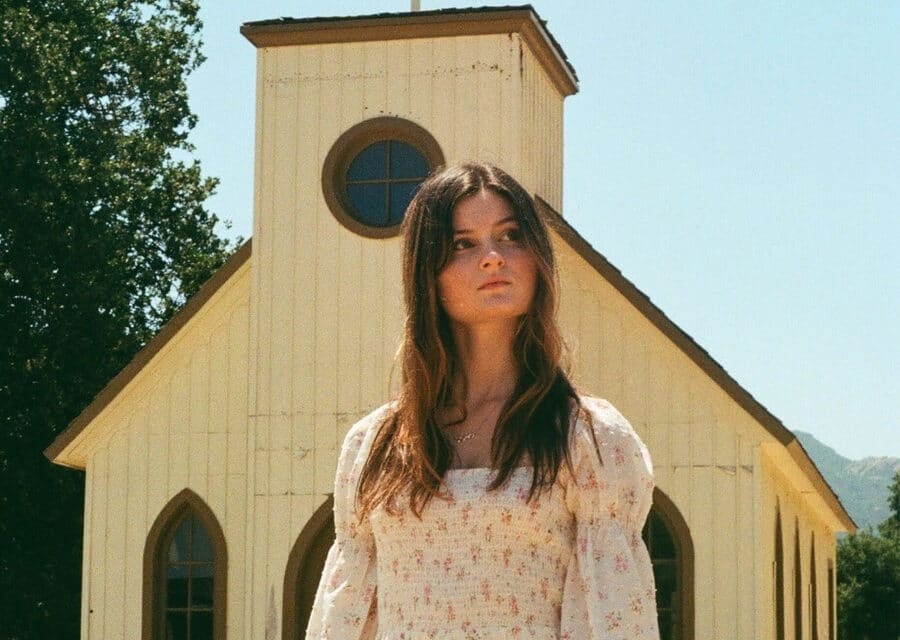
Los Angeles indie-pop duo Queen Anne have built their reputation by embracing contradiction. Their music is cinematic yet intimate, dark yet playful, emotionally devastating while never losing its sense of humor. Since emerging with Real Enough and their haunting reimagining of David Bowie’s Let’s Dance, the collaboration between actress and songwriter Katie Silverman and producer Sandy Chila has become one of indie pop’s most intriguing new voices, earning recognition from EARMILK, 1883, Galore, and numerous “Bands to Watch” lists.
Their latest single, “Baby Girl (Likes to Lie),” may initially sound like a witty confession from an unreliable narrator, but beneath its playful exterior lies a fascinating meditation on storytelling, identity, and the complicated relationship between fiction and honesty. Like much of Queen Anne’s work, it blurs the boundary between performance and authenticity, asking whether emotional truth sometimes requires a little invention.
We spoke with Katie Silverman about unreliable narrators, absurd humor, David Lynch, songwriting as character work, and why Queen Anne exists somewhere between a band, a fictional universe, and perhaps even a multiverse.
“Baby Girl (Likes to Lie)” feels playful on the surface, but underneath it’s really exploring identity, storytelling, and performance. What attracted you to writing from the perspective of an unreliable narrator?
In all my art, I’m obsessed with truth.
I started as an actor, and one of the first things you learn is that good actors actually make terrible liars. Playing someone else convincingly requires complete honesty and vulnerability.
The same thing applies to improvisation. Even if the scene is completely ridiculous—say aliens invading a summer camp—I’m always asking myself, What’s emotionally true here?
Songwriting fascinates me because it’s built on a contradiction.
Everyone understands songs aren’t journalism, but there’s still this expectation that they’re autobiographical, almost confessional. If I spend years crying over a breakup song and then discover the songwriter has never even dated anyone, I’ll admire their imagination—but I’ll also feel slightly cheated.
At the same time, songwriting itself almost encourages dishonesty. You’re trying to rhyme, keep the meter flowing, and find words that sound beautiful. Sometimes the perfect lyric isn’t literally true.
I wanted to lean into that contradiction and intentionally play with people’s expectations.
Queen Anne constantly balances irony with genuine emotional vulnerability. How do you know when a song should make people laugh and when it should completely break their hearts?
If people want to be emotionally devastated, they can just read the news.
I absolutely want the music to mean something, but I also want it to be enjoyable.
I grew up loving pop-punk, and one thing I always appreciated was feeling like the artist and the listener were on the same side.
Songs like Low Self-Esteem or My Own Worst Enemy invite you inside someone’s distorted thinking without becoming unbearable.
I’ve never been especially good at “winking” at the audience, but I do think it’s considerate to make sure everyone has some fun along the way.
Otherwise things become pretty dreary.
The story behind choosing the title—because everyone disliked it equally—is hilarious. How important is absurdity to your creative process?
Completely essential.
I firmly believe that if you take yourself too seriously, nobody else will take you seriously either.
When Sandy and I write together there’s always room for complete nonsense.
One of our favorite tricks is throwing in a totally unexplained non-sequitur whenever something starts feeling too earnest.
Also, it helps to eat pistachios.
The kind you have to shell yourself.
Queen Anne’s music feels dreamy, cinematic, and strangely theatrical. Were there particular filmmakers or artists shaping this era?
Films influence me constantly.
We’re usually aiming somewhere around David Lynch…
Although occasionally we accidentally end up somewhere closer to Tarantino.
The funny thing is I’m actually not very visual.
If I try drawing something, it usually just makes people sad.
Sandy, meanwhile, builds cabinets and haunted houses.
I’m much more interested in narrative than aesthetics.
When I’m writing, I’m usually thinking about the story first rather than how everything looks.
Your acting background seems deeply connected to your songwriting. Do you approach songs like character studies?
Absolutely.
When I sing, I still use techniques I learned in musical theatre.
I’m always asking: Who am I talking to? What do I want from this person?
The funny part is that even if I wrote the song directly from my own life, I’ll still completely reinterpret it while performing.
Sandy is also incredibly involved with the vocal performances, so his perspective often changes how I see the story.
Sometimes the emotional truth that produces the best performance isn’t actually the same truth that inspired the song originally.
Thankfully I’ve had enough bad relationships to have plenty of material to choose from.
Your version of David Bowie’s “Let’s Dance” transformed a celebration into something haunting. What attracts you to exploring familiar emotions through darker perspectives?
Probably something went wrong during my childhood.
Beyond that, I’m endlessly fascinated by the human experience.
Especially love.
Love is such a strange contradiction.
On one hand it’s completely selfless.
On the other hand, it’s incredibly possessive.
You want to merge with another person, maybe even consume them emotionally.
And attachment always creates suffering.
My songs explore those darker emotional spaces not because they’re depressing, but because those feelings feel enormous.
They’re haunting because they’re deeply human.
Queen Anne has often been compared to artists like St. Vincent, Clairo, and Chappell Roan, but the project feels more like an ongoing fictional universe than a traditional band. How do you think about it?
Honestly?
Probably a multiverse.
That way, whenever I contradict myself or change my mind, I can just say it’s a different timeline.
Queen Anne is also a fictional character inside Cleavage, which is our completely true vertical microdrama about the absolutely real story of the band.
So there are stories inside songs…
Stories inside videos…
Stories inside other stories…
It’s all wonderfully confusing.
Many of your songs explore contradictions—wanting intimacy while hiding behind humor, craving validation while resisting it. Why are those emotional tensions so compelling?
Because I’m genuinely confused by them myself.
If I actually understood relationships, my songs would probably be much simpler.
They’d just say something like:
“I like this person.”
Or…
“Actually never mind.”
“And also they smell funny.”
Instead, songwriting becomes my way of asking questions rather than pretending I already know the answers.
There’s something unmistakably “Los Angeles after midnight” about Queen Anne’s music—glamorous, lonely, surreal. How much does growing up in LA shape your perspective?
I sometimes wish I hadn’t been born here.
Not because I dislike Los Angeles—I love it—but because I’ll never get to experience that classic montage where someone arrives with nothing but a suitcase and a dream.
I grew up in the San Fernando Valley.
That usually doesn’t make the montage…
Unless it’s a Paul Thomas Anderson movie.
Growing up here teaches you something strange.
People always say LA is fake.
I don’t think that’s true.
It’s just that nothing is entirely real.
Everything doubles as a movie set.
Even my childhood home.
If the songs feel cinematic, it’s because life here already feels like a film.
Or at least a student film.
Queen Anne has quickly become one of indie pop’s most talked-about new projects. Do you feel pressure to define exactly what Queen Anne is becoming?
Not really.
It’s going to evolve whether I want it to or not.
I’d hate to build my entire identity around something incredibly specific…
Like velvet suits.
Imagine I announced that velvet was officially my thing.
Then seven years later I suddenly develop a velvet allergy.
Now I’m secretly wearing fake velvet everywhere.
Living in constant fear that someone will expose me.
Eventually I go into anaphylactic shock on national television.
Career over.
So really…
The moral of the story is probably just to get allergy tested.
That seems like the safest strategy.