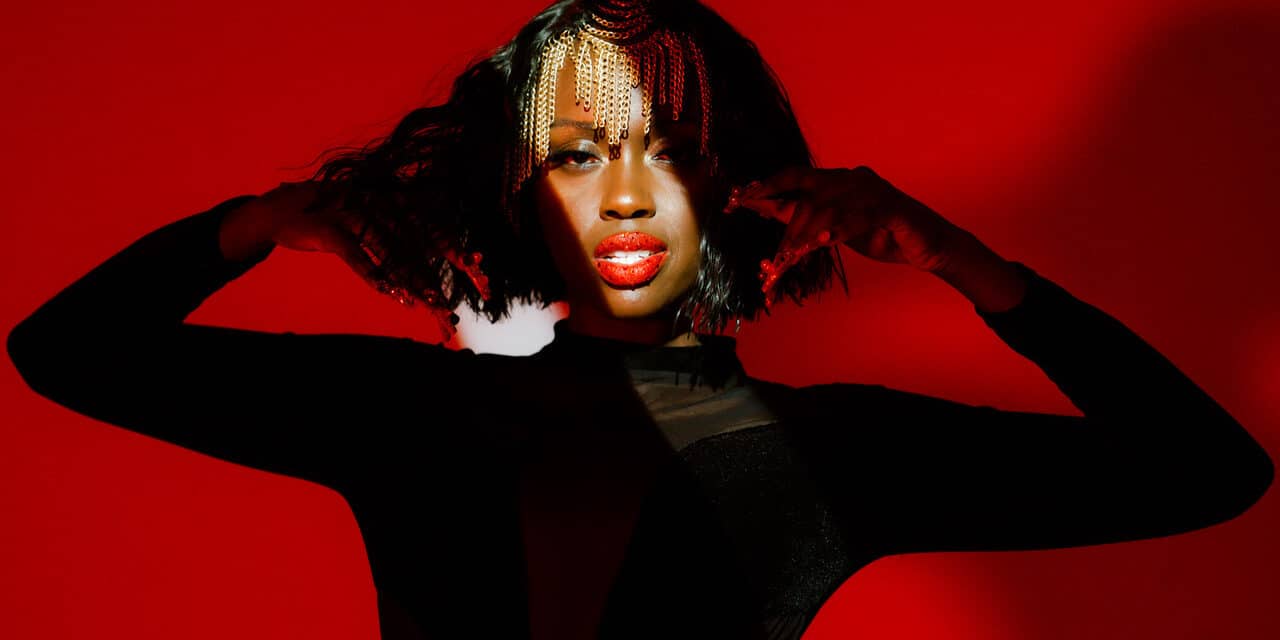
Known to audiences around the world for her standout role in Thor: Love and Thunder, AKOSIA has already proven herself as a compelling presence on screen. Now, with her six-track EP Eat The Night, she steps fully into her own spotlight as a musician, delivering a fearless collection that fuses electro-pop, R&B, and dark electronic textures into an empowering statement of survival, liberation, and self-discovery.
Written during one of the most transformative periods of her life, Eat The Night chronicles the journey from emotional captivity to personal freedom. Powered by commanding vocals, cinematic production, and unapologetic lyricism, the EP celebrates female autonomy while confronting the pain that often precedes healing.
We caught up with AKOSIA to discuss reclaiming her voice, balancing acting and music, embracing vulnerability, and why women deserve to take up as much space as they choose.
Eat The Night feels like a deeply personal statement about reclaiming your voice and identity. What was happening in your life that made this the right time to tell these stories?
I had just broken up with a very abusive and controlling man, and I felt so free. I finally had time to go to the studio with no time limit, hang out with my friends without him blowing up my phone, and come home to peace without a man asking me a million questions about what I did and who I was with.
That relationship was extremely damaging, and I needed to pour positive mantras into my brain. I began reminding myself of how amazing I am, and I sat down and wrote the lyrics to the first track, “Whatever I Like, Whenever I Want,” which really set the tone for the whole EP.
You’ve built a successful acting career while simultaneously developing your music. How do those two creative worlds influence one another, and what does music allow you to express that acting cannot?
Music is limitless, whereas acting has many boundaries.
When I write music, I create an entire world from scratch. When I’m acting, I have to fit into someone else’s vision and live inside the space they’ve created.
Both mediums push me creatively in different ways. They force me to grow, give me fresh perspectives, and constantly inspire one another.
The EP blends electro-pop, R&B, and darker electronic textures into something both intimate and cinematic. How did you arrive at this sonic palette?
I was really angry.
I was angry that he hurt me, and I was angry at myself for staying so long with a loser. Sorry—not sorry.
It was important that the production carried that feminine rage. I wanted to make music you couldn’t ignore. Music that makes you jump out of bed, full of energy and ready to grab life by the horns.
Artists like Charli XCX and Azealia Banks channel that kind of energy in very different ways, and I definitely drew inspiration from that.
Themes of female autonomy, empowerment, and liberation run throughout the project. What conversations were you hoping these songs would spark?
I always write from personal experience, but I know what I’m going through isn’t unique.
I want to remind women how powerful we are—that we should never be afraid to speak our minds and never stop until we get exactly what we want.
Growing up with B.B. King and Miles Davis before discovering artists like Frank Ocean, SZA, and Jhené Aiko gives you an incredibly broad musical foundation. How do those influences coexist in your songwriting today?
They feed my soul.
Music is sustenance for me, and sometimes it’s a drug.
I don’t want to eat caviar every day. Sometimes I need bread and butter. Sometimes I need candy kiwi to fix my mood.
Every artist feeds my creativity differently. They inspire me to express myself poetically, push my boundaries, and remind me of what it takes to be a true artist. There’s so much sacrifice—and so much ecstasy—in this life.
You’ve collaborated with acclaimed producers like Will Stah and Rob Amoruso while maintaining a very distinct artistic identity. What do you look for in creative collaborators?
I look for people who are better than me.
People who challenge me while still understanding my vision and helping me reach it.
I love collaboration. The creative process is sacred to me, so it’s important that everyone involved feels invested in what we’re making, even though it’s ultimately my music.
Fashion, music, and visual storytelling all seem equally important to your creative identity. How intentional are the visuals when you’re building a new era?
They’re just as important as the music.
I like to think of my work as what I call 3D art.
The first layer is the lyrics and chords. The second layer is the production. The third layer is the visuals.
When all three come together, they allow people to experience the music on a much deeper level.
I’m also very intentional about creating images I’ve never seen before—especially images of Black women occupying spaces we’ve rarely been shown in. That’s incredibly important to me and to other women who look like me.
Your music embraces vulnerability without sacrificing strength. Has emotional honesty become easier as you’ve evolved as both an artist and a person?
I’ve always been a very emotional person.
The hard part has been sharing those emotions because I worry they’ll feel too intense for the people I love.
That’s one of the reasons I write music. It’s a safe place where I can be completely raw and unfiltered.
There are still things I don’t say, but as I’ve grown into the woman I want to become, I’ve become much bolder about speaking my mind.
Right now it’s so important for artists not to mince our words.
The sanity of the world depends on it.
Balancing careers in both film and music, do audiences discover different sides of you through each medium, or ultimately the same person?
Honestly, I think they’re discovering the same person—just through different doors.
When people meet me through Marvel or Thrash, they’re seeing characters built from someone else’s blueprint, but I still have to bring something truthful from myself to make those performances work.
When they meet me through my music, they’re getting the blueprint itself.
There’s no character. No wall.
I’ve noticed people who discover me through acting are sometimes surprised by how raw my music is. They weren’t expecting the same woman who played a goddess to be writing about a man who hurt her.
But that’s exactly the point.
I’m not playing a version of myself in my music. I’m not hiding behind someone else’s writing.
My music is honest. It’s simply a smaller door that fewer people have walked through so far.
Ultimately, I want those two audiences to become one audience—not “the actress who also sings” or “the singer who also acts.”
Just AKOSIA.
Eat The Night closes one chapter of your journey from darkness toward self-discovery. Where do you see AKOSIA’s creative evolution heading next?
I’m still evolving into the woman I hope to become, and I want to stay in this space for a while because I need it—and I think women around the world need it too.
I want to become stronger, smarter, richer, and I want my life to be proof that women can achieve anything they set their minds to.
The odds are stacked against us, but somehow that’s exactly what refines us and makes us stronger.
I see women evolving at an incredible pace, building this worldwide network of support, and I want to be part of that.
I want my music to become part of that tapestry.
On Eat The Night, AKOSIA transforms personal pain into collective empowerment, refusing to let survival be the end of the story. What emerges is more than a breakup record or a declaration of independence—it’s the sound of an artist reclaiming every part of herself. Whether on screen or behind a microphone, AKOSIA continues to prove that her greatest role is simply being unapologetically herself.