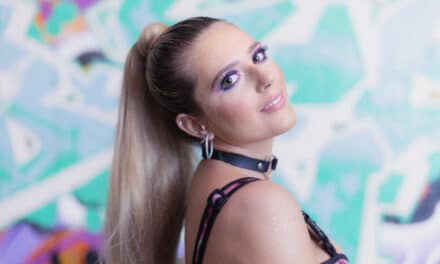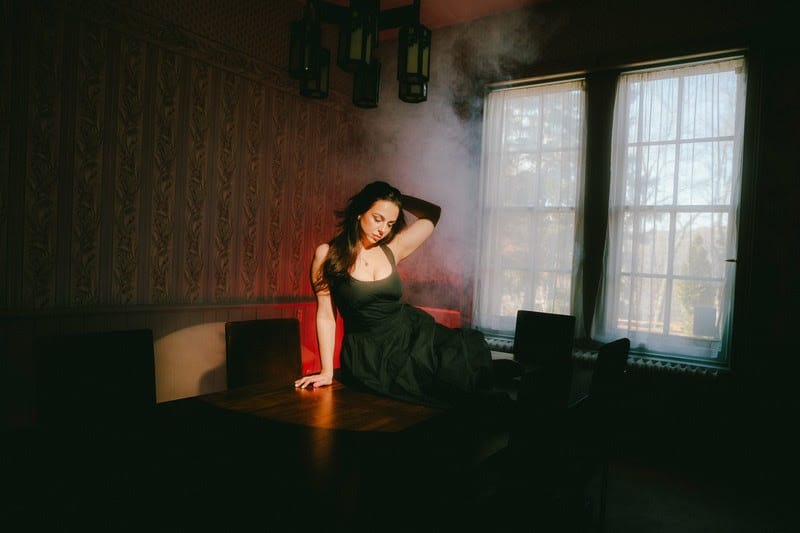
PHOTO CREDIT: NATALIE NGUYEN
On “I Hope You Love Me,” the beautiful anxiety of new relationships, vulnerability as connection, and figuring yourself out through the people you meet
There is something uniquely terrifying about wanting to be loved by someone who doesn’t really know you yet.
Before the relationship has history, before intimacy becomes familiar, before you know whether any of it will actually work, there’s simply possibility—and all the anxiety that comes with it.
Ariana Fig captures that suspended moment on “I Hope You Love Me,” a bright, fast-moving pop-folk confession from her debut album, So Long, Sinnerstate!, out August 14.
The Hamilton, Ontario-born singer-songwriter wrote the track the day before her first date with the person who would eventually become her partner. Rather than writing from the comfortable perspective of love already found, Fig documents what comes immediately before it: racing thoughts, insecurity, excitement, and the strange vulnerability of hoping someone will eventually embrace the parts of you they haven’t even discovered yet.
“I was so nervous to go on this first date that I felt like the only real way to get through it was to write about how I was feeling,” she says.
That nervous energy runs through the song itself. Warm acoustic textures collide with a more kinetic, early-2000s pop sensibility, while gang vocals give Fig’s private anxiety an almost communal release. At its center is the wonderfully unguarded refrain: “God damn I hope you love me.”
It’s not sophisticated emotional posturing. That’s precisely why it works.
Across So Long, Sinnerstate!, Fig approaches her twenties with the same openness, examining identity and self-discovery not as solitary pursuits but as processes shaped by the people we encounter. Romantic partners, friends, family, collaborators—even people whose perspectives fundamentally clash with our own—become mirrors through which we begin understanding ourselves.
A SOCAN Award-winning songwriter with roots in classical violin, Fig has gradually built a musical language that refuses to remain comfortably inside one genre. Indie, folk, alternative rock, and pop coexist around lyrics that prioritize emotional clarity over distance. Her single “Running Man” earned SOCAN’s Honorary Young Canadian Songwriter Award, while her music has reached audiences through CBC, SiriusXM, 102.1 The Edge and stages including NXNE and the Sound of Music Festival.
But So Long, Sinnerstate! feels less concerned with arriving at some definitive version of Ariana Fig than learning to become comfortable with uncertainty.
If “I Hope You Love Me” began as anxiety before a first date, its existence now carries an unexpectedly sweet epilogue: the relationship worked out.
The fear was real. So was the hope.
We spoke with Ariana Fig about turning vulnerability into connection, writing through anxiety, discovering yourself through relationships, and why her debut album ultimately feels like a conversation between friends.
So Long, Sinnerstate! explores the emotional landscape of your twenties. Looking back, what has this period of your life taught you about love, identity, and becoming comfortable with who you are?
This period of my life has taught me so much about myself and how being vulnerable is the best thing you can do to connect with others and yourself. I’ve never been shy to share my emotions, but doing it on a scale like this where it’s out in the world for everyone to hear can be fairly daunting.
But since I have been performing my own music over the last 6 years, connecting with people over shared experiences over music is one of the most exhilarating experiences I get to have as an artist. I’ve learned so much about how to love and be loved while writing this album by simply opening up to those around me.
“I Hope You Love Me” captures that fragile space before a relationship truly begins. What made you decide to write about anticipation and vulnerability instead of focusing on love after it has already settled in?
The real answer is my anxiety. I was so nervous to go on this first date that I felt like the only real way to get through it was to write about how I was feeling, which was anxious.
I also think there’s something so pure about saying I Hope You Love Me to someone who barely knows you. There are plenty of songs about love after you’ve already had it and found it, I thought it would be refreshing to hear the perspective of love before you know what it feels like.
You wrote the song the day before your first date with your partner. How surreal is it to now look back on that moment knowing where the relationship has led?
It’s pretty surreal to go back to my headspace then, but it makes me so happy to know that the song sort of manifested a very positive moment in my life.
The repeated line, “God damn I hope you love me,” feels both like a confession and a mantra. Why do you think we often find ourselves asking for acceptance before we’ve fully accepted ourselves?
I think it’s easier to ignore the parts you don’t like about yourself when there’s someone else telling you how much they like you and how special you are to them. I definitely wrote that line and said that to myself as a form of validation.
Your music blends early-2000s pop nostalgia with modern folk storytelling. Which artists or records helped shape the sonic identity of So Long, Sinnerstate!?
I was listening to a lot of alternative rock while writing these songs, some notable albums were M.J Lenderman’s Manning Fireworks, Briston Maroney’s JIMMY, and young friend’s motorcycle sound effects.
Throughout the album, vulnerability feels less like weakness and more like courage. Has songwriting become a way of understanding your emotions, or do you usually know how you feel before you sit down to write?
I think it’s both. There are times when I know I want to write about something I am going through and immediately do it, other times it comes out subconsciously like on “Something’s Out There” or “Motor Mouth.”
It’s one way to process my emotions but not the only way, sometimes I go into a writing session not having a clue about what I’m feeling but music has a way of making it come out eventually.
You and Emma Whale chose to reframe fear into optimism while writing “I Hope You Love Me.” Was that shift something that happened naturally, or was it a conscious decision to challenge your own mindset?
It was a conscious decision on Emma’s part. She really showed me why the song would be so much more refreshing and honest if we leaned into the optimism of being scared, and the hope you have before meeting someone new for the first time.
The album centers on self-discovery through relationships rather than in isolation. Do you think we truly learn who we are on our own, or does it take other people to reveal those parts of ourselves?
I think it 100% requires meeting lots of new people to discover who you are, whether that’s romantic relationships, family relationships or platonic relationships. You can’t figure out what you truly like until you’re met with people who think opposite from you, or disagree with you.
There’s an honesty in your songwriting that feels refreshingly unfiltered. How do you decide which moments of your personal life are meant to stay private and which become songs?
I honestly don’t decide that. I just write and if I write a song that I like overall, then I choose to share it. But I’ve never felt the need to not write about something specific.
As listeners experience So Long, Sinnerstate!, what do you hope they take away from your story? Is there one feeling or realization you hope stays with them long after the album ends?
I really hope it just feels like a conversation between friends. I hope everyone who listens finds at least one thing they can relate to and takes away of being okay with the unknown.
So Long, Sinnerstate! arrives August 14, with “I Hope You Love Me” available now.
“I Hope You Love Me” single artwork and press photography by Natalie Nguyen.