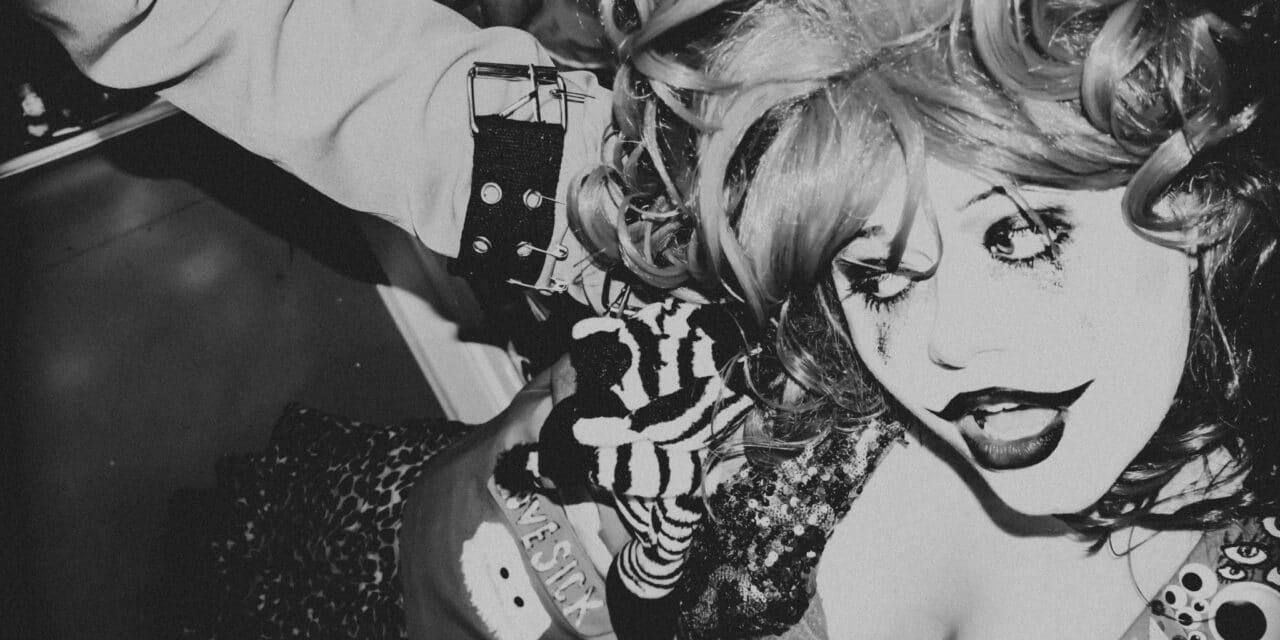
Photo by: Lottie McGowan (@disturbi.art)
On their explosive new single, the Brighton artist collapses grunge, shoegaze, synth-pop, religious imagery, and raw vulnerability into a love song about obsession so total it begins to feel holy.
Infatuation has always had something religious about it.
The fixation.
The rituals.
The private mythology.
The conviction that one person has somehow become more vivid than everything surrounding them.
On “Like Adam Would,” Brighton solo artist Girl Apocrypha does not attempt to make that feeling sound reasonable.
She makes it biblical.
“I wrote ‘Like Adam Would’ from a place of total infatuation,” she explains, “a feeling so intense I could only bear to explain as biblical. Holy.”
It is an appropriately excessive description for a song that refuses to stay inside any one musical shape.
Distorted guitars explode into electronic minimalism. Programmed drums retreat before live drums come crashing back in. Synths flicker around shoegaze haze. Piano appears unexpectedly. Vocals move between claustrophobic processing, open melodic release, and moments of exposed vulnerability.
Everything feels like it could collapse at any moment.
Then it reorganizes itself.
The instability suits the subject.
“Like Adam Would” is not really interested in describing a balanced relationship. It captures the point where attraction becomes tunnel vision—when another person stops feeling like one element of your life and begins temporarily reorganizing the entire world around them.
“It’s seeing scripture in a person’s words,” Girl Apocrypha says. “Creation in their face.”
For a project already built around the collision of theatricality, distortion, pop instinct, and emotional extremity, it feels less like a stylistic departure than a sharpening of purpose.
When Desire Becomes Mythology
There is an important difference between telling someone you love them and turning them into a creation myth.
Girl Apocrypha chooses the latter.
The biblical framing of “Like Adam Would” transforms infatuation into something almost cosmological.
The person being desired does not simply appear attractive.
Their face contains creation.
Their words become scripture.
The speaker’s field of vision ends “just millimeters away” from their outline.
“And making no attempt to expand it,” she adds, “because why would I want to look at anything other than you?”
It is romantic.
It is also slightly terrifying.
That tension becomes even more important when Girl Apocrypha explains that the religious imagery is not merely aesthetic. She frequently turns toward religious language when writing about romantic partners because its symbols offer a recognizable shorthand for emotional extremity.
God. The Devil. Angels. Mary. Adam and Eve.
They are characters loaded with centuries of meaning before a songwriter even touches them.
In the particular case of “Like Adam Would,” the connection was also deeply personal: the person who inspired the song had an intense interest in religion, particularly Catholicism, and Girl Apocrypha found herself fascinated by what she learned from them.
The song therefore becomes, in her words, “a bit of a love letter.”
But it is a love letter written with the benefit of knowing that obsession and intimacy are not necessarily the same thing.
Girl Apocrypha describes the feeling through a wonderfully precise analogy: enjoying a night out while already knowing the hangover will be unbearable.
The pleasure is real.
So is the damage waiting on the other side.
Adam, Eve, and Mutual Obsession
Within that world, Adam becomes more than a biblical reference.
He represents the person behind the song, but also a particular fantasy of mutual obsession: two people convinced that they are the only ones capable of completely understanding each other.
“Me and them against the world.”
Adam and Eve before there was anyone else to compare themselves to.
Girl Apocrypha was particularly drawn to the imagery of the rib—the idea of sharing something so fundamental to yourself that intimacy becomes almost anatomical.
Whether treated literally, symbolically, or mythologically, the image gives her an appropriately extreme metaphor for the desire to dissolve boundaries between yourself and another person.
That desire is at once seductive and dangerous.
Girl Apocrypha speaks openly about recognizing patterns of attachment and co-dependency within her own relationships. The intensity described in “Like Adam Would” felt exhilarating while she was inside it, but also unsettling because she understood that the obsession was not necessarily coming from somewhere healthy.
These days, she is trying to discover who she is outside her relationships with other people.
The shift complicates the song beautifully.
“Like Adam Would” does not condemn the person who felt that way.
Nor does it romanticize the behavior unquestioningly.
It preserves the high while acknowledging the hangover.
A Wall of Sound That Cannot Stay Standing
The production understands that this kind of obsession should not feel stable.
Recorded alongside producer Jag Jago and mastered by Kurt Martinez, “Like Adam Would” begins with distorted guitar arriving almost violently.
There is little introduction.
The track seems to begin already in motion.
Then, rather than maintaining that intensity, it retreats.
Electronic textures begin flickering underneath the surface. A solitary bass synth and controlled drum programming drag the arrangement toward something hazier and more inward-looking.
The initial explosion becomes suspension.
Then the song breaks open again.
Live drums arrive.
Guitars swell.
Fuzz accumulates.
The track starts pushing forward as though the quieter section had only been gathering pressure.
Girl Apocrypha says the contrast between those sonic environments was never something she worried might dilute the song.
It was necessary.
The relationship itself felt “chaotic, aggressive, fun, intense,” but also “really gentle and caring.”
Only showing one side would have been emotionally inaccurate.
That makes the shifts between beauty and abrasion less like production tricks than psychological documentation.
The song sounds contradictory because the relationship felt contradictory.
Grit and Gloss
Girl Apocrypha’s broader sound exists in a space where styles that might normally be separated are deliberately allowed to contaminate each other.
There is the guitar severity of Interpol, Placebo, and Nine Inch Nails.
There is shoegaze haze.
There is grunge.
But there is also an unmistakable pop instinct informed by artists including Lady Gaga, Grimes, and The Dare.
Rather than choosing between those references, Girl Apocrypha seems more interested in what happens at the collision point.
Grit meets gloss.
Melancholy meets fluorescence.
Rock instrumentation encounters programmed rhythm.
Theatricality meets something much more emotionally exposed.
Interestingly, Girl Apocrypha does not experience those combinations as particularly contradictory.
She simply loves rock and pop.
To her, the distance between the two has always seemed smaller than people insist.
She points toward My Chemical Romance’s “To The End” as an example: distorted guitars and anguished performance sitting alongside backing vocals and harmonies that operate with unmistakable pop instinct.
The inverse is equally possible.
A pop song does not require live drums or guitars to feel heavy.
For Girl Apocrypha, Alice Cooper and Lady Gaga can exist as “two sides of the same coin.”
That philosophy frees the project from having to resolve itself stylistically.
She can simply take what she needs.
The Voice as an Instrument
At the center of all of this movement is Girl Apocrypha’s voice.
Its instability becomes another form of storytelling.
At times, the vocal sounds narrowed and processed, almost trapped inside the production.
Elsewhere it opens dramatically.
Then the surrounding instrumentation falls away enough for the voice to become startlingly exposed.
Those transformations are especially interesting given that Girl Apocrypha did not begin the project feeling confident as a singer.
Before becoming a solo artist, she says she was “insanely insecure” about her voice.
When her previous band ended, she was confronted with an uncomfortable reality: if music was genuinely what she wanted to pursue, she needed to find a version of that pursuit that did not depend entirely on other people remaining in her life.
Her desire to have something that belonged to her eventually became stronger than her fear of singing.
The psychological trick that helped was simple.
Treat the voice like an instrument.
Not an identity.
Not a referendum on whether she deserved to be an artist.
An instrument she was learning how to use.
That perspective eventually turned insecurity into experimentation.
Because she did not consider herself a traditionally accomplished singer, she became increasingly interested in manipulating vocals, processing them strangely, and discovering sounds that conventional technique might never have led her toward.
“Limitations often breed creativity,” she says.
In Girl Apocrypha’s case, a perceived limitation is actively becoming part of the project’s signature.
Contradiction as Personality
The collisions running through Girl Apocrypha’s music—grit and gloss, theatricality and sincerity, aggression and vulnerability—are not consciously engineered branding exercises.
They are closer to personality.
“It’s not just a reflection of who I am creatively but who I am as a person,” she says.
Girl Apocrypha often notices these contradictions only after other people point them out.
That makes sense when she explains songwriting as a largely therapeutic practice.
She is not necessarily entering a song intending to create a carefully balanced narrative.
She is unloading the conflicting feelings surrounding whatever she is experiencing.
Those feelings rarely agree with one another.
That friction becomes the music.
She has previously described songwriting as a space where she can express “the worst version” of herself—the jealous, obsessive, difficult, irrational, or contradictory thoughts that might be destructive if acted upon but can become meaningful once transformed into art.
The persona therefore offers freedom without complete disguise.
Girl Apocrypha can exaggerate.
Perform.
Distort.
But the emotions underneath remain sincere.
Music for People Who Still Want Objects
Girl Apocrypha’s experimentation extends beyond the recordings themselves.
At a moment when music promotion is increasingly optimized around interchangeable social posts, streaming links, and short-form clips, she has been experimenting with something closer to physical world-building.
Mini-zines have appeared around My Chemical Romance and Hayley Williams UK dates.
Audience members have been invited to write inside a guest book at live shows.
Exclusive MP3 players loaded with unreleased music have been given away.
She hands CDs to strangers on nights out in Brighton.
For Girl Apocrypha, these gestures are not an ideological rejection of digital culture.
She uses TikTok too.
She understands the importance of an online presence.
She simply believes physical experiences do something digital discovery cannot replicate.
A CD passed between strangers can create a memory.
A postcard can become an object someone keeps.
A guest book becomes evidence that a particular group of people occupied the same room on the same night.
One of her favorite stories involves encountering someone outside a pub who recognized her because Girl Apocrypha had previously handed her a CD on a night out. The stranger and her friend had apparently been talking about that very encounter shortly before seeing her again.
They ended up getting drinks together.
That is the kind of connection Girl Apocrypha is chasing.
Not reach.
Memory.
The Fan on the Other Side
Much of this instinct comes from having spent years deeply invested in music fandom herself.
She remembers imagining the kinds of promotional gestures she now gets to execute as an artist.
Giving someone a CD.
Mailing a zine.
Sending a postcard.
Offering something strange and tangible enough that a listener might remember where they were when they received it.
“It feels so surreal to be on the other side of the fan experience,” she says.
Her sentimentality is perhaps most obvious in the guest book she brings to shows.
That one, she admits, is partly for herself.
After gigs, she goes home and reads the notes, jokes, drawings, and messages people left behind.
It turns the ephemeral nature of a performance into an archive.
The show ends.
The object remains.
Building Girl Apocrypha Beyond Music
That desire for physicality connects to something larger happening around the project.
Girl Apocrypha has started thinking about the character as existing beyond songs altogether.
“It sounds so obvious,” she says, “but I had a bit of a realization that this project can be literally anything I want it to be.”
She is already developing ideas that have little to do with music itself and more to do with the world Girl Apocrypha inhabits.
She is deliberately keeping those plans vague.
But the ambition is clear.
The project is not simply becoming a collection of singles with accompanying visuals.
It is becoming a universe.
And the name itself may offer the best explanation of what kind.
Something Outside the Canon
“Apocrypha” generally describes texts whose authenticity or place within an accepted canon is disputed.
For Girl Apocrypha, the word carries an unexpectedly intimate history.
She first learned it from the same person who inspired “Like Adam Would.”
She liked how it looked.
Then she looked it up.
The definition felt uncannily appropriate.
“This whole project feels like what the word Apocrypha means—something outside of what is real, something whose legitimacy is debated.”
Girl Apocrypha never expected to become a solo artist.
She had always imagined herself making music, but previously within bands.
Insecurity made doing it alone seem almost impossible.
The solo project therefore feels like an alternate version of her life that somehow became real.
“This is an exploration into something that I never thought would exist,” she says. “It feels like I’m in an alternate timeline, but one I am so thankful to be in.”
The “Girl” comes from another set of influences: the film Girl, Interrupted and The Dresden Dolls’ “Girl Anachronism.”
Both engage, in different ways, with the complexity of mental illness in young women—a subject Girl Apocrypha connects closely to her own experience.
The name therefore acknowledges instability rather than hiding it.
It announces that this project will contain the parts of herself that might otherwise be left outside the official story.
The unofficial texts.
The contradictions.
The flaws.
The apocrypha.
In Conversation With Girl Apocrypha
MUNDANE: “Like Adam Would” describes infatuation in almost biblical terms—scripture, creation, devotion. What made religious imagery feel like the right language for expressing this particular kind of desire?
GIRL APOCRYPHA: I tend to gravitate towards using religious imagery in songs that are about romantic partners because it feels like the most accurate way to express the depth of what I feel.
I think as an artist, and even just as a person, I yearn quite a lot to be seen and understood by others, and so using this religious imagery feels like a way to concisely convey what it is that I’m trying to express. Everybody knows the connotations surrounding the Devil, God, angels, Mary, Adam and Eve, etc. It’s almost like its own language, a reference to a story that everybody knows.
I think it also helps me to convey the extent of just how strongly I feel about something, which is a helpful tool.
With “Like Adam Would” in particular, the person I wrote it about was really interested in religion, I think specifically Catholicism, and knew a vast amount about the topic, and I really enjoyed learning about it from them, so naturally it felt like a thematic center point.
MUNDANE: There’s something almost overwhelming about the intensity you describe: your entire field of vision narrowing until another person becomes the only thing worth looking at. Do you see the song as celebrating that kind of infatuation, or questioning it too?
GIRL APOCRYPHA: It definitely doesn’t feel like a celebration.
It’s more like the feeling of really enjoying a night out while you’re on it but knowing that the hangover is going to be unbearable.
I have a lot of issues around attachment and co-dependency and so I tend to find myself in super intense relationships that aren’t good for me or the other person. Love, validation and romance are beautiful parts of life but I definitely have a tendency to overindulge, so naturally I’m drawn to people who have a similar problem.
With this particular song, I remember these feelings being a lot of fun in the moment, but also quite unnerving because I knew that my obsession wasn’t coming from a healthy place.
These days, I’m trying to find out who I am outside of my relationships with others. I’ve really been trying to learn how to self-regulate and I’ve made way more progress than I thought would be possible for me, but I’m aware that there’s this deeply unhealed part of me that is always going to be looking for an amount of love and validation that will somehow “fix” me, as I try to provide an amount that will “fix” someone else.
At the moment, I feel like I accept that it just isn’t something that’s possible, and that’s a good thing, because as an adult I can give myself everything I need.
MUNDANE: The title “Like Adam Would” immediately evokes ideas of creation, innocence, temptation, and desire. What does Adam represent to you within the world of the song?
GIRL APOCRYPHA: Adam not only represents the person I wrote the song about, but also the experience of mutual obsession.
Feeling like it’s me and them against the world, like we are the only two humans who truly understand one another. Adam and Eve.
I was mainly drawn to the story of how Adam took out one of his own ribs to give to Eve, and the intimacy of sharing even the most innate parts of yourself with someone else.
It also tied together quite nicely because, as I mentioned, the person I wrote it about was highly interested in religion, and would endlessly be learning about it.
The song’s a bit of a love letter in that way.
MUNDANE: Sonically, the track moves between distorted guitars, shoegaze atmosphere, electronics, piano, and moments of vulnerability. How do you approach balancing chaos and beauty without losing the emotional core of the song?
GIRL APOCRYPHA: Honestly, that wasn’t really a concern of mine because I feel like the contrast between the harsh and pretty sounds, and the loud and quiet moments is exactly what gives the song the emotional impact I was intending while writing it.
Ultimately, that’s how the love I was referencing felt like. Chaotic, aggressive, fun, intense, but also really gentle and caring.
It wouldn’t be an accurate picture without both of these sonic landscapes because that wouldn’t express what the relationship felt like.
MUNDANE: Your vocals constantly shift between processed, contained performances and much more exposed moments. How much do you think of your voice as another production instrument when you’re building a track?
GIRL APOCRYPHA: It’s basically the only way I think about my voice.
Before starting this project I was insanely insecure about it and I really felt like singing was something that I just couldn’t do, even if I really wanted to.
When the band I was previously in broke up, I had this really uncomfortable realization that if I really do want to pursue music—which of course I do, I’ve always wanted that—then I have to find a way to do it that isn’t nearly as reliant on other people, because it’s so common for people to come and go from your life in your 20s.
My need for something that was mine overrode the insecurity about my voice, so I tried to get over it.
The thing that helped the most is to constantly tell myself that my voice was just an instrument that I was learning how to use, and I still need to tell myself that.
I don’t think I’m a great singer now by any stretch, especially compared to my peers who are unfathomably talented, but I’ve really fallen in love with being a solo artist and expressing this side of myself, and I’m learning to not give my energy to comparison.
Because I’m not as skilled at singing in a traditional way, it has meant that I have ended up experimenting way more with strange vocal production on my songs and I think it’s really shaping what my sound is as an artist.
So it has turned out to be a good thing, really. Limitations often breed creativity. At least that’s what I tell myself.
MUNDANE: Girl Apocrypha seems to thrive on contradictions—grit and gloss, theatricality and sincerity, grunge and pop. Are those tensions something you consciously built into the project, or are they simply a reflection of who you are creatively?
GIRL APOCRYPHA: It’s not just a reflection of who I am creatively but who I am as a person.
It’s strange, because when I’m writing it doesn’t feel like I’m purposely including a lot of contrast, whether sonically or lyrically, but I’ve noticed that it’s a common thing for other people to notice about my music, which I find super interesting.
It’s very rare that I won’t feel extremely contrasting feelings about whatever situation I’m going through, and I think I truly do write as a therapeutic exercise a lot of the time, so it’s not that I’m trying to construct a story or a narrative, but more so just getting out all of my own personal feelings.
I think I remember saying in an interview once that music gives me a space to express the worst version of myself, and that if I was exactly like how I described in my songs, I don’t think I would have anyone around me.
MUNDANE: Your influences stretch from Interpol, Placebo, and Nine Inch Nails to Lady Gaga, Grimes, and The Dare. What excites you about bringing pop theatricality into darker, guitar-driven alternative music?
GIRL APOCRYPHA: What doesn’t excite me about it?
I just love pop music and rock music so much. They’re really not as different as they’re made out to be—or maybe they are, and that’s why I struggle to see the contrast in my own music.
A great example of what I mean is the track “To The End” by My Chemical Romance. God, what an incredible song from what is probably my favorite album of all time.
It of course has all the distorted guitars and angsty vocal performances, but there are so many aspects of it that make it feel like such a pop song, specifically the backing vocals and harmonies.
Similarly, there are pop songs that don’t even contain guitar or live drums at all and yet that feel so heavy. Both “Venus” and “Judas” by Lady Gaga come to mind, as does “Fame Is A Gun” by Addison Rae.
To me, artists like Alice Cooper and Lady Gaga are two sides of the same coin.
I love both and take inspiration from both, so it’s only natural that my music will reflect both. The most exciting part is being able to pick and choose exactly which aspects of these genres I want to explore in this project.
MUNDANE: You’ve experimented with zines, guest books, and even MP3 players loaded with unreleased music. Why is creating physical, direct experiences with fans important to you in an increasingly algorithm-driven music culture?
GIRL APOCRYPHA: I really do just love to make things for people.
Sometimes I’ll go on a night out in Brighton and give out CDs to strangers that I meet, because it just feels like so much more of a real connection.
I was standing outside of a pub once and this girl walked past and we both recognized each other and she informed me that I had given her a CD on a night out a while ago—the night “Dealer” was released, I think. She said that her and her friend were literally just talking about it before they bumped into me.
It was such a sweet experience. We ended up going to the same place for drinks and getting to know each other more.
I just really value human connection in that way, and I think real physical objects or experiences are always going to be more memorable than seeing a TikTok of a song you think is cool.
Don’t get me wrong, I’m not even doing any of this in an anti-algorithm way. I post as many slightly embarrassing TikToks as the next artist and I think it’s a mistake to underestimate the value of your online presence, but you really just can’t beat physical media.
I think a lot of my marketing approach in that way comes from my years of experience as a teenager being such a huge fan of other artists and deeply loving music. It’s really all I’ve thought about since I can remember.
A lot of the fun promotion things I’m doing now, like giving out CDs randomly, are things I thought about endlessly as a teenager. It feels so surreal to be on the other side of the fan experience.
I can’t believe that people genuinely get excited when I send them a postcard or a zine—even if it does take me a stupidly long time to take them to the post office. As I’m typing this I’ve just remembered there’s a bunch of postcards I have forgotten to send out. Whoops!
Funnily enough, I’m actually on my way to Reading Festival right now to work at a temporary tattoo stand, and I’ve brought some CDs, badges and postcards to give out to people who might be interested.
I just love it.
Don’t even get me started on the guestbook… that truly is just for me. I can’t even express how much I love coming home from a gig and reading all the kind or fun or silly things people have written, or drawn.
I guess what it boils down to is that I’m just an extremely sentimental person, and so that’s reflected in how I try and connect with others.
MUNDANE: Girl Apocrypha already feels like a project with its own visual and theatrical universe. How far do you ultimately want that world to extend beyond the music itself?
GIRL APOCRYPHA: It’s interesting you ask because I’ve been thinking a lot about this recently.
It sounds so obvious but I had a bit of a realization that this project can be literally anything I want it to be.
I don’t want to give too much away but I’ve had some really fun ideas that I’m going to work on that are basically nothing to do with the musical side of things, but are more about the actual world that Girl Apocrypha as a character lives in.
Basically, it’s going to extend far beyond the music—unless I totally forget to do any of this, which is a very real possibility lol.
MUNDANE: Apocrypha refers to writings that exist outside an accepted canon, which feels fitting for an artist moving between genres and creative traditions. What does the name Girl Apocrypha mean to you, and what does it say about the artist you’re becoming?
GIRL APOCRYPHA: I actually learned the word from the person that “Like Adam Would” is about.
I was just immediately drawn to it because it looked beautiful, and whenever I don’t know a word I always look it up.
It feels like such a perfect name for me as an artist because this whole project feels like what the word Apocrypha means—something outside of what is real, something whose legitimacy is debated.
I really never thought I’d be a solo artist. I always knew I wanted to do music but I had only ever been in bands.
It felt like the only way I was able to pursue music because I was so insecure and very much felt not good enough to do it on my own, so I liked the idea of my artist name being honest about my origins as a musician.
This is an exploration into something that I never thought would exist. It feels like I’m in an alternate timeline, but one I am so thankful to be in.
As for the “Girl” part of the name, I was inspired by the film Girl, Interrupted and the song “Girl Anachronism.”
Both the film and the song explore the intricacies of how mental illness presents in young women, which feels like such an integral part of my experience as a person in this world.
I’m only just now starting to accept how much I really have struggled with mental illness, and trying to understand the external factors that contributed.
I like how the name is such an immediate acknowledgement of my flaws, because that’s the part of myself that I share the most within my music.
An Alternate Timeline Worth Inhabiting
Perhaps the most revealing thing Girl Apocrypha says about this project has nothing directly to do with “Like Adam Would.”
“This is an exploration into something that I never thought would exist.”
There is something beautifully appropriate about an artist called Girl Apocrypha describing her career as an alternate timeline.
A solo project that once felt illegitimate or impossible becomes real.
A voice she believed was inadequate becomes an instrument whose perceived limitations inspire experimentation.
Contradictory emotions become songs.
Insecurity becomes theatricality.
A difficult relationship becomes scripture.
And a word learned from the person who inspired “Like Adam Would” eventually becomes the name under which all of those transformations can exist.
The apocryphal text is traditionally the story left outside the official version.
Girl Apocrypha seems increasingly interested in building an entire creative universe out of precisely those pieces of herself.
The obsessive part.
The sentimental part.
The theatrical part.
The person who gives strangers CDs on nights out and then treasures the possibility that somebody might actually remember receiving one.
The person who can recognize that romantic obsession was unhealthy while still admitting it felt incredible.
The artist who loves Nine Inch Nails and Lady Gaga without needing to explain why they belong in the same sentence.
That refusal to simplify herself is what makes “Like Adam Would” more interesting than a straightforward song about infatuation.
It is not simply saying: I loved you.
It is saying: I made you holy because I needed the feeling to be that large.
And now, from the other side of it, Girl Apocrypha can see both the beauty and the danger in having done so.
The song does not erase either one.
Instead, distorted guitars, synthetic textures, fragile vocals, religious symbols, and pop instinct are allowed to coexist until the contradictions begin forming their own strange logic.
Girl Apocrypha once believed being a solo artist belonged to some alternate version of her life.
With “Like Adam Would,” that alternate timeline is beginning to look increasingly real.
And she is already thinking about how much larger its world can become.