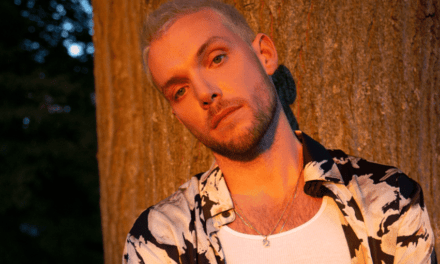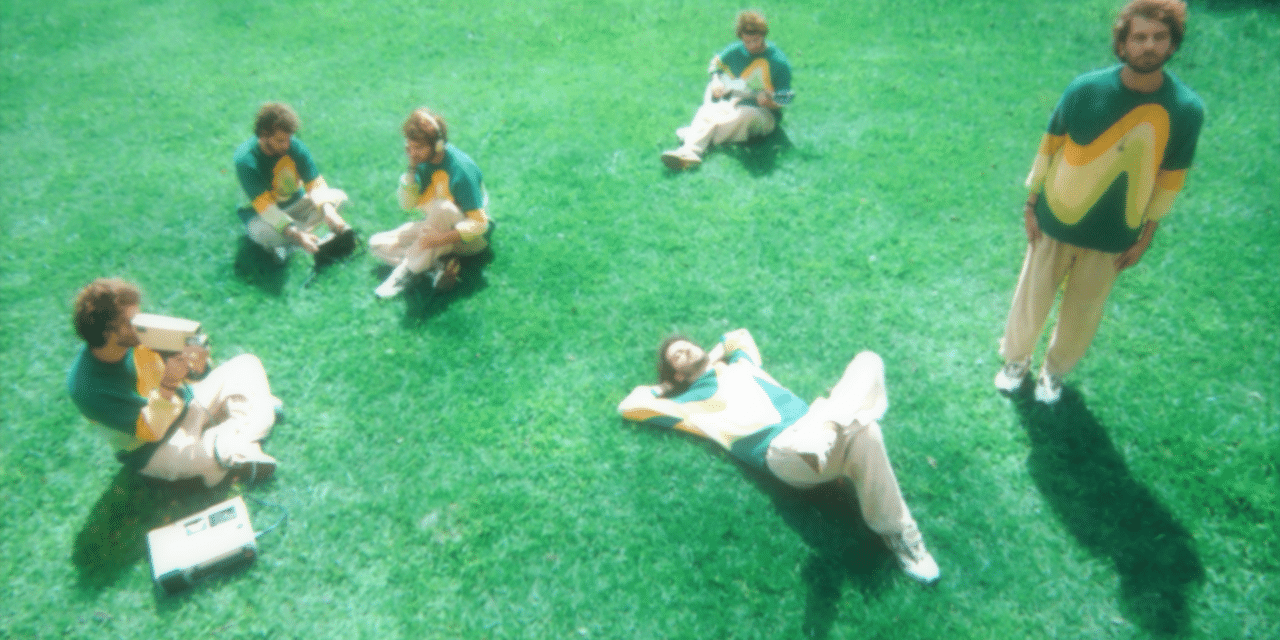
On his new EP, Brazilian-born, Brooklyn-based multi-hyphenate Rafael Melo turns anxiety, migration, absurdity, unrealized futures, and the strange comfort of living inside your own head into dream-pop that refuses to choose between sincerity and irony.
There is a particular kind of crisis that arrives when you look backward and realize how much of your life happened somewhere nobody else could see.
Inside imagined conversations.
Possible futures.
Alternate versions of yourself.
Plans you never executed.
Arguments you rehearsed.
Lives you briefly inhabited without ever leaving the room.
For Rafael Melo, the Brazilian-born, Brooklyn-based artist behind Late Again, that realization became the foundation for his new EP, I Dreamt I Was Awake.
“I’m in my mid-mid life crisis wondering where all those years went,” he says. “I realized more than half of them were probably spent inside my head.”
It sounds, initially, like regret.
Melo is not convinced it should be.
“As much as it sounds like a bad thing when I say it out loud, I keep asking myself if there’s anything objectively wrong with it.”
That question is more interesting than a straightforward condemnation of escapism.
If imagined lives influence real decisions, if fictional scenarios eventually become songs, films, games, relationships, or entirely different versions of ourselves, where exactly does fantasy stop being part of reality?
“Living in the fictional scenarios of our minds might be as real as anything else if you know how to eventually materialize them somehow,” he says.
“This EP is an attempt at that.”
Across six tracks, I Dreamt I Was Awake inhabits the uncomfortable gap between the life somebody imagined and the one they actually got.
It is not particularly interested in closing that gap.
Instead, Late Again wanders around inside it.
Sometimes tenderly.
Sometimes sarcastically.
Sometimes with phased guitars, Brazilian harmonic references, dream-pop synths, Japanese grooves, understated chaos, and jokes about humanity’s impending technological or political disasters.
The latest single, “Crazy or Stupid,” might be the clearest expression of that philosophy.
The world may be ending.
Late Again would still like the chorus to be catchy.
Laughing While Everything Feels Slightly Wrong
“Crazy or Stupid” contains references to some unmistakably contemporary anxieties.
Artificial intelligence.
Deportation.
The vague sensation that social life has become simultaneously more technologically advanced and less comprehensible.
But Melo resists turning those concerns into a manifesto.
“It’s ultimately a funny ballad that doesn’t take itself too seriously.”
That instinct is essential.
The track sets unnerving ideas against blissful synths, phased guitars, languid dream-pop textures, and an infectious melody.
Nothing sounds quite as panicked as the subject matter suggests it should.
The discrepancy creates its own commentary.
Melo believes irony can make difficult ideas easier to approach because it disarms both the audience and the person saying them.
“When you’re shielded by a layer of irony it feels easier to say whatever it is you need to say.”
That does not mean the sentiment is insincere.
Humor does not cancel seriousness.
It changes the angle of entry.
The challenge is avoiding both extremes: suffocating earnestness on one side and detached provocation on the other.
Melo describes the latter rather perfectly as sounding like “a teenagey edgelord.”
The sweet spot is somewhere in between.
Which is where Late Again seems most comfortable living anyway.
The Average Eds
The characters populating “Crazy or Stupid” have names like Fred, Jed, Greg, and Ted.
They sound specific.
They are deliberately not.
“They’re fragments of anyone, really,” Melo says. “Fred, Jed, Greg, Ted. They all rhyme in a silly way, they all evoke a similar feeling when you say them out loud.”
Then comes perhaps the best description:
“Average Eds.”
The joke reveals something important about Melo’s observational writing.
He is not necessarily constructing elaborate fictional biographies for each person wandering through the song.
They operate more like composites.
Tiny human containers for shared anxieties.
That is why references to deportation or AI can appear inside a song that remains breezy enough for summer listening.
The absurdity is not imposed on reality.
It is already there.
Late Again simply notices it.
Filling the Gaps in the Internal Monologue
Melo’s songs frequently feel like overheard conversations between his internal life and the external world.
He describes observation as one of the best methods he knows for interrupting the endless dialogue inside his own head.
“Observing the world around me is one of the best ways I know to fill in the gaps and add some periods to that internal dialogue.”
Those gaps are where songs begin.
It is an important distinction.
Late Again’s writing is personal, but it is rarely isolated.
The self becomes a lens rather than the entire subject.
“If it was just about me, I’d feel even more narcissistic than I already do whenever I get up on a stage.”
So strangers enter.
Cities enter.
Politics enter sideways.
Technology becomes background noise.
Someone’s immigration anxiety can coexist with somebody else’s romantic confusion.
The world intrudes upon the internal monologue until eventually a song appears.
Brazilian by Way of Everything Else
Late Again’s sonic identity is similarly uninterested in clean borders.
Melo grew up on the coast of São Paulo, while the project now operates from Brooklyn.
His music moves somewhere between North American indie pop, Brazilian bossa nova references, dream-pop, cinematic textures, and Japanese ’80s grooves.
Asked how those influences learned to coexist, Melo offers a cultural explanation.
“I think mixing up a bunch of stuff and seeing what sticks is a very Brazilian thing to do.”
Brazil is often reduced internationally to a handful of recognizable musical and cultural tropes.
Melo is more interested in hybridity.
“The most Brazilian thing possible is how we blend completely different worlds in a seamless/chaotic way.”
São Paulo itself becomes the perfect example.
Japanese.
Italian.
Lebanese.
Brazilian.
Countless immigrant communities layered across the same city.
“The food is great, man,” Melo adds.
Maybe musical hybridity is simply another version of the same phenomenon.
Take apparently unrelated ingredients.
Stop worrying so much about whether they are supposed to sit beside one another.
See what happens.
New York Did Not Solve Belonging
Moving thousands of miles from São Paulo to Brooklyn gave Melo two distinct creative environments to draw from.
But distance also produced an unexpected realization.
The emotional questions he carried were not particularly Brazilian.
Nor particularly American.
“I mostly write about the things these two worlds have in common.”
Belonging, especially, survived the flight.
“You don’t have to fly 4,000 miles away from home to be struggling with belonging.”
Melo says moving to New York actually helped him recognize how universal that sensation could be.
People around him seemed to experience versions of the same alienation he had known since childhood.
Perhaps place does not always create personality.
“Maybe it’s not always the place that shapes you,” he says. “Maybe we are in the place we are because of our shape.”
It is exactly the kind of thought that belongs inside a Late Again song.
Philosophical enough to linger.
Casual enough not to announce itself as philosophy.
No Late Againverse
Melo’s career has never been limited to songwriting.
His wider creative life stretches across award-winning films, independent video games, screenwriting, directing, commercial work, production, and visual storytelling.
From the outside, it would be tempting to describe all of this as one expansive interdisciplinary universe.
Melo refuses.
“There’s no Late Againverse.”
The main reason?
“It’d be a very silly name.”
Still, the disciplines clearly contaminate one another.
Screenwriting changed his approach to lyrics.
Production taught him how to finish things.
Directing advertising gave him money to record his first EP.
Soul-crushing jobs created material.
Every medium quietly finances, informs, or emotionally supplies another.
Melo may not consciously experience himself as building a grand unified body of work while he is inside hyperfocus mode.
But the boundaries remain porous.
One project leaves residue on the next.
He just wishes the whole thing resulted in a simpler answer when somebody at a bar asks what he does.
Creativity as Colliding Thoughts
That same philosophy extends naturally to collaboration.
Melo thinks of ideas as objects floating around until two previously unrelated thoughts collide.
Sometimes both belong to the same person.
You lie in bed at three in the morning and suddenly understand how two fragments fit together.
Collaboration introduces another possibility.
Somebody else arrives carrying the missing thought.
“It feels better when someone else comes along and spits an idea that ties things together.”
Late Again has benefited from collaborators across remarkably different disciplines, including Brazilian arranger and composer Arthur Verocai and visual artist Gabriel Rollinos, who created the visualizer for “Crazy or Stupid.”
What Melo values is not simply technical ability.
It is surprise.
“It’s just very cool to hear something you’ve never heard before from someone else.”
The ideal collaborator expands the possible shape of an idea.
Not by decorating it.
By supplying something you could not have thought of yourself.
Contradiction as a Place to Live
Across I Dreamt I Was Awake, contradiction appears almost constantly.
Tenderness against irony.
Optimism against anxiety.
Minimalism against intricacy.
Brazil against Brooklyn.
Fantasy against reality.
Individual experience against shared neurosis.
Melo is drawn to those tensions partly because resolution makes him suspicious.
“There just seem to be way too many angles to any experience lived by anyone out there, dude.”
Contradiction keeps the ending open.
Maybe that reluctance to resolve things is indecision.
Melo is willing to entertain the possibility.
“Maybe I should start being bolder and just commit more often.”
But until he discovers what deserves commitment, he is content to defend the unresolved middle.
“The limbo itself is a valid place to hang.”
That line may be the unofficial thesis of I Dreamt I Was Awake.
The EP is filled with lives that did not become what someone expected.
Futures hovering alongside present realities.
Anxieties made funny before they become unbearable.
Places that fail to cure the feelings we blamed on other places.
Dreams that might count as living if they eventually produce something tangible.
Late Again does not resolve those contradictions.
He gives them furniture.
Dreaming as Material
The title I Dreamt I Was Awake initially suggests disorientation.
But Melo’s explanation transforms it into something more productive.
If half your life has happened inside your head, perhaps the obvious response is to mourn the wasted time.
Or perhaps the imaginary life was raw material.
A screenplay lives inside somebody’s head before becoming images.
A song exists internally before vibrating through a speaker.
A game begins as a hypothetical world before anyone can enter it.
The imaginary does not automatically oppose the real.
Sometimes it precedes it.
Melo’s multi-disciplinary career makes that argument almost inadvertently.
Again and again, he has taken things that initially existed only as possibilities and materialized them into another medium.
I Dreamt I Was Awake turns that process inward.
The question is no longer simply whether dreaming prevented him from living.
It is whether the dreaming was another form of living all along.
In Conversation With Late Again
MUNDANE: Your upcoming EP is titled I Dreamt I Was Awake, which immediately blurs the line between reality and imagination. What was happening in your life that inspired you to explore that emotional space between the life we envision and the one we actually inhabit?
LATE AGAIN: I’m in my mid-mid life crisis wondering where all those years went.
I realized more than half of them were probably spent inside my head.
And as much as it sounds like a bad thing when I say it out loud, I keep asking myself if there’s anything objectively wrong with it.
Living in the fictional scenarios of our minds might be as real as anything else if you know how to eventually materialize them somehow.
This EP is an attempt at that.
MUNDANE: “Crazy or Stupid” tackles everything from AI anxiety to deportation fears, yet somehow feels breezy, playful, and even comforting. Why do you think humor and beautiful melodies can sometimes communicate difficult truths more effectively than direct confrontation?
LATE AGAIN: When you’re shielded by a layer of irony it feels easier to say whatever it is you need to say.
I like to think it disarms both the listener and yourself.
This doesn’t mean you ultimately don’t mean what you’re saying, though, you know.
So to get a point across I find it important to look for a balance between being too earnest and sounding like a teenagey edgelord.
MUNDANE: Your music exists somewhere between Brooklyn indie pop, Brazilian bossa nova, dream-pop, and Japanese city pop. Rather than treating those influences as separate worlds, you make them feel like they naturally belong together. How did you arrive at that sonic language?
LATE AGAIN: I think mixing up a bunch of stuff and seeing what sticks is a very Brazilian thing to do.
There are a lot of worn-out tropes when you think about Brazil. But if you look closely, you’ll realize that the most Brazilian thing possible is how we blend completely different worlds in a seamless/chaotic way.
Speaking of, did you know São Paulo has the largest foreign communities of Japanese, Italian, Lebanese—and many others—in the world?
The food is great, man.
Maybe that’s where it comes from.
MUNDANE: Beyond music, you’ve built a career across award-winning films, video games, and visual storytelling. How do those different creative disciplines influence the way you approach songwriting, and do you see every project as part of one larger artistic universe?
LATE AGAIN: Whenever I’m working on something I’m usually in hyperfocus mode and therefore it’s rare to see my silly projects as part of a bigger thing.
But I guess they do complement each other.
Screenwriting changed the way I approach lyrics, production taught me how to suck it up and get shit done, directing ads gave me the money to record my first EP, some soul-crushing job gave me something to write about, and so on.
It’d be cool to find a simpler answer when someone asks me what I do at a bar.
But there’s no Late Againverse.
Mainly because it’d be a very silly name.
MUNDANE: There’s a quiet wit running throughout your lyrics that turns everyday absurdities into something almost cinematic. Do your songs begin by observing the world around you, or by trying to make sense of your own internal dialogue?
LATE AGAIN: Observing the world around me is one of the best ways I know to fill in the gaps and add some periods to that internal dialogue.
I’d say those gaps are where a song starts.
If it was just about me, I’d feel even more narcissistic than I already do whenever I get up on a stage.
MUNDANE: The characters in “Crazy or Stupid” feel incredibly specific, yet they reflect anxieties that almost everyone is carrying today. Are these portraits inspired by real people, or are they fragments of different experiences stitched together?
LATE AGAIN: They’re fragments of anyone, really.
Fred, Jed, Greg, Ted.
They all rhyme in a silly way, they all evoke a similar feeling when you say them out loud.
Average Eds.
MUNDANE: Having grown up on the coast of São Paulo before building your career in Brooklyn, you’ve experienced two very different creative cultures. In what ways has living between those worlds shaped both your identity and your songwriting?
LATE AGAIN: It’s given me a lot to write about.
But it’s funny—I realized I mostly write about the things these two worlds have in common.
You don’t have to fly 4,000 miles away from home to be struggling with belonging, you know.
I think I needed to move to New York to realize that.
A lot of people here seem to feel a similar way to how I did ever since I was a kid.
I don’t know, maybe it’s not always the place that shapes you, maybe we are in the place we are because of our shape.
MUNDANE: Your work often balances tenderness with irony, optimism with uncertainty, and minimalism with rich musical detail. Why are you drawn to contradiction rather than resolution?
LATE AGAIN: I have a hard time with resolution.
There just seem to be way too many angles to any experience lived by anyone out there, dude.
I think contradiction is a tangible way to leave things open-ended.
Maybe I should start being bolder and just commit more often.
But while I haven’t figured out what to commit to, I keep telling myself that the limbo itself is a valid place to hang.
MUNDANE: You’ve collaborated with artists from very different musical backgrounds, from Arthur Verocai to visual artist Gabriel Rollinos. What do you look for in a collaborator, and how do those creative exchanges push you into places you wouldn’t reach on your own?
LATE AGAIN: A few years ago I was thinking about how cool ideas are often a combination of two separately preconceived thoughts.
It’s like they just keep floating around in the ether until they find each other and finally become something.
Sometimes you’ll have those two thoughts on your own, and you’ll connect them in bed on a Sunday at 3am.
But it feels better when someone else comes along and spits an idea that ties things together.
It’s just very cool to hear something you’ve never heard before from someone else.
I’ve been very lucky to work with people that do that all the time.
Even luckier to be friends with them.
MUNDANE: If I Dreamt I Was Awake were adapted into a film, what would the final scene look like?
LATE AGAIN: Main character wakes up.
And has to go through the whole thing again.
MUNDANE: What feeling would you hope the audience carries with them after the credits roll?
LATE AGAIN: Just sticking around for the credits is already a huge win, you know.
And Then You Wake Up
For an artist whose work spans music, film, games, visual art, Brazil, Brooklyn, fictional scenarios, very real anxieties, and jokes deployed precisely when sincerity starts becoming uncomfortable, Melo’s imagined ending for I Dreamt I Was Awake is suspiciously concise.
The main character wakes up.
Then has to do everything again.
No revelation.
No final answer.
No grand cinematic proof that the preceding experience transformed them permanently.
They simply wake up.
It is funny.
It is also exactly right for a record so preoccupied with the space between imagined lives and actual ones.
Maybe repetition is the real condition.
You wake up.
You go to work.
You worry about technology replacing you.
You wonder whether the country you live in will continue allowing you to live there.
You think about home.
You invent another life.
You write something.
You laugh at something horrible.
You make plans.
You fail to follow some of them.
You try again.
The distinction between dreaming and waking becomes increasingly difficult to maintain.
Maybe that is why Late Again does not seem especially interested in resolving it.
I Dreamt I Was Awake does not promise that your imagined future will eventually become your real one.
It offers something less comforting and perhaps more useful:
the possibility that the strange intermediate state counts too.
The unfinished version.
The contradictory version.
The person caught between cities.
The career with too many answers to the question What do you do?
The thought that has not yet collided with the other thought that will make it meaningful.
The life lived partly in the world and partly inside your head.
Melo calls it limbo.
For now, he has decided it is a valid place to hang.
And if the whole thing turns out to have been a dream?
Apparently we wake up and do it again.