
Photos by Delfina Pignatiello.
On her debut album, the Argentine artist turns neo-perreo, reggaetón, electroclash and distorted club electronics into a hyper-feminine universe built around fantasy, autonomy and contradiction
Six Sex has never treated music as something that exists only in sound.
Fashion, movement, sexuality, performance and imagery have always been part of the architecture surrounding her songs. But on ULTRA, her 16-track debut album, those elements come together with a new sense of scale. Rather than simply documenting where the Argentine artist is now, the record feels like the construction of an entire universe—one capable of holding radically different sounds, characters and emotional states at once.
Interestingly, that expansiveness wasn’t necessarily planned.
“I always try to think of my projects as little universes of their own,” Six Sex explains. “When I was building ULTRA I wasn’t strategically planning to include one song of every style. I was following the kind of music that pulled me in and inspired me at the time.”
That instinctive approach explains some of the album’s volatility. Produced by Six Sex alongside Bbynito, Qiri, Cimarrón and Fermín Ugarte, ULTRA moves between neo-perreo, reggaetón, hyperpop, underground club music and electronic experimentation without treating those categories as boundaries.
Instead, they become different rooms within the same world.
From the opening declaration of “Ultra Terrorific Fantasy” through the independence of “boyfree,” the provocation of “PANTALOM” and the bodily reclamation of closing track “no more porn,” the album repeatedly circles questions of desire and agency. Who gets to look? Who gets to want? Who has control? And what happens when control itself becomes unstable?
For Six Sex, those contradictions are central.
“The concept of the record is clear, even if it isn’t just one thing,” she says. “It’s everything that happens between independence and dependence, control and the lack of it, sexuality and its constant power play.”
At the center of all of it is femininity—not presented as something fixed or easily resolved, but as something capable of being playful, sexual, confrontational, contradictory and self-defined.
That philosophy extends into Six Sex’s increasingly recognizable visual identity. Clothing, choreography and aesthetics don’t decorate the music after the fact; they help articulate what the music itself feels like.
“It all works together,” she says. “I’ve always liked to express myself through the clothes I wear, how I move as a performer, and how everything around my project looks.”
The result is what Six Sex describes as an almost invisible creative DNA, connecting the different dimensions of the project even as the music itself refuses to remain still.
And that universe is rapidly becoming international. Following a sold-out 14-date first U.S. tour, festival appearances across Latin America and a growing audience that has pushed her beyond 820,000 monthly Spotify listeners, ULTRA arrives alongside another stage in her global expansion.
But for a project this interested in transformation, perhaps the most compelling thing about ULTRA isn’t where Six Sex fits within contemporary club culture. It’s how confidently she is constructing a language of her own inside it.
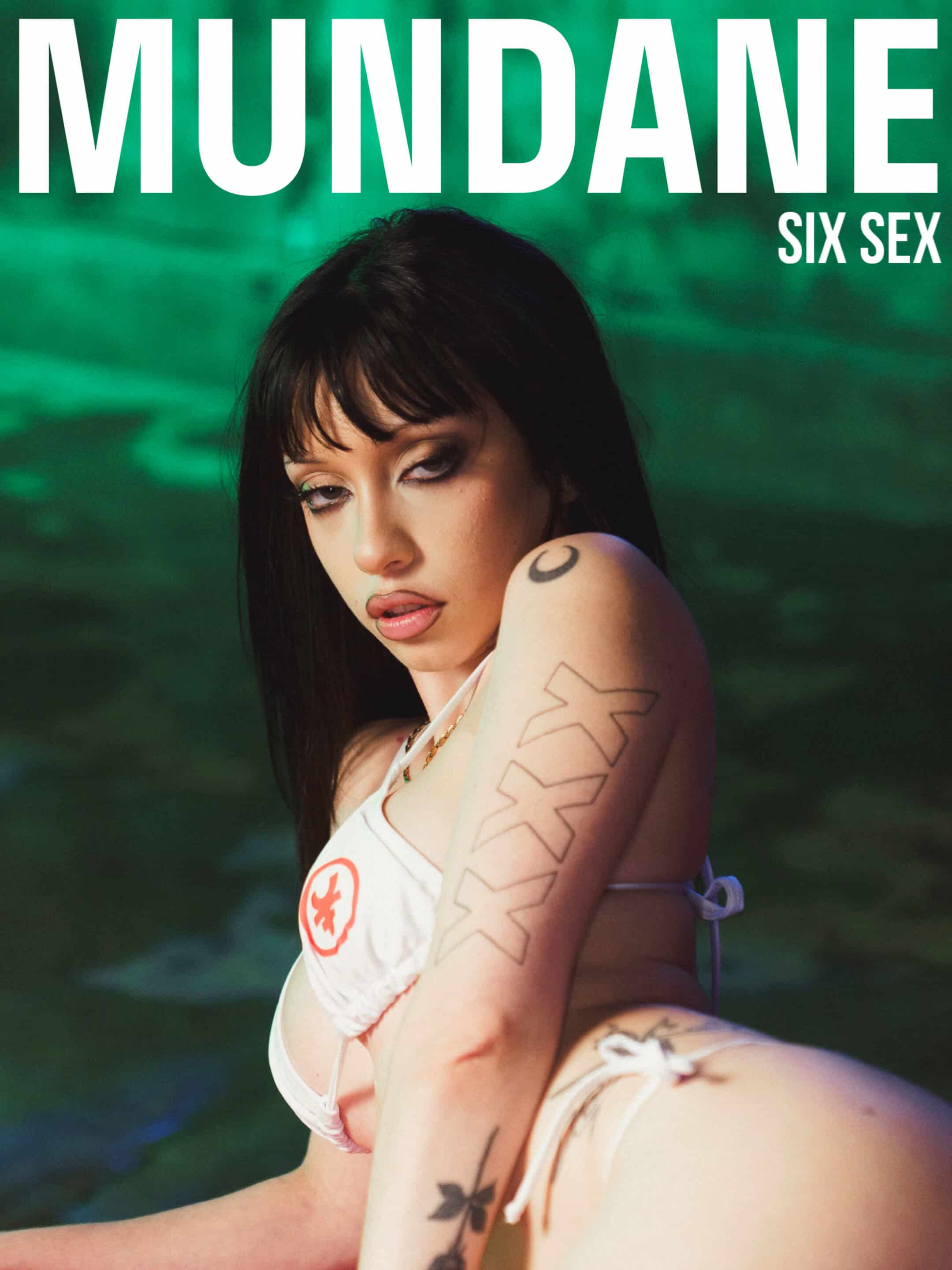
Mundane caught up with Six Sex to discuss the making of ULTRA, turning different genres into a cohesive universe, the relationship between fashion and sound, modern femininity and why the album ultimately ends by reclaiming control.
————–
ULTRA feels like your most complete artistic statement so far, blending neo-perreo, reggaetón, hyperpop, and experimental club music into one cohesive universe. When did you realize you weren’t just making an album—you were building an entire world?
I always try to think of my projects as little universes of their own. When I was building ULTRA I wasn’t strategically planning to include one song of every style, I was following the kind of music that pulled me in and inspired me at the time, and then finding ways to make it all cohesive with the songs I already knew were going to be part of the album.
The truth is ULTRA moves through a lot of genres, themes, and even characters, but that’s more a reflection of how I lived through making the album than something I set out to do on purpose.
Your visual identity has become just as recognizable as your music. How do fashion, performance, and aesthetics help communicate the world of Six Sex beyond what listeners hear in your songs?
It all works together. I’ve always liked to express myself through the clothes I wear, how I move as a performer, and how everything around my project looks.
It all ends up being intertwined in a pretty tight way, since fashion, performance, and aesthetics always work in service of reinforcing or defining my identity. That builds a kind of DNA that’s almost invisible but very solid, and that’s ultimately how my project looks from the outside.
I think we made that happen on ULTRA, and my creative team and I were able to capture most of the ideas and fantasies I had in my head. At the end of the day, the point of working across all those areas is to visually represent how the music feels, which makes the music hit even harder.
Tracks like “boyfree” celebrate independence, while “no more porn” closes the album by reclaiming ownership over the body and sexuality. Did you always envision the album ending on such a powerful statement, or did that narrative emerge naturally during the writing process?
The truth is, while I was making the album I didn’t imagine it would end this way, but I definitely wanted there to be a strong final message, one that gave meaning to what I was trying to express.
I think the concept of the record is clear, even if it isn’t just one thing: it’s everything that happens between independence and dependence, control and the lack of it, sexuality and its constant power play.
The feminine role that runs through all of those themes is, in most part, what builds ULTRA from start to finish.
————–
There is something fitting about ULTRA refusing to resolve itself into a single idea.
Its power comes from the friction: independence against dependence, pleasure against control, fantasy against reality, pop immediacy against underground experimentation. Six Sex isn’t trying to eliminate those contradictions. She’s making them dance together.
And perhaps that’s what makes ULTRA feel bigger than a debut album. It doesn’t simply introduce a collection of songs—it establishes the rules, aesthetics and tensions of a world that belongs unmistakably to Six Sex.
A world where femininity doesn’t need to behave consistently to be powerful, where the body can be both spectacle and sovereign territory, and where the club becomes a place not only to escape yourself, but to decide who you want to be.