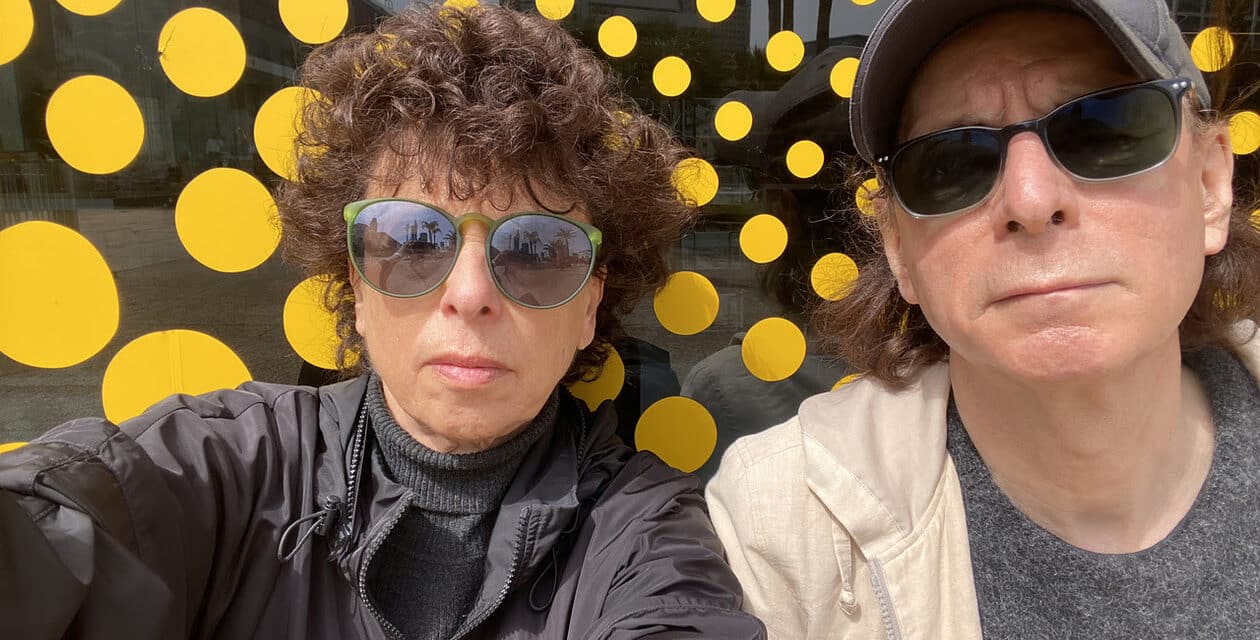
On their new album, Colin Newman and Malka Spigel turn dark grooves, direct observation, public art, collaboration, and decades of shared creative life into a record that looks backward only long enough to keep moving forward.
There is a peculiar trap waiting for artists with history.
At a certain point, the past becomes valuable enough that everyone around them has an incentive to keep selling it back.
Anniversaries.
Reissues.
Legacy tours.
Repackaged memories.
The same songs, the same stories, the same cultural reference points, offered again with slightly altered framing.
For Immersion, the electronic project of Colin Newman and Malka Spigel, that possibility seems far less interesting than whatever happens next.
Despite careers that stretch across decades—and musical histories that inevitably bring names like Wire and Minimal Compact into the conversation—Newman and Spigel remain strikingly resistant to nostalgia.
Their new album, What Is Lost Will Return, arrives September 4 via their own label, swim ~, following 2025’s deliberately exasperated WTF??.
The change in titles alone suggests a movement.
From disbelief toward possibility.
From reaction toward endurance.
From “what the fuck?” toward the question of what remains once the shock has passed.
The duo describe the emotional character of the new album as “a poignant mixture of joy and melancholy.” It is a record of hypnotic grooves, melodic restraint, electronic texture, observational lyrics, and a fascination with the contemporary world that refuses to become trapped inside its ugliness.
That perspective matters.
Immersion are not pretending the world is calm.
They are asking what kind of creative response remains useful when chaos itself has become repetitive.
“You can’t live like that,” Spigel says of remaining inside negativity. “You have to find a positive because otherwise you can’t go forward.”
Perhaps that is the real premise of What Is Lost Will Return.
Not optimism as denial.
Optimism as forward motion.
When Words Fix a Song in Place
The contrast between the album’s singles makes Immersion’s creative range especially clear.
“We Don’t Need Your Validation” is direct.
Its title alone contains an argument.
“Megafauna,” by contrast, communicates without words.
Built around a dark dub-like groove, ominous guitar movement, and strange, almost primordial textures, the instrumental suggests lumbering creatures moving through some imagined landscape.
Newman and Spigel describe its title in similarly physical terms: giant beings moving slowly to a beat, drawn toward “the sound of a primordial piper.”
For Spigel, instrumental music retains a useful ambiguity.
“Once you put words into a song, it gives much more of an image, a picture.”
Without them, the listener gets more room.
“It’s more abstract. It’s more open to anybody listening to feel whatever they feel about it.”
Newman sees that contrast as increasingly important because Immersion’s recent lyric writing has become intentionally direct.
Their words are generally “very much about what they’re about.”
That clarity has power.
It also has consequences.
Lyrics can fix a song “in time and space.”
An instrumental can remain more slippery.
For Immersion, the coexistence of those approaches prevents the record from turning into one continuous statement.
Sometimes they want to tell you exactly what they mean.
Sometimes the music is more useful when it refuses explanation.
From an EP to an Album in Weeks
What Is Lost Will Return emerged quickly.
Very quickly.
At one point in March, Newman and Spigel believed they had an EP.
By the end of April, they had an album.
There was practical momentum behind that transformation. Touring was approaching, and having something new to carry onto the road felt appealing.
But speed did not turn the process into formula.
“We have a lot of experience of doing this,” Newman explains. “But we don’t work to a formula.”
Immersion’s songs are built layer by layer.
One person contributes something.
The other responds.
Neither necessarily knows where the track is headed.
“Until it’s finished, we don’t really know exactly where it’s going,” Spigel says.
The surprise arrives afterward.
“Wow, we did that.”
That sense of discovery is significant after so many years of working together.
Experience has clearly made them faster.
It has not made the process predictable.
That distinction may be one of the reasons the work still feels alive.
Competence can easily harden into routine.
Immersion appear more interested in using experience to create the conditions for spontaneity.
Hope After “What the Fuck?”
The philosophical movement from WTF?? to What Is Lost Will Return is not subtle.
The previous title captured a collective mood remarkably efficiently.
Confusion.
Exasperation.
A sense that the absurdity of the world had outrun language.
But there are limits to staying inside that reaction.
“You can’t live like that,” Spigel says.
Eventually, art has to offer something beyond identification with the crisis.
Newman puts it more directly:
“Art should provide some context, but it should also provide a way of communication, hope.”
He is skeptical of nihilism altogether.
“I don’t think now is a time for nihilism.”
In fact, he questions whether there was ever much use for it.
To him, nihilism can become a kind of indulgence—a pose available when circumstances are comfortable enough to make despair aesthetically interesting.
The present moment, in his view, demands something else.
“Don’t indulge it.”
Creating music itself becomes part of that answer.
“The process of creating music is therapeutic for us,” Spigel says.
Newman follows with characteristic dryness:
“You just get the results of our therapy.”
That humor is important.
The album may be responding to contemporary instability, but it does not sound weighed down by the responsibility of solving it.
It simply refuses to let despair have the final word.
Megafauna on the Brighton Seafront
The visual world around “Megafauna” extends the track’s ambiguity.
Creating a video for an instrumental presented an obvious problem.
Without lyrics, there was no narrative to illustrate.
Instead, Newman and Spigel searched for imagery that carried the same sense of scale, mutation, and strangeness.
They found it close to home.
The video incorporates footage of Ivan Morison’s “Soft Machines”, large sculptural works installed along the Hove seafront as part of the Brighton Festival, along with imagery from “Sense of Unity with Dundu,” another Brighton Festival performance.
“We were looking for kind of mutation and huge creatures,” Spigel explains.
The “Soft Machines” fit almost immediately.
Newman is careful to clarify that the supposedly “existing footage” was still their own material—some of it simply shot years earlier.
That distinction fits the record’s broader philosophy.
The past is present.
But it is being reused rather than worshipped.
Brighton itself becomes part of the creative resource.
“There’s always something going on and there’s always some arty stuff and just great images that you can shoot,” Spigel says.
Even while answering the interview, they mention recently filming drum and bass performers on bicycles for another video.
The environment continues feeding the work.
Nothing needs to arrive with a grand plan.
Sometimes you simply notice what is happening around you and recognize that it belongs in the world you are already building.
Life Partner, Art Partner
The intimacy between Newman and Spigel is difficult to separate from the music.
They describe themselves as life and art partners.
Asked where one relationship ends and the other begins, Spigel seems almost puzzled by the premise.
“I guess it’s just a continuous thing.”
They live in the same space.
They record there.
They rehearse there.
Creative life does not require entering a separate professional zone.
“When you’re so close to someone, there’s no boundaries, there’s no ego.”
That does not mean sameness.
In fact, Spigel immediately emphasizes the importance of leaving space for the other person to create and express.
Newman agrees that their dynamic differs from a conventional band.
They have been working together, in one form or another, for longer than most people realize—essentially from the time they first met.
“What you see is what you get with us, I guess.”
But their closeness does not erase disagreement.
“When it comes to playing or singing, we have different ideas,” Spigel says.
“Otherwise it’d be boring.”
They are not one person.
The absence of hard boundaries is not the absence of individuality.
It is the confidence that difference does not threaten the partnership.
Anti-Nostalgia as Practice
It would be easy for Immersion to stop here.
That may be the most important fact about them.
There is enough history.
Enough catalog.
Enough credibility.
Enough cultural significance attached to the projects Newman and Spigel have already been part of.
They could spend years revisiting it.
Newman knows this.
The music industry, he argues, has structural incentives toward repetition.
“It’s easier to sell things which are the same as other things.”
Or, even more precisely:
“A different package of the same thing over and over again.”
Older artists are particularly vulnerable to being absorbed by that machinery.
“We could just be touring something that we made years ago.”
They are not.
Instead, Immersion continue making new records, meeting new people, collaborating, broadcasting a radio show, finding unexpected sounds, and expanding their network of creative relationships.
“We’re actually doing new work.”
That sentence sounds almost mundane.
In context, it becomes the entire manifesto.
New friends.
New modes of expression.
New ways to connect with the world.
“That feels genuinely exciting and much, much more interesting.”
Creativity as Connection
That insistence on the future does not mean pretending the past never happened.
What Is Lost Will Return itself acknowledges history.
The title carries memory inside it.
But what returns does not have to return unchanged.
Immersion’s current creative life appears increasingly organized around connection.
They collaborate frequently.
They meet artists through their radio show.
They find inspiration in new music.
Some relationships stay social.
Others become artistic.
The boundary between the two can blur.
“It feels like we’ve opened the door to something which is about creativity and connection,” Newman says.
“And that’s a very human thing.”
The possibilities are therefore effectively endless.
Not because every musical idea is unprecedented.
Because every new relationship changes the conditions.
A collaborator brings a different tension.
A different instinct.
A different way of hearing.
Another door opens.
As Spigel puts it:
“If you don’t live in the past—the way you create, the way you think—then it does feel forward and endless.”
For artists this far into their careers, that may be far more radical than reinvention for its own sake.
They are not trying to erase who they were.
They simply refuse to assume that who they were is more interesting than who they might meet tomorrow.
In Conversation With Immersion
MUNDANE: There’s an interesting tension between “Megafauna” and “We Don’t Need Your Validation.” One communicates entirely through texture and atmosphere, while the other is much more direct and lyrical. What can instrumental music express for you that words sometimes cannot?
MALKA SPIGEL: It’s not easy to answer, actually.
I guess once you put words into a song, it gives much more of an image, a picture.
With an instrumental, it’s more abstract. It’s more open. Anybody listening can feel whatever they feel about it.
You’re not directing it too much by putting words into it.
COLIN NEWMAN: With Immersion and text, certainly over the last two albums, we’ve tended to be much more direct.
So there is a tension, a contrast, because obviously the instrumentals don’t have that directness in the text.
Perhaps that’s good for us.
With Immersion, we don’t really want to have texts that are too open to interpretation. They are very much about what they’re about.
But obviously that does fix it in time and space, I guess.
MUNDANE: The album was created during a very concentrated burst of inspiration. After working together for so many years, what conditions still allow the two of you to surprise each other creatively?
MALKA SPIGEL: I’m not sure about surprise.
I guess we constantly surprise each other because we surprise ourselves as well.
It’s all quite spontaneous.
You create the tracks and it comes layer by layer, and each person contributes something.
Until it’s finished, we don’t really know exactly where it’s going.
So I guess the surprise is at the end, when we think, “Wow, we did that.”
COLIN NEWMAN: This particular record did happen in a surprisingly short timescale.
At some point in March, we thought we had an EP, and by the end of April, we had an album.
There was a little bit of pressure from thinking that we wanted to release something to coincide with our touring, which was about to happen in the UK and some of Europe.
The idea that you’d like to have something in your hand when you go out on the road—it’s not always necessary, but it’s quite nice to have something new.
I’m really surprised at the quality of it given how quickly it came together.
On the other side, we have a lot of experience doing this.
But we don’t work to a formula.
It’s not like, “You’ve got to do this, this, this and this.”
It just comes how it comes, as Malka said.
MUNDANE: There’s a lot of observation of the contemporary world throughout the album, but you seem interested in responding to chaos without simply reproducing its anxiety. Do you think making hopeful art feels more radical now than making nihilistic art?
MALKA SPIGEL: Probably.
We hear from a lot of artists that we play on our radio show who have a similar way of thinking—how to find your own center in the chaotic world, how to find like-minded people.
We kind of got here after feeling everything is chaos and responding to it in a negative way.
You can’t live like that.
You have to find a positive because otherwise you can’t go forward.
COLIN NEWMAN: Last year we did another album, WTF??, and “What the fuck?” pretty much sums it up.
It pretty much sums up what everyone else was thinking as well.
We’re not channeling anything particularly new or different to anyone else.
In some ways, as Malka alluded to, we’re tapping into how it is now.
It’s what we need.
Art should provide some context, but it should also provide a way of communication, hope. There are all kinds of things that art can provide.
I don’t think now is a time for nihilism.
To be honest, I’m not even sure there ever was a good time for nihilism.
It’s kind of the bored teenager thing.
It’s been overdone.
It’s a kind of self-indulgence of a world of plenty, where everything is fine actually.
But we don’t live in that world anymore, so don’t indulge it.
MALKA SPIGEL: Also, I think just the process of creating music is therapeutic for us.
We feed that positive feeling into it.
COLIN NEWMAN: You just get the results of our therapy.
MUNDANE: The video for “Megafauna” combines footage of Ivan Morison’s “Soft Machines” with imagery from “Sense of Unity with Dundu.” What attracted you to those images, and how did they expand the strange, almost mythological world already suggested by the track?
MALKA SPIGEL: Some of it was existing footage.
Sometimes it’s not easy with an instrumental track to imagine what video would work.
We were looking for mutation and huge creatures.
We were lucky that the “Soft Machines” were on the beach in Brighton.
We went and filmed it, and it seemed to be the kind of subject that suited it.
COLIN NEWMAN: When Malka says some of it was existing, it means something that she shot several years ago, as opposed to something we got off the internet.
It’s all in Brighton.
There might be some scenes that aren’t in Brighton, but for the most part, those two artworks were both part of something called the Brighton Festival, which happens every May and commissions pieces of all kinds.
When it works, it’s fantastic public art.
Certainly those “Soft Machines” on the promenade in Hove were extremely visible and really quite extraordinary things to have there.
MALKA SPIGEL: Brighton in general is a very good place if you want good footage because there’s always something going on.
There’s always arty stuff and just great images that you can shoot.
Yesterday we were watching drum and bass on bicycles.
COLIN NEWMAN: It got filmed for the next video.
There really is a lot going on in Brighton.
MUNDANE: You’ve described yourselves as life and art partners, which gives your collaboration a very different intimacy from a conventional band dynamic. After decades of sharing both life and creative work, where does one relationship end and the other begin—or have those boundaries disappeared entirely?
MALKA SPIGEL: I’m not sure.
I guess it’s just a continuous thing.
We live in the same space. We record and rehearse in the same space.
When you’re so close to someone, there are no boundaries, there’s no ego.
There’s a lot of giving space to the other person to be creative and to express.
COLIN NEWMAN: Absolutely.
There are fewer boundaries.
Bands obviously have a dynamic, and very often it’s a bunch of blokes and how a bunch of blokes relate.
We do have a different dynamic because we’re a couple and we’ve been working together a long time—a lot longer than anyone actually realizes.
We’ve been working together more or less since the day we first met.
It’s become more public, what we do together, and in a way we live it more publicly.
It’s not like we don’t have a private life.
It’s just, what you see is what you get with us, I guess.
MALKA SPIGEL: When it comes to playing or singing, we have different ideas.
Otherwise it’d be boring.
We’re definitely not the same person.
MUNDANE: What Is Lost Will Return references your past without living inside it, while simultaneously expressing a fascination with what comes next. At this stage, what still feels genuinely unknown or unexplored musically? Is that uncertainty what keeps Immersion moving forward?
MALKA SPIGEL: Definitely.
We collaborate a lot, and we collaborate with different artists.
Each brings different qualities, different tensions, different connections, and it all feeds into our own creativity.
Our radio show too—we hear a lot of new music.
So there are endless inspirations.
We’re definitely looking forward.
COLIN NEWMAN: It’s a strange thing.
We know more artists now than we’ve ever known.
We have connections with more artists.
We do stuff with more different artists, ranging from going out and having a drink to actual collaboration.
And the line blurs between that as well.
It feels like we’ve opened the door to something which is about creativity and connection.
That’s a very human thing.
Of course it’s endless because, in a way, we’re endless until we’re finished.
That’s what we are.
It’s not a thing with a built-in lifespan.
It’s hard to really put it into words.
It’s kind of slippery.
But it feels really exciting.
MALKA SPIGEL: If you don’t live in the past—the way you create, the way you think—then it does feel forward and endless.
COLIN NEWMAN: There is so much in this industry driving endless recycling and living in the past because it’s easier to sell things which are the same as other things.
Or it’s easier to sell a different package of the same thing over and over again.
As older artists, we could just be consumed by that.
We could just be touring something that we made years ago.
But we’re not doing that.
We’re actually doing new work.
We’re finding new friends, new modes of expression, new ways to connect with the world.
And that feels genuinely exciting and much, much more interesting.
What Returns Does Not Have to Return Unchanged
There is a satisfying contradiction inside the title What Is Lost Will Return.
Return implies repetition.
Immersion do not.
The album seems less concerned with recovering the past than with recognizing what remains useful inside it.
Experience.
Instinct.
Connection.
The ease that comes from knowing another person deeply enough to make something without having to explain every choice.
The confidence to create quickly without turning speed into formula.
The understanding that an instrumental can mean precisely because it refuses to tell the listener what it means.
The knowledge that anger can be useful until it becomes somewhere you live.
And perhaps most importantly, the realization that longevity does not have to mean preservation.
Newman and Spigel could become custodians of their own histories.
Instead, they keep behaving like artists who have somewhere else to go.
Their radio show introduces them to new music.
New artists become friends.
Friends become collaborators.
Public art becomes footage.
A Brighton street becomes material for the next video.
A small amount of touring pressure turns an EP into an album.
One person adds a layer.
The other answers.
Eventually they look at each other and think:
We did that.
That cycle appears to matter far more to Immersion than protecting a legacy.
Their past is present because it inevitably shaped them.
But it is not where they live.
“What you see is what you get,” Newman says of their relationship.
The same could probably be said of the project.
Two people sharing a life, sharing a studio, paying attention to what is happening around them, and continuing to turn that attention into new work.
After decades together, they have not discovered some final formula for creativity.
They have found something better.
A reason to remain curious.