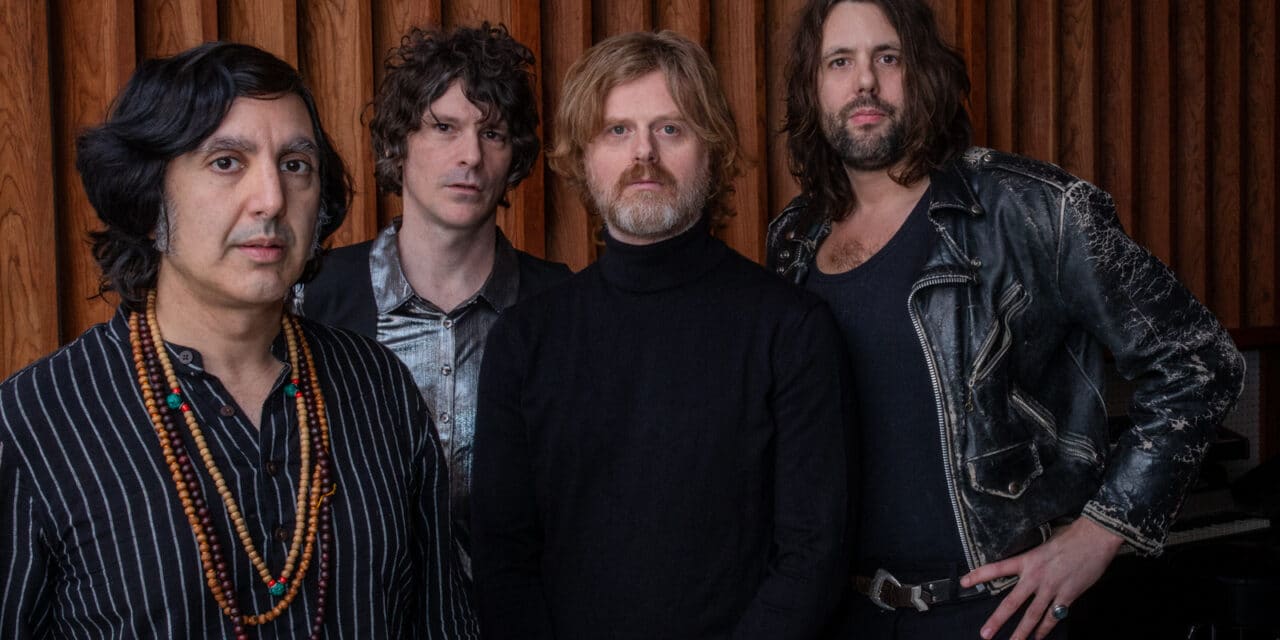
For Rishi Dhir, grief and hope have never really existed on opposite sides of the emotional spectrum. If anything, they have spent the past two decades feeding one another.
The Montreal musician, songwriter, producer and sitarist has built Elephant Stone around that tension. Across ten releases and twenty years, the band has developed a psychedelic language that pulls from Indian classical music, Western psych-pop, rock and increasingly cinematic production without treating those influences as separate worlds. What may once have been described as fusion has become something much more instinctive: simply the way Dhir hears and processes the world.
That instinct takes on particularly personal weight with ASHA.
Named after Dhir’s late mother—and after the Sanskrit word for “hope”—the album arrives from a period in which private grief, political unease, mortality and a wider sense of cultural darkness became increasingly difficult to separate. Rather than attempting to resolve those tensions, Dhir allows them to coexist.
“Asha means hope, but it’s also always been how I move through things,” he says. “I take in what’s happening around me, and hope is what carries me through the hard parts, the promise that something better is coming.”
That doesn’t make ASHA an exercise in uncomplicated optimism. Song titles including “Everything Evil,” “Fascists Killed Yer Rock ‘N’ Roll,” “A Beautiful Fate” and “Spirit, Take Me Away” suggest a record staring directly at darkness while searching for something beyond it.
For Dhir, there isn’t necessarily a boundary between the personal and political material entering the music. “That’s just what’s happening, in the world and in my life at the same time,” he explains. “This record is just me processing all of it.”
Sometimes the songs even seem to understand what he is processing before he does.
“Parallel and Contrary Motion” began without Dhir fully understanding its emotional destination. Its title was pulled from his daughter’s piano book, but the composition eventually revealed itself as being connected to the death of his friend Christian. The musical concept—two things moving together and apart—suddenly became an eerily precise description of grief itself.
“You’re never just one thing,” Dhir says.
That philosophy extends beyond ASHA. Despite Elephant Stone’s long association with transcendental psychedelia, Dhir says the project itself actually began with loss. Music has remained his outlet, therapy and source of hope ever since.
Twenty years later, he is still searching for essentially the same thing.
“Some kind of transcendence,” he says. “Some kind of peace with what I can’t control.”
We spoke with Rishi Dhir about ASHA, losing his mother and his friend Christian, the relationship between grief and hope, letting go of the idea of “fusion,” working alone inside Sacred Sounds and why, after twenty years of Elephant Stone, the hardest creative decision is sometimes simply trusting yourself enough to know when something is good.
ASHA takes its name from your late mother, and “Asha” means “hope” in Sanskrit. When making a record so deeply connected to grief, what did hope actually mean to you—and did that definition change while you were creating it?
Asha means hope, but it’s also always been how I move through things. I take in what’s happening around me, and hope is what carries me through the hard parts, the promise that something better is coming. With this record I didn’t want to just point at how bad things are. I wanted to give people something back that actually said hope, not just grief.
The album seems to exist in the friction between personal sorrow and a broader sense that the world itself is becoming darker. How do you separate private grief from collective anxiety when both are entering the same songs?
Honestly it’s hard to know where one ends and the other starts. What’s mine and what I’m just picking up from everyone else, the world around me. It all gets processed through me the same way. What comes out is me trying to take my grief and the collective anxiety and turn it into something universal.
“Parallel and Contrary Motion” began before you fully understood what it was about and eventually became connected to the loss of your friend Christian. Have you often found that songs understand what you’re processing emotionally before you consciously do?
“Parallel and Contrary Motion” started before I understood what it was. I wrote it for my friend Christian, who I lost. I didn’t know that’s what it was about until it was already there. Some songs work that way, they get to it before I do.
The phrase “Parallel and Contrary Motion” originally came from your daughter’s piano book. Once the song took on such profound emotional meaning, did the musical concept itself—things moving simultaneously together and apart—begin to feel like a metaphor for grief?
The title came from my daughter’s piano book, I just liked the phrase. Once the song became about Christian, yeah, it turned into exactly that, things moving together and apart at the same time. That’s grief. You’re never just one thing.
John-Mark Lapham interpreted the song visually through a dying man who needs help letting go, rather than illustrating the lyrics literally. What was your reaction to seeing someone else transform such a personal song into a story you hadn’t necessarily imagined?
John-Mark took it somewhere I didn’t picture, a dying man who needs help letting go. It wasn’t what I imagined but it fit the song completely. I like handing something that personal to someone else and seeing what they find in it that I couldn’t see myself.
For twenty years, Elephant Stone has brought Indian classical tradition into conversation with Western psychedelia. At this point, does the sitar still represent a bridge between different musical identities for you, or has that distinction essentially disappeared within your creative language?
The sitar’s so deeply part of how I write now, it doesn’t feel like bridging anything anymore. There’s no two worlds I’m translating between. This is just how I express myself musically. It’s not a fusion, it’s just what my music is.
You now produce, engineer and mix much of Elephant Stone’s work from your own Sacred Sounds studio. Has becoming increasingly self-sufficient allowed the records to become more vulnerable because there are fewer barriers between the initial emotion and the finished recording?
Very much so. Working alone gives me the time to actually sit with what a song is, musically and lyrically, before it’s finished. And it lets me go places I don’t think I’d be comfortable going if I was doing this in a studio with someone else watching.
ASHA contains titles like “Everything Evil,” “Fascists Killed Yer Rock ‘N’ Roll,” “A Beautiful Fate” and “Spirit, Take Me Away.” There seems to be a conversation between darkness, politics, mortality and transcendence running through the album. Do those subjects feel inseparable to you right now?
No distinction really. That’s just what’s happening, in the world and in my life at the same time. This record is just me processing all of it.
After ten albums, it would be easy for Elephant Stone to settle into an identifiable psychedelic vocabulary, yet you’ve described the project as constantly deconstructing the past. What parts of your own musical identity are you currently most interested in destroying or rebuilding?
For me it’s about trusting myself. Trusting the decisions I make while I’m writing and recording, not second-guessing everything as I go. But it comes down to the end too, I have to be fearless enough to actually decide if something’s good or not. That’s the hard part. Not the writing, the deciding.
Elephant Stone began as a search for transcendental sound, while ASHA arrives after twenty years of music and some profound experiences of loss. Has your understanding of transcendence changed—and what are you searching for through music now?
Elephant Stone actually began and stemmed from loss. And oddly enough, it’s continually been my outlet, my therapy, and my hope ever since. That hasn’t changed in twenty years. What I’m searching for through music now is the same thing I always was, some kind of transcendence, some kind of peace with what I can’t control.