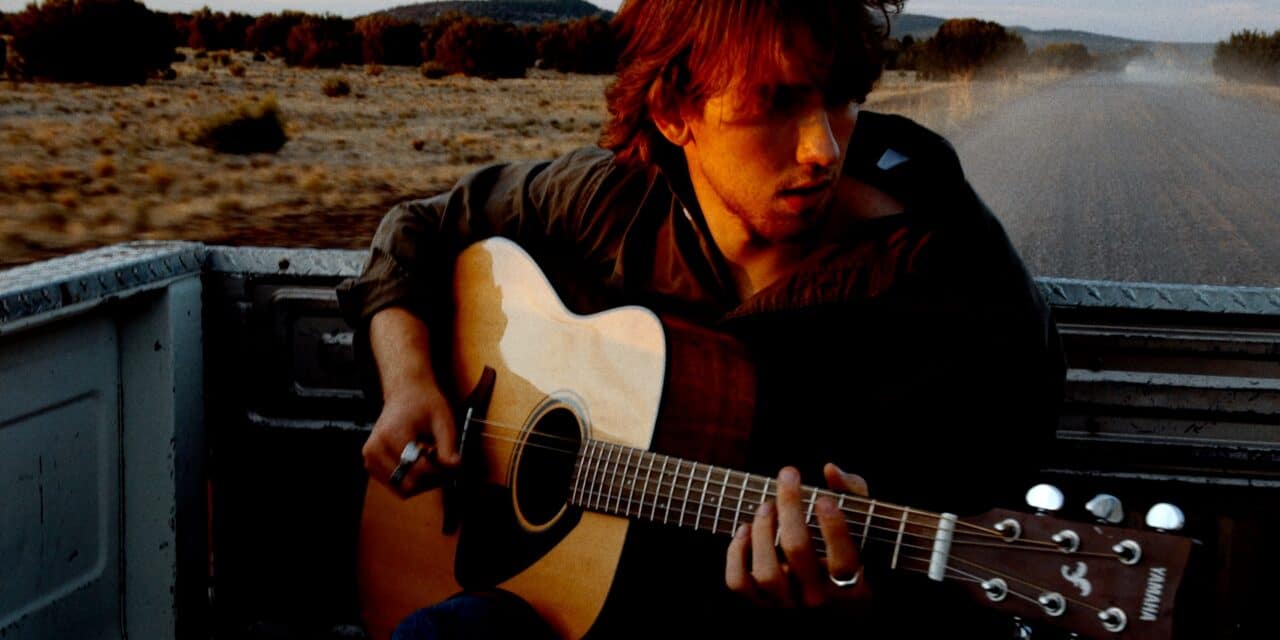
From an isolated cabin in Arizona to the jazz clubs and classrooms of New York City, emerging singer-songwriter Joshua Jensen has followed the roots of American music in search of something deeply human. With his single “People Were Singing,” he brings together folk, gospel, classical composition, and the spiritual language of improvisation to explore memory, loneliness, and the possibility of finding hope through music.
There’s something quietly radical about making music that doesn’t seem particularly concerned with keeping up.
In an era when artists are encouraged to define themselves immediately, release constantly, and capture attention within seconds, Joshua Jensen is moving in a different direction.
The Arizona-born, New York-based singer-songwriter is more interested in what music can preserve than how quickly it can travel.
His influences stretch across generations and traditions: the emotional intimacy of Joni Mitchell, the harmonic sophistication of classical music, the improvisational freedom of jazz, and the communal spirituality of folk and gospel.
But rather than treating these traditions as separate genres to combine, Jensen approaches them as interconnected expressions of something fundamentally human.
“Those are all branches from the same mother tree,” he tells MUNDANE. “Now I try to just sit under it and take it in.”
His single “People Were Singing” captures that philosophy through an intimate arrangement that gradually expands beyond its acoustic foundations.
Resonant guitar accompanies Jensen’s unpolished, expressive vocals before layered harmonies, electric guitar, bass, and violin introduce a more expansive emotional landscape.
The result occupies an intriguing space between traditional songwriting and something more atmospheric, almost dreamlike.
But beneath the arrangement lies a complicated meditation on memory and absence.
“It’s about the crowd taking over and feeling alone in the middle of all of it,” Jensen explains.
And for an artist whose earliest experiences with music were rooted in collective singing, that contradiction carries particular weight.
When Music Was a Form of Prayer
Jensen’s relationship with music began long before he considered becoming a recording artist.
Growing up, his family used singing as a way to navigate the uncertainties and emotional complexities of everyday life.
“My grandpa would bring out his guitar at the end of our family gatherings and we would sing together,” he recalls.
“In those moments, it didn’t matter what family drama happened that day, we would all find a way to harmonize.”
It’s a simple memory, but one that reveals something essential about his understanding of music.
Before songwriting became an individual form of expression, singing was a shared experience capable of temporarily dissolving conflict and creating connection.
That early exposure also shaped his relationship with musical tradition.
With only a handful of albums available to him as a child, Jensen found inspiration in Joni Mitchell’s Blue, recordings of Ravel’s piano works, and George Benson.
Their differences mattered less than their shared ability to communicate personal experiences.
“Every one is just trying to express their own story or personal experience,” he says. “We should never worry too much about genre in that aspect.”
It’s an outlook that continues to guide his songwriting.
Rather than trying to reconcile different influences into a marketable identity, Jensen follows the emotional connections between them.
The Loneliness Inside “People Were Singing”
At first, “People Were Singing” might suggest a moment of collective joy.
But Jensen’s explanation reveals something considerably more complicated.
The song began with a nostalgic Western guitar riff and a dream he’d had about someone a few nights earlier.
As he attempted to translate that experience into music, he found himself confronting the impossibility of fully reconstructing the person or relationship he remembered.
“It’s devastating to try and write a song about someone but find yourself unable to fill in all the details,” he explains.
“I think most of the ‘song’ in ‘People Were Singing’ goes unsung.”
That absence becomes the emotional center of the track.
Rather than explaining every detail, Jensen allows the arrangement and the spaces between words to carry much of the story.
The gradual expansion of the instrumentation mirrors the experience of being overwhelmed by memories that cannot be neatly organized or contained.
“Once you let all the memories of someone hit you it’ll toss you into the dizziness of a dream or a rodeo nightmare,” he says.
The song becomes less about describing a particular relationship than about surrendering to the emotional force of remembering it.
And there’s something especially poignant about that idea coming from an artist who associates singing with family, community, and togetherness.
In “People Were Singing,” the crowd is present, but connection remains elusive.
From the Arizona Wilderness to New York City
Jensen’s creative journey has taken him between two dramatically different environments.
During the pandemic, he spent time in an isolated cabin in northern Arizona, writing songs and teaching himself the fundamentals of music production.
Later, he moved to New York City, where he briefly studied jazz and encountered musicians who expanded his understanding of improvisation and musical expression.
For Jensen, the transition from rural isolation to urban intensity wasn’t a departure from his creative instincts.
It was an extension of them.
“Country folks get caught up thinking that moving to a big city will dim the wild hearts but I find it quite the opposite,” he says.
“NYC is a wilderness of fun and so important historically to a lot of the music I love.”
His time studying jazz introduced him to musicians including Reggie Workman, whose influence helped broaden his perspective.
Although Jensen doesn’t identify primarily as a jazz musician, he remains fascinated by the tradition’s relationship with spontaneity and spiritual expression.
“Jazz taught me the deep, spiritual practice of creation,” he explains.
That education complements his earlier classical piano training, which continues to inform his ability to arrange strings, transcribe music, and develop more elaborate compositions.
Together, these experiences have given Jensen a musical vocabulary that extends well beyond conventional singer-songwriter territory.
Following the Roots Rather Than the Trends
Jensen describes his exploration of musical history as “swimming down further into that pond.”
It’s a fitting metaphor for an artist who seems more interested in discovering where sounds come from than predicting where the industry is heading.
He sees music as an interconnected constellation of influences, traditions, and cultural exchanges.
“My favorite thing is to trace the invisible lines that connect my inspirations to each other,” he says.
That curiosity has led him to explore orchestral composition, jazz, film scores, R&B, and hip-hop alongside his more guitar-driven material.
But he’s also conscious of the responsibility that comes with drawing inspiration from musical traditions shaped by different communities.
“I will always try to honor the people that have given so much to music,” he explains.
For Jensen, looking backward isn’t about recreating an idealized past.
It’s about understanding the people and creative histories that made his own expression possible.
And despite the old-soul quality of his current work, he has no intention of remaining confined to a single sound.
“There’s no fear in change for me,” he says. “Who knows, maybe I’ll create something completely different next.”
The Beauty of Imperfection
Perhaps the most revealing aspect of Jensen’s artistic philosophy is his resistance to perfection.
As contemporary music becomes increasingly shaped by technological precision and the pressure to produce immediately accessible content, Jensen finds himself craving something more tangible.
“In this day and age, I’m really craving things that are handmade, where the humanity inside them is tangible,” he says.
“Nothing perfect or predictable ever gives you goosebumps or makes you cry.”
That belief helps explain the intimacy of his songwriting.
Rather than removing every imperfection or resolving every emotional ambiguity, Jensen allows uncertainty to remain part of the experience.
His music isn’t designed to provide immediate answers.
It invites listeners to recognize something of themselves within the questions.
And as he prepares to introduce more of his work, including a debut EP planned for the fall, Jensen is approaching his career with an unusual sense of openness.
“I think I’ve finally realized my goal is to give everything I have away,” he says.
“My story is yours now.”
It’s a striking statement from an emerging artist still discovering the boundaries of his own creative identity.
But perhaps it also reveals the deepest connection between his childhood experiences of family singing and the music he’s making today.
The songs may begin with his memories, his loneliness, and his attempts to understand the world.
But their purpose is ultimately communal.
“Hopefully it will have a life of its own in the greater consciousness and lead people to genuinely find joy beyond all the loneliness and suffering that is rampant today,” Jensen says.
“Hope is real.”
In Conversation With Joshua Jensen
MUNDANE: Your music feels rooted in tradition while still sounding deeply personal and contemporary. What first drew you toward the worlds of folk, gospel, and old-world ballads, and how have those influences shaped your identity as a songwriter?
Joshua Jensen: I only had a few albums to listen to as a kid. Blue by Joni Mitchell, Ravel piano works, and some George Benson albums among them. I think they all influenced me in their own way. Every one is just trying to express their own story or personal experience and we should never worry too much about genre in that aspect.
Growing up my family would use song as a form of prayer to try and ground ourselves amidst the chaos of life. My grandpa would bring out his guitar at the end of our family gatherings and we would sing together. In those moments, it didn’t matter what family drama happened that day, we would all find a way to harmonize.
MUNDANE: “People Were Singing” feels almost spiritual—not necessarily in a religious sense, but in the way it creates space for reflection and connection. What was the emotional starting point for this song?
Joshua Jensen: Simple western guitar songs are some of the most profound to me. I found the opening riff to be quite nostalgic and coupled it with a dream I had a few nights earlier about someone. It’s devastating to try and write a song about someone but find yourself unable to fill in all the details. I think most of the “song” in “People Were Singing” goes unsung. It’s about the crowd taking over and feeling alone in the middle of all of it.
Jazz taught me the deep, spiritual practice of creation that a lot of singer-songwriters aren’t as in touch with as I would hope they’d be. I wouldn’t call myself a jazz musician, but I love the tradition of complete improvisation and spiritual vocabulary that it taught me.
MUNDANE: You went from writing songs in an isolated cabin in northern Arizona during the pandemic to studying jazz in New York City. How did those two completely different environments change the way you approach music?
Joshua Jensen: It’s been a wild adventure. Country folks get caught up thinking that moving to a big city will dim the wild hearts but I find it quite the opposite. NYC is a wilderness of fun and so important historically to a lot of the music I love. The longer I’m here, the more I realize how connected it all is.
I had a brief stint at jazz school and got to work with Reggie Workman and more legends who opened my mind to new horizons. I wouldn’t call myself a jazz musician, but I love the tradition of complete improvisation and spiritual vocabulary that it taught me.
Equally important was my early classical training on the piano. Now when I need to record strings or transcribe a song onto a score I can speak the right language. Which is something I hope to do more of.
MUNDANE: There’s a quiet patience to your songwriting. Rather than demanding attention, your songs seem to invite listeners in gradually. Is that something intentional, or simply a reflection of your personality?
Joshua Jensen: I find that stories are more interesting to me when they have a twist or surprise ending. I’m a thrill seeker in music for sure. “People Were Singing” is a tough journey to accept. Once you let all the memories of someone hit you it’ll toss you into the dizziness of a dream or a rodeo nightmare, not sure which.
In this song I’m submitting to just let those memories consume the moment and try to forget that I once had the best waltz partner in the room.
MUNDANE: Your arrangements are beautifully restrained, allowing acoustic instruments, layered vocals, and subtle textures to carry as much emotion as the lyrics themselves. When you’re writing, do you hear the sonic landscape alongside the words, or does it emerge later in the process?
Joshua Jensen: I hear everything in my head and the whole practice of making music for me is just pulling it down into real life so I can take a bite of it.
MUNDANE: You’ve described your musical journey as “swimming further into the pond,” tracing modern music back to its roots. What have you discovered about yourself by looking backward instead of chasing what’s current?
Joshua Jensen: It’s a vast constellation I’m continually scoping out, my favorite thing is to trace the invisible lines that connect my inspirations to each other. I will always try to honor the people that have given so much to music, and also to let them guide you on how to carry the torch in a sense.
MUNDANE: As someone with a classical background who has embraced blues, folk, gospel, and jazz, do you ever feel caught between musical worlds, or do you see those genres as different dialects of the same language?
Joshua Jensen: Those are all branches from the same mother tree. Now I try to just sit under it and take it in.
I have made a lot of different kinds of music. I’ve made probably three or four albums worth of orchestral music, jazz, film scores, R&B, and hip-hop. I would love to continue to explore all of what makes the grand constellation of music come together while still honoring my own heritage—and not encroaching on other peoples.
MUNDANE: Many emerging artists feel pressure to establish a clear identity immediately. As you’re introducing yourself to listeners through these first releases, how do you balance revealing who you are while still leaving room to evolve?
Joshua Jensen: There’s no fear in change for me. I knew this more guitar-based project needed to be the start of things because that’s how I was first introduced to singing and music making. Who knows, maybe I’ll create something completely different next. Still finding the wave.
MUNDANE: There’s an old-soul quality to your music that feels increasingly rare in today’s fast-moving music landscape. Do you ever worry that slowing people down is a harder sell in the streaming era, or do you think audiences are craving exactly that kind of honesty?
Joshua Jensen: In this day and age, I’m really craving things that are handmade, where the humanity inside them is tangible, so that’s what I’ll be making from now on. Nothing perfect or predictable ever gives you goosebumps or makes you cry. So I’m constantly trying to find the edge of my own expectation while still being true to soul.
MUNDANE: As listeners prepare to hear more music later this year, what do you hope they understand about Joshua Jensen—not just as a musician, but as a storyteller—by the time the final song ends?
Joshua Jensen: I think I’ve finally realized my goal is to give everything I have away. My story is yours now. And I hope people see themselves in the story. Hopefully it will have a life of its own in the greater consciousness and lead people to genuinely find joy beyond all the loneliness and suffering that is rampant today. Hope is real.
Listen to Joshua Jensen’s “People Were Singing” and watch the accompanying video: YouTube
Joshua Jensen’s debut EP was planned for fall 2026, with further details to be announced.