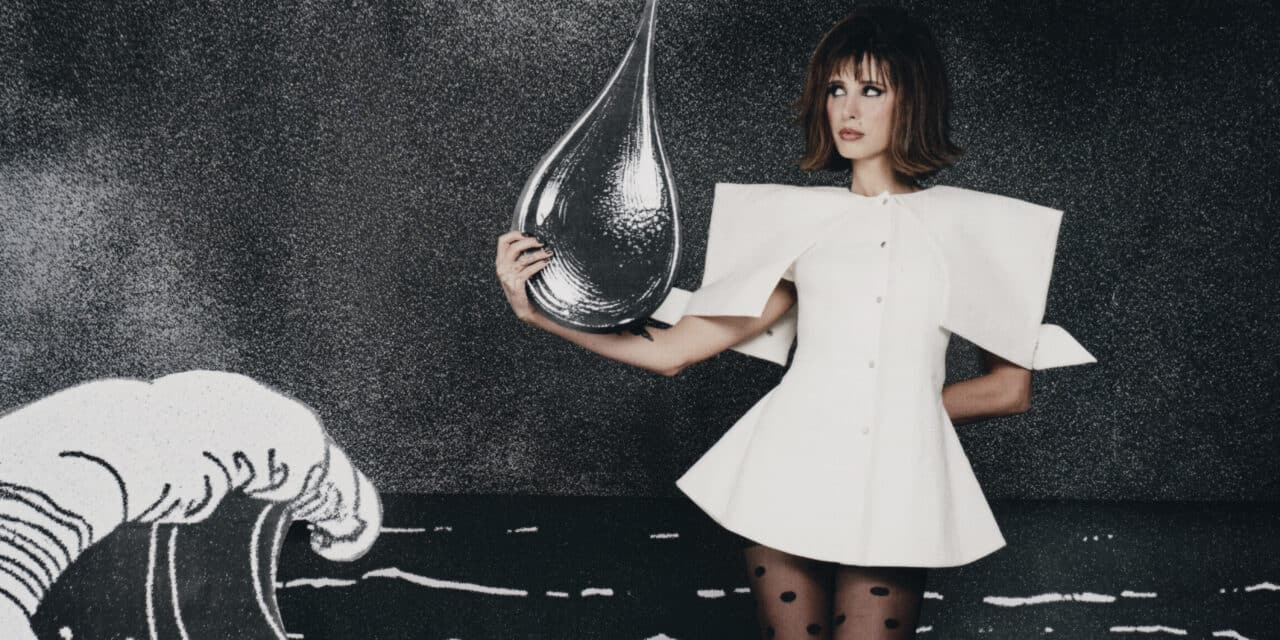
Photo Credit: Stefano Giovanni Giuliano
On “CALL ME,” the Los Angeles artist chooses autonomy without pretending the right decision doesn’t hurt—and turns her music into a physical archive through The Bond St. Bulletin
Most music releases now arrive and disappear through the same screen.
A song drops. A clip circulates. An algorithm decides who sees it. By the following week, everyone is already being encouraged to move on to something else.
Annika Rose wants you to stop scrolling long enough to actually sit with the story.
With her forthcoming EP READ ALL ABOUT IT, the alternative-pop artist is building an era that deliberately pushes against the disposability of digital culture. Alongside each release, Rose writes, prints, and physically distributes The Bond St. Bulletin, her own newspaper exploring the emotional experiences that exist around the songs.
More than 5,000 copies have already made their way into listeners’ hands.
“I’ve realized there are no limitations for creativity,” Rose says. “There are systems in place for how things ‘should be done’ inside of this industry, but at the end of the day it’s ART.”
Her latest single, “CALL ME,” is a fitting opening chapter.
Written with Austin Ward and J Tyler Johnson, the collaborators behind her internet hit “I’M GOOD. I’M GREAT,” the track sits inside a particularly uncomfortable emotional contradiction: caring deeply for someone while knowing that pursuing a relationship with them would compromise an independence you have only recently learned to protect.
After leaving a long-term relationship, Rose found herself discovering who she was without another person defining the edges of her life. Then a close friendship revealed a possible romantic dimension.
“CALL ME” is not about regretting the choice to remain independent.
It is about the grief that can still follow the right decision.
“Sometimes choosing yourself can be just as painful as choosing someone else,” Rose explains.
That emotional ambiguity is exactly where her songwriting thrives. Instead of resolving the situation into a clean breakup narrative or romantic fantasy, she allows the uncertainty to remain. In fact, Rose finds unfinished situations particularly fertile creatively: when there is no definitive ending, the mind keeps rehearsing every possible one.
Writing becomes a way to discover where she actually stands.
“CALL ME felt like an exhale,” she says, “because by the end of writing it I think I understood more of how I actually felt.”
The larger READ ALL ABOUT IT world extends that impulse beyond three-minute songs.
Rose began working professionally in music unusually young, entering the industry at thirteen and signing with Simon Cowell’s Syco Entertainment as part of a girl group before being dropped at fifteen. A succession of deals followed throughout adolescence.
Now 24, she views those experiences less as a conventional cautionary tale than an accelerated education in self-trust.
“Nobody knows better for me than me,” she says. “Nobody is responsible for preserving my curiosity and integrity and passion except for me.”
That philosophy now applies to everything around the music.
Her newspapers turn streaming-era releases into objects. A press conference replaces the predictable listening-party format. Lyrics become reporting from her own interior life. Instead of treating storytelling as packaging around the songs, Rose is asking how far the story can expand once it leaves them.
Mundane spoke with Annika Rose about choosing yourself even when it hurts, rebuilding autonomy after relationships, surviving the music industry from adolescence, challenging the attention economy with physical media, and why she wants her imperfect life documented rather than polished into mythology.
Every era of your career seems to come with its own world-building element, but READ ALL ABOUT IT takes that to another level with The Bond St. Bulletin. What made you decide that this story needed to exist in print as much as it does in music?
I think what the newspapers represent is less about each individual story and more about what they represent on a larger scale.
I’ve been writing these papers for over a year now, unsure of their evolution. It wasn’t until I completed the music for READ ALL ABOUT IT that I decided to stamp them as a part of my artistic identity and really create an impact with them in an obvious sense.
Every song I write comes from a deeply personal experience as I move through the world. Some of those experiences have a hard time just fitting into three minutes.
The contextualization of these stories through print serves as its own medium for storytelling while simultaneously creating an experience people can engage with that forces them to slow down while ingesting art. And forces me to sit inside of my own pain and joy.
And then the real glory of it all is being able to exchange those mutual experiences physically versus digitally.
“CALL ME” isn’t really a love song—it’s about everything that happens after you choose yourself. Do you think we spend enough time talking about the grief that can come with making the right decision?
Oof…!!!! I love this question. And no!!! I don’t think we do.
But maybe that’s okay? Perhaps it’s less about talking about it and more about thoroughly understanding and internalizing it to understand how it affects your operating system.
Most times, at least for me, the harder choice is the more appropriate one—but I really need to understand inside myself WHY it feels so devastating.
Am I upsetting another person? Is the prospect of their upset overriding my ability to choose what feels best for me even if that’s the outcome?
There’s so many things to take into consideration.
I think grief lives on all sides of a decision. Whether it is immediate or imminent or years down the line.
Maybe the real challenge comes from the conversation with yourself in understanding where the grief is rooted.
We could all talk to ourselves more.
You’ve experienced both the traditional major-label system and complete creative independence. Looking back now, what did those early experiences teach you that you couldn’t have learned any other way?
Ooohhhhh!!! Oh man, there’s so many. I’m gonna write a novel in this interview.
Simply put—nobody knows better for me than me. Nobody is responsible for preserving my curiosity and integrity and passion except for me.
Nobody really knows what they’re doing and if they say they do they’re lying.
And the cultivation of self-trust is the most valuable thing I could ever carry. And that only comes from learning the hard way what happens when you overly outsource to other people.
I’m so grateful I started so young. I know how to wear the pants at 24. And I know how to do it with respect and love as the main drivers.
And on top of that, collaboration from a young age is an incredibly valuable skill. You really learn ~people~ if you know what I mean.
I like knowing I can depend on myself but I also like knowing I can allow space for other people to show up as they are and work with that.
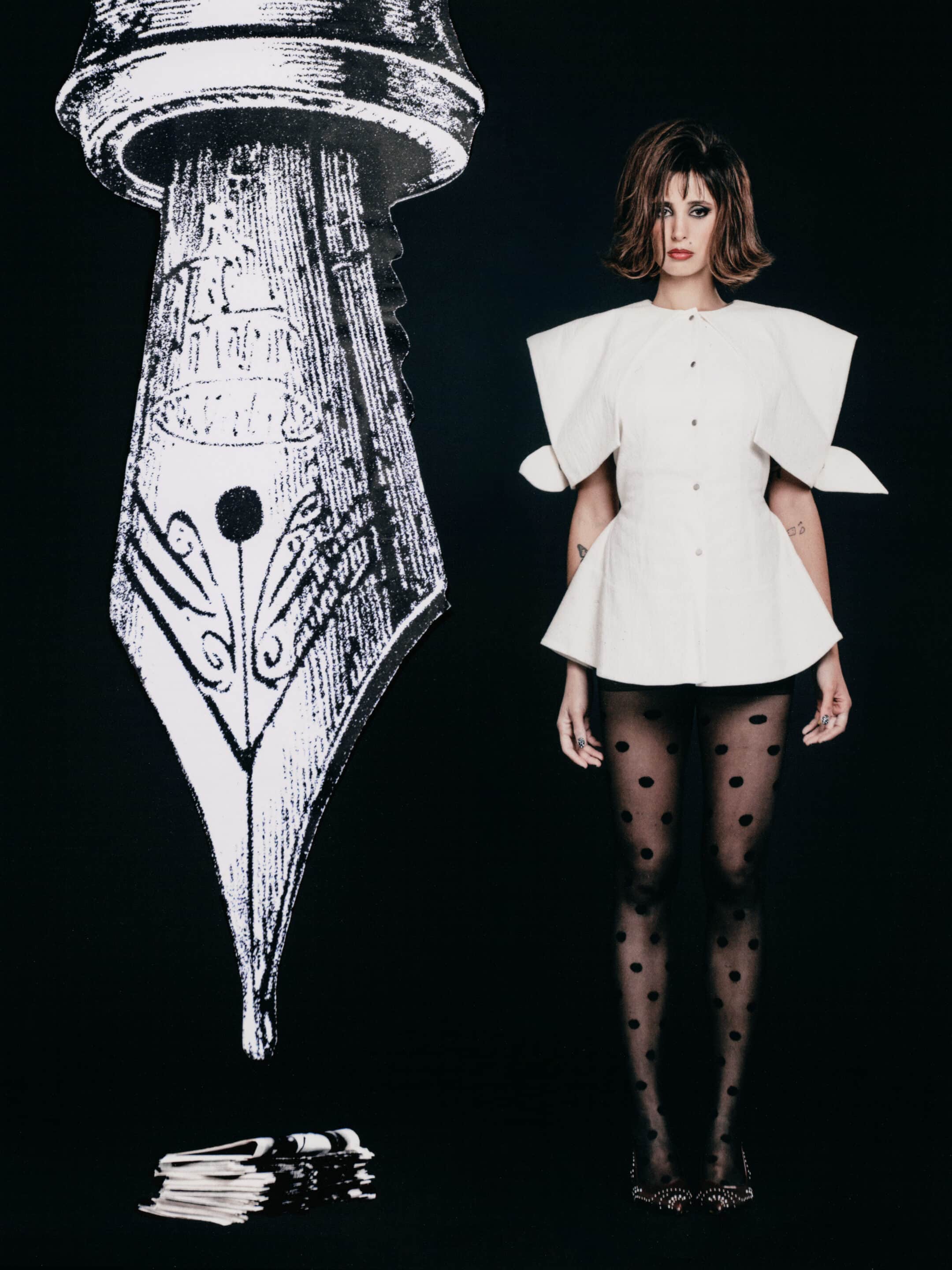
One of the most fascinating things about your work is that you’re asking people to slow down in an industry obsessed with speed. Whether it’s printing newspapers or hosting a press conference instead of a typical release party, do you feel like you’re quietly rebelling against the way music is consumed today?
In a way yes. Though I suppose it might be less of a rebellion and more of a challenge.
I like knowing I do something that tests the attention span of people. And my own too.
Every ink drop is melted onto these pages with intention. It forces me to slow down and think so carefully about how I tell stories through this medium.
And it opens up so many doors in alignment with that narrative that begs for other realms of creativity to surround that “aesthetic,” if you know what I mean.
I’ve realized there are no limitations for creativity. There are systems in place for how things “should be done” inside of this industry, but at the end of the day it’s ART.
Systems and structure are the antithesis of art.
So yeah, fuck the system. There are no rules. The artist is the driver—we write our own rules.
There’s a line between preserving a friendship and risking it for something more, and “CALL ME” lives right in that uncomfortable space. Have you found that the hardest songs to write are the ones without a clear ending?
Hmmm, I actually think they might be the easiest!!!!
When the outcome of a situation is floating in that super uncomfortable liminal space, I think it takes up more brain space and becomes pretty all-consuming.
When I’m bouncing between all these potential outcomes and verdicts and endings and blah blah blah, there’s nothing final to hold onto.
So the words spill out, because it’s almost like you’re trying to land somewhere through a song. Or just dipping in and out of the different possible scenarios.
It’s being worked through in real time.
“CALL ME” felt like an exhale because by the end of writing it I think I understood more of how I actually felt, and maybe didn’t want to, or wasn’t quite ready to admit some of those things before.
You’re not just releasing songs—you’ve created an entire physical archive around your music. Years from now, when someone stumbles across an old copy of The Bond St. Bulletin, what do you hope they understand about this chapter of your life?
Great questions wow.
I would hope they understood how much creating from the heart meant to me.
I would be less focused on what I was particularly going through in each newspaper, but more so I would hope they understand the ethos of why I made them in the first place.
How I really made an effort to create meaning inside of something that has become so passive for most consumers in our culture.
This chapter of my life is built around chasing excitement and following my higher intuition—vulnerability, community, brutal honesty, and creativity. With some humor in there.
I hope that is felt and understood in retrospect.
Alternative pop often balances vulnerability with polished production, but your lyrics feel almost journalistic in their honesty. Has writing the newspaper changed the way you write songs, or do both outlets come from the same creative instinct?
They both come from the same creative instinct.
I never write songs with the newspaper in mind. The music will always lead.
And it’s all the more exciting when the story reveals itself after the songs are written and I know how to use it in the newspaper.
That unraveling is the best part.
Finding disguised storylines inside of the main storyline and expanding on those nuances inside of the paper.
It’s so fun omg—I’m literally just on the ride as I build it.
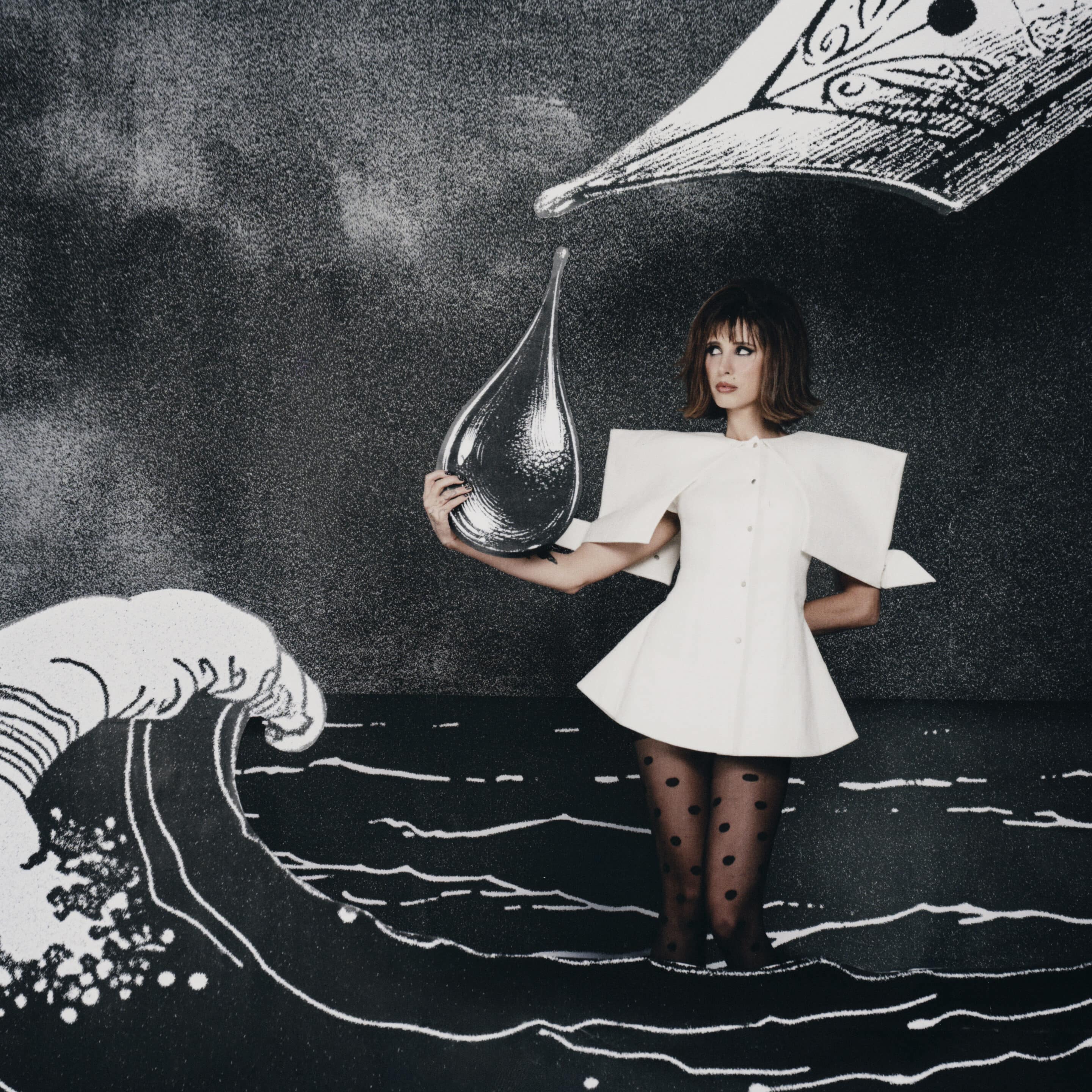
There will be three editions of The Bond St. Bulletin connected to READ ALL ABOUT IT. As each installment expands the story, what do you want the newspapers to reveal that listeners couldn’t necessarily understand from hearing the songs alone?
At the time of our interview, only the first newspaper connected to the EP had been written, with two further editions still to come.
You describe “CALL ME” as existing in the liminal space between protecting your independence and holding onto someone you love. Do you think your definition of love has changed as you’ve become more comfortable with your own autonomy?
Oh ABSOLUTELY.
It was beyond my wildest comprehension that autonomy could exist inside of a partnership as well… I had never experienced that before.
I spent my most formative years in a relationship where I didn’t have enough experience as an isolated unit in adulthood to confidently bring autonomy and independence into a relationship.
It was not their fault either, I was just young and didn’t know any better.
Now having spent a lot of time figuring out how I move when I am not defined by anybody or anything, I know how to preserve my independence and support somebody else’s while being together.
It’s beautiful and the greatest gift I gave to myself.
Which I know now.
You’ve built this era around the idea that stories deserve to be documented, not just consumed. If someone picked up The Bond St. Bulletin ten years from now without knowing who you were, what would you hope they learned about the woman behind the headlines?
I would hope they learned that I am just an imperfect human—talking about my imperfect stories and imperfect experiences in hopes that the honesty the songs and papers carry are enough to feel acceptance inside their own experiences and stories and imperfections.
There is a light when you feel even the tiniest percentage of connection through somebody else sharing their pain and joy and love and loss through whatever medium.
These just happen to be mine.
There is an irony to calling the project READ ALL ABOUT IT while making work that resists the speed and sensationalism usually associated with headlines.
Rose isn’t particularly interested in giving listeners a condensed version of herself.
She is doing almost the opposite.
The song offers one angle. The newspaper opens another. A physical performance adds something streaming cannot. The archive grows slowly enough that meaning has time to accumulate around it.
And perhaps that is why The Bond St. Bulletin matters beyond its novelty.
It turns the usually invisible context surrounding a song into something physical enough to survive the release cycle.
Years from now, the streams will still exist somewhere—or perhaps they won’t. Platforms change. Catalogues migrate. Links die.
Paper has its own fragility, of course.
But somewhere there may still be a folded copy of The Bond St. Bulletin, carrying evidence that Annika Rose was here, trying to make sense of love and independence and growing up in public, one imperfect headline at a time.
“CALL ME” is out now. Annika Rose’s READ ALL ABOUT IT EP arrives October 14 in partnership with Broke Records.