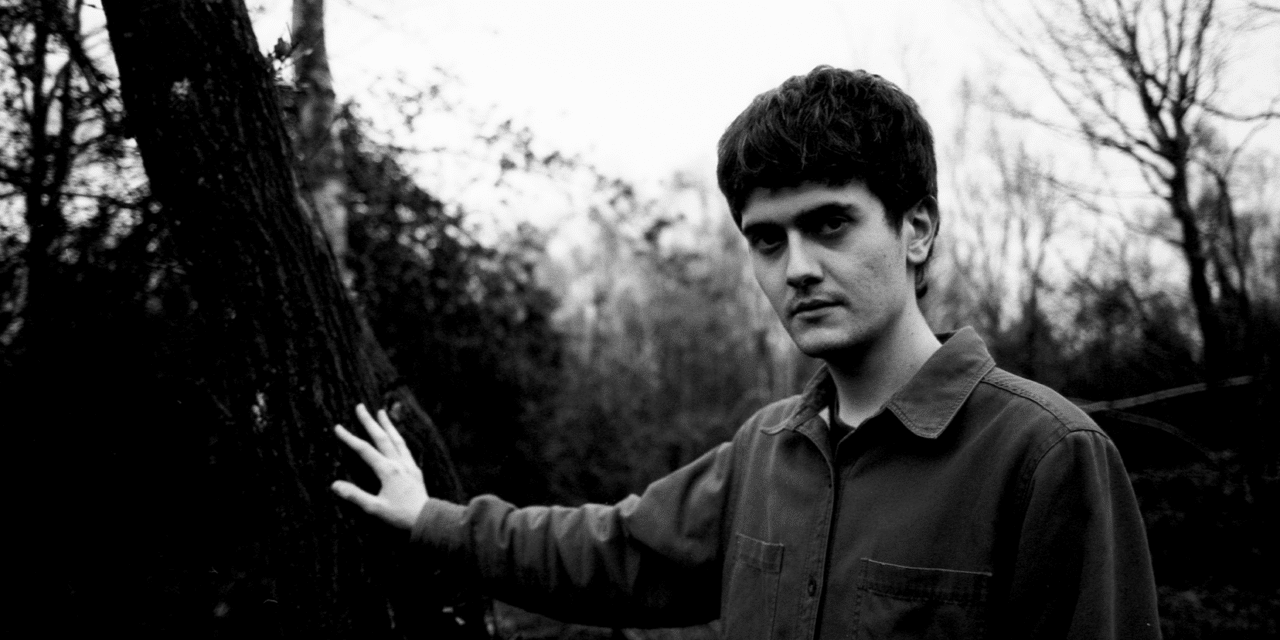
Photo credit Ben Meyer
On his debut album, Blake Watt turns distance, memory, uncertainty, and restraint into a quietly cinematic collection that trusts suggestion more than explanation.
Some records ask to be heard loudly.
The Thread asks for something more difficult: attention.
The debut full-length from Family Stereo, the recording project of 25-year-old singer-songwriter Blake Watt, moves patiently through themes of distance, connection, memory, longing, and uncertainty without rushing to define any of them too clearly.
Released via Bella Union, the album feels less like a sequence of declarations than a series of emotional landscapes.
A place appears.
A feeling enters it.
Then Watt leaves enough room for the listener to decide what happens next.
“I’m interested in conjuring up an image or a feeling, and then just letting it sit there,” he says.
That instinct toward restraint shapes almost every dimension of The Thread.
The arrangements are spacious.
The writing is pared back.
Images are allowed to remain unresolved.
Even when the songs come from something concrete—most notably the long-distance relationship Watt was in while writing much of the record—he resists translating experience into direct explanation.
Instead, he searches for the atmosphere surrounding it.
The vastness.
The waiting.
The physical space between two people and the emotional meanings that accumulate inside it.
For Watt, that is often where the song begins to become interesting.
Letting the record reveal itself
The Thread was not conceived around a single predetermined story.
Watt does not generally begin an album by deciding what it needs to mean.
“I don’t think I really write with a single narrative in mind when I’m starting to create songs for an album,” he explains.
Whatever emotional state he occupies inevitably finds its way into the songs, often subconsciously.
The cohesion comes later.
Production becomes the place where instinct turns into architecture.
“Then I suppose we make more of a conscious decision with the production choices to create a sonic world that feels consistent.”
That distinction helps explain why The Thread feels unified without sounding overly conceptual.
The songs were not forced to address the same subject.
They simply emerged from the same emotional weather.
Then Watt and his collaborators found ways to make that weather audible.
“Remedy” and the power of leaving something unsaid
Final album single “Remedy” might be the clearest example of Watt’s approach.
Built around spare piano and shimmering synth textures from producer Sam Hodder-Williams, the song barely seems interested in announcing itself.
It unfolds.
Slowly.
Carefully.
Its emotional weight comes from control rather than excess.
Watt acknowledges that he has a strong aversion to writing or arranging anything that feels “too on the nose.”
Sometimes, he admits, that instinct may work against him.
But he continues to trust it.
“It always just feels right in the moment to leave a lot of space around things,” he says.
That space is not emptiness.
It is invitation.
Watt is interested in suggesting an image strongly enough that the listener’s imagination begins doing part of the work.
“Our imagination is probably often more powerful than anything art can express,” he says.
If the music can provoke that internal response without spelling everything out, he considers the song successful.
It is a philosophy that feels increasingly countercultural.
The modern attention economy rewards immediacy, overstatement, constant stimulation, and the removal of ambiguity.
Family Stereo does almost the opposite.
The songs trust silence.
Simplicity as resistance
Watt describes his songwriting as increasingly pared back.
“Simple is better,” he has said.
Not simple in the sense of emotionally shallow.
Simple in the sense of removing anything that does not earn its place.
“I love telling a story in the simplest way or conveying a feeling in the simplest way, with not too many frills.”
That minimalism also reflects his relationship with the world outside the songs.
“I feel quite overstimulated by the modern world,” Watt says, “so I like listening to and making music that goes against that.”
In that sense, The Thread is not merely aesthetically restrained.
Its quietness becomes a form of refusal.
It does not compete with noise by becoming louder.
It creates another pace entirely.
Chiseling toward something true
Watt’s influences include Elliott Smith, Neil Young, Adrianne Lenker, and Bob Dylan—writers whose work often finds universality through precision rather than scale.
He is careful not to describe them as templates.
Instead, they establish a standard.
“I am constantly bowled over by the sophistication of their work,” he says.
That admiration pushes him to keep revising.
Early versions of songs may be perfectly acceptable.
That does not mean they are finished.
“I write a lot of stuff that’s fine, but to my ears just not good enough, so I keep chiseling away until I have something that feels profound to me.”
There is another lesson Watt takes from those artists that may be even more important.
They sound as though they are writing for themselves first.
“I really get the sense that all of these writers just make stuff that sounds good to them, with little care to what others might think.”
Watt admits that kind of confidence does not always come naturally.
But it remains an ideal.
From drummer to storyteller
Before guitar and songwriting became central, Watt was a drummer.
He began playing guitar around age 15, gradually moving toward the songs that would eventually shape Family Stereo.
The rhythmic background never disappeared.
It now influences how he hears language.
“The words have to sound good phonetically as well as being meaningful,” he says.
That insistence gives his lyric writing a musical quality beyond literal meaning.
A sentence needs to communicate.
But it also needs to sit correctly in the mouth.
The syllables need to move.
That relationship between rhythm and language is subtle, but it helps explain why Family Stereo’s understated songs can still feel propulsive even when little appears to be happening on the surface.
Landscapes before explanations
The cinematic quality of The Thread is also tied to Watt’s highly visual songwriting process.
“I definitely think visually when I’m writing,” he says.
He needs to picture a place.
Then something emotional emerges from the image.
“A feeling emerges that feels connected to that place somehow.”
This process offers an alternative to literal confession.
Rather than announcing an emotion and building imagery around it, Watt often seems to begin with the landscape and allow the emotional meaning to appear indirectly.
That method suits songs about distance particularly well.
Travel becomes geography and metaphor simultaneously.
A road can be a road.
It can also be separation.
A place can carry memory without anyone explicitly announcing what happened there.
The external world becomes a container for internal uncertainty.
A family full of music, but an identity of his own
Watt grew up surrounded by music.
His parents are Tracey Thorn and Ben Watt of Everything But The Girl, making musical inheritance impossible to pretend away.
But The Thread does not feel preoccupied with proving distance from that history.
Watt seems more interested in the less dramatic problem of trusting himself.
When asked when he stopped worrying about expectations, his answer is refreshingly unresolved.
“I think I still worry about expectations, and have trouble trusting my instincts.”
That uncertainty is not framed as something he has conquered.
“It’s a daily struggle to trust what feels right to me, but I feel like I usually get there in the end.”
That sentence could easily describe the album itself.
The songs rarely begin with certainty.
They move toward something that feels right.
Then they stop.
The geography of a long-distance relationship
Travel and distance recur throughout The Thread because they were not merely abstract concerns.
Watt was writing from inside a long-distance relationship.
But again, he resisted turning the songs into diary entries.
“I guess [I was] not really spelling out how I was feeling,” he says.
Instead, he wanted to capture the scale of separation.
“I was more trying to capture that feeling of vastness between us.”
That choice creates a particular emotional effect.
The listener is not told exactly what to feel about the relationship.
They are placed inside the distance.
The geography does the emotional work.
“That felt more interesting to me than just how I felt day to day.”
Learning to remain uncertain
Perhaps the most striking thing about The Thread is its unwillingness to resolve itself.
Watt does not write from a position of certainty because certainty does not seem especially true to his experience.
“I am quite an uncertain person,” he says.
He questions decisions.
He worries he is doing the wrong thing.
Instead of using songwriting to escape those impulses, he leans deeper into them.
“It’s cathartic for me to try and go deeper into that feeling of uncertainty with my music, to really sit in the discomfort of it.”
Most people spend their lives searching for the opposite.
Certainty promises safety.
It promises resolution.
But Watt finds something creatively useful in recognizing how little can ever truly be guaranteed.
“I think certainty is something we all strive for, but nobody can really be certain about anything in life.”
Then comes the wonderfully contradictory conclusion:
“I want to strive for more uncertainty!”
In Conversation With Family Stereo
MUNDANE: The Thread feels less like a collection of songs and more like a quiet journey through distance, memory, and connection. When did you realize these songs belonged together as a single story rather than individual moments?
BLAKE WATT: I don’t think I really write with a single narrative in mind when I’m starting to create songs for an album.
Whatever state of mind I’m in at the time of writing inevitably just seeps into the music subconsciously.
Then I suppose we make more of a conscious decision with the production choices to create a sonic world that feels consistent.
MUNDANE: “Remedy” says so much through restraint. What attracts you to leaving space in your music instead of filling every moment, and what emotions can silence communicate that words sometimes can’t?
BLAKE WATT: I think I have a real aversion to anything that feels too on the nose.
Sometimes I feel like it may be to my detriment that I avoid saying things outright, but I can’t help it.
It always just feels right in the moment to leave a lot of space around things.
I’m interested in conjuring up an image or a feeling, and then just letting it sit there, and seeing what that does to it.
Our imagination is probably often more powerful than anything art can express, so if my music is provocative in that way, I feel I’m doing something right.
MUNDANE: Simplicity seems to be a guiding principle throughout your songwriting. In an era where bigger often feels synonymous with better, what have you discovered about the power of saying less?
BLAKE WATT: Again, I just write what feels natural, and that seems to be a very pared-back thing.
I also feel quite overstimulated by the modern world, so I like listening to and making music that goes against that.
MUNDANE: Your influences span artists like Elliott Smith, Neil Young, Adrianne Lenker, and Bob Dylan, all known for their ability to make deeply personal songs feel universal. What lessons have you taken from those writers without losing your own voice?
BLAKE WATT: I think these writers just set the bar very high for me.
I am constantly bowled over by the sophistication of their work, and I find them very inspiring.
Early in the writing process for songs, I write a lot of stuff that’s fine, but to my ears just not good enough, so I keep chiseling away until I have something that feels profound to me.
Also I really get the sense that all of these writers just make stuff that sounds good to them, with little care to what others might think.
MUNDANE: You began your musical journey as a drummer before eventually finding songwriting through the guitar. How did changing instruments change the way you think about rhythm, melody, and storytelling?
BLAKE WATT: I think it made me approach lyric writing in a rhythmic sense.
The words have to sound good phonetically as well as being meaningful.
I don’t know if that’s because I used to drum, but it’s very important to me.
MUNDANE: The album has an almost cinematic quality, allowing listeners to drift through landscapes both physical and emotional. Do visual imagery and places naturally come to you while writing, or do those worlds emerge later in the process?
BLAKE WATT: Yes, I definitely think visually when I’m writing.
I have to be able to picture a place, and then an emotion emerges that feels connected to that place somehow.
I also don’t like to write super literal lyrics, so picturing places, or writing in a more abstract sense, is helpful for me.
MUNDANE: Growing up surrounded by music inevitably shapes your relationship with creativity, but you’ve carved out an identity that feels entirely your own. At what point did you stop worrying about expectations and start trusting your own instincts?
BLAKE WATT: I think I still worry about expectations, and have trouble trusting my instincts.
It’s a daily struggle to trust what feels right to me, but I feel like I usually get there in the end.
MUNDANE: Throughout The Thread, travel and distance seem to function as both literal experiences and emotional metaphors. What have movement and change taught you about the idea of home?
BLAKE WATT: Well, I was writing a lot about a long-distance relationship I was in at the time, but I guess not really spelling out how I was feeling.
I was more trying to capture that feeling of vastness between us.
That felt more interesting to me than just how I felt day to day.
MUNDANE: Your songs never rush to provide easy answers—they seem comfortable sitting with uncertainty. Do you think music is more powerful when it asks questions instead of trying to resolve them?
BLAKE WATT: I think generally I am quite an uncertain person.
I have a tendency to not trust my decision making, or feel like I’m doing the wrong thing.
It’s cathartic for me to try and go deeper into that feeling of uncertainty with my music, to really sit in the discomfort of it.
I think certainty is something we all strive for, but nobody can really be certain about anything in life, and to me that’s an interesting dilemma.
I want to strive for more uncertainty!
MUNDANE: The Thread invites listeners to slow down in a world that’s constantly asking us to speed up. If someone listens to the album from beginning to end without distractions, what do you hope they discover about themselves along the way?
BLAKE WATT: I guess I hope that whatever is brewing away in the back of your mind gets poked at slightly.
I never used to like thinking about difficult things, but I find more now that prodding at them and trying to unravel them is a much healthier way to live, to actively work through them.
So I hope that my music prods and wheedles in a productive way.
Striving for More Uncertainty
There is a strange confidence in saying you want more uncertainty.
Not because uncertainty is comfortable.
Watt makes it clear that it is not.
But perhaps certainty is sometimes another way of closing a question too early.
The Thread seems determined to resist that impulse.
Its songs leave emotional doors slightly open.
They suggest rather than explain.
They move through landscapes without insisting on exactly what those landscapes symbolize.
They allow silence to remain part of the arrangement.
And they trust listeners enough to let their own memories enter.
That trust becomes especially significant on a debut.
There is often pressure for a first album to define an artist decisively: here is the sound, here is the identity, here is the statement.
Family Stereo introduces himself differently.
Through restraint.
Through uncertainty.
Through the recognition that some of the most meaningful things may remain partly unresolved.
The title The Thread feels appropriate because the album’s connections are often delicate.
A relationship stretched across geography.
A melody linking one memory to another.
A landscape holding an emotion that cannot quite be said directly.
A rhythmic phrase inherited from years behind a drum kit.
A family history of music existing somewhere behind the present without needing to dominate it.
What connects these songs is not a single story so much as a shared way of paying attention.
Watt wants the listener to slow down long enough for whatever has been “brewing away” in the background to become visible.
To prod at it.
To unravel it.
Not necessarily to solve it.
That distinction is what gives The Thread its quiet power.
The album does not promise clarity.
It offers something potentially more useful:
enough stillness to notice the questions you have been avoiding.