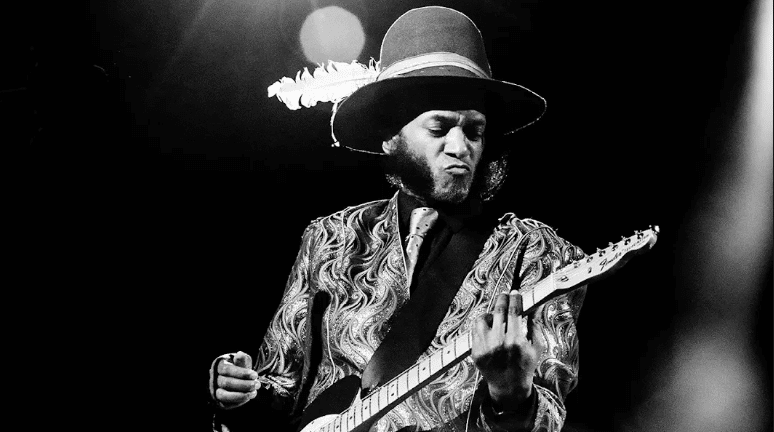
There is something almost rebellious now about leaving the rough edges in.
At a moment when music can be tuned, edited, quantized, optimized, and polished until virtually every trace of accident disappears, Fantastic Negrito is moving in the opposite direction. His new live album, Fantastic Negrito Alive!, out July 17 via Storefront Records, is built around the belief that imperfection isn’t something to correct. It’s often where the life is.
That philosophy comes roaring through new single “Beat Salad,” recorded live in Rubigen, Switzerland. The track behaves exactly as its title suggests: blues, funk, soul, rock, rhythm, instinct, and whatever else happens to enter the room are thrown together without much concern for classification. Rather than controlling every variable, Negrito allows the performance to breathe, stumble, stretch, and surprise itself.
For an artist whose career has consistently resisted easy categorization, that freedom feels especially appropriate. Across three GRAMMY wins, an NPR Tiny Desk Contest victory, festival stages from Glastonbury to Newport Folk Festival, and collaborations spanning Sting, E-40, and Tank and the Bangas, Fantastic Negrito has repeatedly treated roots music less as a museum piece than as raw material.
But Alive! isn’t simply interested in documenting what Fantastic Negrito sounds like onstage. It’s about why live music still matters.
His concerts operate somewhere between gig, gathering, ritual, and what he memorably calls “church without religion.” The crowd isn’t there merely to observe. The band isn’t there simply to reproduce recordings. Something unpredictable is supposed to happen between them, and the exchange itself becomes part of the music. For Negrito, that sense of community isn’t incidental to the performance. It’s the reason for it.
That distinction carries added weight in an increasingly automated cultural landscape. Alive! arrives not as an argument against technology, but as a reminder of what technology cannot fully replicate: a roomful of people reacting to one another in real time, musicians listening and adjusting instinctively, a voice cracking at precisely the right moment, a crowd giving something back.
Fantastic Negrito wanted the album to feel sonically honest—to “stare into your eyes through your ears,” as he puts it—and the simplest route was to remove the safety net altogether.
We spoke with Fantastic Negrito about rejecting perfection, community as an artistic purpose, creating with the wisdom of a grandfather and the freedom of a teenager, surviving an industry obsessed with categorization, and why his most important ambition remains remarkably simple: contribute something.
Fantastic Negrito Alive! captures the raw energy of your live performances instead of chasing studio perfection. What made this the right moment to document your music in its most spontaneous, unfiltered form?
We live in an age of artificial intelligence, perfect pitch, Auto-Tune, and this constant pursuit of the cleanest, most flawless performance. I found myself craving the opposite, which has always been my nature. I wanted to break the surface and get back to something that felt sonically honest, something that embraced imperfection instead of hiding it.
Artistically, I wanted to stare into your eyes through your ears. I wanted the music to penetrate your heart and activate your spirit. I wanted people to feel something real.
So I thought, what’s more honest than just throwing up a few microphones and recording what actually happens on stage? No safety net. No chasing perfection. Just human beings sharing an experience together.
That’s what Alive! is about.
You’ve described your concerts as spaces where the line between performer and audience disappears. What do you think people are searching for in live music today that they can’t find through streaming or social media?
Well, I don’t know what people are searching for. I think it’s different for everybody. Some people are just going to pick up sexual partners. Some people are going to listen to the music. Some people want to be seen. Some people are looking for their spirit to be moved. Some people are going to learn something, and some people are going to burn something.
I don’t really like this idea that everybody’s looking for one thing. Human beings are too complicated for that.
But in the end, I think we all need some of the same basic things. We need food. We need water. We need love. We need hugs. We need pesky little bugs… and so on and so on.
We all want to feel loved, included, and spiritually satisfied. Maybe music is one place where, for a couple of hours, we get a little closer to that.
Throughout Alive!, there’s a strong sense of community—not just between you and your band, but between you and the audience. How important is that shared experience to you, and what do you hope people take away from it?
I think that strong sense of community is the reason why I do this. It’s the reason I’ve played in over 40 countries around the world. I think people understand that’s what Fantastic Negrito is bringing: a sense of community, a sense of purpose. Shake your ass like a tambourine. Open your mind, your heart, and your soul. Share the joy.
There’s nothing unique about it. I think before human beings even had language, they gathered around a fire and celebrated through sound, energy, movement, dance, and purposeful healing. That’s what we’ve always done.
I don’t even know how much of a musician I am. I do it for different reasons. I love playing with really great musicians because they take care of that part. I can take care of the rest.
Every night my job is simple: turn the bullshit into good shit. A celebration. Church without religion.
For 90 minutes, if you come in feeling down, carrying negative energy, we’re going to exercise those demons out of you. My hope is that you leave feeling enlightened, enriched, and a whole lot better than when you walked in.
I get to be a preacher, a teacher, a healer, an emotion-feeler. I can’t believe I’m able to do this. I’m eternally grateful that people have embraced my message and the energy I bring to a live show.
Throughout your career you’ve consistently challenged expectations of what blues and roots music can sound like. How do you honor those traditions while continuing to reinvent them for a new generation?
I think the most important thing is I don’t think about it too much. I don’t overanalyze it. When that creative portal opens up, I just let it happen. I feel like it’s a message from the cosmos, the galactic universe, and I’m just a conduit.
That’s the great thing about being 58 years old and doing this. I don’t have the pressure that pop music people have of being a slave to numbers or trends. I’m just a guy trying to be creative and hopefully be useful to people. Hopefully always contributing.
Roots, blues, soul, jazz, hip-hop, country… this is all a huge part of my existence as a human being. So why overthink it?
I like to create with the wisdom of a grandfather and the creative freedom of a 17-year-old.
Your personal journey has become an essential part of your artistry, but your music never feels defined by your past alone. How has your relationship with storytelling evolved as both a songwriter and performer?
I don’t know if I have the definitive answer to that, but I hope I’m always evolving. I hope I’m always challenging myself, always growing.
I feel most comfortable with what I’ve done creatively when I’m feeling uncomfortable.
It’s a train ride that never ends. It has a few stops, a few transfers, but it never ends. And it shouldn’t.
You’ve often spoken about creating music that feels deeply human in an increasingly algorithm-driven culture. Do you think authenticity has become more valuable precisely because so much of modern life is curated and automated?
I think authenticity is always valuable. Stick to it, no matter what they say. No matter what the numbers say, stick to it.
It’s important in a world where everything is one press of a button away, where we seemingly have access to everything and anything, all the time, anytime. I don’t know if that’s a good thing.
This is precisely why I felt Alive! was an important chapter in my long journey.
From winning the first NPR Tiny Desk Contest to performing at festivals like Glastonbury and collaborating with artists across genres, you’ve built a career on doing things your own way. Looking back, what risks ultimately proved to be the most rewarding?
First of all, I always have to give praise to NPR Tiny Desk. I don’t believe I’d be here without that institution. It changed my life, and I’m forever grateful for what they did for independent artists like me.
I think I’ve probably said this before, but I don’t even know if it was a risk. The greatest decision I ever made was giving up on the idea of trying to be famous or trying to be some big star. I chased all those things when I was in my twenties.
One day I just decided to walk out into the streets and start playing the music and songs that I believed in, the songs I felt were needed at that moment in the Bay Area. I wanted to be a contributor.
When I started that whole journey, people pulled me aside and said, “Hey, you should do neo-soul. You should make something that’s easier for people to digest. You should be this. You should be that.” People always wanted me to star in their fantasy.
So maybe that was the risk. Just being who you are. But first you have to discover who you are, then accept who you are, and then spend the rest of your life trying to improve, failing, winning, learning… all of the above.
Music has always had the power to bring people together across cultures, generations, and backgrounds. After touring the world, what have your travels taught you about the things that unite us?
This is a good question. It’s a recurring theme throughout the globe. What brings us together? What tears us apart? Don’t we live in some of the most polarizing times ever? Or does it just feel that way because we’re living in the moment?
The thing I’ve learned is that it doesn’t matter what your political or religious affiliation is, your sexual orientation, the color of your skin, the size of your feet, how big your head is, or how small your hands are. The most important thing is how big and open your heart is. That cures everything. That smashes down all barriers.
I really try to lean into that. I’ve learned that the more open my heart is, the more I let down my own barriers, especially when I’m performing live. Then it becomes a delight, a wonderment, a wonderfully peculiar, whimsical, spiritually satisfying 90 minutes for everyone involved: the band, the audience, the sound engineer, the crew, everybody.
One of my favorite things is when the crew and the festival staff want to buy an album or a T-shirt after the show. Those are the people who see everything. They’ve seen every artist, every performance, every night. So when something moves them enough that they want to take a piece of it home, that means the world to me.
Mostly, I’ve learned to be grateful. Grateful for being there and respectful of the craft. Writing songs and being true to the art form has become an international passport for me.
I’m grateful that this is my life, and I get to share it with you.
Music has always been a reflection of the times. As someone who has never been afraid to tackle difficult subjects, what responsibility, if any, do artists have in helping people navigate today’s world?
I’ve heard this sentiment my entire life. I have control over me, and that’s a big job. I have to worry about the choices I make. It’s hard to judge what other people should be doing when it’s challenging enough just making sure you’re doing the right thing yourself.
I know what I should do. I know the responsibility I feel as an artist, and I always come back to one word: contributing. I use that word all the time because it’s such a powerful, undefeated word. You can’t lose with that word.
All I can do is be an example of how I think human beings should conduct themselves as artists walking this planet. Engaging. Entertaining. Challenging. Healing. Celebrating. All the good things. The sweet spots.
Looking ahead, what continues to inspire you creatively, and what do you hope audiences will discover in the next chapter of Fantastic Negrito?
Right now I’m in the chapter of Alive! I think I’ll be in this chapter for a little while. It is the most engaging, authentic, blistering chapter of my career so far.
The first time I put this album on, I kind of looked around the room, looked to the left, looked to the right, and I found something deep. I felt something profoundly engaging. I felt something that moved me. As an artist, that’s what I’m here for. Inspiration.
I hope this chapter inspires people to make something happen. Make up your mind. Make your bed. Make a sandwich. Make a baby. Just make something.