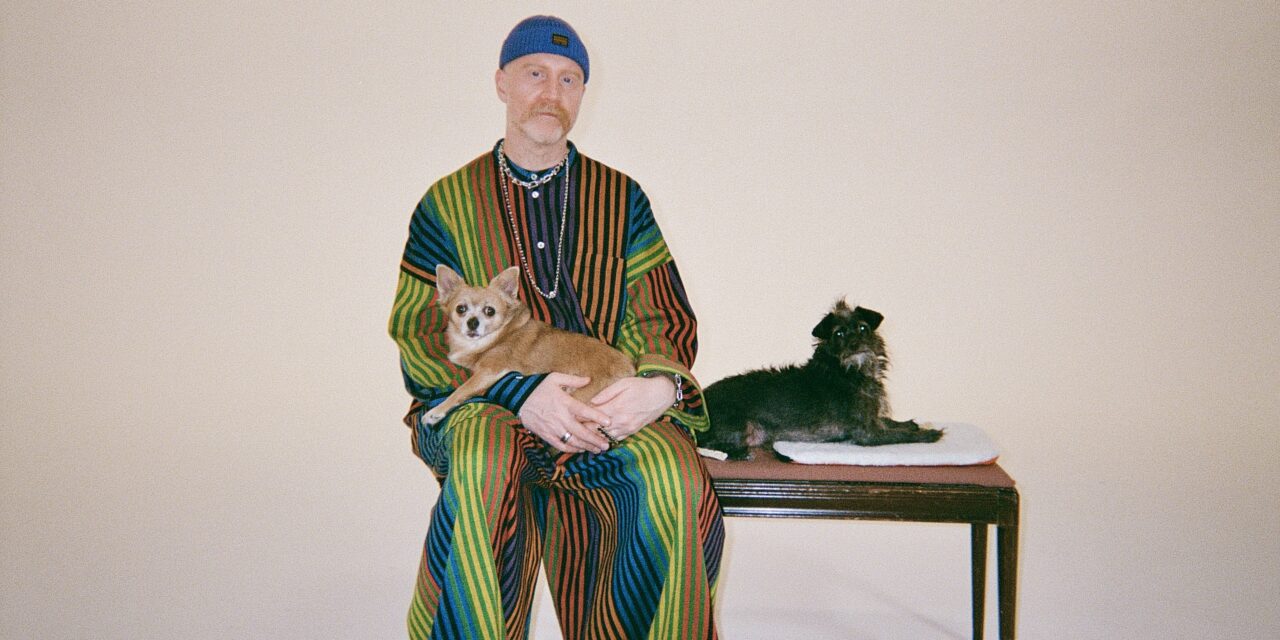
There are retrospectives designed to celebrate a career, and then there are projects that force an artist to confront the life underneath it.
For Logan Lynn, The Pain and The Power is the latter.
Directed by Cai Indermaur, the documentary traces nearly three decades of Lynn’s life and work across queerness, fundamentalist Christianity, addiction, trauma, recovery, activism, music, and reinvention. It is not structured as a clean redemption story, nor does it attempt to turn survival into something tidy. Instead, it looks directly at the contradictory reality of becoming someone new while still carrying every version of yourself that came before.
The project arrives alongside an original motion picture soundtrack of the same name, out September 4 through PortuGAY, the LGBTQ+ division of Portugal. The Man’s KNIK Records. The pairing feels essential. Music is not simply used to underline what happens onscreen; it operates as another narrator, carrying emotions that resist being explained through interview footage alone.
Early singles “The Cocaine Scene” and “Too Hard” immediately establish the terrain. They deal with addiction, exhaustion, detachment, and the strange intimacy that can develop between a person and the very thing destroying them. Yet, as with much of Lynn’s work, darkness rarely arrives without humor, movement, provocation, or some stubborn refusal to surrender joy.
That tension runs throughout The Pain and The Power. Lynn’s story includes religious trauma, abuse, sixteen years of addiction, career highs, public collapse, fractured relationships, recovery, and the long work of rebuilding. But the film is ultimately less interested in cataloging damage than in asking what happens after it.
What do you keep?
What do you release?
And who are you when identities that once kept you alive no longer fit?
For Lynn, the answer seems increasingly rooted in community. Friends, mentors, chosen family, queer creatives, recovery, his partner, his dogs, and music itself became part of a foundation strong enough to replace the one that fell apart. Even revisiting archival footage from years Lynn barely remembers became unexpectedly freeing; once those experiences were placed inside the film, they finally had a container.
That willingness to look directly at the past also reflects Lynn’s evolution as an activist. Where he once viewed advocacy partly through the language of answers, he now seems more interested in creating space for questions, recognition, and connection. His work doesn’t insist on telling audiences what to think. It asks whether telling the truth might be enough to make someone else feel less alone.
And perhaps that is the real power inside The Pain and The Power: not overcoming the past, but refusing to let it dictate what comes next.
We spoke with Logan Lynn about opening his archives, watching footage from years lost to addiction, queer survival, why humor and grief belong beside one another, the importance of creative ownership, and why truth may be one of the most radical forms of freedom available to us.
The Pain and The Power feels like much more than a documentary—it plays like a deeply personal reflection on identity, survival, and reinvention. What made this the right moment to tell your story so openly?
I don’t know that there ever is a “right” moment to tell a story like this. For a long time I thought I had to wait until everything made sense or until I’d somehow figured life out, but healing doesn’t really work that way. It’s ongoing.
At some point I realized the story wasn’t about arriving at some perfect ending, but rather that it was about showing what it actually looks like to keep choosing life, even when it’s messy.
When the opportunity presented itself by way of Portugal. The Man, and because I had this existing friendship with Cai Indermaur, the idea of opening the vault and the archives felt safe somehow.
I figure the danger is there whether I speak this truth out loud or not. I would rather people understand what happened along the way, how I got here, than try and protect some bullshit optics around my life or my career.
It is what it is, and now what it is, is a movie.
The film explores the intersections of queerness, faith, addiction, trauma, and recovery. Were there parts of your journey that were especially difficult to revisit, and did making the film ultimately change your relationship with those experiences?
Absolutely. There were moments I hadn’t looked at in years because survival required me to keep moving. Sitting with old footage, journals, music, and memories forced me to see those versions of myself with a lot more compassion than I had before.
Recovery teaches you that shame loses its power when it’s brought into the light. Making the film didn’t erase the shame of some of my experiences, but it helped me stop seeing those moments as things that happened to me and start recognizing them as part of how I became who I am.
I was high for sixteen years. Barely remember any of that…so seeing the footage from my addiction was really me experiencing myself during that era for the first time.
Pretty wild. So much cringe. But also freeing somehow.
It has a container now. All of it.
Music has always been central to your career, but in this project it becomes a character in its own right rather than simply a soundtrack. How did you approach creating songs that could carry the emotional weight of the film itself?
I didn’t want the songs to explain the movie. I wanted them to expand it.
Some of these tracks come from places that are too complicated for dialogue. Music has always been where I tell the truth first, and easiest.
The soundtrack became another voice in the conversation; a way to express grief, anger, hope, and joy in ways that words alone sometimes can’t—or at least I am not always able to.
You’ve spent nearly three decades evolving as both an artist and an activist. Looking back, how has your understanding of what it means to use art as a form of advocacy changed over the years?
When I was younger, I thought advocacy meant having the answers. Now I think it’s much more about asking honest questions and creating spaces where people feel seen, heard, or appreciated.
Art doesn’t have to tell people what to think. Mine certainly isn’t designed for that. Never has been.
Sometimes music’s greatest power is simply reminding someone they’re not the only person who’s ever felt this way.
If I have managed to do that from time to time with folks, I take that as a win.
Your work has consistently balanced vulnerability with irreverence, often finding moments of joy alongside difficult subject matter. Why has humor remained such an important part of the way you tell your story?
Because that’s what being alive feels like.
Even in the darkest parts of my life, people were still laughing. We were still making each other dinner. We were still dancing.
Joy isn’t the opposite of grief; it exists right beside it.
Humor has always been one of the ways I’ve survived, and I think that’s true for a lot of queer and trans people.
We laugh and we dance because otherwise, we die. And fuck that shit.
The release of this film under PortuGAY, the LGBTQ+ imprint from Portugal. The Man’s KNIK Records, feels symbolic of a new space dedicated to queer storytelling. What does it mean to be part of a platform that prioritizes these voices at a time when representation continues to evolve?
It feels incredibly meaningful because PortuGAY isn’t just about representation. The label is about ownership.
Queer artists deserve the opportunity to tell our own stories on our own terms. Portugal. The Man has always understood that community is something you build, not something you market.
To be able to release this project within that family feels deeply aligned with everything the film stands for.
I love John and Portugal. The Man has been my chosen family for a decade. It feels right for them to be putting this out.
John gave me a chance many years ago to become something new. This is still that, all these years later.
Throughout your career you’ve refused to separate your personal life from your creative work. Do you believe audiences connect more deeply with artists today because they’re willing to embrace that kind of honesty?
I think people have an incredible radar for authenticity. They don’t expect perfection anymore; they expect humanity.
I’ve never been interested in pretending I’ve got it all figured out. If someone sees themselves in my story, that’s infinitely more valuable than trying to appear flawless.
I was never any good at flawless, never any good at public image. You either vibe with me or you don’t. Take it or leave it.
I’ve always been too fucked up to be anything but myself.
The title The Pain and The Power suggests that resilience isn’t about erasing hardship but transforming it. What have been the most unexpected sources of strength throughout your life and career?
Community, without question.
The people who refused to give up on me when I had every reason to give up on myself are why I am still here. Recovery taught me that healing isn’t something we accomplish alone.
Love showed up in places I never expected—in friends, mentors, strangers, my dogs, my partner, music.
Those relationships became the foundation I built a new life on.
It took me over a decade to stop waiting for the bottom to fall out, but it never did.
Love saved me, over and over, and I guess I still feel surprised by that.
You’ve witnessed enormous changes in both queer culture and the music industry over the past 30 years. What gives you hope when you look at the next generation of LGBTQ+ artists finding their voices today?
Queer and trans artists are far less interested in fitting into boxes than my generation was forced to be.
They’re making work that’s unapologetically gay, joyful, political, vulnerable—all at once. And in the mainstream!
Even as we see backlash against our communities, I also see young artists refusing to disappear. That’s incredibly hopeful to me.
Visibility has always been an act of courage.
I came up in the music industry during a time where it was not cool to be out. It’s cool now and I fucking love that.
This documentary feels like both a retrospective and the beginning of a new chapter. After audiences experience the film and its companion album, what do you hope they understand—not only about Logan Lynn, but about the universal power of healing, self-acceptance, and choosing to keep going?
I honestly hope they leave thinking less about me than about themselves.
This film isn’t really about my life—it’s about what we do with the lives we’ve been given.
Every one of us carries pain. Every one of us has the capacity to transform it into something meaningful.
If someone walks away believing that they’re still worthy of love, that their story isn’t over, and that healing is possible even if it isn’t linear, then this project has done exactly what I hoped it would.
Also for my family, making this film has facilitated a type of closeness I did not think was possible, even after coming back together many years ago.
Truth is magic. Love is magic.
My hope is that some of that magic rubs off on people as they watch the movie.
![meg elsier Returns with New Single “sportscar [scrapped]” & ‘spittake’ Deluxe LP](https://mundanemag.com/wp-content/uploads/2025/07/1644_0005-440x264.jpg)