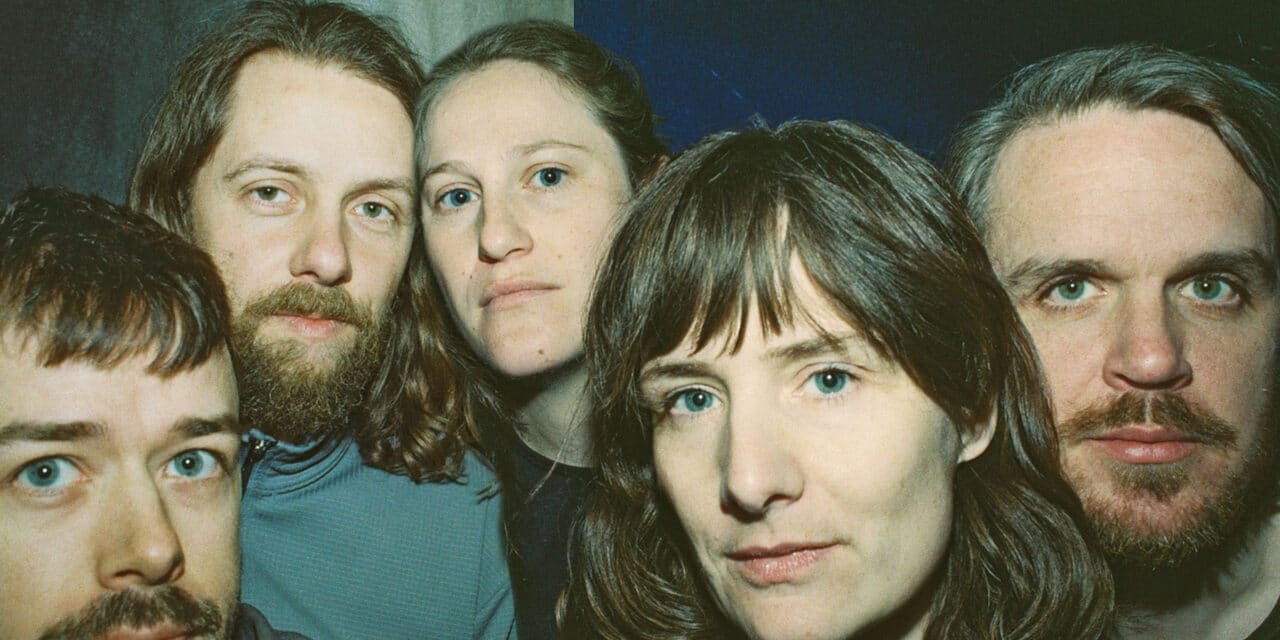
Credit: Herup Mørck
The Danish quintet return with their fourth album, a self-produced meditation on vulnerability, parenthood, uncertainty, and the radical act of staying emotionally open
There is something quietly defiant about naming an album Softy in 2026.
For Danish quintet Lowly, softness is not passivity. It is not weakness, retreat, or naivety. It is a survival strategy.
Their fourth studio album, Softy, due October 30 via Bella Union, finds Nanna Schannong, Soffie Viemose, Kasper Staub, Thomas Lund, and Steffen Lundtoft returning to the most instinctive version of their creative process: getting in a room together, listening closely, and trusting each other enough to let the music remain exposed.
That simplicity became necessary.
After more than a decade as a band, the five members now live across different parts of Denmark, balancing families, careers, parenthood, and increasingly crowded nervous systems. Rather than disguising those limitations behind excessive production, Lowly decided to let them shape the record.
“We had to keep it simple because practically we are living in separate parts of Denmark, with busy schedules and pressed nervous systems,” the band explains.
For the first time, they also chose to self-produce.
That decision gives Softy a different kind of intimacy. The record still carries the expansive dream-pop, electronic detail, restless rhythm, and unusual harmonic language that has defined Lowly’s work, but there is less distance between the people making the songs and the emotions inside them.
Nothing feels overly protected.
The title track makes that philosophy explicit. Propulsive and gradually danceable, “Softy” layers airy vocals, restless percussion, and americana-adjacent guitars around an idea that initially sounds contradictory: emotional resilience may depend not on hardening yourself, but on remaining flexible.
“If your layer’s too thin, just flow / If it’s ripping your skin, just flow / Let the rubbles within just flow,” Nanna sings.
The song is simultaneously about giving and taking, parenthood and partnership, dependency and exhaustion. It understands that love can ask enormous things of people already operating at their limits.
That tension echoes throughout the album.
Across ten tracks, Softy turns toward parenthood, family, grief, courage, and the difficulty of caring for the world without being consumed by it. Personal intimacy is repeatedly interrupted by the violence and instability outside the home. Rather than trying to resolve those contradictions, Lowly allow them to sit beside one another.
One of the album’s most revealing moments emerged from something painfully ordinary: putting a child to sleep while doomscrolling.
A member of the band recalls sitting beside their one-year-old daughter, one hand resting on her stomach while the other held a phone. Then, amid the endless stream of social media, an image of a dead child in Gaza appeared.
“The two children suddenly [were] within the same circumference,” they recall.
That collapse of distance became difficult to process. How do you protect the intimacy of your own home while remaining emotionally present to suffering elsewhere? When does exposure create awareness, and when does it make us numb? How do you care for your child, your community, and people thousands of miles away without turning empathy itself into another impossible demand?
Softy does not pretend to have the answers.
In fact, uncertainty may be one of its defining emotional states.
Lowly have always made music that resists arriving exactly where you expect. Songs stretch, redirect themselves, and often reveal their emotional center slowly. In a culture increasingly built around instant hooks and immediate payoff, that patience feels almost stubborn.
But the band laugh at the suggestion that it is some deliberate rebellion.
“We try and try to fit into the pop box, but it just won’t happen!”
Maybe that inability to fit is exactly why Softy works.
Mundane spoke with Lowly about vulnerability as strength, self-producing for the first time, parenthood in an unstable world, the blurred boundaries between private and global grief, and why sometimes the most courageous thing you can do is refuse to become harder.
Softy feels like an album that embraces vulnerability rather than resisting it. In a world that often rewards emotional armor, what inspired you to make softness the defining theme of this new chapter?
I think because we are a bit stretched thin and thin-skinned and it wouldn’t be possible for us to be like, yeah we’re pushing through the pain! It wouldn’t be an honest representation of us, and it also is not what we believe in.
Sensitivity has proven to be the only thing keeping this world together.
For the first time, you chose to self-produce an album instead of relying on an outside producer. How did taking complete ownership of the creative process change the way you trusted yourselves—and each other?
We’ve all sort of established lives and families and separate careers in the period of being a band together, and to be each other’s life witnesses like that also means you learn to respect and understand each other’s choices and motivations.
I think this time we’ve really been leaning into each other’s capacities, and there’s been a lot of trust in being able to leave things to someone else when it mattered more to them.
It’s been a kind of exchange, where who took the lead would shift depending on who felt most strongly about something.
And it has felt really satisfying to trust that and experience what we are capable of together.
Your music has always lived somewhere between dream-pop, electronic textures, and organic instrumentation, but Softy feels even more expansive and human. Were there any rules you deliberately broke while making this record?
The circumstances surrounding the record were both emotional and pragmatic.
We had to keep it simple because practically we are living in separate parts of Denmark, with busy schedules and pressed nervous systems. So this was what was possible.
At the same time we also wanted it to be very clear in its expression, not polishing anything up, reflecting the fact that the world is going to shit at the moment and wanting to hold up a mirror to that somehow.
And also talking about very personal stuff that feels important to share in an unfiltered way.
Parenthood, family, love, and loss all run through the album, yet the songs never feel heavy for the sake of being heavy. How do you balance emotional honesty with the sense of hope that seems to exist underneath these stories?
I think writing about tragedy in a humorous way or describing the beauty of sorrow has always been quite important to us.
If you just describe darkness in dark tones, it doesn’t stand out or make you feel anything.
It’s the contrasts that are part of human nature and also they’re more interesting to write about.
The title track suggests that emotional resilience isn’t about becoming stronger, but about remaining open despite everything life throws at you. Has your definition of strength changed over the years?
Yes I think so, I think I’ve become more open about what I’m afraid of, and displaying vulnerability has maybe become a new definition of strength for me.
Strength is also knowing what your body and mind are capable of, and learning to say no to things that are not sustainable.
Maybe because we all have kids now that rely on us, we’ve become better at taking care of ourselves.
Brian Eno has publicly praised your previous work, and you’ve steadily built a reputation for creating immersive sonic worlds. Do you think about your music as storytelling, world-building, or something closer to emotional architecture?
All of the above!
I love the storytelling part! I am a total geek when it comes to words, abstractions and punchlines.
I also love a good, well-crafted pop song where the chorus hits you smack in the heart right when the most emotional lyric also hits, and the sub bass plays the sixth of the chord and you explode in harmonic ecstasy!
I think sonically we are all very curious, we like a lot of synthesisers, guitar pedals and funny chord progressions that can take you on a journey.
And also: thank you, Brian, for the praise. We love you and we’re ready to collab when you are!
Much of Softy was created by simply getting back into a room together and making music face-to-face. After more than a decade as a band, what did returning to that instinctive process remind you about why Lowly exists?
We started playing together as friends who didn’t know each other very well, but were fans of each other’s way of playing, and I think I was reminded why I’m a fan of the other four.
They are all fascinating musicians, always exploring the limits of their instruments.
Throughout the album, there’s a recurring tension between personal intimacy and the uncertainty of the world outside. How much of this record became a response to the current moment, and how much was simply a reflection of where you all are in life?
I had this experience where I was putting my one-year-old at the time to sleep.
As it was normally a very long and tedious process, I tended to sit there in the dark and doomscroll on Instagram while having one hand on my daughter’s belly and the other holding the phone.
And then one evening, among all the trash of the internet, a dead child from Gaza appeared on my screen and I just felt like this was an insane situation, where distances to things that mean a lot to me were dissolved.
The two children suddenly within the same circumference.
I swiped the dead child away and looked at my living child trying to grasp what that feeling was. I am still very confused about it.
It’s sort of a breach of intimacy that we allow to happen daily. And we are becoming more and more cynical and numb to this exposure.
We mustn’t close our eyes to the fact that a genocide is happening, but we also have to shut it off sometimes.
We should write about it, but it can also be relevant to write about how it is to feel like an insufficient parent in a privileged society.
I should put question marks after all these sentences, because I am not so certain of how to deal with it.
However, the juxtaposition or displacement of where you address your concern, and how to navigate caring about what is closest to you at the same time as caring and hurting for a people or a community, is very interesting to me, but also confusing and filled with guilt and insecurities.
Many of the lyrics are shaped by this.
Your songs often reward patience, unfolding slowly before revealing their emotional payoff. In an era of instant gratification and short attention spans, do you see that as a quiet act of rebellion?
We try and try to fit into the pop box, but it just won’t happen! Haha.
No, I think we like this type of music where you don’t know what to expect, so naturally that’s what we gravitate towards.
If Softy could leave listeners with one lasting feeling after the final song fades out, what do you hope they carry with them into their everyday lives?
Ok speaking of the final song. When I realised what the meaning of the lyrics were, I was reading them as we were recording, I just broke down.
And I haven’t been able to re-record the lead again. So the vocals on the record are actually the cue takes, where I’m trying to keep it together.
Kasper wrote those lyrics and it’s for his son, from an experience of standing with him in a shed during a rainstorm, and he tells him:
Don’t be like the constant pillar holding the ceiling
Be like the changeable clouds
I hope that people take this with them, that they shouldn’t carry the world on their shoulders, and that they should be able to be whoever they want. And live without fearing for their lives.
Maybe after they’ve heard the album, they’ll also want to express their anger at the inequalities of the world, call their local politicians about trans rights or join an anti-war demonstration.
Or maybe they’ll just feel seen and resonate with the way we document our frustrations and limitations.
I would be honored by that.
The image Lowly leave us with is not one of endurance through rigidity.
It is a cloud.
Changeable. Unfixed. Unable to hold up a ceiling because it was never meant to.
That may be the clearest expression of what Softy is ultimately reaching toward. In a period defined by pressure—from parenthood, politics, technology, grief, expectation, and the impossible demand to absorb suffering from everywhere at once—Lowly are asking whether strength might look less like carrying everything and more like learning what you can put down.
Not indifference.
Not disengagement.
Just enough softness to remain human.
Lowly’s Softy arrives October 30 via Bella Union.