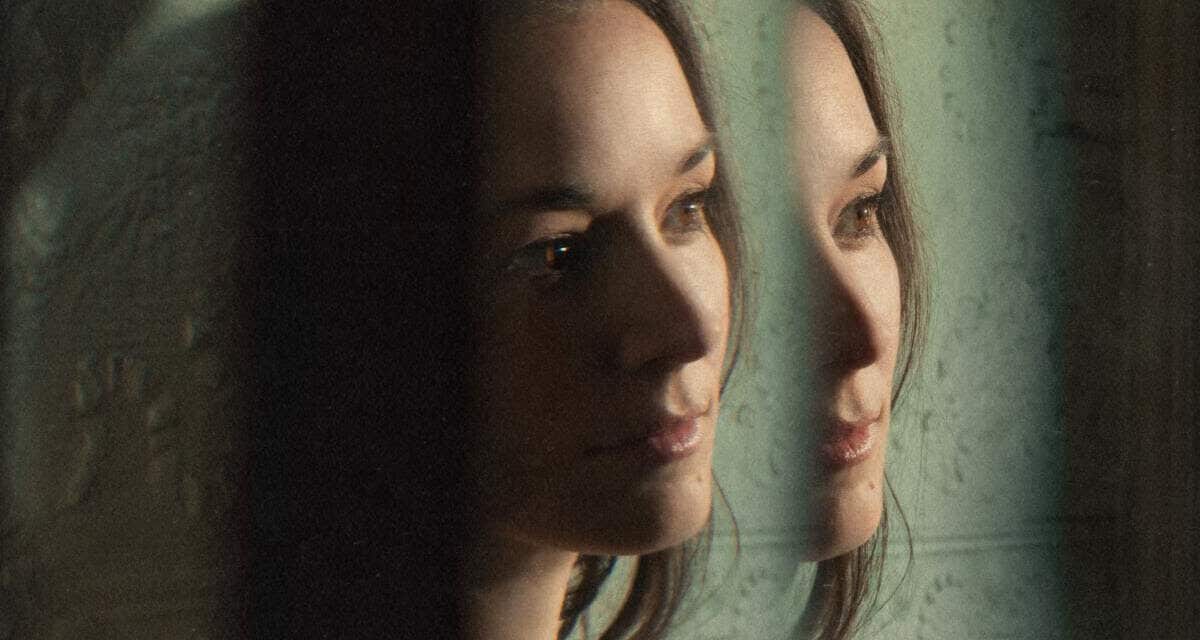
On her fourth album, produced by Joe Henry, Glaspy steps away from the digital noise and toward something more instinctive—an intimate meditation on contradiction, presence, artistic purpose and the freedom of refusing to make yourself easily understood.
Margaret Glaspy has little interest in making herself easier to categorize.
On I Am Both, her fourth full-length album, the New York-based singer-songwriter embraces the grey areas instead: the distance between who we are and how we are perceived, between personal introspection and engagement with the world, between structure and improvisation, and between making art as a career and making it because the act itself feels necessary.
Released August 7 via ATO Records and produced by three-time Grammy winner Joe Henry, I Am Both arrives after Glaspy made one deceptively simple but transformative change to her life: she stepped away from social media.
The result wasn’t merely more time to write. Glaspy describes the decision as fundamentally changing the way she experienced her own mind.
“It felt like I woke up from a deep sleep of self awareness and fear that I voluntarily chose everyday.”
Without the constant influx of opinions, comparisons and algorithmically organized information, she found herself returning to what she describes as “original thought.” Songwriting became richer. Her curiosity returned. Most strikingly, she says she began to “feel like a child again in all the good ways.”
That rediscovery is everywhere on I Am Both.
Escaping the pressure to make sense
The album’s title initially sounds like a declaration: an insistence that two seemingly incompatible truths can coexist.
But Glaspy is resistant to turning that idea into too neat a thesis.
Asked whether making the record was an exercise in embracing contradiction, she offers a subtly different explanation.
“I’m not sure that I was trying to embrace contradiction as much as I was just letting myself do my work without taking into account what would be appealing or make sense to others.”
That distinction gets to the heart of I Am Both.
The complexity wasn’t manufactured as a concept. It emerged when Glaspy stopped anticipating how the work might be received.
The title track itself is based around a female character Glaspy admires: someone capable of containing multitudes while still seeing reality clearly. It reflects Glaspy’s growing understanding that although categorizing ourselves can temporarily feel safer, accepting our own complexity might ultimately be far healthier.
It is also difficult not to connect that philosophy to her retreat from social media.
For Glaspy, digital culture doesn’t simply distract. It can actively encourage us to understand ourselves through categories.
“We are all just here with all kinds of grey area,” she says, “but I think it’s possible that the pedestal on which we place our devices and technology could be very problematic in our ability to be at peace with our own contradictions.”
She points toward a “digital frequency” that aggregates people into identifiable groups. I Am Both pushes in the opposite direction.
It leaves room for mess.
Getting the practice back
Glaspy began the album with what she calls a goal of getting her “practice back.”
She wrote lyrics longhand before refining them on a typewriter, deliberately slowing down a process taking place within a culture increasingly obsessed with speed. After breaking from social media, she discovered a sustained creative momentum that ultimately produced songs spanning fictional narratives, personal revelations and observations of a world increasingly difficult to ignore.
For someone who released her acclaimed debut Emotions and Math in 2016, the process wasn’t about learning how to become a songwriter. It was about returning to the conditions that allowed her to feel like one.
And when the songs were ready, she approached recording with a similarly immediate philosophy.
I Am Both was recorded during just three days at New York City’s Reservoir Studios with drummer and percussionist Jay Bellerose, keyboardist Patrick Warren and bassist Ross Gallagher, alongside Henry.
Glaspy describes herself in the studio as more photographer than sculptor.
Rather than assembling songs layer by layer until every detail reaches some imagined state of perfection, she wants to capture what happens when musicians enter a room and react to one another.
Many of the performances on I Am Both are first takes.
“Making live music with others is also an acceptance of what is rather than what you thought it was,” Glaspy explains. “If you are lucky, you realize that what it IS is much cooler than anything you could think up.”
It is an idea that extends far beyond recording technique.
Accepting what exists rather than forcing it toward a predetermined ideal could almost serve as the album’s wider philosophy.
Capturing rather than constructing
Joe Henry was particularly suited to that approach.
Glaspy first connected with Henry at a T Bone Burnett-curated Bob Dylan tribute at New York’s Town Hall in 2022, and their eventual collaboration feels less like a producer being brought in to reshape an artist than two musicians discovering a shared language.
Glaspy pushes back against the suggestion that Henry’s role was to teach her to trust instincts she hadn’t trusted before.
“I don’t think I ever lacked trust in myself,” she says.
Instead, the relationship is more personal.
“I just love Joe Henry and he is like family to me. If I’m honest, I love being around him and I love trying to impress him.”
That affection is important because I Am Both depends upon vulnerability without overworking it.
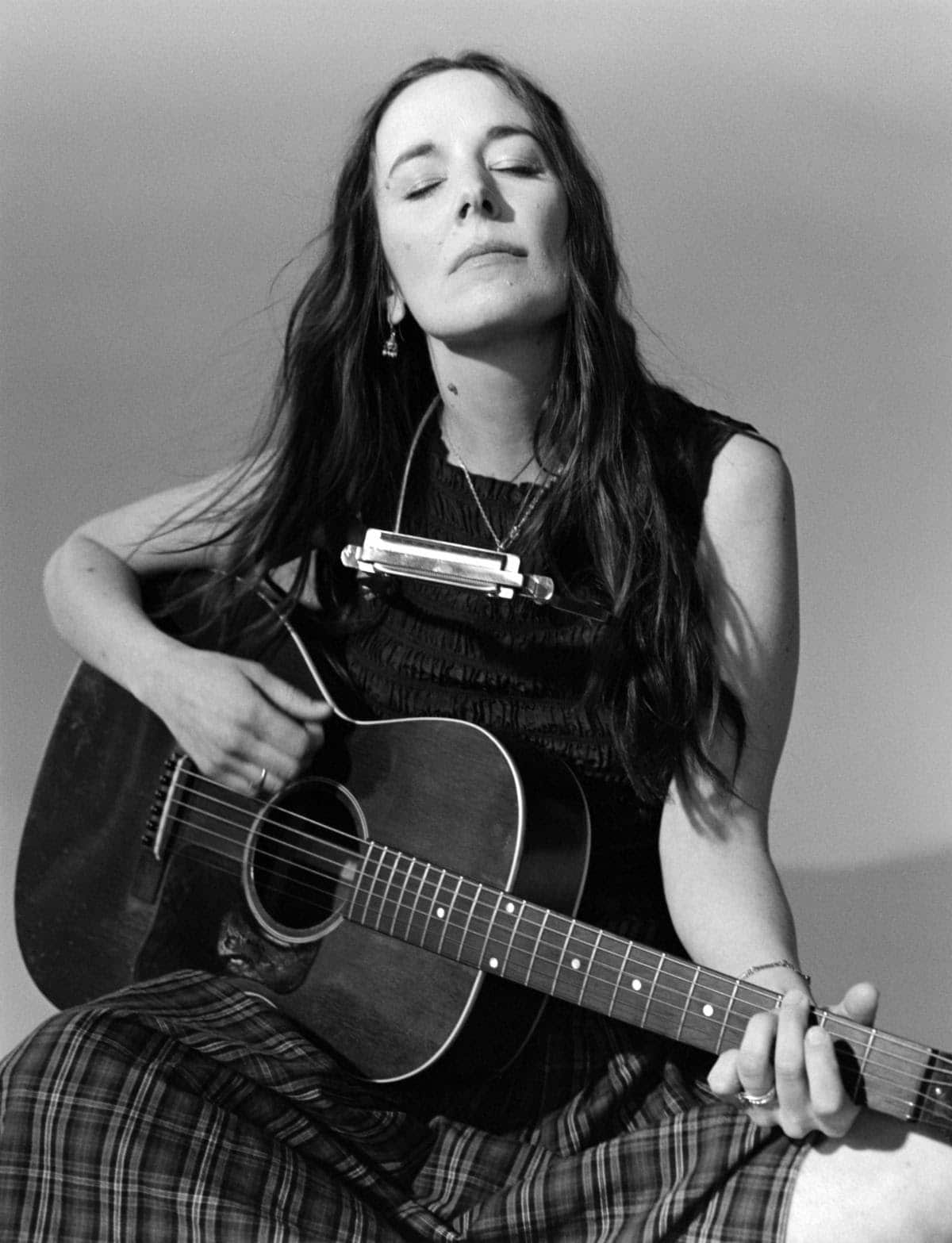
The record’s folk-leaning indie rock maintains the directness that has long characterized Glaspy’s writing, but the live recording process gives the songs space to behave unpredictably. Her guitar isn’t merely a foundation for her lyrics; when asked whether it functions as another voice in the conversation, her answer is characteristically economical:
“Yes.”
Sometimes the shortest answer is the clearest one.
Songs that behave like films
While I Am Both repeatedly returns to Glaspy’s internal world, some of its strongest moments emerge when she moves into characters and scenes.
Opening track “Michigan” imagines the aftermath of a breakup through someone abandoning New York for the Midwest. The idea came partly from Glaspy’s own experience visiting Michigan and thinking about the fantasy New Yorkers sometimes project onto rural life as an escape from the city’s intensity.
Rather than explaining every detail, she lets the song operate through fragments.
That visual quality runs throughout her writing.
“I have been told that I write songs to feel like movies,” she says.
It is a description she readily accepts.
“I wish I was a film maker and I wish I was an author, but I’m a songwriter and I hope to make things feel visual and immersive.”
“That Rose” similarly transforms longing into something almost surreal, while “Common Ground” turns outward toward a culture increasingly comfortable with either worshipping people or dismissing them entirely.
Glaspy is interested instead in the difficult middle territory: seeing people as people.
When asked how she knows whether a song needs to turn inward or widen its perspective toward society, however, she refuses to intellectualize the process.
“I have no idea. I just do it.”
It may be the most useful explanation of her creative philosophy on the entire record.
Looking outward without losing intimacy
That instinctive movement between personal and political becomes particularly striking on “Martin Luther King Jr.”, which reframes passages from a 1957 sermon by the civil rights leader and places them in conversation with contemporary problems, including America’s housing crisis.
Glaspy has spent considerable time listening to King’s speeches and describes his public speaking as transcendent.
Rather than separating the historical from the contemporary, the song asks what happens when language created in response to one moment of social crisis continues to resonate inside another.
Elsewhere, “Reminder” finds Glaspy confronting the uncomfortable gap between awareness and action.
The song builds around the recognition that hope isn’t enough by itself. Showing up means accepting mistakes, apologizing, questioning yourself, risking discomfort and still remaining willing to fight for something.
For Glaspy, it functions partly as a message to herself when she feels she isn’t contributing anything meaningful.
It also represents the creative freedom she found while making I Am Both. The song doesn’t conform neatly to the structures she once believed songs needed to follow.
She no longer seems particularly interested in “neat and tidy and symmetrical.”
The freedom is in letting the thought determine the form.
Art instead of metrics
That same reconsideration has reached Glaspy’s definition of professional success.
The contemporary music industry has become exceptionally good at quantifying artists: followers, streams, engagement, ticket counts, monthly listeners, chart positions, visibility.
Glaspy increasingly thinks about music through an almost opposite framework.
Public service.
“You show up in city after city and you bring the music with you,” she has said of touring, “and hopefully it reaches whoever needs to hear it.”
It’s a remarkably grounded way of thinking about a profession structured around perpetual growth.
Asked how that shift has affected her career, Glaspy says it has made everything simpler.
“When I make things on behalf of art and wonder, money is less interesting.”
That doesn’t mean pretending material reality doesn’t exist. She is explicit that money matters and that she needs it. What she rejects is allowing the possibility of financial reward to determine the work itself.
“When I have made art with the hope of money on the other side, the art isn’t good,” she says.
Instead, she wants music to function as exploration.
“When I make music to explore and dig, I feel whole and I feel that I am contributing to the greater good in my own way.”
There is something quietly radical about that position within a culture where creative work is increasingly expected to behave like content and artists are encouraged to behave like endlessly available personal brands.
Glaspy’s retreat from social media therefore becomes more than a productivity experiment. It is connected to a much larger refusal: the refusal to let visibility determine value.
“I Am Both”
Perhaps that is what ultimately makes the album’s title so effective.
I Am Both doesn’t ask listeners to choose between competing versions of themselves.
It doesn’t even necessarily ask them to celebrate their contradictions.
Instead, it suggests they might simply allow those contradictions to exist.
For Glaspy, the concept reaches beyond identity and into nearly every aspect of the album’s creation. Songs can be fictional and deeply personal. Recording can be disciplined and improvisational. Music can be a livelihood and a public service. An artist can possess certainty about her craft while remaining completely open to what happens when other musicians enter the room.
And perhaps most importantly, a person can acknowledge uncertainty without immediately attempting to resolve it.
When asked whether listeners becoming more comfortable with their own contradictions would represent the greatest possible success for I Am Both, Glaspy doesn’t complicate the answer.
“That would be wonderful.”
After an album spent resisting categories, algorithms, perfectionism and predetermined outcomes, it feels fitting.
Margaret Glaspy isn’t offering a formula for escaping the noise of modern life. She is documenting what happened when she turned some of it off long enough to hear herself again.
And on I Am Both, what she hears is not one clean, easily categorized voice.
It is many.
I Am Both is out now via ATO Records. Margaret Glaspy will tour North America, the UK and Europe throughout the fall.