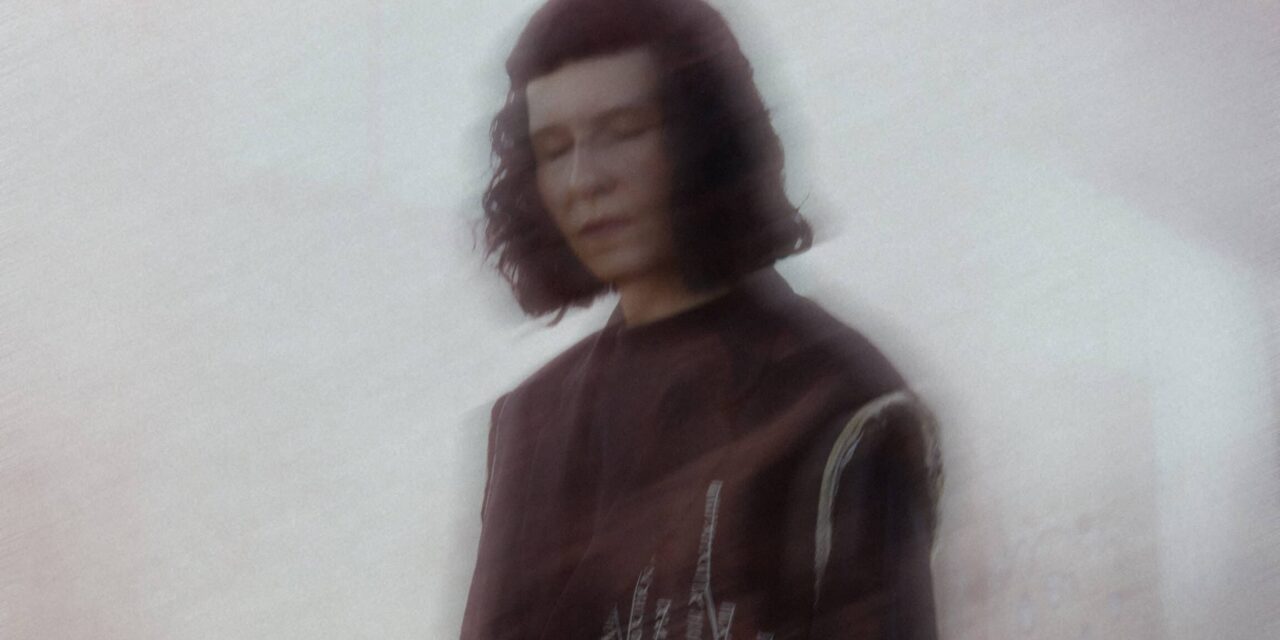
There’s something quietly confrontational about the music of Miglio.
Not loud in the traditional sense, but emotionally insistent — songs that sit inside instability rather than trying to resolve it. On her latest release, “L’amore ci farà a pezzi” (“Love Will Tear Us Apart”), Miglio revisits one of the most visceral moments from her recent album Traumfabrik Again, expanding it into a two-sided exploration of emotional collapse, memory, and transformation.
Released in a double version featuring Max Collini on Side A and an ambient reinterpretation by Sara Berts on Side B, the project doesn’t simply remix the original track — it fractures and rebuilds it from entirely different emotional angles.
A Title That Stops Being a Reference
The title immediately evokes Joy Division’s iconic “Love Will Tear Us Apart,” but Miglio doesn’t approach it as homage or nostalgia. Translating the phrase into Italian transforms it into something sharper, more exposed, more physical.
What begins as a citation becomes a rupture.
Miglio describes the song as emerging from deeply private images that gradually expanded into something broader and more collective. The result is a track suspended between intimacy and disintegration, where fragmented emotional landscapes replace linear storytelling.
That tension defines the song itself: control constantly slipping into collapse, clarity dissolving into emotional overload.
Between Emotional Precarity and Urban Isolation

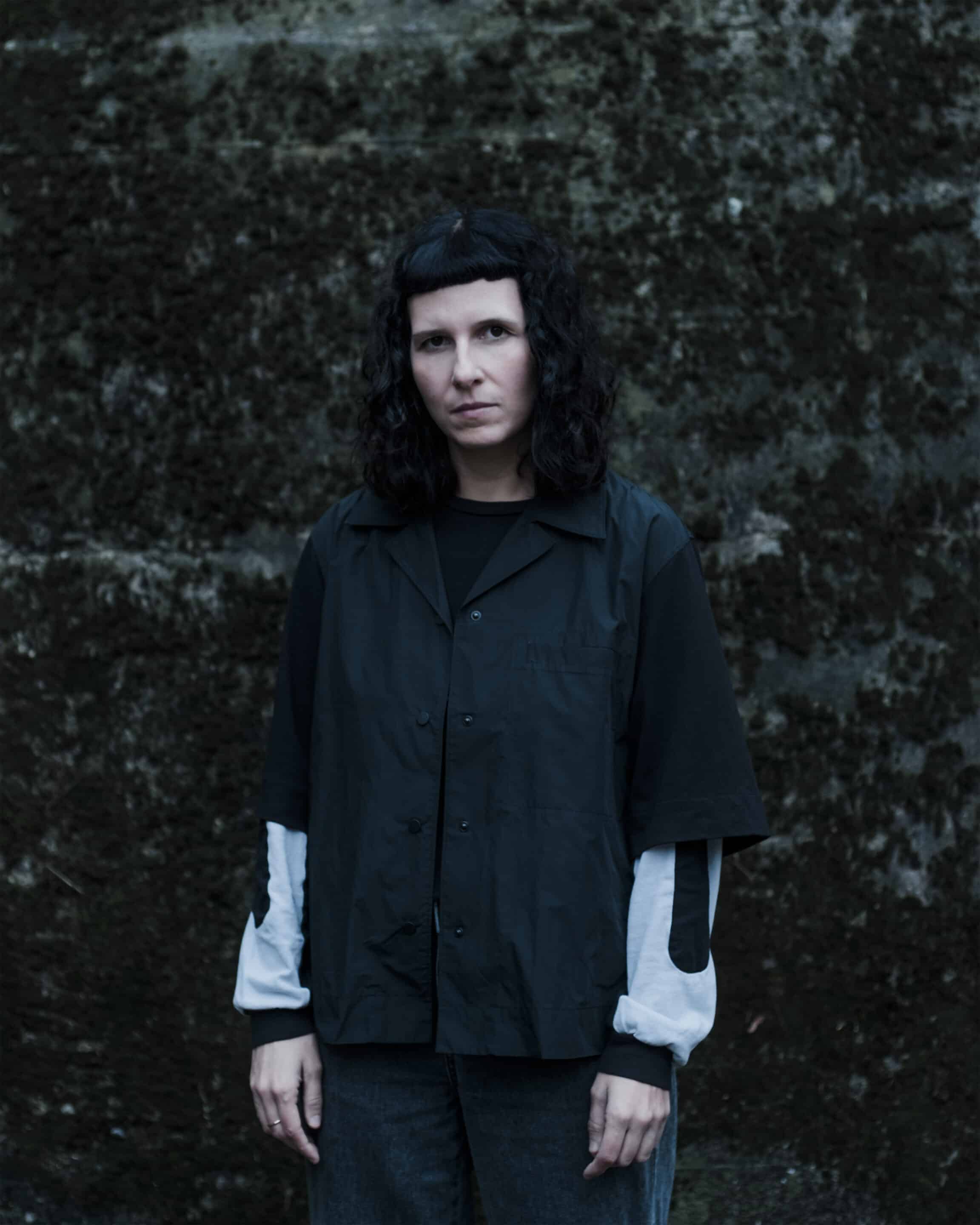
Born in Brescia and based in Bologna, Miglio — the project of Alessia Zappamiglio — has steadily carved out one of the more distinctive voices within contemporary Italian experimental songwriting.
Her work blends cantautorato, electronic music, and new wave textures without ever feeling trapped by genre. Instead of using influence as aesthetic decoration, she filters everything through emotional geography: precarious relationships, urban alienation, private fractures, and collective anxiety.
For Miglio, the personal is never disconnected from the political.
Not politics in a partisan sense, but as lived experience — bodies, labor, loneliness, desire, emotional survival. Her songs consistently occupy that space where private stories begin to reveal broader social tensions.
And “L’amore ci farà a pezzi” may be the clearest example of that instinct so far.
The Collision with Max Collini
On Side A, Max Collini enters the track not as a guest feature, but as a second emotional narrator.
Best known for his work with Offlaga Disco Pax, Collini brings a lucid, almost literary counterweight to Miglio’s vulnerability. His contribution introduces memory, irony, and disillusionment into the song’s emotional architecture, widening its perspective without overwhelming it.
The collaboration feels inevitable — two artists connected by a similar emotional landscape, both deeply tied to the imagery and contradictions of Northern Italy, both drawn toward storytelling that lives between realism and emotional abstraction.
Rather than decorating the song, Collini destabilizes and expands it.
Sara Berts Turns the Song into Atmosphere
If Side A intensifies the emotional narrative, Side B dissolves it completely.
Turin-based composer and sound artist Sara Berts reconstructs the track as an ambient piece built on subtraction, reverberation, and suspended space. Using layered synth textures and binaural stereo processing, she transforms Miglio’s voice from narrator into sonic material.
Meaning becomes fluid.
Words drift in and out of focus. Rhythm disappears into atmosphere. What remains is not the song itself, but the emotional residue of it.
It’s less a remix than a rewriting.
Traumfabrik Again and the Refusal of Formula
The title Traumfabrik Again — literally “Dream Factory Again” — references not only imagination, but a specific artistic attitude rooted in experimentation, freedom, and resistance to institutionalized creative structures.
That ethos runs throughout Miglio’s work.
She consistently resists repetition, avoiding formulas that feel too recognizable or too safe. Her music thrives on instability — the sense that songs are still evolving even as you listen to them.
That refusal extends beyond sound into identity itself. Whether composing emotionally raw electronic songs or creating music for fashion house Etro, Miglio approaches every project through the same lens: emotional coherence over aesthetic performance.
Living Between Tension and Suspension
What makes “L’amore ci farà a pezzi” so compelling is that neither version offers resolution.
One side pulses with nervous emotional intensity. The other drifts into abstract suspension. Together, they mirror the unstable rhythm of contemporary emotional life itself — oscillating constantly between overwhelm and numbness, collapse and stillness.
Miglio seems fully aware of that contradiction.
And rather than choosing between the two states, she inhabits both simultaneously.
“L’amore ci farà a pezzi” begins from an iconic imaginary but becomes something deeply personal. When did you realize that the title wasn’t just an homage, but a crack you had to move through?
At the beginning it was almost an instinctive gesture, maybe even a bit naïve: translating that title, moving it into my own language, and seeing what would happen. Then I realized I was opening something. In Italian, that phrase exposes itself differently — it becomes something stronger. That’s when I understood I wasn’t quoting anything anymore, but entering a fracture that directly concerned me. From that moment, the song started taking on its own direction, much more connected to my own imagery, my relationships, and my personal way of existing inside that fracture.
The song constantly moves between control and loss, clarity and collapse. Is that dynamic something you experience in life too, or only in your writing?
It’s definitely something I recognize in life as well. There’s always an attempt to control things, to give them shape, to understand them, to name them. And then there’s the moment when that structure can no longer hold, when it breaks, and something more real happens — but also something much harder to manage. In writing, this tension becomes more visible because I can push it further, exaggerate it even, but it’s not artificially constructed. It’s genuinely the way I experience things: balancing between the need for clarity and the risk of collapse.
Your work often combines emotional precarity and urban margins, intimacy and collective tension. How important is it for you to tell private stories as something political?
For me, it’s essential, even if not always explicitly. The private sphere is never neutral — it’s shaped by social, economic, and cultural conditions. Relationships, bodies, work, loneliness, desire… all of these things are formed within a context. Telling personal stories without considering that context risks making them sterile or self-referential. What interests me is exactly that point where a personal story opens up and becomes recognizable, shareable, almost collective. Not to simplify it, but to reveal its implications.
I also remain convinced that everything we do is political — not political in a partisan sense, but as an active awareness of each individual living and participating within society and everything that comes with it.
Your collaboration with Max Collini feels almost inevitable, like the meeting of two similar emotional geographies. What did he bring to the song that you couldn’t have reached alone?
Max brought a perspective that I couldn’t have had on my own. His voice and his words carry a history, a memory, an imagery that interacts with the song but also shifts it somewhere else. He introduced a lucid, sometimes ironic distance that coexists with the fragility of the track without canceling it out. It’s as if he expanded the song’s emotional space, making it less closed in on itself. It wasn’t a decorative addition at all — it truly became another perspective entering the piece and changing its balance.
In Sara Berts’ remix, the voice loses its narrative centrality and becomes sonic material. Are you fascinated by the idea of being “rewritten” through other languages?
Yes, very much so.
Something radical happened with Sara’s version: the voice stops being the center and becomes almost a texture, one element among others — even though fragments of phrases and sung lines still emerge clearly throughout the track.
I’m very interested in this kind of rewriting because it shows how a song can exist in entirely different ways.
Traumfabrik Again already suggests, in its title, a dream factory returning — perhaps fractured. What relationship do you have today with the concept of dreams: refuge, illusion, or necessity?
Traumfabrik means “dream factory,” but what struck me most was the attitude behind the original “Traumfabrik,” which was a squatted apartment in Bologna in the late ’70s. It was a place centered around artistic experimentation, around developing new languages disconnected from the logic of organized industry and commercial systems — an idea of free art.
That’s what fascinated me most and what inspired the title of the album, obviously bringing it back into my own story and vision.
As for the concept of dreams themselves, it feels a bit naïve to me. What matters more is pursuing what you truly desire. That feels more concrete.
Your work blends songwriting, electronics, and new wave without ever sounding merely referential. How do you transform influences into identity rather than aesthetics?
It’s not entirely conscious. Influences are part of what I listen to and what formed me, but I never begin with the intention of “referencing” something. Instead, I try to understand what remains inside me from those languages, what still speaks to me.
When you work from that place — from the traces that genuinely pass through you — it becomes harder to fall into pure quotation. Identity also comes from subtraction: removing what feels too recognizable or too derivative and allowing something more personal to emerge, even if imperfect.
You also composed music for Etro, bringing your sound into the fashion world. What changes when you write for images instead of for a personal wound?
With Etro, I was given enormous artistic freedom, which for me is fundamental and the basis of every creative process. Otherwise, I simply wouldn’t do it.
It was certainly a different approach. I composed the music imagining an expanded visual world, thinking about “sound rooms” that could move across the bodies of people wearing the clothes, becoming part of the garments themselves and the story surrounding them.
It’s another point of view, but the attitude remains the same as when I write for myself.
Your lyrics often suggest a hunger for new language and new forms of expression. Are you afraid of artistic repetition?
Yes, absolutely. Not repetition itself — because certain elements inevitably return — but the risk of settling into a formula.
When you begin recognizing yourself too much in what you’re doing, when you already know how something will function, that becomes dangerous for me. I need to feel a certain instability, even the possibility of failure. The search for a language that remains recognizable while always capable of evolving and experimenting is fundamental to me.
If these two sides represent different ways of inhabiting the same pain, which one do you feel you’re living in right now: the tension of Side A or the suspension of Side B?
Right now I recognize myself in both — in tension and then in suspension. A continuous alternation.