The internet has spent years teaching us to believe that attention is passive.
We scroll. We watch. We click. We share. We move on.
But for Vita Kari, attention is not merely something an artwork receives after it has been made. Attention is part of the material itself.
The Los Angeles-based visual and performance artist works across video, textiles, public interventions, speculative storytelling, and participatory media, examining the systems that shape how contemporary culture understands visibility, authenticity, technology, branding, and trust.
Their central proposition is deceptively simple: what if virality itself is an artistic medium?
That question has become one of the defining ideas behind Kari’s practice.
Rather than using social media merely to promote finished work, they treat the internet as an active performance space where meaning mutates through comments, reposts, arguments, misunderstandings, and collective participation.
“The video isn’t the finished piece,” Kari explains. “It’s what sets everything else in motion.”
That distinction becomes particularly relevant at a moment when much of cultural life is experienced through interfaces designed to reward immediate reaction.
Virality is typically treated as a metric. It measures reach, engagement, relevance, or commercial potential. Kari approaches it differently: as a social behavior that can be choreographed, interrupted, observed, and transformed into art.
Their recent projects make that philosophy tangible.
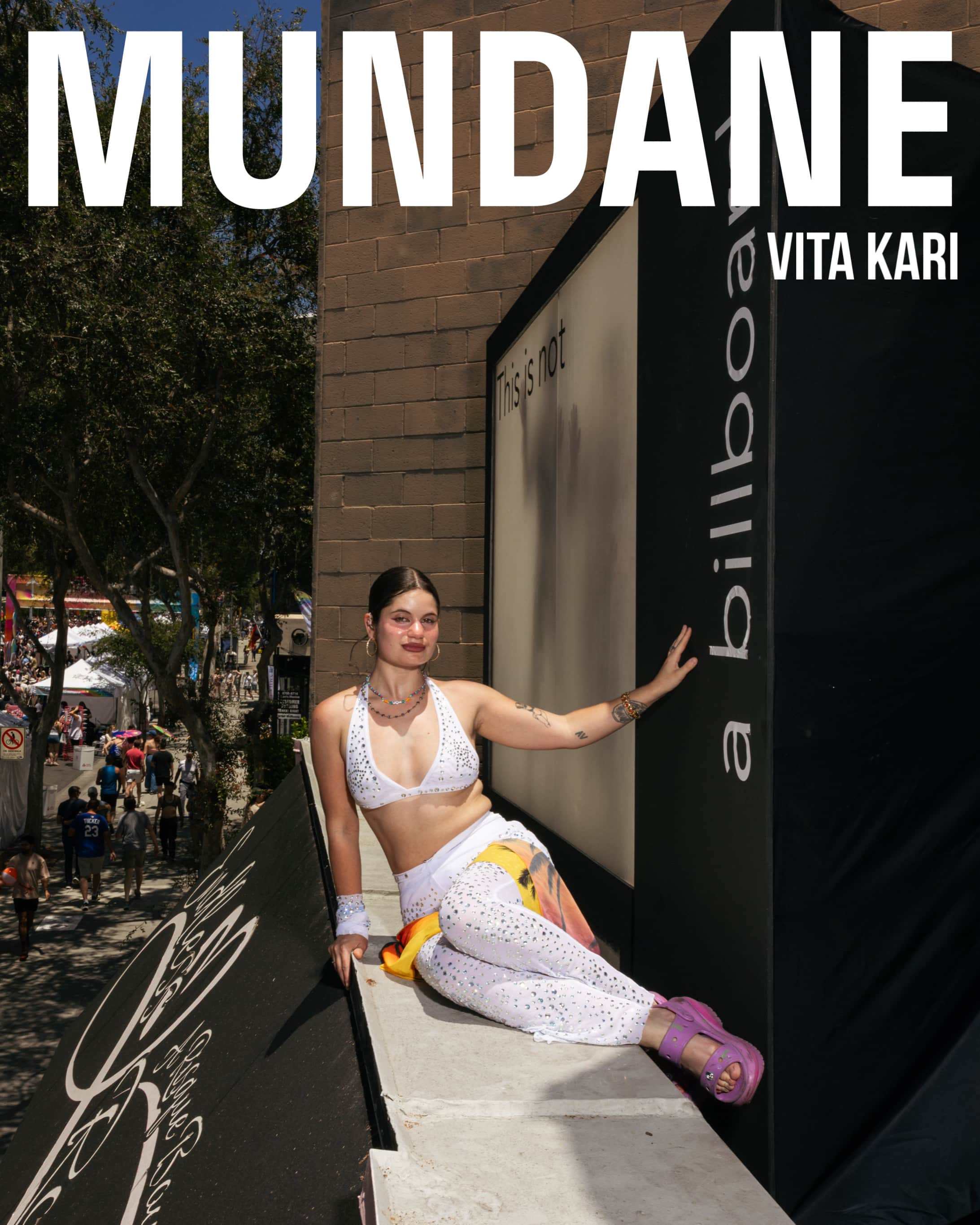
This Is Not A Billboard uses the visual language of advertising to examine what it means to become visible inside an attention economy. Kari also recently collaborated with Joaquin Stacey-Calle as part of the Jeffrey Deitch x LACMA Art Parade and joined Love to Hate, an exhibition examining society’s fascination with outrage, spectacle, and public discourse.
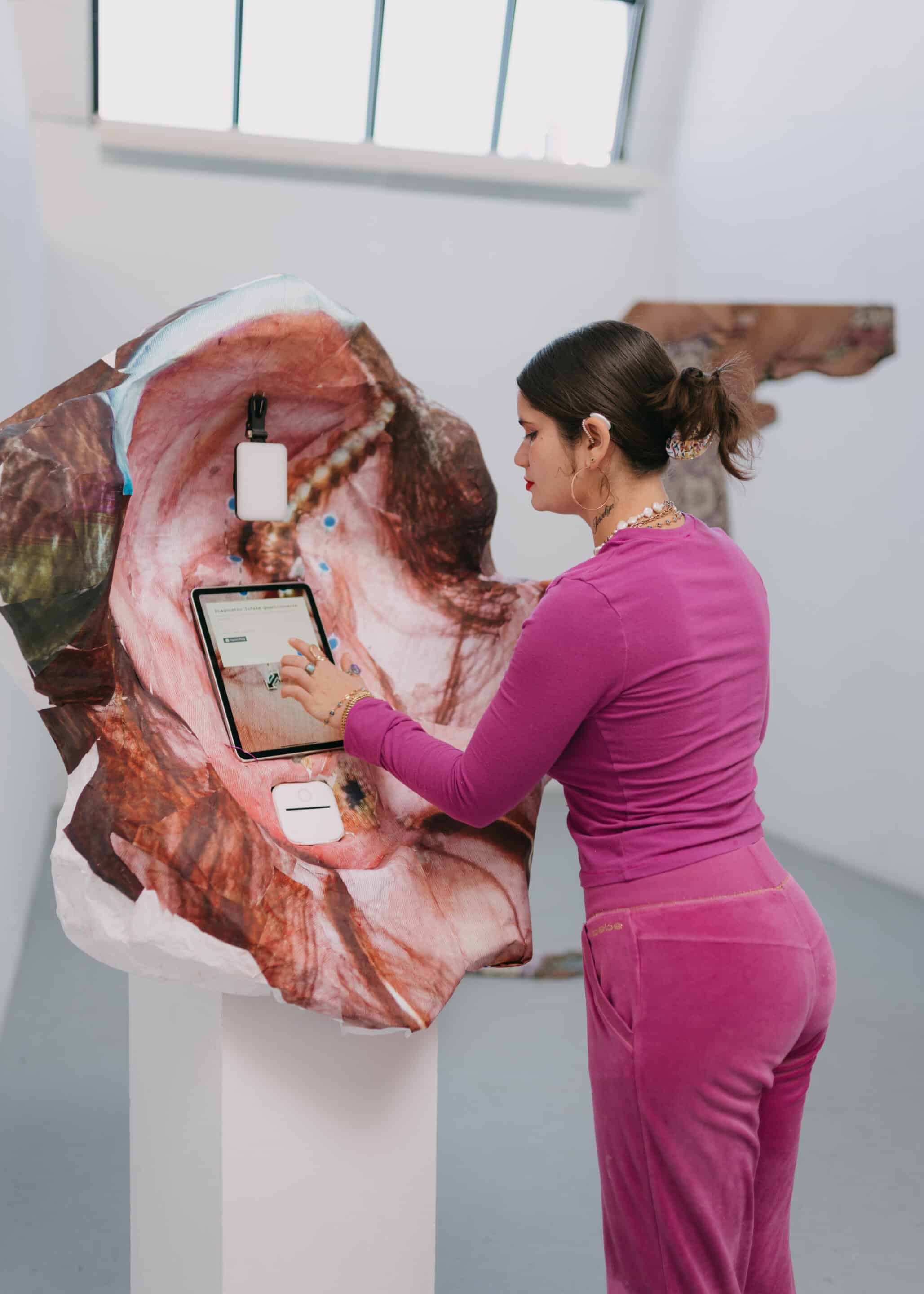
Then there is VitaSona, Kari’s ongoing speculative project built around a fictional hearing-aid company.
The project collapses distinctions between product design, branding, technological critique, performance art, and corporate mythology. Instead of asking an audience simply to observe an art object, VitaSona asks them to negotiate a system whose reality is deliberately uncertain.
That uncertainty is crucial.
Once an audience begins asking whether something is authentic, commercial, fictional, exploitative, progressive, or satirical, the work has already begun operating.
“Once someone starts questioning whether something is real, or why they believed it in the first place, they become part of the artwork,” Kari says.
As a Deaf/Hard of Hearing artist, Kari’s relationship with technology is not theoretical. Hearing aids, smartphones, captions, transcription, and accessibility technologies are integrated into everyday embodied experience. Their work therefore refuses the simplistic separation between “human” and “digital” that still shapes many conversations around emerging technology.
For Kari, technology is already intimate.
It is already bodily.
It is already shaping perception.
We spoke with Vita Kari about virality as a contemporary artistic medium, Los Angeles as a laboratory for collapsing cultural categories, accessibility, speculative technology, artificial intelligence, and why making people question reality can ultimately be an optimistic gesture.
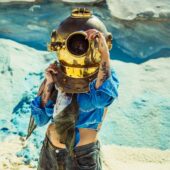
Credit Sean Behr
Your work sits at the crossroads of performance art, internet culture, and technology. What first drew you to treating virality itself as an artistic medium rather than simply a way of distributing your work?
I actually started with the question: could virality itself be a medium?
The funny part was that I realized pretty quickly that if I wanted to prove that, I first had to figure out how to go viral.
So I spent a year deeply studying the internet. I watched way too much content, paying attention to what made people stop scrolling and essentially studying the material I wanted to work with.
I didn’t want to copy those structures. I wanted to queer them.
I would take formats millions of people already understood and push them just far enough that people couldn’t immediately tell whether they were looking at an artwork, an advertisement, a performance, or a joke.
I have always been inspired by video artists such as Nam June Paik and Pipilotti Rist, who expanded what video could be. That made me wonder what video art could look like now if it lives on the internet.
Once I post a video, people start reposting it, arguing about it, and changing its meaning.
After a while, I realized I wasn’t really watching the artwork spread anymore.
I was watching the artwork happen.
That’s when I started thinking about virality differently.
The video isn’t the finished piece. It’s what sets everything else in motion.
Projects such as This Is Not A Billboard and VitaSona blur the boundaries between art, branding, and social experimentation. What do fictional or speculative worlds let you explore that traditional exhibitions cannot?
With This Is Not A Billboard, I could build a fake advertisement and watch how people responded to it in real life.
With VitaSona, I’m building a fictional hearing-aid company to imagine what the world might look like if hearing aids had evolved more like luxury accessories than medical devices.
I’m less interested in making an object that people simply look at than creating a situation people have to move through.
Once someone starts questioning whether something is real, or why they believed it in the first place, they become part of the artwork.
Public participation plays a central role in your practice. How much do you carefully orchestrate, and how much do you intentionally leave open to unpredictable human behavior?
The framework is carefully planned, but the artwork isn’t.
I spend a lot of time building the conditions for a piece, but once people enter it, I lose control—and that’s the point.
I’m interested in what people do when they aren’t given a script.
Whether someone participates in person or in the comments, their reactions shape the work in ways I could never plan for.
That’s usually where the artwork becomes more interesting than anything I could have made by myself.
Attention has become one of the world’s most valuable currencies. Do you see your work as critiquing the attention economy, participating in it, or both?
I think it’s both.
I’ve always loved performance art because it is a time-based medium where the body is the material.
The internet made me realize a performance didn’t have to end when the event ended. It could keep unfolding online through millions of people participating in it.
Because of that, I don’t really see attention as something separate from the work. It’s one of the materials I’m working with, just like video, performance, or sculpture.
At the same time, I think the attention economy deserves to be questioned.
Most platforms reward certainty, speed, and outrage.
I’m interested in making work that slows people down instead.
If someone has to stop and ask, “Wait… is this real?” then I’ve interrupted the way they normally consume content, even if it is only for a few seconds.
Most people scroll without thinking about why they stopped.
I’m interested in making work that makes them notice their own attention.
As a Deaf/Hard of Hearing artist, accessibility is embedded within your practice. How has your lived experience shaped how you think about communication and technology?
One thing people don’t always realize is that I control my hearing aids with my phone.
I am constantly adjusting them throughout the day depending on where I am.
In a strange way, my phone has become part of my body.
I think that has changed how I think about technology.
I don’t really see it as something separate from us.
It is already shaping how we communicate, what we notice, and even how we experience our own senses.
That is something that appears in almost all of my work.
Los Angeles has long blurred entertainment, commerce, technology, and contemporary art. How has the city shaped your creative perspective?
Frank Lloyd Wright said, “Tip the world over on its side and everything loose will land in Los Angeles.”
I have always loved that quote because LA feels like a city where nothing quite fits into one category.
That has been true for my own practice.
I have never felt like I needed to choose between being an artist, making videos, working with brands, or building fictional worlds because, in Los Angeles, those things are already in conversation with one another.
My work is really a product of that collision.
You’ve collaborated with brands including Google, Spotify, Marc Jacobs, and Loewe while maintaining a practice that questions systems of influence and trust. How do you navigate collaboration and critique simultaneously?
Brands are some of the most influential cultural institutions we have today, and honestly, they are incredibly interesting.
I use my proximity to those spaces to inform my work, like VitaSona, my fictional hearing-aid company.
I’m interested in the infrastructure around products just as much as the products themselves: the branding, language, marketing, and everything surrounding them.
I’m fascinated by how those systems shape the way we communicate and even the way we understand ourselves.
Many of your projects deliberately blur what is real, authentic, or manufactured. Why are people so drawn to that uncertainty?
We have always loved illusion.
Trompe-l’œil paintings are hundreds of years old, and they worked for the same reason internet hoaxes work today.
They create a moment where you stop and ask yourself, “Is this real?”
That moment of uncertainty is where a lot of my work lives.
AI, immersive technologies, and algorithmic platforms are rapidly reshaping culture. Which developments excite you, and which deserve more scrutiny?
As someone who became hard of hearing or Deaf later in life, AI tools have enormous potential for captions, transcription, and hearing technology.
I’m excited to see accessibility tools improve for everyone.
The things that concern me are the environmental cost and mental health implications.
I also don’t want to see AI replacing creative jobs.
Looking ahead, what do you hope people ultimately remember about your work?
There are so many artists already doing incredible work online.
I hope my contribution is helping expand the conversation around Virality as a Medium—the hill I will die on—and that it becomes part of a broader shift in how we think about the internet.
More than anything, though, I hope the work reminds viewers that reality really is a construct, and that is actually incredibly freeing.
So many of the things that shape our lives only exist because we collectively agree they do.
I hope that leaves participants and viewers feeling slightly less afraid to imagine different ways of living and creating.
The phrase “virality as a medium” initially sounds like a provocation.
But the more closely Kari’s work is examined, the more literal the idea becomes.
Oil paint behaves according to specific physical properties. Film creates meaning through duration, framing, and montage. Performance art introduces the body, time, and presence as artistic materials.
Virality also has properties.
It accelerates.
It mutates.
It removes context.
It creates copies whose relationship to an original becomes increasingly unstable.
It rewards emotional immediacy.
It transforms spectators into distributors, critics, interpreters, and sometimes unwilling performers.
Kari’s work begins by acknowledging these characteristics instead of pretending the internet is simply another neutral exhibition space.
This is why the comment section matters.
A traditional artwork can be misunderstood, debated, or criticized after its completion, but those reactions remain largely external to the object itself.
With Kari’s work, reaction can become structure.
Someone reposting a video with an incorrect explanation may alter its cultural meaning. A viewer confidently insisting a fictional product is real extends the performance. Someone accusing the work of manipulation unintentionally demonstrates precisely how quickly trust is constructed online.
The audience does not merely interpret the artwork.
It produces part of it.
That participatory structure also complicates the traditional relationship between artist and control.
Kari carefully builds the framework, but the ultimate outcome must remain unstable.
If everything were predetermined, the work would stop being a social experiment and become theater with invisible actors.
Instead, Kari creates conditions.
What happens afterward belongs partly to everyone else.
This is especially visible in This Is Not A Billboard.
Advertising depends on immediate recognition. A viewer encounters an image and instinctively understands its function: something is being sold, promoted, branded, or announced.
By manipulating that familiar language, Kari creates a small break in cultural automation.
The viewer looks.
Then looks again.
The interruption may last only seconds, but those seconds expose how quickly people classify the world around them.
The same dynamic becomes more elaborate in VitaSona.
A fictional hearing-aid company allows Kari to explore not only accessibility but the cultural assumptions surrounding disability, medicine, fashion, technology, and desirability.
Why are some forms of wearable technology treated as aspirational while others remain medicalized?
Eyeglasses can become fashion statements.
Smartwatches become status symbols.
Headphones are designed as lifestyle objects.
Hearing aids, despite their technological sophistication and intimate relationship with perception, are still frequently framed primarily through deficiency.
By imagining an alternative corporate history, VitaSona makes those assumptions visible.
Speculative storytelling becomes a method of cultural diagnosis.
Rather than arguing directly that existing systems should be different, Kari creates a fictional system and asks why it feels unusual.
The difference between the imagined world and the existing one reveals the bias.
Kari’s lived relationship with hearing technology gives this exploration additional depth.
The phone controlling their hearing aids is not merely an interface.
It participates in perception itself.
Volume, environmental sound, communication, and sensory access move through a device that contemporary culture still often describes as separate from the “real” human body.
Kari’s experience suggests that separation is already obsolete.
Technology is not approaching the body from somewhere in the future.
For many people, it is already inside the architecture of everyday perception.
This makes their relationship with artificial intelligence similarly complex.
AI can generate serious ethical, environmental, labor, and psychological concerns while simultaneously creating meaningful accessibility tools. Captions, transcription, and adaptive hearing technologies are not speculative luxuries for people who rely on them.
The contradiction resists the clean optimism or pessimism that often dominates conversations around emerging technology.
Kari’s work is most interesting precisely when it refuses that binary.
The same refusal applies to branding.
Collaborating with major companies while creating work that interrogates corporate influence could appear contradictory from a distance.
Kari treats proximity as research.
Brands are among the most sophisticated contemporary producers of mythology. They do not simply sell objects. They manufacture languages, identities, aspirations, rituals, and entire systems through which people communicate social meaning.
For an artist interested in constructed reality, ignoring branding would mean ignoring one of the dominant storytelling forces of the present.
Los Angeles provides a particularly fertile environment for this practice because the city has always resisted clean distinctions between artifice and reality.
Film sets become tourist attractions.
Personal identities become professional brands.
Art, fashion, entertainment, technology, and commerce regularly occupy the same rooms.
A person can move from gallery opening to influencer campaign to studio production without experiencing those environments as entirely separate cultural worlds.
Kari understands that instability not as a problem but as material.
Their practice exists precisely because the categories are collapsing.
Artist.
Creator.
Performer.
Influencer.
Designer.
Brand collaborator.
Cultural critic.
The contemporary creative economy asks individuals to occupy multiple identities simultaneously, often while insisting each identity should remain legible enough to market.
Kari chooses to make the confusion visible.
This may also explain their fascination with illusion.
The internet did not invent uncertainty about reality.
Painting has simulated depth for centuries. Theater asks audiences to believe fictional people are real. Cinema constructs emotional truth from editing, performance, lighting, and sound.
What digital culture has changed is scale and velocity.
An illusion can now encounter millions of people before anyone agrees on what it is.
That creates obvious dangers.
It also creates artistic possibility.
Kari enters that unstable space not to celebrate deception, but to make the mechanics of belief more visible.
“Is this real?” therefore becomes less important than the question underneath it:
Why did I believe it?
And beneath that sits an even larger one:
How much of what I consider reality exists because enough people around me have collectively agreed to treat it as real?
Money.
Brands.
Status.
Platforms.
Virality.
Professional legitimacy.
Beauty standards.
Cultural relevance.
The boundaries separating artist from influencer or advertisement from entertainment.
Much of contemporary life is sustained by shared agreements that feel natural only because they are constantly reinforced.
Kari sees something liberating in recognizing their constructed nature.
If these systems were built, they can be questioned.
If they were collectively imagined, perhaps alternatives can be collectively imagined too.
That optimism prevents the work from collapsing into a familiar dystopian critique of technology.
Vita Kari is not simply telling us that the internet is manipulative, brands control us, or algorithms distort reality.
We already know those stories.
Their work asks what becomes possible once we understand that we are also participating in the construction.
The audience is not outside the system.
The audience never was.
And that may be the most important element of Vita Kari’s work: the moment you stop being a spectator is the moment the artwork truly begins.