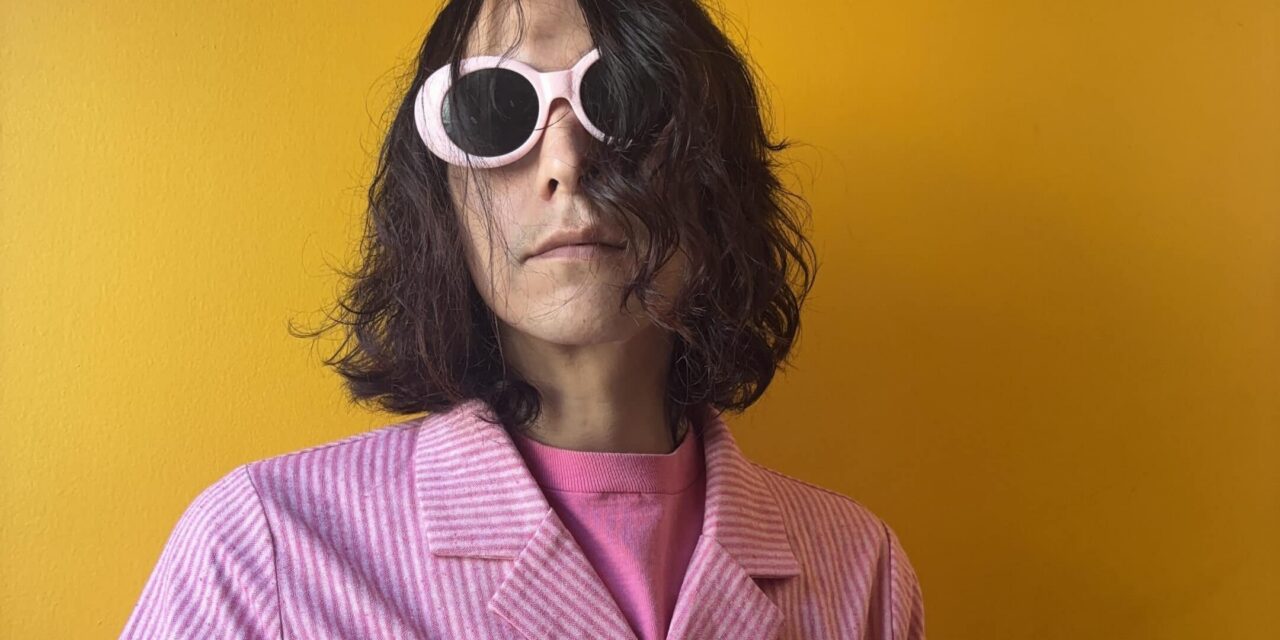
Anishinaabe-Canadian artist ZOON has always approached music less like performance and more like emotional archaeology. Across dreamy textures, tape hiss, ambient distortion, and shoegaze-inspired experimentation, Daniel Monkman turns memory into atmosphere — building songs that feel suspended somewhere between spiritual healing and emotional collapse.
On the forthcoming album HAPPY THOUGHT SCHOOL, ZOON confronts some of the most painful experiences of their life directly: racial trauma, addiction, heartbreak, chronic pain, and the lingering psychological damage of growing up as one of the only Native students in a deeply hostile school environment. But rather than collapsing under that weight, the album reshapes those experiences into something strangely luminous — a form of survival refracted through what ZOON calls “cosmic moccasin-gaze pop.”
We spoke with ZOON about the emotional origins of the record, discovering the Omnichord during physical recovery, transforming trauma into sound, and why experimentation has become inseparable from identity itself.
Q: HAPPY THOUGHT SCHOOL explores heartbreak, relapse, racial trauma, and spiritual recalibration. What did the process of making this album look and feel like for you?
ZOON:
Happy Thought School was a very strange place for me. Before that, I went to Sargent Tommy Prince School, where everyone around me was Indigenous — the students, teachers, principals — so I felt understood there. But when I transferred to Happy Thought School, it was the complete opposite. I was one of the only Native students there.
My mom didn’t want me placed in the special needs class, so I was put into regular classes where I dealt with racism almost every day. Students called me racist names, but what hurt most was the teachers. Some wouldn’t help me when I asked questions, and I overheard one teacher say they thought I had lice because I came from the reservation. That stayed with me for a long time.
Eventually I stopped wanting to go to school. My dad, who was a residential school survivor, understood that pain in his own way. He would let me stay home, watch movies with him, or play guitar. Looking back now, that’s really where I started learning chords and melodies and where music became a safe place for me.
As I got older, I realized how damaging that experience at Happy Thought School really was, especially because the name itself felt so contradictory to what I lived through there. I carried a lot of mental pain from that time and turned to substances to cope with those memories.
Then, when I got a 24-track recorder, I started recording those emotions instead of burying them. At first it was hard to write about that school, but as I got older and became more confident in songwriting, it became easier to finally put those experiences into words. A lot of HAPPY THOUGHT SCHOOL came from confronting that pain directly and turning it into something honest.
Q: Where does the title “OMNI II” come from? Did the title exist before the music?
ZOON:
The title “OMNI II” came from a pretty personal place. Over the last six years of touring, my spinal arthritis started getting a lot worse. It reached a point where I could barely hold my guitar through an entire set. After shows, I’d have to lie flat on the ground because the pain was so intense. I would get these full-body spasms in my back, and for a long time I used substances to try and manage the pain.
Eventually it got serious enough that I had to go to therapy and really confront how much both the physical pain and substance use were affecting my life. During that time, I stopped using guitar as much because it became too painful to play for long periods.
While touring in Japan, I found an Omnichord, and that instrument completely changed things for me. It was physically much easier on my body, but creatively it also opened up a whole new world of sound. I didn’t want to abandon the guitar-driven “moccasin gaze” sound I had been developing, so instead the Omnichord became an extension of it.
I started creating all these fragmented ideas and textures with the Omnichord that began expanding the sound of moccasin gaze into something new. “OMNI II” really represents that transition — both physically and creatively. The title actually came after the music. Once I realized how much the Omnichord had reshaped the way I was writing and recording, the name just made sense.
Q: Your music has been described as “cosmic moccasin-gaze pop.” What does that phrase mean to you?
ZOON:
“Cosmic moccasin-gaze pop” is probably the closest description of my sound that has actually made sense to me, because it captures both where I come from culturally and where I’m trying to push the music sonically.
When I started using the Omnichord more, it really expanded the way I approached sound and songwriting. Around that time, I began collaborating with Chris Chu, whose album Big Echo was a huge breakthrough record for me back in 2010. I never imagined we’d eventually work together. When I sent him my song “Vibrant Colours” from Bleached Wavves, he immediately responded saying it reminded him of old-school shoegaze and that he wanted to be part of it.
By the time I was making my third album, I had gone even deeper into experimenting with the Omnichord. I would send Chris these 30-second fragments layered through wild chains of effects pedals — some custom-built for me and others I had collected over the years. Through that process, I started discovering textures and sounds that felt completely new to me, especially in the way the Omnichord could interact with shoegaze and ambient music.
One moment that really stayed with me was working with Laraaji. The day after our session together, he emailed me and said, “You have given me hope with your talent on the Omnichord. I have never heard those sounds before.” Hearing that from someone I respect so deeply made me realize I was creating something genuinely different with the instrument.
So to me, “cosmic moccasin-gaze pop” isn’t just a genre label — it’s a way of blending Indigenous identity, emotional storytelling, ambient textures, shoegaze, and experimental sound design into something that feels personal and new.
Q: The album repeatedly transforms painful memories into melody. Does music feel more like escape, confrontation, or survival for you now?
ZOON:
Definitely survival. There were long periods where I didn’t know how to process certain experiences outside of music. Recording became a way to sit with emotions I had spent years avoiding.
A lot of these songs started as fragmented memories or feelings that didn’t fully make sense yet. By layering sounds, textures, tape hiss, field recordings — all those little imperfections — it felt like I was creating an emotional environment where those memories could finally exist honestly without destroying me.
Q: There’s a contradiction embedded in the title HAPPY THOUGHT SCHOOL itself — something optimistic masking deep pain. Was that duality intentional across the album too?
ZOON:
Absolutely. Pop radio was a refuge for me growing up. I’d be listening to bright early-2000s pop songs while feeling completely isolated internally.
That contradiction became the architecture of the album — beautiful melodies carrying painful undercurrents. I wanted the songs to feel comforting and unsettling at the same time because that’s honestly how memory works for me.
Q: Shoegaze has historically been associated with obscured emotion and abstraction, but your work feels intensely personal and direct underneath the haze. How do you balance atmosphere with storytelling?
ZOON:
I think atmosphere is storytelling. The textures matter just as much as the lyrics to me.
The distortion, the tape hiss, the ambient layers — those sounds carry emotional information. They can express confusion, grief, nostalgia, or spiritual disconnection in ways language sometimes can’t.
I’ve always wanted the music to feel immersive emotionally, not just sonically.
Q: Your work often connects Indigenous identity with experimentation rather than tradition being frozen in time. Why is pushing sound forward important to you?
ZOON:
Because Indigenous identity isn’t static. We’re living in the present and future too.
I think there’s sometimes this expectation that Indigenous art has to look or sound a certain way in order to be considered authentic. But experimentation is part of survival too. Innovation is part of culture evolving.
For me, using shoegaze, ambient music, the Omnichord, pedals, tape manipulation — all of that still feels deeply connected to my identity and ancestry. It’s just expressing it through a different sonic language.
Q: The album deals with addiction, chronic pain, racial trauma, and healing all at once. What did making this record teach you about yourself?
ZOON:
That healing isn’t linear.
There were moments while making this record where I felt like I was progressing, and other moments where I felt completely consumed by old patterns again. But I think the difference now is that I’m more willing to confront those cycles honestly instead of hiding them.
Music helped me stop romanticizing my own suffering. It became less about escape and more about understanding.
Q: What do you hope listeners carry with them after hearing HAPPY THOUGHT SCHOOL?
ZOON:
I hope people feel less alone in whatever they’re carrying.
A lot of this record came from experiences I used to feel ashamed of — racism, addiction, isolation, chronic pain, heartbreak. Turning those things into music helped me survive them.
If someone hears these songs and feels understood, even briefly, then the album did what it was supposed to do.