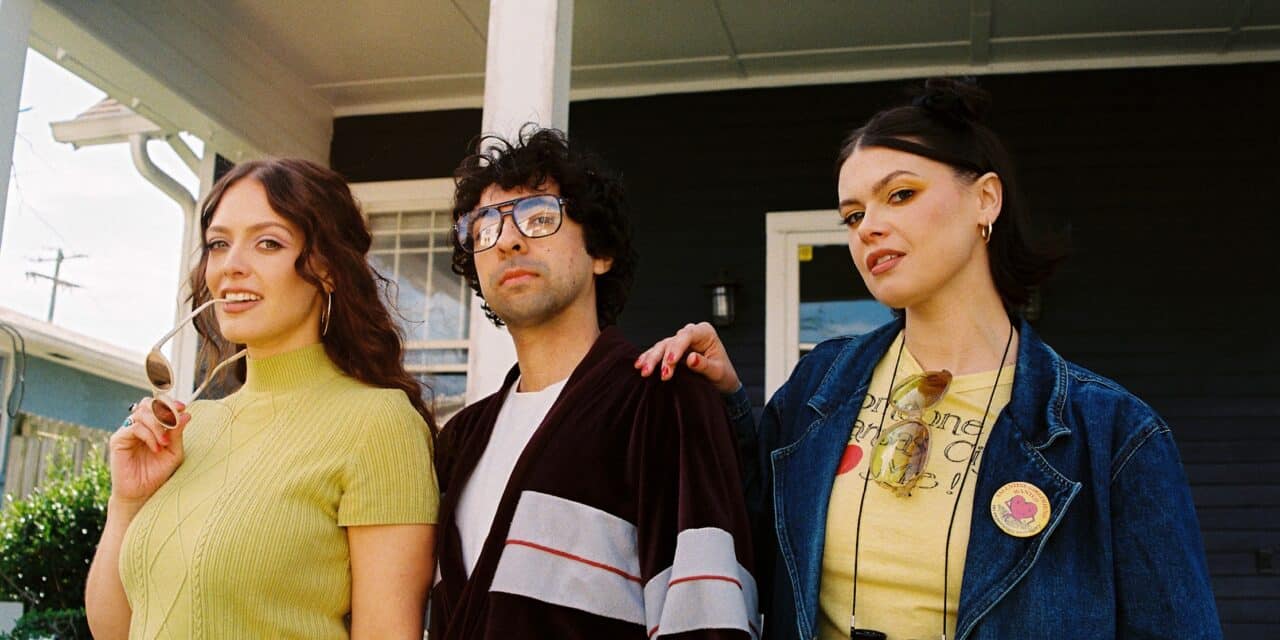
With “Little Blue House,” indie-pop trio Moody Joody tap into something deceptively simple: the strange emotional electricity of curiosity. Beneath the song’s playful groove and chant-along hooks lives a deeper tension between innocence and rebellion, suburban nostalgia and the longing to escape it. The track feels simultaneously sun-soaked and slightly voyeuristic, capturing the sensation of growing up inside a carefully constructed world while secretly imagining another one just outside the frame.
Built around danceable rhythms, quirky textures, and emotionally sharp songwriting, “Little Blue House” also signals an important evolution for the band. For Moody Joody, the song acts as an “Easter egg” for their forthcoming debut album — a project rooted in emotional duality, reckless honesty, and embracing the full spectrum of being human.
We spoke with Kayla, Kaitie, and Andrew about childhood imagination, suburban isolation, artistic freedom, and why creating music still feels like returning to their younger selves.
Q: “Little Blue House” feels like curiosity turned into a chorus. What is it about not knowing that makes something so magnetic?
Kayla:
I think it’s about the possibilities of it all. Children have this sort of innate gift of imagination. So much of this record to me feels like returning to a sense of self with a childlike wonder. Writing this song felt very nostalgic in that way — growing up in the early 2000s with a boombox, meeting up with friends after school to ride bikes, and daydreaming about what was going on when the neighbors or parents were having a party.
Q: The song taps into suburban nostalgia — bike rides, cul-de-sacs, imagining other lives. Do you think growing up in a “bubble” makes curiosity more intense later on?
Kayla:
When we were writing this song, I envisioned a very specific chapter of my childhood where I would have sleepovers at my friend Kelsey’s house and we’d play ghost in the graveyard after dark with all of the neighborhood kids. I think we all have moments where that childlike wonder dissipates and life unfolds in front of our eyes. Traveling really opened my eyes to possibilities outside of how I grew up in the Midwest. If you get outside of your comfort zone, you’d surprise yourself by what’s out there.
Kaitie:
Definitely. When you grow up thinking there’s only one way of living and then you find out there’s more out there, it’s hard not to crave exploration. Finding out I could be an adult in a band instead of following this other path that had been carved out for me was — and still is — the most exciting ongoing discovery.
Q: There’s a slightly dark, voyeuristic edge beneath the playfulness. Were you consciously exploring that tension between innocence and intrusion?
Kayla:
This song felt like an ode to that childhood version of myself that had a vivid imagination with a bit of cheekiness. There’s also this juxtaposition of trying to capture the feeling of always “keeping up with the Joneses” that I sometimes felt growing up in the suburbs.
Kaitie:
Yes. As much as I was curious, I was also a people pleaser and wanted to do what was “right,” so I kept a lot of my curiosity to myself. That feeling of being torn between two worlds definitely exists in the song.
Q: The “little blue house” becomes almost symbolic. Is it a place, a mindset, or the version of life you once felt excluded from?
Kayla:
To me, it represents a world of possibilities outside your comfort zone. It’s allowing your inner child to steer the ship a little more — dreaming bigger, imagining more, creating more.
Kaitie:
Originally, it came from a place of exclusion — not feeling cool enough, edgy enough, or brave enough to fully express myself the way I saw others doing. It represents self-expression, rebellion, indie music, and living authentically. The cool thing is that over the last few years, I feel like I’ve finally moved into my own “little blue house.”
Q: Sonically, the track feels more groove-driven and playful than some of your previous work. What gave you permission to lean into that side of yourselves?
Andrew:
I was listening to “Genius of Love” by Tom Tom Club and got excited by the idea of a Moody Joody song with that kind of groove. I made a drum loop on my laptop that eventually became the foundation of “Little Blue House.” It’s a vibe we hadn’t explored before, but we’re always trying to keep things fresh and do something new.
Q: You’ve described this song as an “Easter egg” for the album. What does it reveal about the larger world you’re building?
Kayla:
We’ve always been very album-oriented. Every song on this record was approached intentionally. We wanted to build a world people could find themselves in. “OOPS!,” “Loretta’s Last Call,” and “Little Blue House” all capture different emotions and experiences, but they’re connected through this idea of owning your humanness and showing up with reckless abandon.
Kaitie:
Thematically, it reveals part of a larger story — learning how to go your own way. Visually, the little blue house has also become a symbol for us.
Q: Writing as a trio often means balancing different instincts. How do you navigate creative differences while keeping things fun?
Kayla:
Writing together has always felt easy and seamless, especially after nearly six years as a band. We’re constantly finding ways we relate to each other emotionally and sonically — whether that’s saying a song should feel like a late-night drive or something disco and dancey.
Andrew:
We’re lucky. We all have different tastes and instincts, but somehow when we get in a room together, it’s like we morph into one Moody Joody. We’ve created an environment where everyone feels free to be their authentic creative self.
Kaitie:
We genuinely trust each other’s visions and strengths. That makes everything easier.
Q: There’s a chant-along quality to the song that feels communal. Is your music becoming more about shared experience than personal storytelling?
Kayla:
I think personal storytelling naturally becomes shared experience once you release it into the world. You never know how someone will connect to a song. Maybe it becomes background noise at a party, maybe someone’s crying on their bathroom floor listening to it after a breakup. That exchange is what I love most about live shows.
Kaitie:
I hope so. I want people to connect these stories to their own lives and feel understood or less alone.
Q: After building momentum with millions of streams and growing support, how do you keep that childlike curiosity alive as the stakes get higher?
Kayla:
For me, it’s remembering why I started. I keep showing up for the girl who grew up watching Hannah Montana and the girl who got cut from show choir. Honoring her has really helped me heal my inner child.
Kaitie:
Writing honestly and trusting our instincts helps keep that curiosity alive.
Andrew:
This is all I’ve ever wanted to do. Seeing even one person consciously choose to listen to our music gives me that same childlike excitement I had growing up. It reminds us to stay true to ourselves.
Q: If “Little Blue House” represents the beginning of this new chapter, what kind of emotional and sonic landscape can listeners expect from the debut album?
Kayla:
This album contains everything: playful moments, sunshine, glitter, but also heartbreak, emotional depth, softness, anger, and loss. We wanted it to feel like a full-spectrum emotional experience.
Kaitie:
You’ll dance, cry, release anger, fall in love, accept yourself — all of it. We are Moody Joody after all.
Andrew:
We care deeply about albums as complete experiences — sequencing, sonics, visuals, storytelling. We’ve wanted to make this record for six years, and now we finally know exactly how we want to present ourselves. It’s emotionally and sonically expansive in every way.