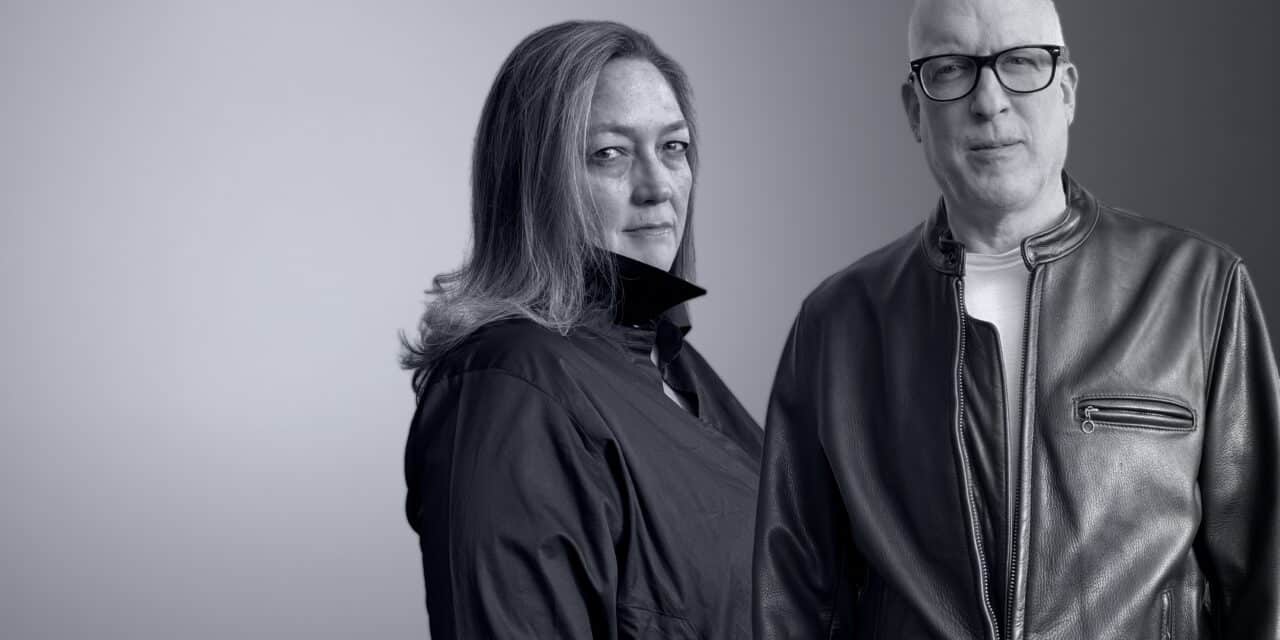
Unlettered’s new album Devil’s Bowl does not simply arrive as a post-punk record. It feels like a pressure reading from a world coming apart in real time. Led by multi-instrumentalist Mike Knowlton, the project moves through grinding guitars, heavy basslines, hypnotic repetition, and lyrics that observe collapse without pretending to solve it.
Following Five Mile Point, a record shaped by personal grief and transition, Devil’s Bowl turns outward. Its songs examine performance, exhaustion, public discourse, identity, and the strange instability of the present moment. The new single “Before::After” captures the terrifying instant before irreversible change, when the ground begins to move and nobody knows what comes next.
We spoke with Knowlton about instability, modern identity, ambiguity, repetition, and why collapse and transformation often feel like the same thing.
Devil’s Bowl feels less like a traditional album and more like a transmission from a fractured reality. What emotional or psychological state were you trying to capture?
Honestly, exhaustion, with a sense of dread underneath it.
I was trying to capture the feeling you get when you watch public discourse fall apart in real time and nobody involved seems to notice or care. I wanted to explore the gap between what is being said and what is actually happening. That gap is the record’s territory.
Our first LP, Five Mile Point, came from a specific personal experience: my father’s illness and death, my move to Florida, and the disorientation of that whole period. Devil’s Bowl was more externally focused. It was about observing the outside world and finding it equally disorienting.
The tools were the same: density, tension, and dissonance. But the subject shifted. This album is less about excavation and more about observation.
“Before::After” explores the threshold before irreversible change. Why are you drawn to instability rather than resolution?
Instability feels more honest most of the time.
Life isn’t clean or easily resolved. We would like it to be, but it isn’t. In “Before::After,” I’m exploring the moment before things have settled, when the outcome is still uncertain and you feel the full weight of it.
It’s about that compression, the way time stretches when you are standing at the threshold. Once you are through it, the story becomes clearer and tidier. I’m not interested in the tidy version.
We are not living in a moment that resolves cleanly, so writing toward resolution feels disingenuous.
There’s a recurring tension between authenticity and performance, especially in “Burn After Reading.” Do you think modern identity has become inseparable from curation?
For a lot of people, yes, but I’d push back a little on the word curation.
Curation at its best adds value. It filters noise and provides context and meaning. What’s happened to modern identity is something shallower than that. We’ve optimized the presentation of ourselves not to add value, but to maximize response, reach, and views. The performance becomes the point, and there’s nothing underneath it.
“Burn After Reading” is about that idea specifically: the strategic reveal, showing only what makes you popular and concealing what doesn’t. It came directly from watching how people manage their public selves, myself included.
I don’t know whether that’s new or just newly visible because of the internet. Maybe we’ve always done this, and now we simply have better infrastructure for it.
Sonically, the record feels physical: grinding basslines, collapsing guitars, rhythms that sound almost industrial. How important is texture and discomfort in communicating emotion?
It’s central to the music I like to listen to and create.
There are things discomfort can communicate that melody alone can’t. That specific unease, the feeling of something not quite fitting, pressure without a clear source. Music with deep texture holds my attention longer. I want you to feel it physically before you process it intellectually.
The industrial quality is partly intentional and partly what happens when you work alone in a studio for months. There’s a claustrophobia that sets into the recording. I don’t fight it. I embrace it and see where it takes me.
Your music sits somewhere between post-punk, noise rock, and experimental art rock without fully belonging to one scene. Do you intentionally resist categorization?
Not intentionally.
I’m just following what sounds right to me, and what sounds right pulls from a lot of places. Playing music in the NYC underground of the ’90s, I was constantly surrounded by bands that didn’t fit neatly into established genres either. That was the norm rather than the exception.
Genre was something critics needed more than musicians did.
If there is any resistance, it’s to the idea that a record has to plant its flag somewhere immediately. I’d rather make something that takes a while to place than something that announces exactly what it is in the first thirty seconds.
That kind of music is more interesting to me. It makes me work harder as a listener, and it becomes more rewarding after multiple listens.
The album seems haunted by societal exhaustion, information overload, performative certainty, and collapsing consensus. Was Devil’s Bowl shaped by the current cultural climate or something more timeless?
Probably both.
The album is very much informed by the current cultural climate, but the engine underneath it is old: a small number of people accumulating enormous wealth and power and using that to shape reality for everyone else.
That isn’t new. It just looks different in different eras.
What feels new is how little effort is made to conceal it. The brazenness is its own kind of statement.
Devil’s Bowl responds to this particular moment, but also to a force that has always been underneath it.
Vocally and lyrically, there’s a sense of observation rather than direct preaching. Why do you prefer ambiguity over overt political statements?
Some of my favorite songs make overt political statements. The Minutemen’s Double Nickels on the Dime is one of my favorite records specifically because of its critiques of racism, war, and social inequity.
But for the music I make, I prefer ambiguity.
In some ways, I think it better describes the world we live in. Writing toward ambiguity feels more honest than writing toward a conclusion I’ve already reached.
Observation also requires more of the listener. If I describe something precisely enough without editorializing, you bring your own response to it. That response might be different from mine, and that’s the point.
Sometimes observation leaves the door open, while declaration closes it.
The phrase “the grief turns structural” captures the shift from Five Mile Point to this record. Did widening the lens from personal loss to collective unrest change your songwriting process?
It did.
Five Mile Point was grief with a specific focus: my father’s death and that period of transition. Writing it was almost confessional in places, and cathartic because of that.
Devil’s Bowl required a different approach. The subject was less personal, but in some ways harder to grasp because it was everywhere and diffuse rather than focused.
Practically, I stopped waiting for a clear emotional through-line before beginning a song. On Five Mile Point, I usually knew what a song was about before I finished it. On Devil’s Bowl, I would sometimes finish recording something and only later understand what it was reaching toward.
The writing became more associative and less narrative.
There’s something hypnotic about the repetition and tension in your music, almost like being trapped inside a thought loop. Are you interested in music as a psychological experience as much as a sonic one?
Yes, very much.
Repetition is one of the most powerful tools available, and one of the most misunderstood. It isn’t laziness. It’s about building pressure.
You repeat something, and the listener starts to lean into it. They begin to anticipate. What you do with that anticipation is where the tension either pays off or doesn’t. Lungfish understood this deeply, and they continue to inspire me.
The hypnotic quality is intentional. I want the listener to feel slightly destabilized and suspended. In that state, they’re more open to what the song is actually doing, and they can discover the subtle ways repetition changes over time.
The thought loop you mention is interesting because a lot of the album is about exactly that: being unable to exit a pattern, watching the same dynamics repeat at larger and larger scales.
Devil’s Bowl never clearly answers whether the vibration underneath the record signals collapse or transformation. Do you personally believe those two things are sometimes the same?
Yes, often they are.
The difference between collapse and transformation is mostly about whether you survive it and how, or if, you can make sense of it afterward.
From inside the process, they feel identical: destabilizing, disorienting, loud in ways that aren’t always sonic.
Five Mile Point was about a collapse that turned out to be a personal transformation, though I couldn’t see that while I was inside it.
With Devil’s Bowl, I’m less certain about the outcome. The scale is larger, and the forces involved are more powerful.
I left it unresolved because I genuinely don’t know the answer. I don’t know if we’re watching something fall apart or watching something become something else.
Ultimately, that question is what the album explores.