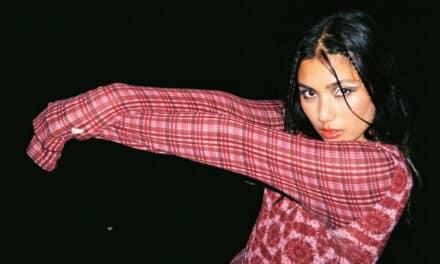
The German-born, Houston-based independent artist turns people-pleasing, boundaries and hard-earned self-worth into an alternative-pop reinvention where hip-hop rhythms, synthwave atmosphere and vulnerable songwriting collide
There is a particular kind of strength that comes from realizing kindness and unlimited access are not the same thing.
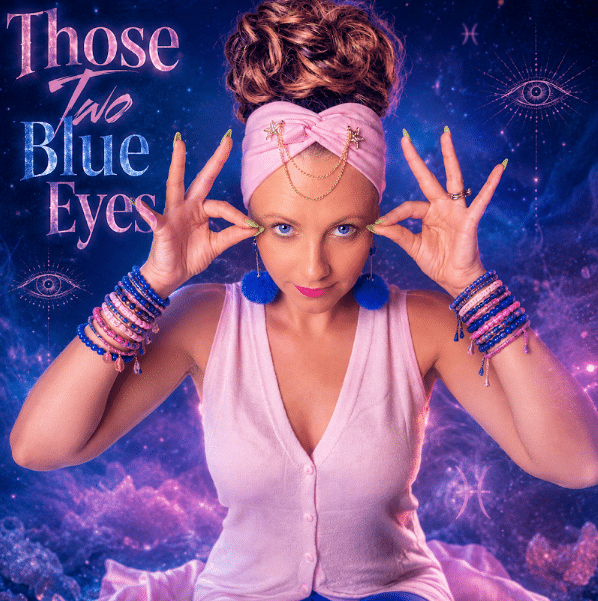
For Neona, that distinction sits at the center of “Those Two Blue Eyes,” a new single that marks both a sonic evolution and a more personal shift in how she understands herself.
Produced by George Harris, the track brings together rhythmic guitars, R&B and hip-hop-influenced drums, synthwave atmosphere and traces of ’80s pop. It is the result of two years spent experimenting with different musical directions until the pair arrived at something that finally felt distinctly Neona. As Harris describes it, the track pulls their favorite elements from R&B, hip-hop, dance music and synthwave into a clearer artistic identity.
But the most significant transformation happening in “Those Two Blue Eyes” is not necessarily musical.
It is about boundaries.
The song emerged from Neona recognizing the ways people-pleasing had shaped her relationships—and how frequently sensitivity had become synonymous with sacrificing her own emotional well-being. What initially began with the painful necessity of establishing boundaries within her family eventually revealed itself as a much wider pattern.
A friendship became another catalyst. Neona found herself repeatedly questioning someone else’s inconsistent behavior while simultaneously wondering whether she was the one overreacting. Eventually, she stopped investing energy into the cycle.
That decision helped expose something bigger.
“I realized how much time I was spending wondering whether other people’s behavior was normal, what I had done wrong, and whether I was overreacting,” she says.
It is precisely this tension—between softness and self-protection—that makes “Those Two Blue Eyes” feel less like a revenge anthem than a reclamation.
Even the wonderfully theatrical lyric “dark voodoo magic is what you will find” describes something surprisingly grounded: the strange power of finally saying no.
Neona sees that “magic” as the strength that appears when you stop allowing everyone unrestricted access to your time and emotions. The darkness comes from how intimidating that transformation can feel, particularly to people who benefited from the version of you that never pushed back.
Her path toward making music has been equally unconventional.
Born in Germany and now based in Houston, Neona studied Mathematics at Royal Holloway, University of London, before earning a master’s degree in Applied and Computational Mathematics at Rice University. After Hurricane Harvey devastated Houston in 2017, poetry became a way of processing trauma. Eventually, those words became songs.
Today, she operates as a fiercely independent artist, involved in everything from vocal recording and arrangements to distribution, royalties, artwork and marketing.
And despite what one might assume from her mathematical background, there are no equations governing the songwriting.
Neona deliberately keeps the two worlds separate.
Her analytical instincts dominate the infrastructure around her career. The music itself is allowed to be messy.
“If it doesn’t follow the typical verse / pre-chorus / chorus / bridge formula, I don’t force it to,” she explains. “I have songs with three bridges simply because that was where the emotion naturally took them.”
That willingness to follow emotion rather than convention may ultimately be the clearest definition of the new Neona.
Mundane spoke with her about “Those Two Blue Eyes,” learning boundaries after years of people-pleasing, the unexpected relationship between mathematics and music, processing trauma through poetry, navigating independence, finding an international audience and why protecting your softness does not require losing it.
“Those Two Blue Eyes” marks a significant transition in your sound, blending hip-hop drums with 1980s influences. How did you arrive at this specific sonic palette for this new chapter?
To quote my producer George Harris: “We have been experimenting with different genres and sounds over the past two years or so, everything from R&B, hip-hop, dance music and synthwave. This track is the first one we have made together where we have taken all the favourite elements and made something that fits Neona as an artist with a clear direction. In this track you can really hear the R&B/hip-hop influence blended with a synthwave atmosphere.”
The song explores the difficult realization of needing boundaries after a lifetime of people-pleasing. Was there a specific catalyst that brought this realization to the surface for you?
The first time I really understood that I needed boundaries came from realizing how much childhood trauma I had accumulated and that, in order to protect what was left of me, I needed to set some very strict boundaries with certain family members. Initially I saw that as something specific to those relationships, rather than as a broader pattern in my life.
The bigger realization came later through an odd interaction and developing pattern with a then-close friend. I realized how much time I was spending wondering whether other people’s behavior was normal, what I had done wrong, and whether I was overreacting.
She would only reach out after I did, reassure me how much she missed me and wanted to meet, and then disappear again for weeks. I aired my grievances, but the pattern continued, and eventually I stopped pouring my energy into it.
That experience made me recognize how deeply people-pleasing had affected the way I navigated relationships in general.
You describe sensitivity as something that deserves protection. How do you balance maintaining that softness while simultaneously building the strength to enforce boundaries?
I think the most effective way to maintain that balance is to be very careful about who I give my energy to and who I allow close to me. Home is my safe space, where I can be completely myself and allow that softer side of me to exist without needing to protect it.
When I’m out in the world—with friends, my team, or other people I interact with—I intentionally work on cultivating more strength. That means paying attention to when a boundary needs to be set, while still trying to communicate it with kindness whenever possible. I don’t think strength and softness have to cancel each other out.
Because of some childhood trauma that I only began seriously working through last year, the first time I really had to set strict boundaries was with family members. That was by far the hardest, because there is so much history and emotional attachment wrapped up in those relationships.
Once I began learning how to do that, setting boundaries with friends and acquaintances became a little easier, but it is still very much a daily practice for me.
Your background is fascinating—moving from Mathematics at Royal Holloway and Rice University to a career in music. How has your training in applied mathematics influenced the way you approach songwriting and arrangement?
Interestingly, I really don’t feel that my mathematics training influences my songwriting or arrangement very much at all. Those parts of the process are almost entirely led by feel and emotion, and I actually love that because I tend to approach almost everything else in my life analytically.
I let a song’s structure evolve based on what feels right. If it doesn’t follow the typical verse / pre-chorus / chorus / bridge formula, I don’t force it to. I have songs with three bridges simply because that was where the emotion naturally took them.
Where my mathematics background does show up is in everything surrounding the art. Production, distribution, marketing, finances and the overall organization of my career are extremely structured.
That analytical side helps me keep all my ducks in a row so that when I’m actually creating, I can let go of it completely and just follow the song.
You mentioned that poetry became your outlet for processing trauma after Hurricane Harvey. In what ways does your songwriting process still rely on those poetic roots?
Those poetic roots probably show up most in my love of metaphors, imagery and finding unusual ways to say something ordinary.
I always try to include one or more phrases or images that make you look at a familiar feeling differently. In “Those Two Blue Eyes,” for example, I used “to walk along that one-way street to Nowhere Town.” Another song, “What If a Rainbow Had a Favorite Color,” uses that image as a metaphor for accepting only certain parts of ourselves while rejecting the rest.
My favorite way to collect imagery is from fiction books. I might come across a phrase like “an octopus of tangled clothes,” save the image, and later find a completely different emotion or object to connect it to.
That habit of collecting unusual images and waiting for them to find their place in a song is probably the strongest link between my poetic roots and the way I write lyrics today.
Being fully independent means you manage everything from production to distribution and artwork. What is the most challenging part of maintaining total creative control, and how does it affect your connection to the final product?
Although I enjoy having that overview and control, marketing is probably the part I find most challenging.
While I am trying my best to present the core of my music in videos and posts without out-of-character TikTok dances or having to be in front of the camera all the time, I would love more help bringing the visual side of my songs to life.
At the same time, being involved in so many parts of a release makes the final product feel incredibly personal. By the time a song is out, I haven’t just written and recorded it—I’ve helped shape the vocal arrangements, artwork, distribution, marketing and everything surrounding it.
There’s a lot more work involved, but there’s also something very rewarding about seeing all those individual pieces finally come together into one complete world around a song.
The line “dark voodoo magic is what you will find” is incredibly evocative. What does that specific imagery represent to you regarding the discovery of self-worth?
To me, the “magic” is the unexpected power you discover once you finally start setting boundaries and stop giving everyone unlimited access to your time, energy and emotions.
I chose the word “magic” because, until you learn how to do that yourself, the ability can feel almost elusive—you look at other people who seem able to say no or protect their space so naturally and wonder how they do it.
“Dark” is referring to how that strength can feel mysterious, intimidating or even a little dangerous to both yourself and the people who were comfortable with the people-pleasing version of you.
When someone is used to you always saying yes, always understanding and always making room for them, a boundary can suddenly feel incredibly powerful.
That contrast is what I wanted that “dark voodoo magic” imagery to capture.
You’ve built a solid following of over 50,000 monthly listeners and seen unexpected traction in places like Brazil. Why do you think your music has resonated so strongly across such diverse, international borders?
I am convinced that listeners can feel the emotion and intention of a song even if they don’t understand every lyric line.
Sometimes the rhythm, production and energy alone can put you in a certain state of mind and communicate the mood I’m trying to create.
We may come from very different cultures, but the underlying emotions, struggles and experiences are often surprisingly similar, and I think that’s what allows a personal song to travel.
Lyrics are incredibly important to me and I craft every line with care, but I’ve learned that they aren’t always the only doorway into a song. Sometimes people connect with the feeling first.
As a self-taught creative handling every aspect of your own music, what has been the biggest lesson you’ve learned about your own artistic identity through this process?
One of the biggest things I’ve learned is that my artistic identity really lives in contrasts.
I’m 5’3″, and sometimes I feel like one giant fuzz ball of emotions, absorbing everything and everyone around me—so “tiny person, huge emotions” is actually a pretty literal description of how I move through the world.
The more I’ve developed my music independently, the more I’ve realized that this contrast is also at the center of who I am creatively.
That shows up in the production through big, powerful beats and vibrations you can physically feel against my softer, gentler vocals, and visually through bold contrasting colors, oversized earrings and large stacks of bracelets.
Handling so many parts of the project myself has helped me recognize those recurring patterns and understand what genuinely feels like me, rather than trying to fit into someone else’s idea of what an artist should be.
With “Those Two Blue Eyes” acting as the start of a new era, what do you hope listeners understand about your growth as both a person and an artist by the time the track ends?
I hope listeners hear that feeling deeply doesn’t have to mean being consumed by everything around you.
For a long time, sensitivity and people-pleasing were tangled together for me, and I’m learning that sensitivity can actually be a strength—but it also deserves protection.
I hope someone who feels as overwhelmed as I once did comes away realizing that there is a power within them that they can uncover for themselves, and that there is hope even when that strength still feels completely out of reach.
As an artist, I also want this new era to make the contrasts in me clearer: big, bold, powerful production alongside a softer voice and deeply vulnerable writing.
“Those Two Blue Eyes” feels like another step toward owning both sides of myself and, hopefully, showing others that they can protect their softness without having to erase it.
What makes “Those Two Blue Eyes” compelling is that its idea of empowerment is not built around becoming harder.
Neona is not attempting to kill the sensitive version of herself in order to create someone stronger.
She is learning how to defend her.
That distinction runs throughout the song and, increasingly, through the artistic identity forming around it. The production can be enormous while the voice remains gentle. The lyrics can expose vulnerability without surrendering control. The person who feels everything can also decide who gets access to those feelings.
Perhaps that is the real transformation at the center of Neona’s new chapter.
Not learning how to care less.
Learning that caring deeply does not require abandoning yourself.