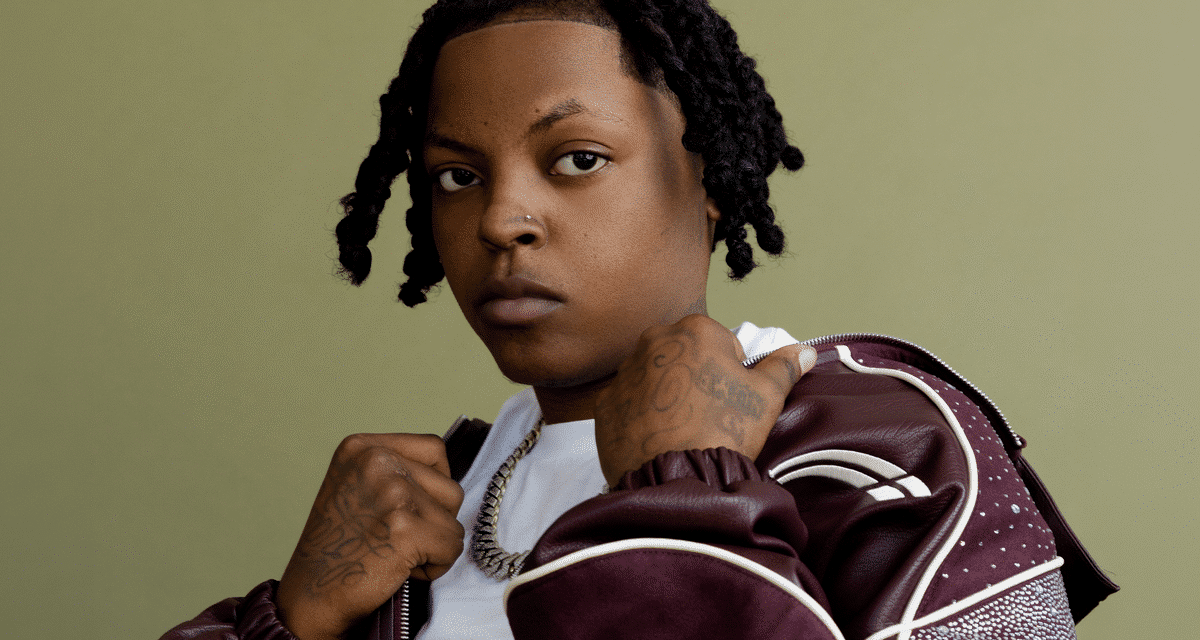
On Jungle This, Jungle That, the Milwaukee rapper turns scrutiny, pressure, hometown identity, vulnerability, and sheer momentum into a debut EP that feels less like an introduction than a declaration of ownership.
There is a difference between being talked about and getting to speak for yourself.
For 414JungleBaby, that distinction sits at the center of Jungle This, Jungle That, her debut EP via 300 Entertainment.
The title sounds playful at first.
Almost dismissive.
Then she explains where it came from.
“‘Jungle this, Jungle that’ is something I say when I have a feeling people are somewhere mentioning me.”
That phrase became increasingly relevant as her name started moving faster.
A viral On The Radar performance.
“Yo Baby” earning recognition from Pitchfork as a Best New Track.
Millions of views.
Co-signs from Sexyy Red, Veeze, Ancyia, J.P., and Bslime.
Songs traveling beyond Milwaukee.
People suddenly paying attention not only to what she releases, but how she looks, what she wears, what video comes next, and what she might become.
Everybody has something to say about JungleBaby.
The EP is her response.
“Alright, people talkin’. Now, it’s my turn to get a say on who I am.”
That sentence does more than summarize the record.
It defines the stage of her career she appears to be entering.
414JungleBaby is no longer making music in the hope that somebody notices.
She is making music while knowing people already are.
And that changes the pressure.
The Moment After People Start Watching
Before momentum, every release is an attempt to interrupt somebody’s attention.
After momentum, the attention is already there.
That can be more intimidating.
“Before, you’re dropping hoping somebody catches it,” JungleBaby says. “Now I can feel people paying attention to what song I’m dropping, what I’m wearing, what video coming next, everything.”
There is an obvious danger in that transition.
Once people become interested, an artist can begin creating for the expectation rather than themselves.
The pressure to repeat whatever first worked becomes enormous.
JungleBaby’s response is almost confrontationally simple.
“If everybody’s watching, give ’em something worth watching.”
Not something familiar.
Something worth watching.
That distinction explains why Jungle This, Jungle That seems so invested in refusing to settle into one version of her.
Going Right When Everything Feels Left
That instinct is particularly clear on “Hit a Right.”
The song moves with an urgency that barely leaves space to think.
That was intentional.
JungleBaby made it while feeling isolated and surrounded by circumstances that seemed to be moving in the wrong direction.
“I felt like I was all I got and a lot was going left.”
The title becomes almost like an instruction to herself.
If everything is going left, hit a right.
Change direction.
Make things better.
The track’s aggression comes from that immediate emotional state rather than a character she consciously constructed.
“I didn’t want to overthink it or make it too perfect. That energy you hear really is how I was feeling.”
That resistance to perfection matters.
Polish can sometimes remove the evidence that a song came from somewhere urgent.
For JungleBaby, the goal was preservation.
Keep the energy intact.
Let the feeling move faster than the editing.
Never Let Them Predict the Next Song
“Hit a Right” also reveals something larger about where JungleBaby is headed creatively.
She has no interest in developing a formula so recognizable that listeners can predict the next record before it arrives.
“I’m comfortable trying different pockets and not feeling like every song gotta sound like the last one.”
That philosophy runs throughout her answers.
She can be melodic.
Playful.
Hard.
Personal.
Aggressive.
None of those modes cancel the others.
“That’s just me.”
There is an important difference between versatility and identity confusion.
JungleBaby clearly sees these shifts as parts of the same person.
“I can be playful and make something melodic, I can talk about pain, then I can turn around and make something hard.”
The continuity is not the production style.
It is her.
“Whatever I’m feeling that day, that’s probably what you’re gonna hear.”
That kind of freedom becomes especially valuable once audiences begin trying to categorize an artist quickly.
A breakout moment creates attention.
It also creates boxes.
JungleBaby appears determined to destroy them before they become comfortable.
Milwaukee Is in the Voice
She is equally clear, however, that expanding beyond one sound does not mean obscuring where she comes from.
Milwaukee is foundational.
“The confidence, the slang, the way we talk, the way we move, even certain pockets and beats—you can hear home in me.”
The city’s rap ecosystem has become increasingly recognizable for its rhythmic choices, vocal cadences, humor, looseness, street reporting, and refusal to behave according to broader industry expectations.
JungleBaby carries that DNA.
But she does not want geography to become another limitation.
“I don’t want being from Milwaukee to put a ceiling on what my music can sound like.”
It is possible to represent somewhere without being reduced to it.
That appears to be the balance she wants.
“I want to be one of those artists where you know where I’m from, but you can’t put me in one box because of it.”
That may ultimately become one of the defining tensions of Jungle This, Jungle That.
The project is deeply rooted.
It is also designed to move.
The Hard Shell and What Lives Underneath
JungleBaby has described growing up with a “hard shell.”
That makes sense given how early resilience became part of her public story.
As a child, she made national headlines after a teacher cut one of her braids in class.
She learned early that being visible could mean being exposed.
Music eventually became a space where the parts beneath that exterior could emerge.
“I used to feel like you couldn’t let people see certain emotions because they might look at it as weakness.”
That understanding has changed.
JungleBaby now recognizes that vulnerability can create connection precisely because so many people have been trained to hide the same emotions.
“Sometimes the most personal stuff is what people connect to the most.”
But she also draws a boundary that feels increasingly rare in an era where artists are encouraged to convert every private experience into content.
“Everybody don’t need access to every part of you just because they listen to your music.”
That is an important distinction.
Vulnerability is not the same thing as total access.
An artist can tell the truth without surrendering everything.
JungleBaby seems interested in deciding which parts belong to the music and which parts remain hers.
Raw, but Intentional
The same philosophy carries into her visual world.
JungleBaby is deeply involved in how her songs look.
Not as an afterthought.
As part of the language.
“Sometimes people see you before they really sit down and listen to you.”
That reality can be frustrating, but JungleBaby treats it as another creative opportunity.
The visual should establish the environment before the first lyric explains anything.
“I want the visual to already tell you something about my world and my energy.”
The key is resisting polish for polish’s sake.
“I don’t want everything overly polished to where it stops feeling like me.”
That line speaks to a broader aesthetic instinct.
The rawness should remain visible.
But raw does not mean careless.
“I want it raw, but intentional.”
That might be the clearest description of the 414JungleBaby world.
Immediate but controlled.
Street-level but stylized.
Personal without becoming overexposed.
“When you see JungleBaby, I want you to know you’re stepping into a world that’s mine.”
Collaboration as Productive Competition
That world does not have to exclude other artists.
The EP’s standout “Gangsta,” featuring Dallas rapper Montana700, demonstrates JungleBaby’s ability to adjust to another artist without disappearing inside the collaboration.
For her, chemistry begins before strategy.
“Energy first.”
A recognizable name is not enough.
“I don’t want to force a collaboration just because somebody has a name.”
What matters is whether another artist creates movement.
“With Montana700, the energy made sense.”
The best feature, in JungleBaby’s view, should bring out a version of her that might not have appeared on a solo track.
She describes the ideal collaborative environment as competitive without actually becoming competition.
Both people push.
Neither person needs to lose.
“Both people trying to make the record better.”
That is collaboration as friction.
Not simply two brands sharing a track.
The Problem With Being Figured Out
JungleBaby is already thinking about what happens after the EP.
Another release, “Blocklist,” arrives August 28 with a new visual.
She is deliberately vague about what it sounds like.
That is the point.
“‘Hit a Right’ gives you that raw, aggressive JungleBaby, but ‘Blocklist’ shows I can switch the whole temperature without losing who I am.”
There is something almost mischievous about the way she describes it.
“If somebody thinks they figured out my sound from one record, August 28 might mess that up for them.”
That sentence feels like a mission statement.
Every time the audience begins completing the picture, change the picture.
Not randomly.
Not for novelty.
Simply because no one record contains the whole person.
The Danger of the First Story
Breakthrough artists are often reduced to the first understandable narrative that surrounds them.
The viral song.
The co-sign.
The performance clip.
The hometown.
The person who reposted them.
The number.
Those details are useful because they make an artist easy to summarize.
They are also dangerous because summaries can become identities.
JungleBaby knows people have already encountered pieces of her story.
“They’ve seen moments, songs take off, the co-signs.”
But she does not believe they have seen the complete version yet.
“They haven’t seen what happens when I really put everything together.”
That might be the real meaning of a debut EP arriving after a breakout year.
The introduction already happened without her permission.
Jungle This, Jungle That allows her to revise it.
This Is My Turn to Speak
414JungleBaby’s moniker itself contains that tension between environment and self-definition.
She earned the name as a teenager in an Atlanta studio after telling people:
“I’m from the jungle, I’m not no baby.”
It was a declaration.
The kind that creates identity through language before the wider world confirms it.
Years later, JungleBaby is doing something remarkably similar on a much larger scale.
People have been mentioning her.
Watching.
Co-signing.
Sharing.
Categorizing.
Predicting.
Now comes the part where she answers.
Not defensively.
Authoritatively.
In Conversation With 414JungleBaby
MUNDANE: Jungle This, Jungle That feels like both an introduction and a warning shot—like you’re showing people exactly who you are while proving anyone who underestimated you wrong. Did making the project feel personal in that way?
414JUNGLEBABY: Jungle This, Jungle That was personal because I felt like I had something to prove, but at the same time I wasn’t really trying to prove nothing to nobody but myself.
“Jungle this, Jungle that” is something I say when I have a feeling people are somewhere mentioning me.
Whether people were supporting me or doubting me, everybody had something to say about JungleBaby.
So the project was me saying, “Alright, people talkin’. Now, it’s my turn to get a say on who I am.”
MUNDANE: “Hit a Right” feels especially immediate and aggressive—the cadence barely gives the listener a second to breathe. What headspace were you in when you made that track, and what did you want it to reveal about where you are creatively right now?
414JUNGLEBABY: I was really just in one of those modes where I felt like I was all I got and a lot was going left—bad—so I suggested hitting a right, stating that things would be going good or better.
I didn’t want to overthink it or make it too perfect.
That energy you hear really is how I was feeling.
Creatively, I’m at a point now where I’m comfortable trying different pockets and not feeling like every song gotta sound like the last one.
I want people to never know exactly what they’re getting from me next.
MUNDANE: The visual for “Hit a Right” amplifies that raw energy rather than polishing it away. How involved are you in building the visual language around your music, and what do you want people to understand about you before they even hear a lyric?
414JUNGLEBABY: I’m very involved.
I’m big on visuals because sometimes people see you before they really sit down and listen to you.
So I want the visual to already tell you something about my world and my energy.
I don’t want everything overly polished to where it stops feeling like me.
I want it raw, but intentional.
When you see JungleBaby, I want you to know you’re stepping into a world that’s mine.
MUNDANE: Your music can move from playful and melodic to genuinely hard without either side feeling like a character you’re putting on. Do you see those different energies as contradictions, or are they simply different parts of who you are?
414JUNGLEBABY: That’s just me.
I can be playful and make something melodic, I can talk about pain, then I can turn around and make something hard.
None of it is a character.
I think that’s actually one of my strengths, because I don’t have to force myself into one sound.
Whatever I’m feeling that day, that’s probably what you’re gonna hear.
MUNDANE: Milwaukee has developed one of the most instantly recognizable rap scenes in the country. What parts of the city do you hear in your own music, and where do you feel like you’re deliberately creating something different from the artists around you?
414JUNGLEBABY: Milwaukee is always gonna be in my music because that’s what made me.
The confidence, the slang, the way we talk, the way we move, even certain pockets and beats—you can hear home in me.
But I also don’t want being from Milwaukee to put a ceiling on what my music can sound like.
I want to be one of those artists where you know where I’m from, but you can’t put me in one box because of it.
MUNDANE: You’ve talked about growing up needing a “hard shell.” As your audience gets bigger, has music made you more comfortable showing what exists underneath that shell, or are there still parts of yourself you intentionally keep protected?
414JUNGLEBABY: Music definitely made me more comfortable showing what’s underneath it.
I used to feel like you couldn’t let people see certain emotions because they might look at it as weakness.
Now, I understand that sometimes the most personal stuff is what people connect to the most.
But I still keep certain things for myself.
Everybody don’t need access to every part of you just because they listen to your music.
MUNDANE: Between your On The Radar performance, “Yo Baby,” “Hit a Right,” and co-signs from artists like Sexyy Red and Veeze, things have been moving quickly. What’s been the biggest adjustment between making music hoping people notice and realizing people are now actively waiting to see what you do next?
414JUNGLEBABY: That’s probably the biggest adjustment—knowing people are actually waiting now.
Before, you’re dropping hoping somebody catches it.
Now I can feel people paying attention to what song I’m dropping, what I’m wearing, what video coming next, everything.
At first that can feel like pressure, but I started looking at it differently.
If everybody’s watching, give ’em something worth watching.
MUNDANE: “Gangsta” with Montana700 showed how naturally you can bounce off another artist’s energy. When you collaborate, what makes somebody interesting to you—is it their sound, their personality, the challenge they bring out of you, or something you can’t really predict?
414JUNGLEBABY: For me, it’s energy first.
Obviously I gotta like the music, but I don’t want to force a collaboration just because somebody has a name.
With Montana700, the energy made sense.
I like when another artist brings something out of me that I might not have done by myself.
The best collaborations feel competitive without actually being a competition—both people trying to make the record better.
MUNDANE: You already have another single and visual, “Blocklist,” arriving August 28. Without giving too much away, what does that release show us about 414JungleBaby that “Hit a Right” doesn’t?
414JUNGLEBABY: It shows another layer.
“Hit a Right” gives you that raw, aggressive JungleBaby, but “Blocklist” shows I can switch the whole temperature without losing who I am.
I don’t wanna give too much away, but if somebody thinks they figured out my sound from one record, August 28 might mess that up for them.
MUNDANE: There’s always a danger that when an artist starts breaking through, people reduce them to a viral record, a co-sign, or whatever first got their attention. As you move into this next run of releases, what part of the 414JungleBaby story do you think people still haven’t seen yet?
414JUNGLEBABY: I think people still haven’t seen the full picture yet.
They’ve seen moments, songs take off, the co-signs.
But they haven’t seen what happens when I really put everything together.
I’m not chasing one moment—I’m trying to build something that lasts.
I want people to look back and realize everything happening right now was really just the beginning.
Not One Moment
The phrase “breakout artist” is useful until it isn’t.
It suggests a before and an after.
Unknown.
Then known.
One song.
One clip.
One co-sign.
One moment when the door supposedly opens.
414JungleBaby appears increasingly uninterested in treating that moment as the story.
“I’m not chasing one moment.”
That is the more difficult ambition.
A moment can happen almost accidentally.
A career requires repetition without becoming repetitive.
It requires learning what people respond to without allowing that response to make every decision.
It requires representing Milwaukee without turning Milwaukee into a marketing category.
It requires letting listeners see enough vulnerability to connect without assuming they are entitled to everything underneath the hard shell.
It requires understanding that the attention you once begged for can become pressure once it arrives.
And perhaps most importantly, it requires surviving everybody else’s first interpretation of you.
The title Jungle This, Jungle That turns that interpretation into fuel.
People will talk.
They will compare.
They will attach her name to whatever song introduced them.
They will explain where she fits.
JungleBaby’s strategy seems to be making the explanation obsolete as quickly as possible.
Hard record.
Melodic record.
Something personal.
Something playful.
A Milwaukee pocket.
Something that refuses to sound regionally predictable.
A collaborative record where another rapper pulls out a different cadence.
A visual that remains raw enough to feel lived in.
Then another release that changes the temperature completely.
The consistency is not sonic.
It is ownership.
“When you see JungleBaby,” she says, “I want you to know you’re stepping into a world that’s mine.”
That is ultimately what a debut should accomplish.
Not tell the audience everything.
Establish who controls the telling.
And if Jungle This, Jungle That is 414JungleBaby finally getting her say, she does not seem particularly interested in having the last word yet.
She wants people to look backward eventually and recognize that the attention, viral moments, performances, co-signs, and records that seemed significant at the time were only fragments.
“The full picture” is still coming.
For now, everybody is watching.
JungleBaby plans to make that useful.